
NEW
Font size
S
M
L
XL
 Worksheets
Contact & Non-Contact Forces
Total questions: 10
Worksheet time: 15mins
Name
Class
Date
1.
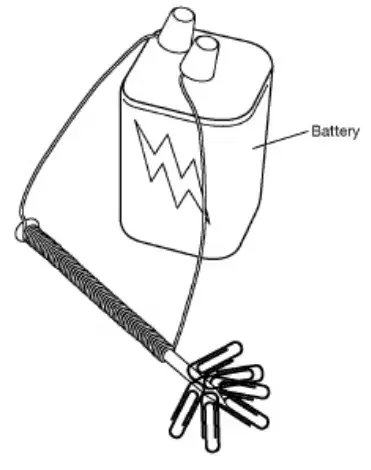
(SC.6.P.13.1) Hector wrapped a copper wire around a nail and attached the ends of the wire to a battery. The picture below shows what happened when the nail was placed near paper clips.
What force was responsible for causing the paper clips to attach themselves to the nail?
a)
balanced force
b)
magnetic force
c)
frictional force
d)
gravitational force
2.
(SC.6.P.13.1) The upward force that a fluid exerts on an object is called the buoyant force. How is the buoyant force similar to the frictional force?
a)
Both buoyant and frictional forces can act over short distances.
b)
Both buoyant and frictional forces do not involve solids.
c)
Both buoyant and frictional forces act only with contact.
d)
Both buoyant and frictional forces push objects upward.
3.
(SC.6.P.13.1) Leanna decided to rearrange her bedroom by moving her dresser to the opposite wall. She tried pushing it, but found that the dresser would not move. What force was Leanne NOT able to overcome?
a)
balanced force
b)
electrical force
c)
magnetic force
d)
frictional force
4.
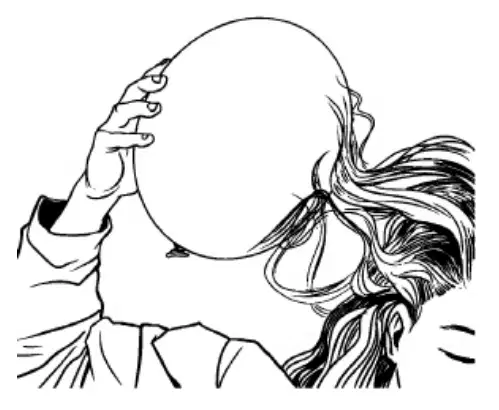
(SC.6.P.13.1) The illustration below shows what happened when a balloon touched a girl’s hair.
Which type of force caused the girl’s hair to cling to the balloon?
a)
magnetic force
b)
gravitational force
c)
electrical force
d)
frictional force
5.
(SC.6.P.13.1) Wet floors can sometimes be slippery. What is the reason for this?
a)
The water produces a new force between the floor and the feet.
b)
The water decreases the fiction between the floor and the feet.
c)
The water sets up a magnetic force between the floor and the feet.
d)
The water increases the friction between the floor and the feet.
6.
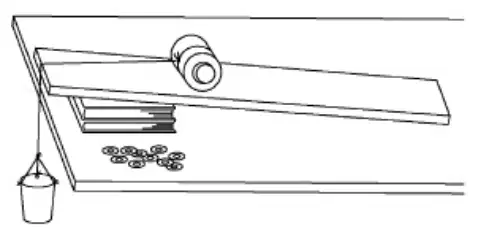
(SC.6.P.13.1) Hassim set up the apparatus shown in the illustration below. Hassim noticed that the object did not roll down the ramp. What force was responsible for keeping the object from moving down the ramp?
a)
unbalanced force
b)
magnetic force
c)
electrical force
d)
gravitational force
7.
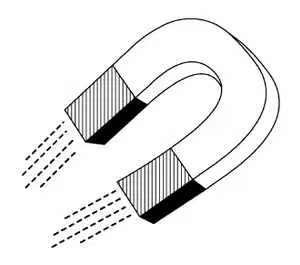
(SC.6.P.13.1) Some magnets are formed into the shape of a horseshoe. Observe the drawing of the magnet below.
What can you conclude about magnetic force from the drawing?
a)
Magnetic force is a contact force.
b)
Magnetic force is weak force.
c)
Magnetic force is a force that acts at a distance.
d)
Magnetic force is everywhere.
8.
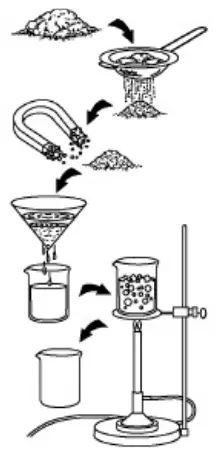
(SC.6.P.13.1) Aito carried out an experiment to separate the components in a mixture. The steps Aito took are shown in the illustration below.
What forces did Aito depend upon to separate the components in this mixture?
a)
magnetic and electrical forces
b)
magnetic and gravitational forces
c)
gravitational and electrical forces
d)
balanced and unbalanced forces
9.
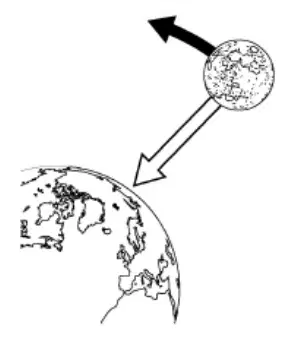
(SC.6.P.13.1) The moon orbits the Earth as shown in the illustration below.
What does the arrow between the Earth and the moon represent?
a)
the direction in which the moon will continue to orbit
b)
the sun’s gravitational attraction for the moon
c)
the moon’s gravitational attraction for other planets
d)
Earth’s gravitational attraction for the moon
10.
(SC.6.P.13.1) Sodium chloride is a chemical that most people know as table salt. Microscopically, it is made of sodium ions that have a positive charge and chlorine ions that have a negative charge arranged like a checkers board. What is the best reason for why sodium ions and chlorine ions form table salt?
a)
They are attracted to each other by the gravitational force.
b)
They fit together like puzzle pieces.
c)
They are compressed by an unbalanced force.
d)
They are held together by the electrical force.
Reset

