
 Worksheets
Par-Ici-Methode-de-Franais-a2 Episode 1 - AU suivant
Total questions: 62
Worksheet time: 37mins
Où sont Thomas et Marie-France ?
Au restaurant
Dans une file d'attente
À la bibliothèque
Pourquoi Thomas et Marie-France attendent-ils ?
Pour s'inscrire à un cours de photographie
Pour une réunion d'information
Pour obtenir leur carte d'étudiant
Pour acheter des billets
Does Thomas know Marie-France?
Yes
No
Maybe
Not sure
Dans quel programme Thomas et Marie-France étudient-ils ?
Baccalauréat en génie mécanique
Baccalauréat en biologie
Baccalauréat en chimie
Baccalauréat en mathématiques
Marie-France et Thomas...
Commencent leurs études à l'université.
Poursuivent leurs études à l'université.
Finissent leurs études à l'université.
Font une pause de l'université.
Which of the following greetings is typically used when arriving in a formal situation in French?
Salut
Bonjour
Bye
Bonne soirée
Which expression would you use in French to respond when someone gives you something?
Enchanté/enchantée
Merci beaucoup
Bonjour
Bonne fin de journée
In which country is the greeting "Konnichiwa!" commonly used when meeting someone for the first time?
New Zealand
Thailand
Japan
France
Associez chaque façon de dire au revoir en français à son niveau de formalité.
Au revoir
Formel
Bonne soirée
Souhait pour la soirée
Bye
Informel
Bon après-midi
Souhait pour l'après-midi

What is the traditional greeting called in New Zealand?
Sawadee
Bonjour
Hongi
Konnichiwa
If you meet someone for the first time in a French-speaking country, which expression would be most appropriate to use?
Merci beaucoup
Enchanté/enchantée
Bonne fin de journée
Salut
Which of the following is a formal way to say goodbye in French?
Salut
Au revoir
Bye
Bonjour
The greeting gesture in Thailand is called (a) .
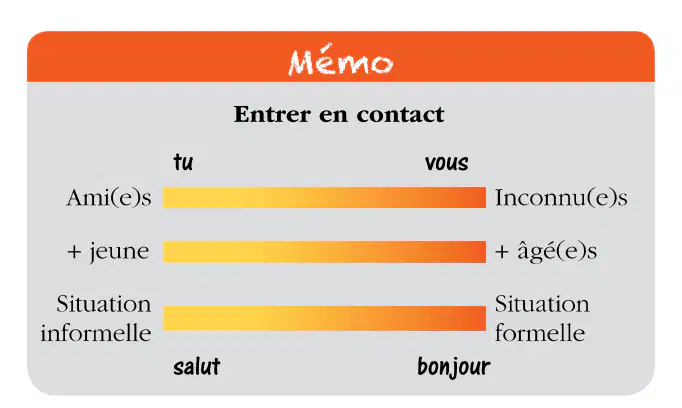
According to the memo, in which situation should you use "tu" when greeting someone in French?
With a friend in an informal situation
With an unknown person in a formal situation
With an older person in a formal situation
With a group of strangers
Which possessive adjective would you use with "vous" for a plural noun in French?
Vos
Ton
Ta
Tes
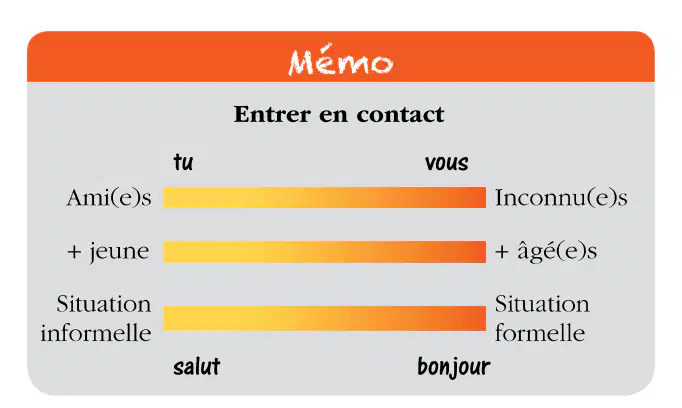
Match each greeting to the situation where it is most appropriate according to the memo.
Bonjour
Situation formelle
Salut
Situation informelle
Ciao
Salutation italienne
Hey
Salutation informelle en anglais
If you are addressing someone younger than you in an informal context, which pronoun should you use in French?
tu
vous
il
elle

Based on the images, which pair is most likely to use "vous" when greeting each other?
Two men in suits shaking hands
Two young friends at a café
A group of students in a classroom
An elderly couple walking together
Why do possessive adjectives change in French depending on whether you use "tu" or "vous"?
Because "tu" and "vous" indicate different levels of formality and number
Because "tu" is only used for objects
Because "vous" is only used for family members
Because "tu" is always plural
Which of the following is the correct present tense form of the verb "être" for "nous"?
nous sommes
nous avons
nous êtes
nous ont
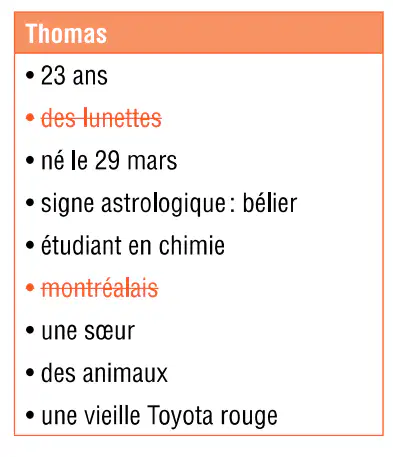
Selon les informations, laquelle des affirmations suivantes est vraie à propos de Thomas ?
Il a 23 ans.
Il a 20 ans.
Il est enfant unique.
Il vient de la Gaspésie.
Which verb would you use to say "I have" in French?
j'ai
je suis
tu es
nous sommes
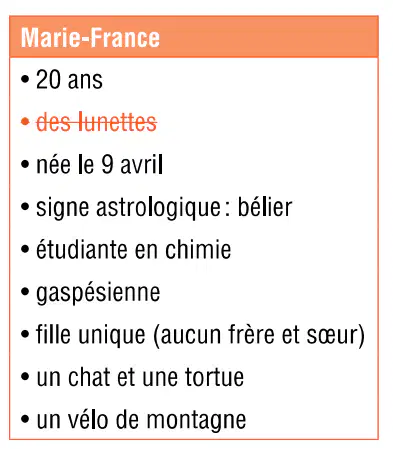
Marie-France has which of the following pets?
A cat and a tortoise
A dog and a rabbit
A parrot and a fish
A horse and a hamster
To describe your age in French, you should use the verb (a) .
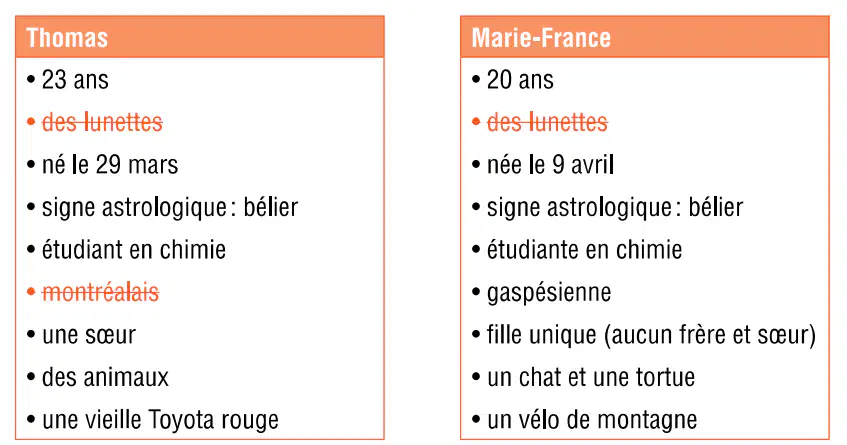
Given the information, which statement is correct about both Thomas and Marie-France?
They are both studying chemistry.
They both have a brother.
They both have a mountain bike.
They are both from Montréal.
Using the verbs "être" and "avoir," how would you say "They have glasses" in French?
Ils ont des lunettes.
Ils sont des lunettes.
Ils a des lunettes.
Ils êtes des lunettes.
Match each present tense verb form to the correct French verb.
vous êtes
être (to be), 2nd person plural
j'ai
avoir (to have), 1st person singular
tu as
avoir (to have), 2nd person singular
ils ont
avoir (to have), 3rd person plural
What is the main purpose of using "Est-ce que" in French questions?
To form closed (yes/no) questions
To express surprise
To indicate possession
To show past tense
Among the following, (a) is NOT a way to form a closed question in French.
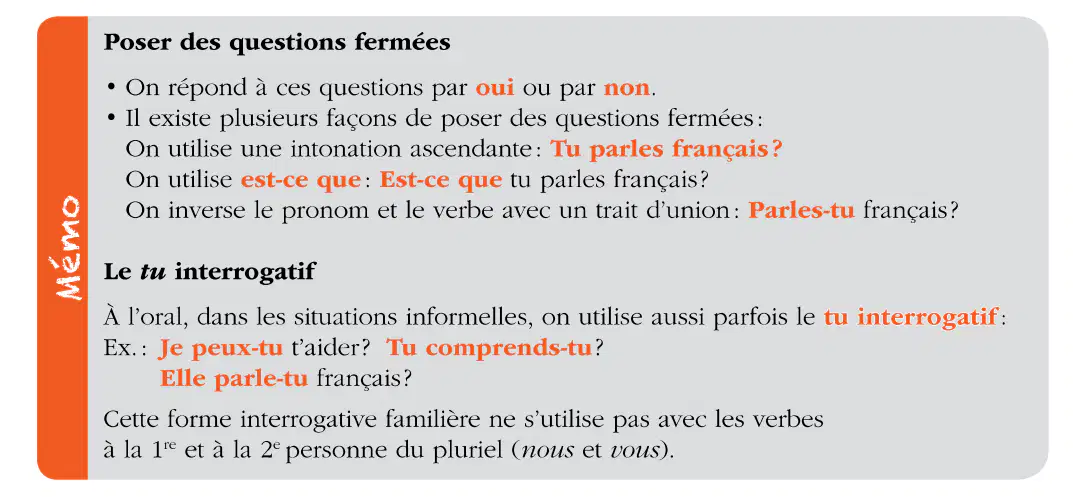
According to the memo, how do you answer a closed question in French?
By saying oui or non
By giving a detailed explanation
By repeating the question
By using a question word
Which form of the interrogative is NOT used with the 1st and 2nd person plural (nous and vous) in French?
The "tu interrogatif" form
The inversion form
The "Est-ce que" form
The intonation form
Transform the following open question into a closed question: "Tu parles français?"
Est-ce que tu parles français ?
Pourquoi tu parles français ?
Où tu parles français ?
Quand tu parles français ?
Which of the following is an example of a closed question in French?
Est-ce que tu as une auto ?
Pourquoi tu as une auto ?
Comment tu as une auto ?
Où tu as une auto ?
Match each function of a hyphen with the correct example sentence in French.
To invert the pronoun and the verb
Parles-tu français?
To indicate a negative sentence
Ne parle-t-il pas?
To show a plural subject
Parlez-vous?
To separate two clauses
Il est parti - elle est restée.
Which of the following is a correct way to ask "Where do you live?" in French in an informal spoken situation?
Où habitez-vous ?
Où tu habites ?
Où est-ce que tu habites ?
Où habites-tu ?
In a formal written situation, how should the interrogative word be placed in a French question?
At the end of the sentence
At the beginning of the sentence, followed by the verb and subject pronoun
After the verb
After the subject pronoun
Which of the following is NOT a recommended way to ask "What is your name?" in formal written French?
Comment t’appelles-tu ?
C’est quoi ton nom ?
Comment est-ce que tu t’appelles ?
Comment tu t’appelles ?
Why should "C’est quoi" not be followed by "est-ce que" in French?
Because it is never grammatically correct
Because it is only used in questions about places
Because it is only used in informal speech
Because it is only used in written French
Which of the following is an example of using "est-ce que" in a French question?
Comment est-ce que tu t’appelles ?
Tu t’appelles comment ?
Comment tu t’appelles ?
C’est quoi ton nom ?
Pour obtenir la réponse "Je commence à 9 heures," il faut poser la question : (a)
Which of the following is a correct way to ask "Who do you live with?" in French?
Avec qui habitez-vous ?
Avec qui tu habites ?
Avec qui est-ce que tu habites ?
All of the above
What is the main difference between asking questions in informal spoken French and formal written French?
The use of "est-ce que" is only allowed in writing
The placement of the interrogative word and the structure of the sentence
The use of "tu" instead of "vous"
There is no difference
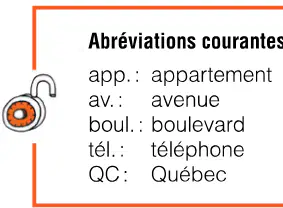
Which abbreviation is commonly used for "appartement" in French addresses?
av.
QC
app.
tél.
How is the phone number 418 394-4918 generally pronounced orally in French?
As a single number: "quatre cent dix-huit, trois cent quatre-vingt-quatorze, quatre mille neuf cent dix-huit"
Separately, digit by digit: "quatre, un, huit, trois, neuf, quatre, neuf, un, huit"
In pairs: "quarante et un, quatre-vingt-treize, quatre-vingt-dix-huit"
Only the last four digits are pronounced
What does the abbreviation "boul." stand for in a French address?
Boulevard
Bureau
Boulangerie
Bouteille
Which of the following is a correct way to write a Canadian postal code in an address?
12345
H2J 8Y9
90210
123-4567
If you are addressing an envelope in French, where should you write the recipient's address?
Top left corner
Bottom right corner
Center of the envelope
On the back of the envelope
What information is typically included in the sender's address on an envelope?
Only the name
Name, street address, city, province, and postal code
Only the city and postal code
Only the street address
It is important to use abbreviations like "av." and "boul." in French addresses to (a) .
Given the address "962, av. du Parc, Montréal (Québec) H2J 8Y9", which part represents the street name?
962
av. du Parc
Montréal
H2J 8Y9
Which of the following is considered confidential in Canada and should only be given to official institutions or employers?
Social Insurance Number (SIN)
Personal address
Phone number
Last name

Match each activity with whether it is suggested in the 'GO FURTHER' section or not.
Participate in a cooking class
NOT suggested in the 'GO FURTHER' section
Subscribe to the library
Suggested: S’abonner à la bibliothèque
Join a chess club
Suggested: Devenir membre d’un club d’échecs
Attend an information session
Suggested: Participer à une séance d’information
If you want to find a language exchange partner, what is one recommended step from the document?
Search the internet for a language exchange website and register
Call your local government office
Visit a bank
Write a letter to your school principal
Why is it important to keep your social insurance number (SIN) confidential in Canada?
It is only given to official institutions, banks, governments, or employers
It is used for public advertisements
It is required for all online purchases
It is needed to join a sports club
Ecoutez les dialogues et associez-les aux photos.
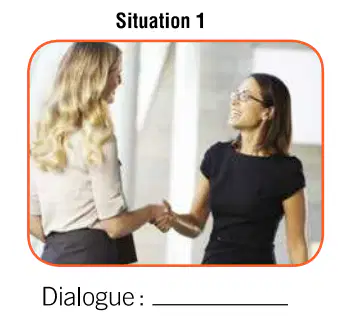
C

B

A
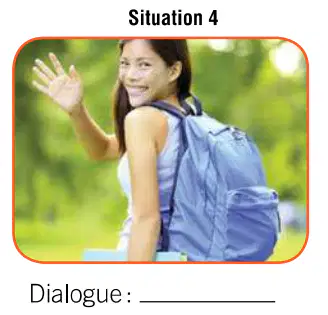
D
Organize these options into the right categories
1
2
3
4
5
6
7
8
9
10
Est-ce que Thomas et Marie-France étudient ensemble en chimie?
Oui
Non
Est-ce que Thomas est un bon ami de Marie-France?
Oui
Non
Marie-France vient-elle de Montréal?
Oui
Non
Est-ce que Marie-France aime Montréal?
Oui
Non
Thomas habite à Montréal ?
Oui
Non
Réécoutez le dialogue. Indiquez qui pose ces questions.
Habites-tu a Montréal ?
Tu viens de quel coin?
Viens-tu de Montréal?
Est-ce que tu aimes la ville?

