
 Worksheets
Gears, Pulleys, & Sprockets
Total questions: 82
Worksheet time: 41mins
Gears, pulleys, and sprockets are power train elements that transfer energy through which type of motion?
Linear motion
Rotary motion
Oscillating motion
Vibrating motion
Which of the following is NOT a function of gears, pulleys, and sprockets?
Change the speed of rotation
Change the direction of rotation
Change the amount of torque available to do work
Generate electricity
Fill in the blank: Gears, pulleys, and sprockets can change the _______ of rotation.
direction
color
temperature
weight
Fill in the blank: Gears, pulleys, and sprockets can change the amount of _______ available to do work.
torque
friction
velocity
temperature

What is a gear train used for?
A gear train is used for transmitting rotary motion and torque through interlocking teeth.
A gear train is used for storing electrical energy.
A gear train is used for cooling electronic components.
A gear train is used for measuring temperature.
A gear train is made when ______ or more gears are meshed.
two
three
four
five
Which gear causes motion in a gear train?
Driver gear
Follower gear
Idler gear
Intermediate gear
What happens to the motion in a gear train?
It stops at the driver gear
It is transferred to the driven gear
It reverses direction
It disappears
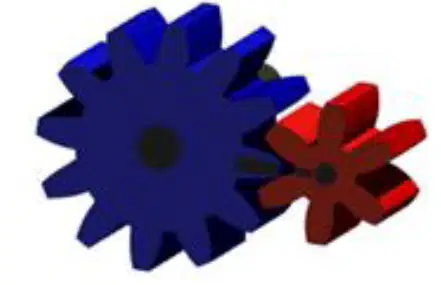
Mating gears always turn in _______ directions. (Fill in the blank)
opposite
same
random
parallel
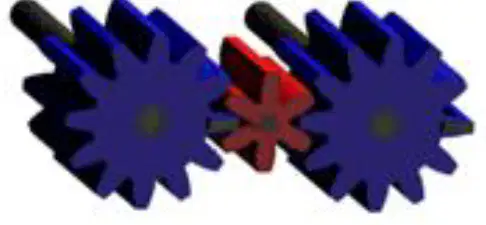
What does an Idler Gear allow the driver and driven gears to do?
Rotate in opposite directions
Rotate in the same direction
Stop rotating
Change size
Mating gears always have the same size teeth (diametric pitch).
True
False
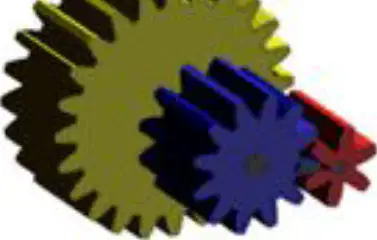
The rpm of the larger gear is always slower than the rpm of the smaller gear.
True
False
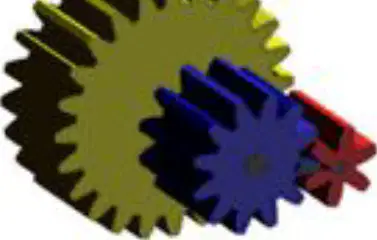
Gears locked together on the same shaft will always turn in the same direction and at the same rpm.
True
False
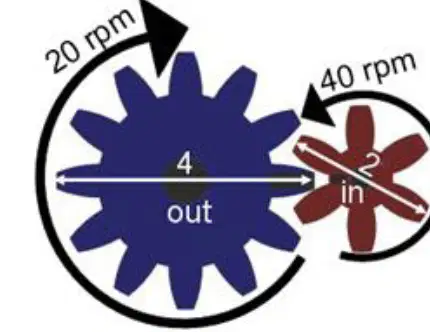
What is the value of n_in (number of teeth for the input gear)?
6
8
10
12
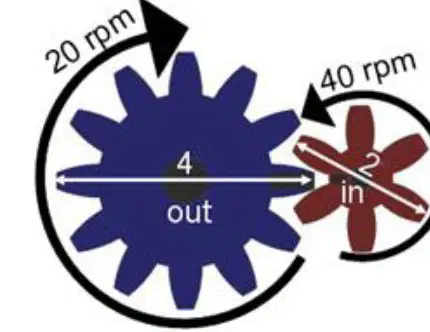
What is the value of d_in (diameter for the input gear)?
2 in.
3 in.
4 in.
5 in.
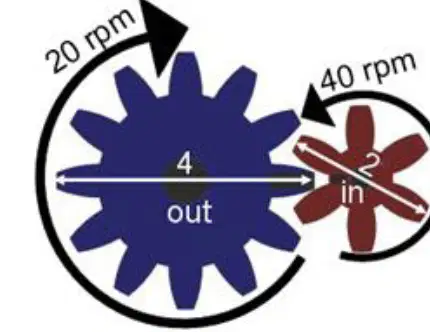
What is the value of w_in (angular velocity for the input gear)?
40 rpm
20 rpm
60 rpm
80 rpm
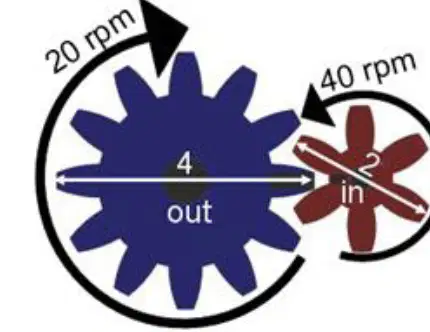
What is the value of t_in (torque for the input gear)?
40 ft-lb
25 ft-lb
60 ft-lb
100 ft-lb
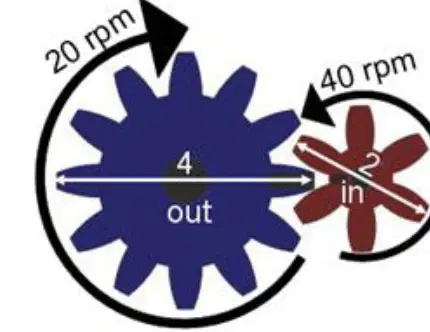
What is the value of n_out (number of teeth for the output gear)?
12
16
20
8
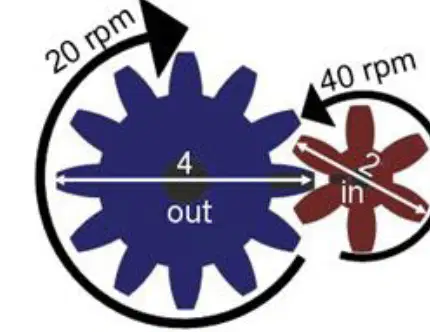
What is the value of d_out (diameter for the output gear)?
4 in.
2 in.
6 in.
8 in.
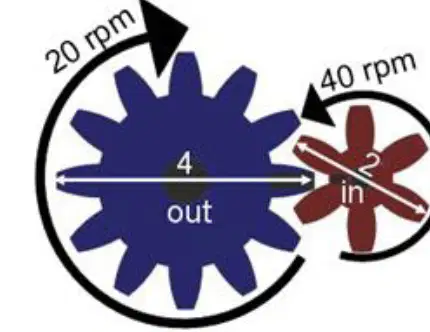
What is the value of w_out (angular velocity for the output gear)?
20 rpm
10 rpm
40 rpm
5 rpm
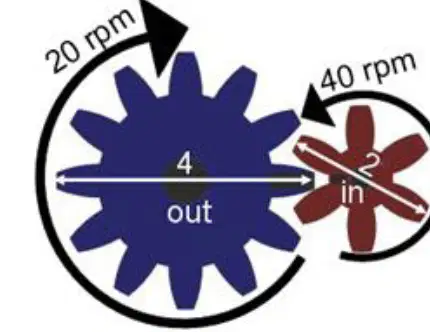
What is the value of t_out (torque for the output gear)?
80 ft-lb
40 ft-lb
120 ft-lb
200 ft-lb
What does the variable 'n' represent in the context of gear ratios?
Number of teeth
Diameter
Angular velocity
Torque
What does the variable 'd' represent in the context of gear ratios?
Number of teeth
Diameter
Angular velocity
Torque
What does the variable 'w' represent in the context of gear ratios?
Number of teeth
Diameter
Angular velocity (speed)
Torque
What does the variable 't' represent in the context of gear ratios?
Number of teeth
Diameter
Angular velocity
Torque
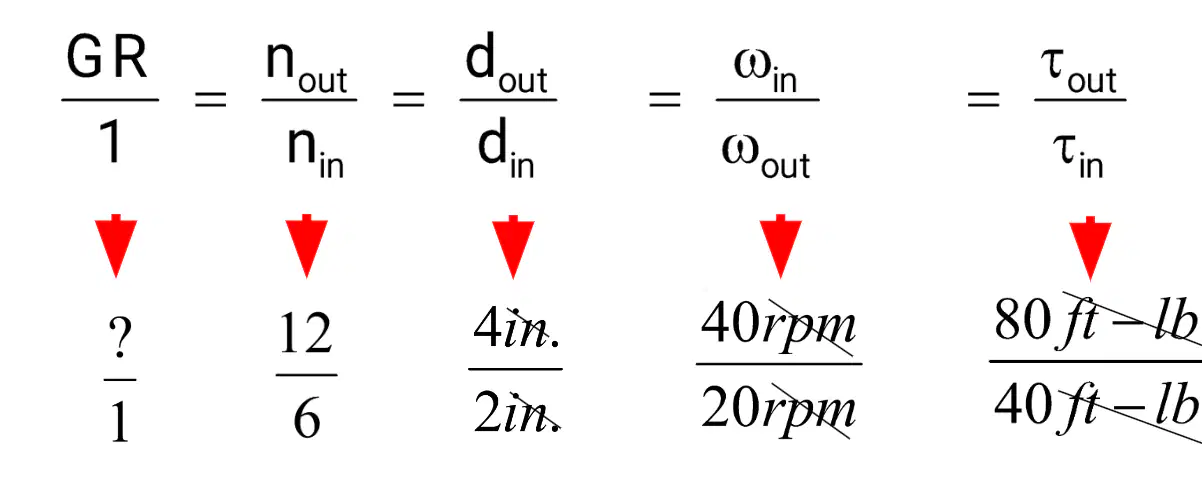
Given the equation GR/1 = n_out/n_in, what is the value of GR if n_out = 12 and n_in = 6? Fill in the blank: GR/1 = 12/6 = __/1
2/1
6/1
12/1
1/2
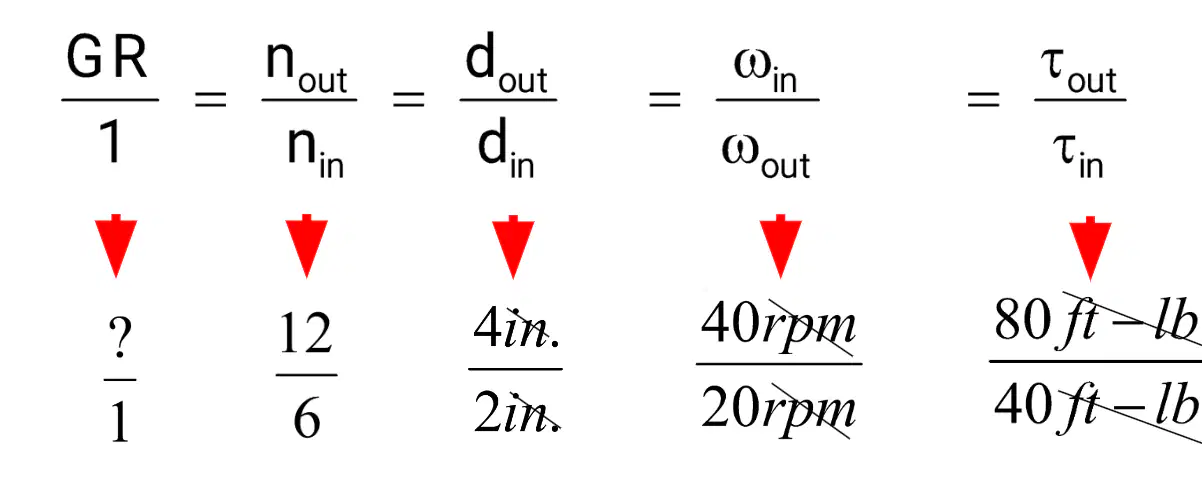
Given the equation GR/1 = d_out/d_in, what is the value of GR if d_out = 4 in. and d_in = 2 in.? Fill in the blank: GR/1 = 4 in./2 in. = __/1
2/1
1/2
4/1
3/1
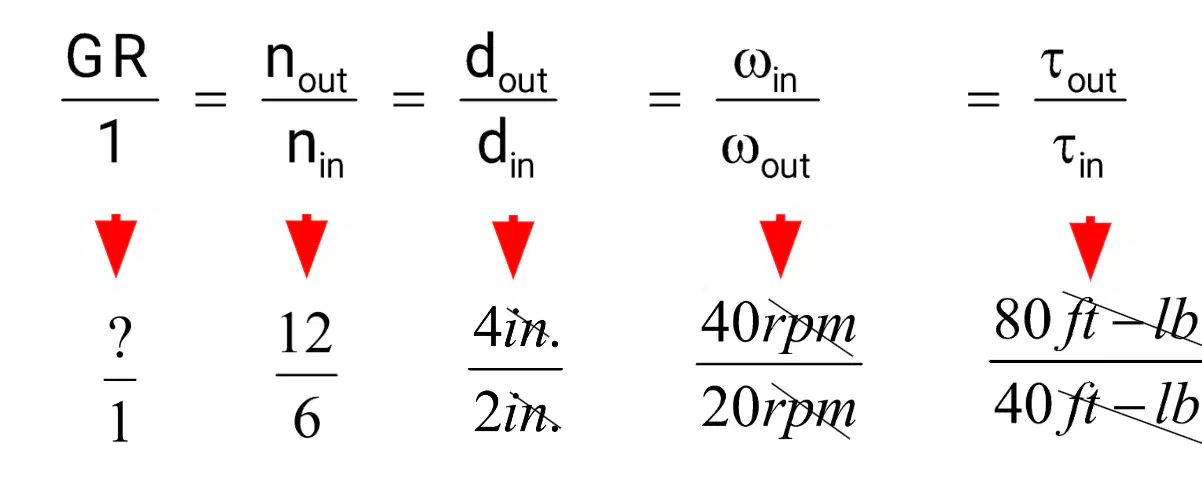
Given the equation GR/1 = ω_in/ω_out, what is the value of GR if ω_in = 40 rpm and ω_out = 20 rpm? Fill in the blank: GR/1 = 40 rpm/20 rpm = __/1
2/1
1/2
4/1
1/4
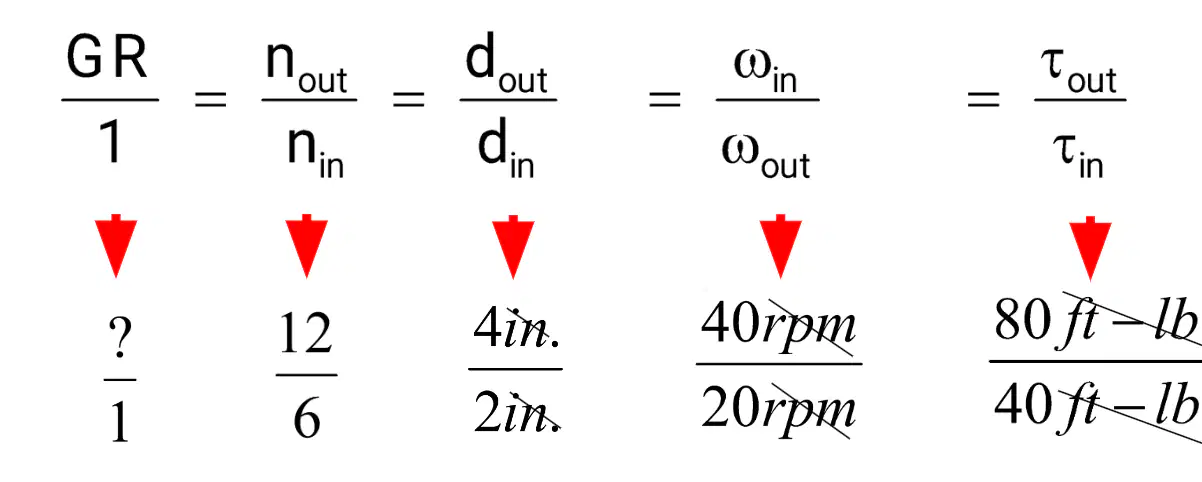
Given the equation GR/1 = τ_out/τ_in, what is the value of GR if τ_out = 80 ft-lb and τ_in = 40 ft-lb? Fill in the blank: GR/1 = 80 ft-lb/40 ft-lb = __/1
2/1
1/2
40/80
4/1
What is the gear ratio (GR) for a system where the output gear has 12 teeth and the input gear has 6 teeth?
2/1
1/2
3/1
1/1
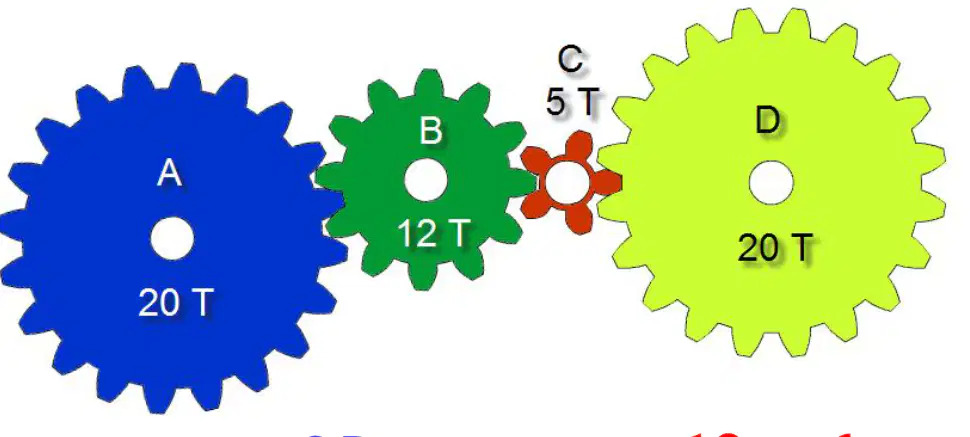
Refer to the diagram of gears A (20T), B (12T), C (5T), and D (20T). What is the gear ratio between gears A and B? (Use the formula GR = n_out / n_in)
0.6 / 1
1.67 / 1
1 / 0.6
2 / 1
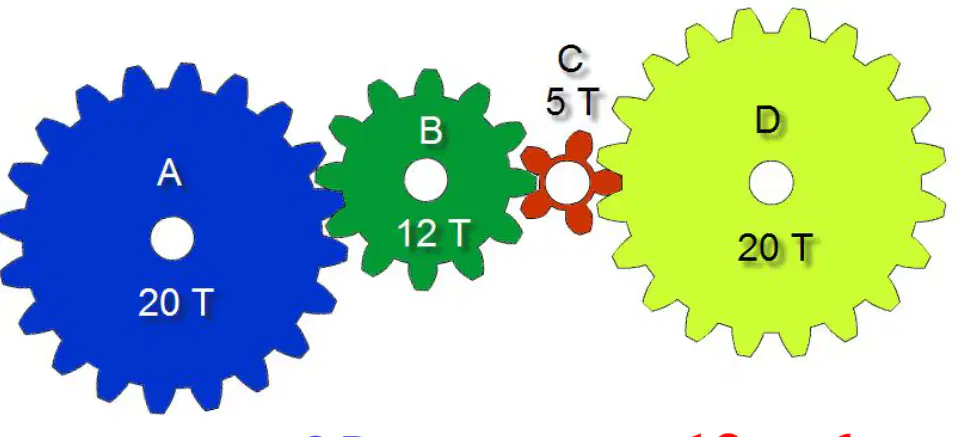
Refer to the diagram of gears A (20T), B (12T), C (5T), and D (20T). What is the gear ratio between gears B and C?
0.42 / 1
2.4 / 1
1.67 / 1
1 / 2
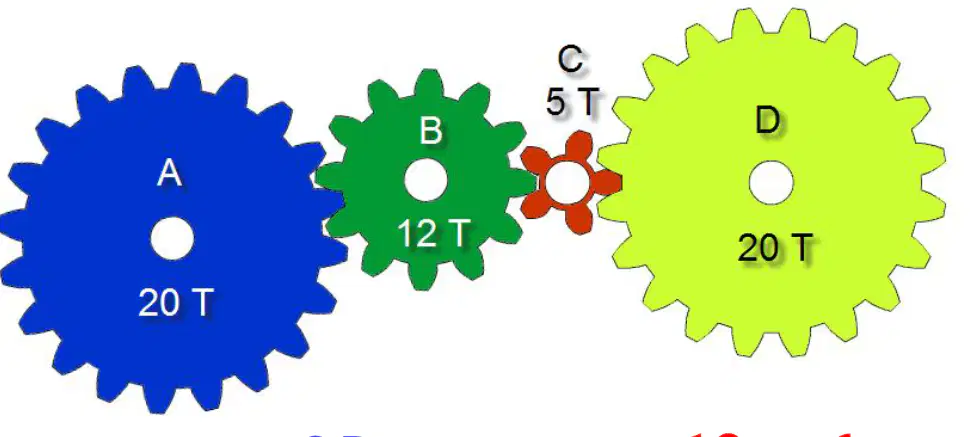
Refer to the diagram of gears A (20T), B (12T), C (5T), and D (20T). What is the gear ratio between gears C and D?
4 / 1
1 / 4
2 / 1
1 / 2
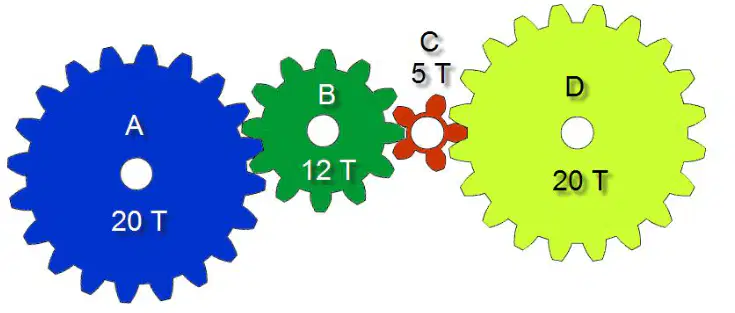
Refer to the diagram of gears A, B, C, and D. What is the TOTAL gear train gear ratio?
1/1
2/1
1/2
4/1
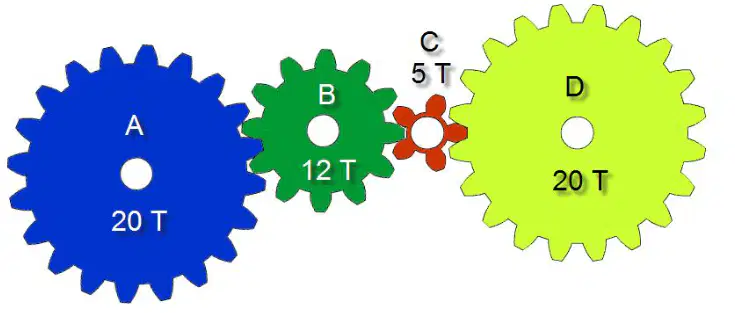
If gears A and D were directly connected to each other, what would the resulting gear ratio be?
1/1
2/1
1/2
3/1
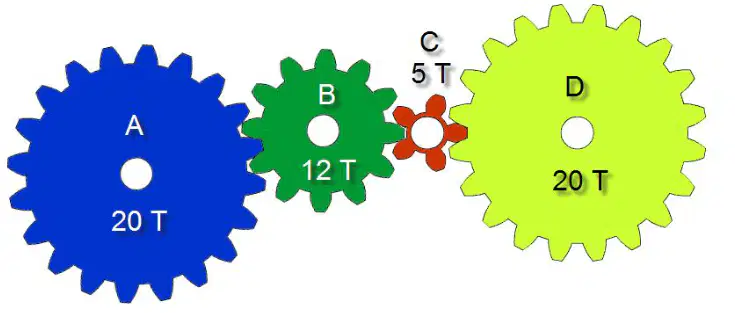
If the last gear had 40 teeth, what would be the total gear ratio?
2/1
1/2
4/1
1/4
Gear ratios are used similarly to which of the following?
Mechanical Advantage (MA)
Power
Velocity
Acceleration
Fill in the blank: Gear ratios apply to ______ instead of force.
torque
speed
distance
power
What is the formula for output force in terms of mechanical advantage (MA) and input force (F_in)?
F_out = MA · F_in
F_out = F_in / MA
F_out = MA / F_in
F_out = F_in - MA
What is the formula for output torque in terms of gear ratio (GR) and input torque (τ_in)?
τ_out = GR · τ_in
τ_out = τ_in / GR
τ_out = GR / τ_in
τ_out = τ_in + GR
In a compound machine, total MA and GR are products of the components.
True
False
Which of the following is used only to calculate forces, not torques?
MA
GR
Both MA and GR
Neither MA nor GR
Which of the following is used only to calculate torques, not forces?
MA
GR
Both MA and GR
Neither MA nor GR
Here are three mechanisms in series: 1. Wheel–axle 2. Gear train 3. Wheel–axle Which of the following is NOT one of the mechanisms listed in the example compound machine?
Wheel–axle
Gear train
Pulley
All of the above are listed
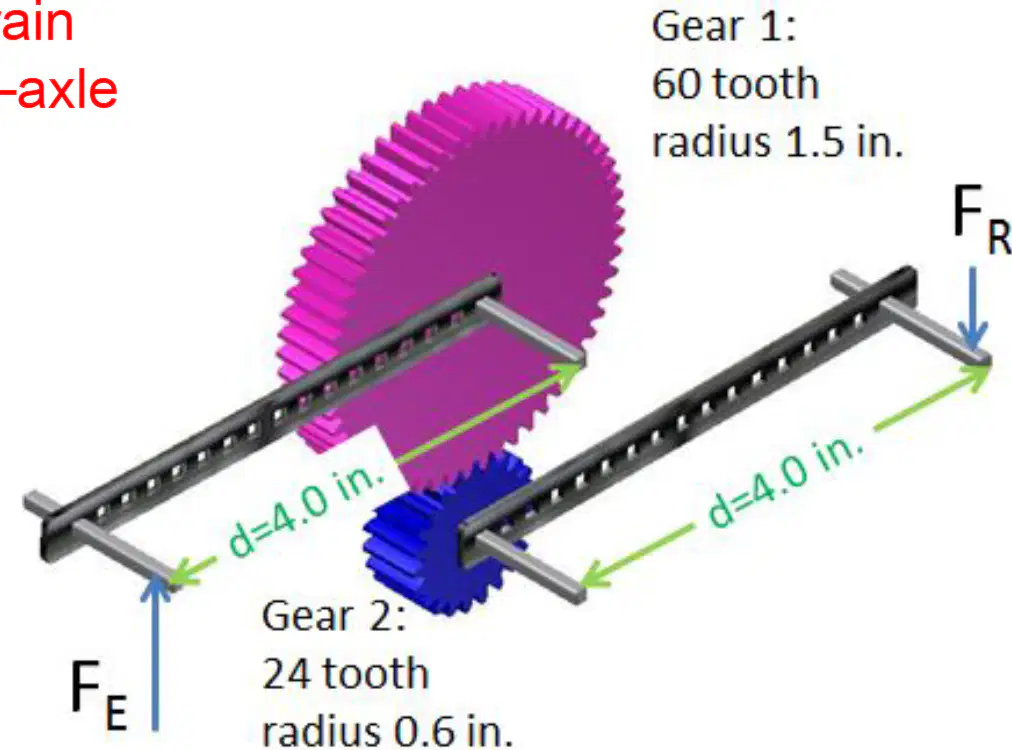
The radius of Gear 1 in the diagram is ____ inches.
1.5
2.0
1.0
2.5
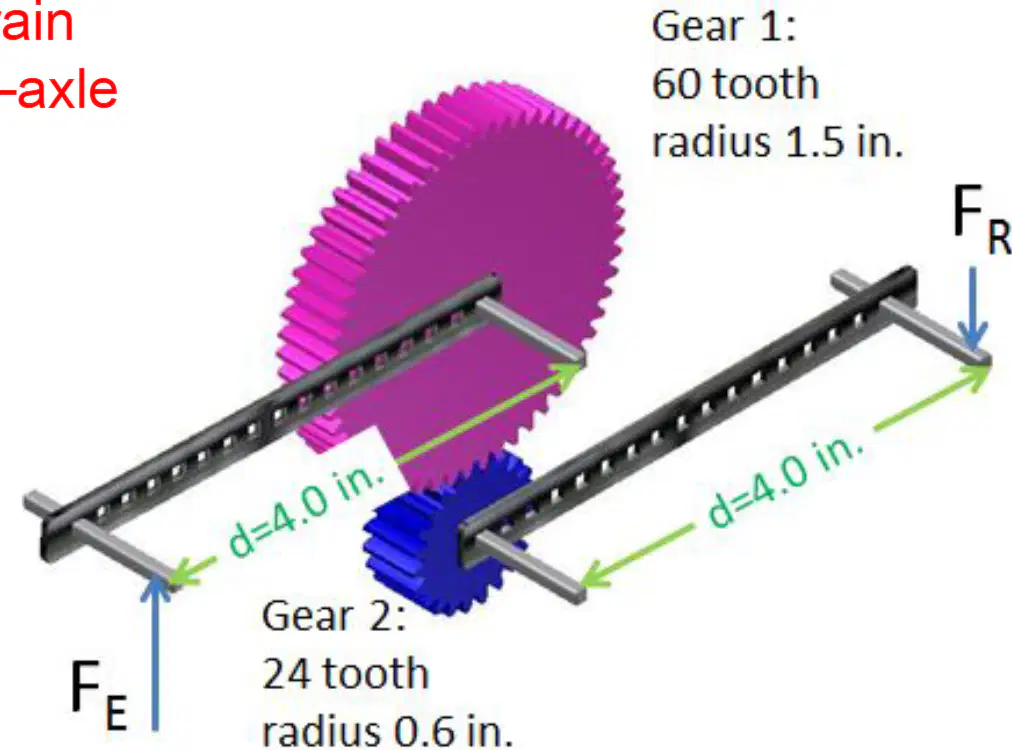
How many teeth does Gear 2 have in the diagram?
24
18
30
36

What is the formula for the mechanical advantage (MA) of a wheel–axle mechanism as shown in the example compound machine?
MA = DR / DE
MA = DE / DR
MA = DE × DR
MA = DR - DE

In the example compound machine, if the effort diameter (DE) is 4.0 in. and the resistance diameter (DR) is 1.5 in., what is the mechanical advantage (MA)?
2.67
1.25
3.50
0.38

Which gear in the diagram has a radius of 1.5 inches and 60 teeth?
Gear 1
Gear 2
Both gears
Neither gear

In the example compound machine, what is the radius of Gear 2?
0.6 in.
1.2 in.
0.3 in.
2.0 in.
What is the formula for the gear ratio (GR) in a gear train as shown in the example compound machine?
GR = n_in / n_out
GR = n_out / n_in
GR = radius_1 / radius_2
GR = force_output / force_input
In the example compound machine, if n_out = 24 and n_in = 60, what is the gear ratio (GR)?
0.4
2.5
1.5
0.25
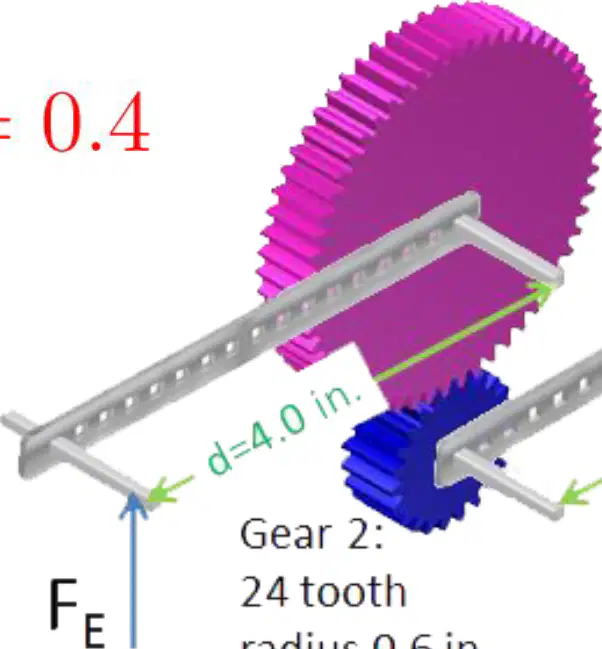
Which of the following correctly describes Gear 1 in the diagram?
24 tooth, radius 0.6 in.
60 tooth, radius 1.5 in.
60 tooth, radius 0.6 in.
24 tooth, radius 1.5 in.
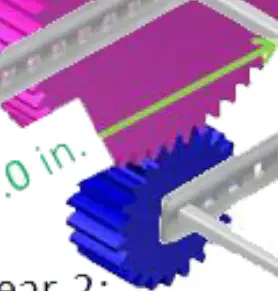
Gear 2 in the diagram has how many teeth and what radius?
24 teeth, radius 0.6 in.
60 teeth, radius 1.5 in.
24 teeth, radius 1.5 in.
60 teeth, radius 0.6 in.

What is the formula for the mechanical advantage (MA) of a wheel–axle mechanism as shown in the example compound machine?
MA = DE / DR
MA = DR / DE
MA = DE * DR
MA = DR - DE

Using the values provided in the example, what is the mechanical advantage (MA) when DE = 0.6 in. and DR = 4.0 in.?
0.15
0.25
0.60
1.50

In the diagram, what is the radius of Gear 1?
0.6 in.
1.5 in.
4.0 in.
2.0 in.
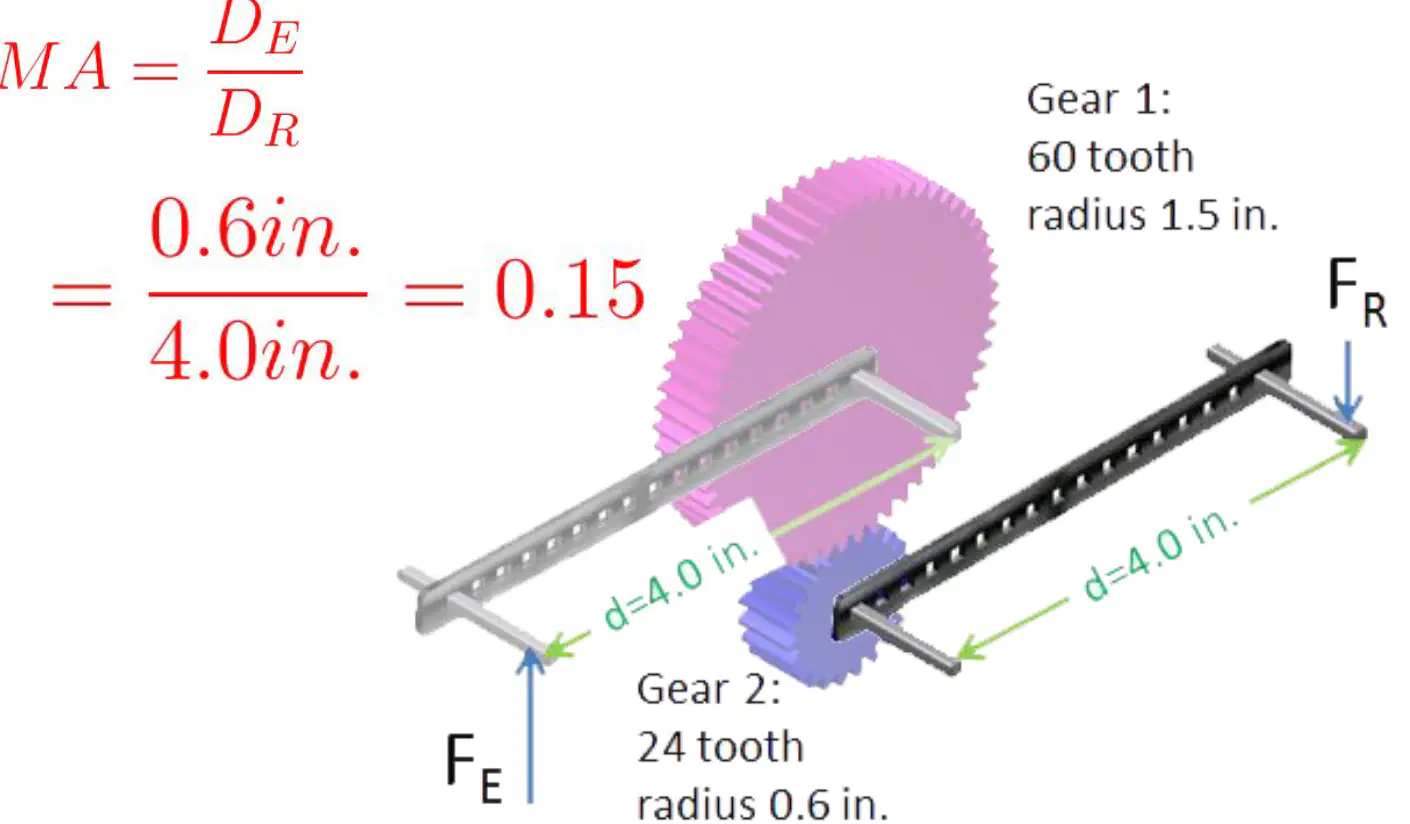
In the example compound machine, how many teeth does Gear 2 have?
24
18
30
12
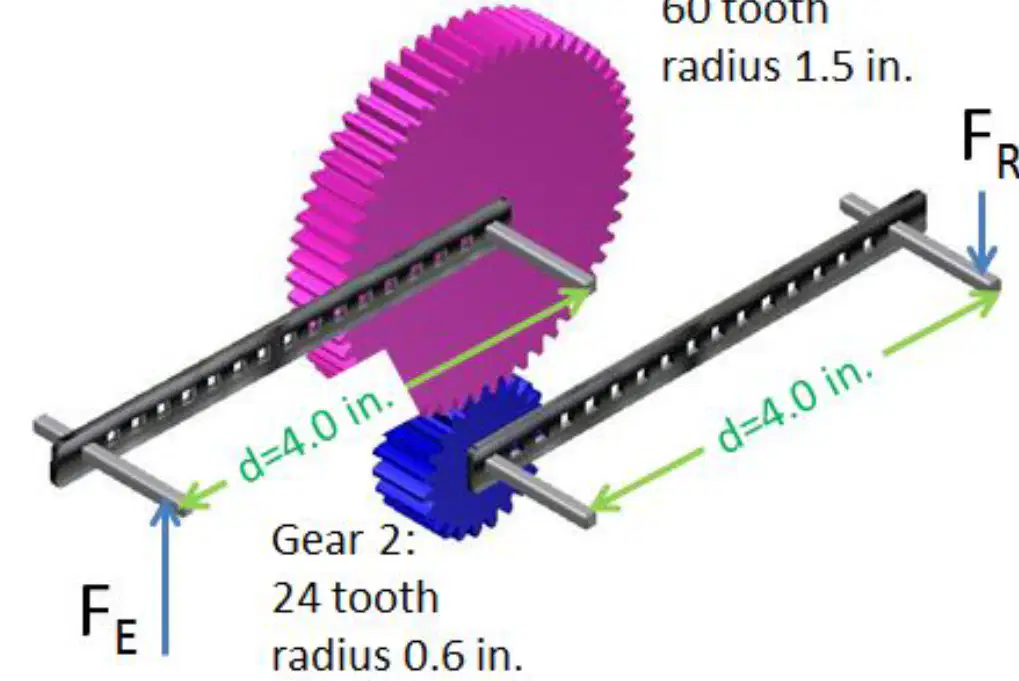
Refer to the diagram and information provided: Gear 1 has 60 teeth and a radius of 1.5 in. Gear 2 has 24 teeth and a radius of 0.6 in. What is the radius of Gear 1?
0.6 in.
1.5 in.
4.0 in.
2.67 in.
Refer to the formula shown: MA_total = MA_1 · MA_3 = 2.67 · 0.15. What is the value of MA_total?
0.4
0.15
2.82
0.25
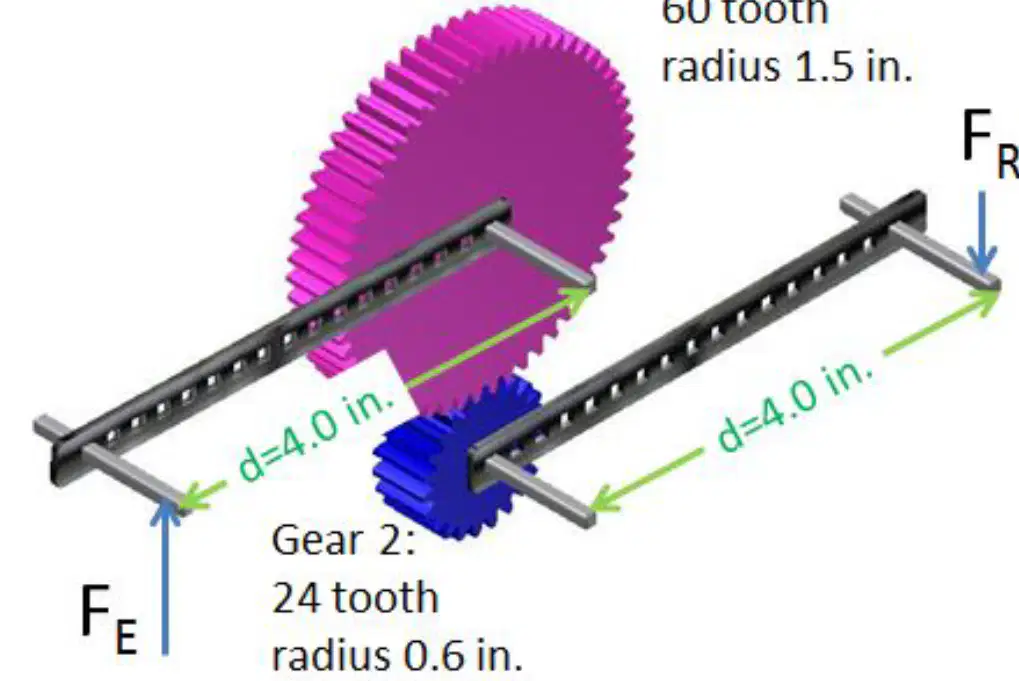
In the example compound machine, what is the number of teeth on Gear 2?
24
60
15
0.4
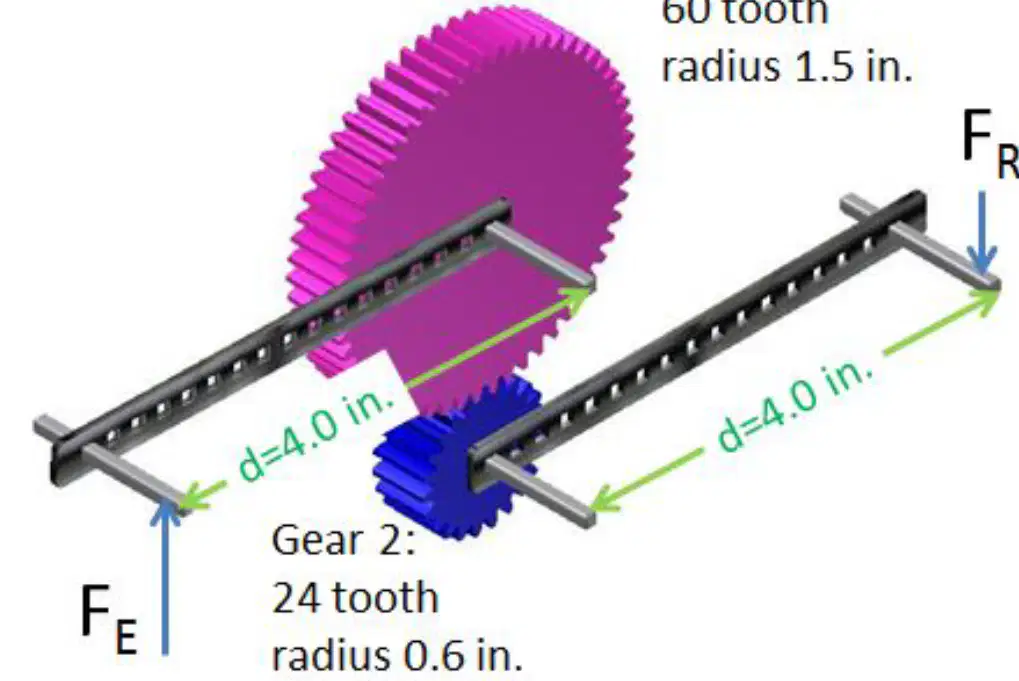
According to the diagram, what is the distance labeled 'd' for both racks?
1.5 in.
0.6 in.
4.0 in.
2.67 in.

What is the total gear ratio (GR_tot) given in the image?
0.2
0.4
0.6
1.5

Refer to the diagram of the Example Compound Machine. How many teeth does Gear 1 have?
24
40
60
100

Refer to the diagram of the Example Compound Machine. Fill in the blank: The distance (d) of the lever arms is ____ in.
4.0
2.5
6.0
8.0

Refer to the diagram of the Example Compound Machine. What is the radius of Gear 2?
0.6 in.
1.5 in.
2.0 in.
4.0 in.
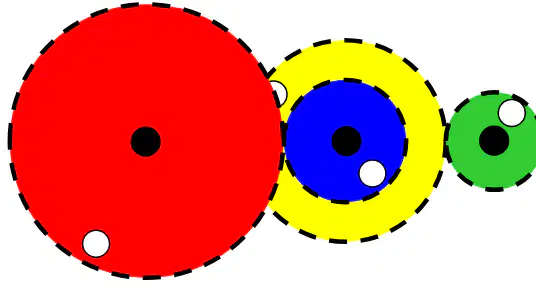
Refer to the diagram of the compound gear train. What do the two middle gears share?
Different axles
A common axle
No axle
A belt
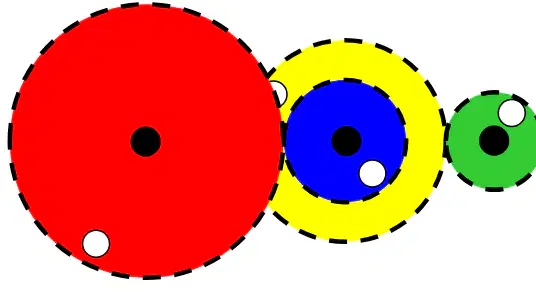
According to the passage, what is the effect of the final gear being connected through the compound gear train instead of directly to the driver gear?
It rotates faster and produces less torque
It rotates slower and produces more torque
It rotates at the same speed as the driver
It stops rotating
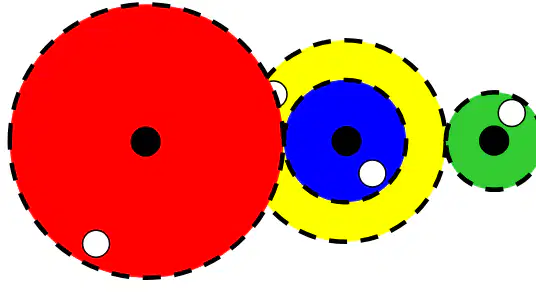
Fill in the blank: The two middle gears in a compound gear train rotate at the same speed because they share a _________.
common axle
tooth profile
gear ratio
lubricant
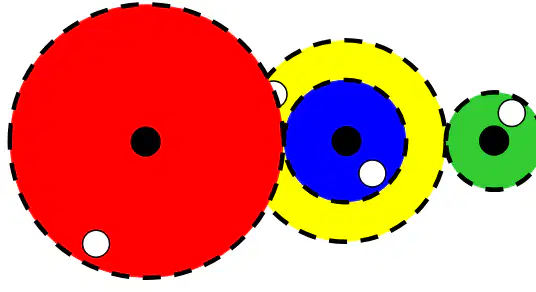
In a compound gear train, the final gear rotates slower and produces more torque than if it were connected only to the driver gear.
True
False
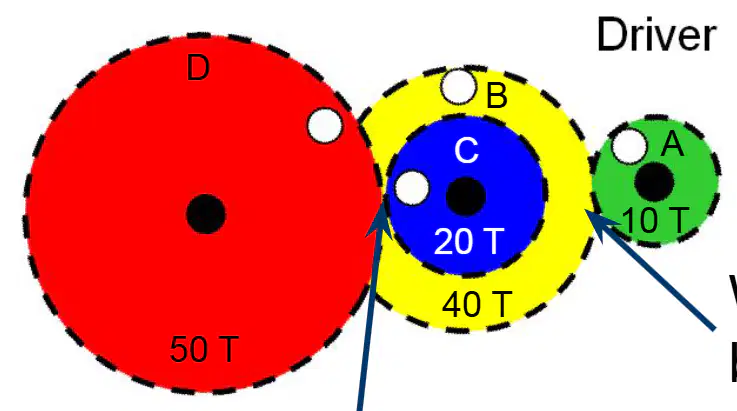
What is the gear ratio between gears A and B?
4/1
1/2
2/3
3/2
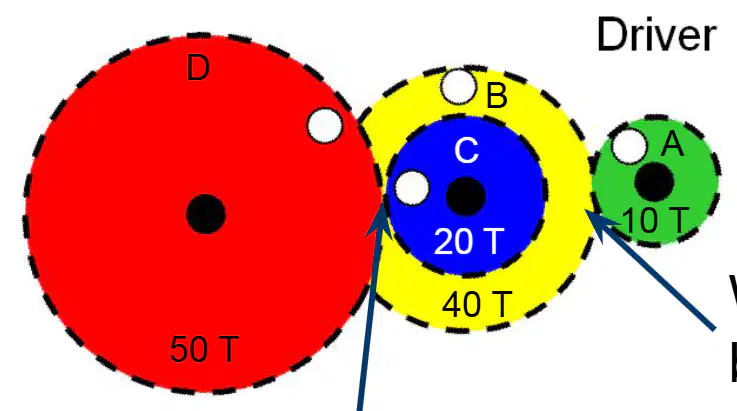
What is the gear ratio between gears C and D?
2.5/1
1/2.5
1/1
5/1
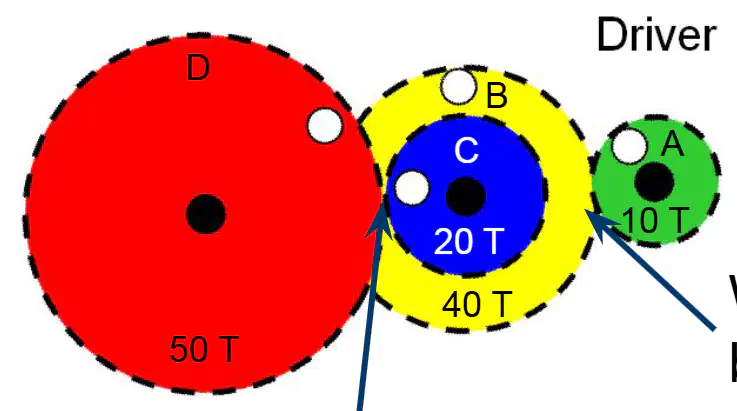
Refer to the diagram of the compound gear system. What is the gear ratio of the entire gear train?
10/1
5/1
2/1
1/5
In a belt and pulley system, which of the following equations correctly represents the relationship between the diameters, angular velocities, and torques of the input and output pulleys?
A) d_out/d_in = ω_in/ω_out = τ_out/τ_in
B) d_in/d_out = ω_out/ω_in = τ_in/τ_out
C) d_out/d_in = ω_out/ω_in = τ_in/τ_out
D) d_in/d_out = ω_in/ω_out = τ_out/τ_in
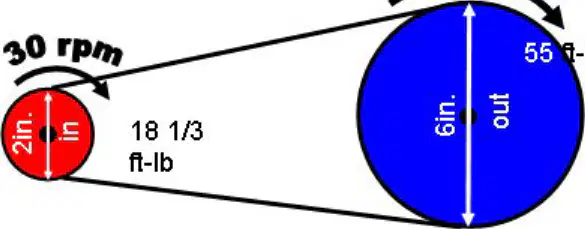
Fill in the blank: In the example shown, the diameter of the output pulley (d_out) is _____
6 in.
4 in.
8 in.
10 in.
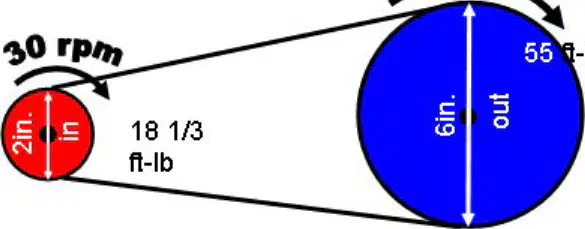
Fill in the blank: In the example shown, the angular velocity of the input pulley (ω_in) is _____
30 rpm
15 rpm
45 rpm
60 rpm
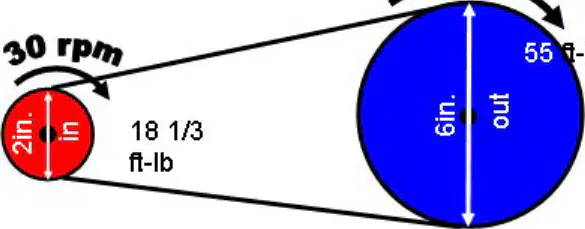
Fill in the blank: In the example shown, the torque of the output pulley (τ_out) is _____
55 ft-lb
25 ft-lb
100 ft-lb
10 ft-lb
Which of the following correctly matches the symbols with their meanings?
d = diameter, ω = angular velocity (speed), τ = torque
d = torque, ω = diameter, τ = angular velocity (speed)
d = angular velocity (speed), ω = torque, τ = diameter
d = speed, ω = diameter, τ = torque
What does the variable 'n' represent in sprocket and chain systems?
number of teeth
number of links in the chain
speed of the chain
diameter of the sprocket
What does the variable 'd' represent in sprocket and chain systems?
diameter
distance
depth
density
What does the variable 'ω' represent in sprocket and chain systems?
angular velocity (speed)
linear displacement
tension force
power output
What does the variable 'τ' represent in sprocket and chain systems?
torque
tension
temperature
time

