wayground logo

Free Printable Worksheets

Font size

S
M
L
XL
Worksheets

Safety Exam

Total questions: 46

Worksheet time: 23mins

Name
Class
Date
1.
Heavy objects should be carried away from the body to avoid back injury
a)
True
b)
False
2.
While discharging a fire extinguisher spray the center of the fire to eliminate the fire
a)
True
b)
False
3.
OSHA establishes and enforces safety standards for the workplace
a)
True
b)
False
4.
Body fluids that can cause disease are blood, urine, stool, semen, CSF, saliva , mucus
a)
True
b)
False
5.
Spilled solutions, such as bleach, should be wiped up immediately
a)
True
b)
False
6.
Laboratory uniforms are worn for protection and as a safety measure
a)
True
b)
False
7.
If any solution comes in contact with your skin or eyes flush the area with water and call the instructor
a)
True
b)
False
8.
Class A fire extinguishers can be used on electrical fires
a)
True
b)
False
9.
While using a fire extinguisher hold the extinguisher firmly and direct it to the middle or main part of the fire
a)
True
b)
False
10.
Smoke and panic kill more people in fires than the fire itself
a)
True
b)
False
11.
For your own safety and the safety of a patient it is important that you wash your hands frequently
a)
True
b)
False
12.
All waste material should be disposed of in the nearest available container
a)
True
b)
False
13.
The bottle label of any solution you use should be read by you at least three times
a)
True
b)
False
14.
All manufacturers must provide a material safety data sheet (MSDS) with any hazardous product they sell
a)
True
b)
False
15.
When lifting a patient in bed a narrow base of support should be maintained
a)
True
b)
False
16.
Horseplay or practical jokes
a)
are permitted if no one is insulted
b)
may be done during breaks or study time
c)
cause accidents and have no place in the lab
d)
usually do not result in accidents
17.
The three things needed to start a fire are
a)
air, oxygen, and fuel
b)
fuel, heat, and oxygen
c)
fuel, carbon dioxide, and heat
d)
air, carbon dioxide, and fuel
18.
Injuries are more likely to happen to persons who
a)
take chances
b)
use equipment properly
c)
practice safety
d)
respect the dangers in using equipment
19.
All injuries obtained in the laboratory
a)
should be treated by a fellow student
b)
can be ignored if minor
c)
should be reported to the instructor
d)
should be washed with soap and water
20.
Which of the following diseases can be contracted by exposure to body fluids?
a)
HIV
b)
Hep B
c)
Hep C
d)
All of the above
21.
Where is the location of the nearest fire extinguisher?
a)
downstairs in the restroom hallway
b)
in the hallway next to the hospital room
c)
downstairs next to building entrance
d)
main building
22.
The R in RACE, the fire safety acronym, stands for
a)
a. run.
b)
b. rescue.
c)
c. rush.
d)
d. remain calm.
23.
In a health care facility, who is responsible for knowing how to use a fire extinguisher?
a)
a. Safety personnel
b)
b. Supervisors
c)
c. Maintenance staff
d)
d. Everyone who works in the facility
24.
How far should you stand from a fire when using an extinguisher to put it out?
a)
a. 2 to 4 feet
b)
b. 10 to 12 feet
c)
c. 6 to 10 feet
d)
d. 15 to 20 feet
25.
Which position ensures a good base of support to prevent fatigue and strain?
a)
a. Feet 8 to 10 inches apart with one foot forward and carrying most of the weight
b)
b. Feet 8 to 10 inches apart, one foot forward, and weight evenly distributed on both feet
c)
c. Feet 3 to 5 inches apart, placed side by side with weight evenly distributed between them
d)
d. Feet at a comfortable distance apart with one foot forward carrying most of the weight
26.
Which of the following is not recommended for picking up and moving heavy objects?
a)
a. Pushing
b)
b. Pulling
c)
c. Lifting
d)
d. Sliding
27.
Which is the safest posture for the health care worker who is pushing a heavy object, such as a hospital bed?
a)
a. Bend at the hips and push forward with the arms.
b)
b. Stand upright and push with the arms.
c)
c. Stand a slight distance away and use the leg muscles.
d)
d. Stand close to the bed and push with the weight of the entire body.
28.
Safety Data Sheets (SDSs) help protect health care workers by providing information about
a)
a. using proper body mechanics.
b)
b. hazardous chemicals.
c)
c. preventing exposure to serious viruses.
d)
d. using electrical equipment.
29.
According to the National Fire Protection Association's color code, blue relates to a
a)
a. fire hazard.
b)
b. health hazard.
c)
c. reactivity hazard.
d)
d. specific hazard.
30.
You have been told to perform a procedure but the equipment is making an unusual grinding noise. What should you do?
a)
a. Stop using the machine immediately and report the problem to your supervisor.
b)
b. Finish the procedure and then report the problem to your supervisor.
c)
c. Find the instruction manual and see if you can identify the problem.
d)
d. Finish the procedure and continue with your work.
31.
Horseplay or practical jokes
a)
are permitted if no one is insulted
b)
may be done during breaks or study time
c)
cause accidents and have no place in the lab
d)
usually do not result in accidents
32.
At a minimum, how often must health care workers wash their hands when performing patient procedures?
a)
a. Before procedures
b)
b. After procedures
c)
c. Before and after procedures
d)
d. Only during procedures if their hands become contaminated
33.
Under what circumstances should a health care worker report a personal accident that occurs on the job?
a)
a. When any accident, even a minor one, occurs
b)
b. When it requires medical attention
c)
c. When a patient is involved
d)
d. When equipment or supplies are broken or wasted
34.
Which gas is necessary for a fire to ignite?
a)
a. Carbon dioxide
b)
b. Hydrogen
c)
c. Carbon monoxide
d)
d. Oxygen
35.
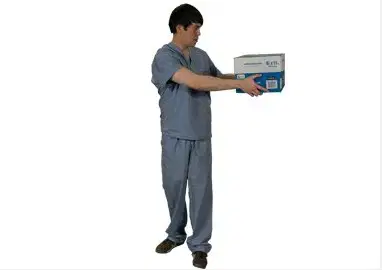
Which part of the body is in the incorrect position?
a)
a. Torso
b)
b. Arms
c)
c. Waist
d)
d. Legs
36.
Which part of the body is in the incorrect position?
a)
a. Torso
b)
b. Arms
c)
c. Waist
d)
d. Legs
37.
Which part of the body is in the incorrect position?
a)
a. Torso
b)
b. Arms
c)
c. Waist
d)
d. Legs
38.
The Acronym 'PASS' is used to help remember the steps for operating a fire extinguisher. Identify the statement that best describes each letter in PASS. 'P'
a)
a. Press on the handle of the extinguisher.
b)
b. Pull the pin at the top of the extinguisher.
c)
c. Put the extinguisher into the room with the fire and shut the door.
39.
The Acronym 'PASS' is used to help remember the steps for operating a fire extinguisher. Identify the statement that best describes each letter in PASS. 'A'
a)
a. Arch hose towards ceiling.
b)
b. Add water to the container.
c)
c. Aim at the base of the fire.
40.
The Acronym 'PASS' is used to help remember the steps for operating a fire extinguisher. Identify the statement that best describes each letter in PASS. First 'S'
a)
a. Send another health care professional to get the doctor.
b)
b. Squeeze the handle slowly, to release the extinguishing agent in the fire extinguisher.
c)
c. Send water through hose rapidly by pulling pin from extinguisher.
41.
The Acronym 'PASS' is used to help remember the steps for operating a fire extinguisher. Identify the statement that best describes each letter in PASS. Second 'S'
a)
a. Sweep from side to side until the fire is completely out.
b)
b. Stop releasing extinguishing agent immediately if fire has not gone out after 1 minute.
c)
c. Set extinguisher to automatically release extinguishing agent by breaking pin.
42.
You open an exam room door and see that there is a fire. What is your correct first step?
a)
a. Yell 'fire!' to alert others
b)
b. Close the door
c)
c. Call 911
43.
You have closed the exam room door and contained the fire. Now what should you do?
a)
a. Go outside and wait for the fire or police department to arrive.
b)
b. Activate the building's fire alarm and instruct those who are ambulatory to leave the building in an orderly manner; evacuate non-ambulatory patients to an area of refuge.
c)
c. Remain calm and alert the practice manager that the fire has been contained.
44.
You are mixing bleach and water to make a diluted solution so that you can clean the countertops in a resident common area, and you accidently spill some bleach on the floor. What is your correct first step?
a)
a. Contain the spill immediately.
b)
b. Put on personal protective equipment, and then contain the spill.
c)
c. Wash your hands.
d)
d. Open a window for ventilation.
45.
Which of the following is NOT a true statement about a chemical spill?
a)
a. You should only attempt to clean up a chemical spill if you have been trained in spill cleanup procedures.
b)
b. Protective gear such as a mask and gloves should be worn, regardless of the size of the spill.
c)
c. After the spill, all materials, including paper towels used in cleanup, must be disposed of as hazardous waste.
d)
d. All answer choices are true.
46.
There is nothing stronger than the _________ of a VOLUNTEER!
a)
lungs
b)
pancreas
c)
thyroid
d)
heart