
 Worksheets
Government Semester 1 Final
Total questions: 50
Worksheet time: 25mins
Name
Class
Date
1.
Which of the following examples shows a government exercising its executive powers?
a)
deciding whether or not a law is constitutional
b)
enforcing a new tax law
c)
making a law that alters voting requirements
d)
settling a dispute between two branches of government
2.
What is an adjective describing a legislative body composed of two chambers?
a)
unicameral
b)
bicameral
c)
tricameral
d)
quadricameral
3.
What is a system of overlapping the powers of the legislative, executive, and judicial branches to permit each branch to check the actions of the others?
a)
popular sovereignty
b)
limited government
c)
separation of powers
d)
checks and balances
4.
Which of the following is an example of checks and balances at work?
a)
The people choose not to re-elect a President whose policies they dislike.
b)
The Federal Government passes a law that overrides similar laws in several States.
c)
A bill passed by the House is vetoed by the Senate.
d)
Congress removes from the bench a federal judge who has accepted a bribe.
5.
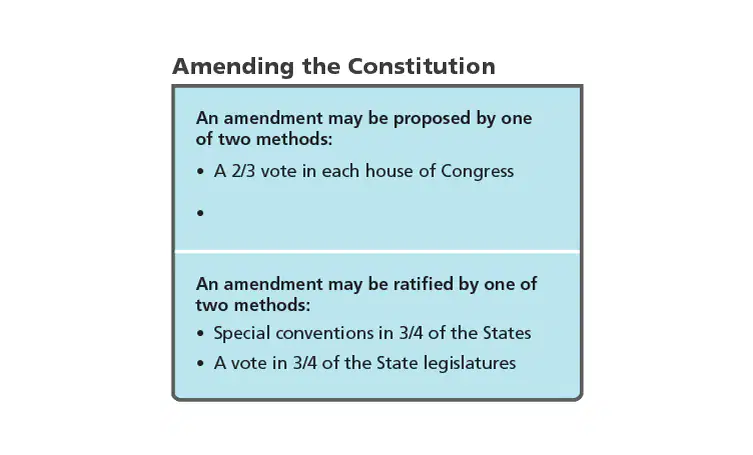
Which of the following statements supplies the information on proposing an amendment that is missing from the chart?
a)
A Supreme Court ruling that calls for an amendment to make a federal law constitutional.
b)
A vote by at least 3/4 of the State legislatures meeting independently at the request of the public.
c)
An executive order issued by the President and then approved by both houses of Congress.
d)
A national convention called by Congress at the request of 2/3 of the State legislatures.
6.

The chart shows some of the powers held by different levels of government in our federal system.
Which of the following powers is a concurrent power shared by both the federal and State governments that is missing from the chart?
a)
Regulating interstate trade
b)
Licensing professionals such as doctors
c)
Seizing property without payment
d)
Setting punishments for crimes
7.
States that joined the Union after the original 13 colonies
a)
were instructed to model their governments on the governments of those original States.
b)
were required to wait for 15 years before they could elect senators to represent their State.
c)
agreed to a follow a common set of local laws and polices established by the Northwest Ordinance.
d)
immediately received the same congressional status and constitutional rights as the original States.
8.
What limit does the Constitution place on the ability of the U.S. government to add new States to the Union?
a)
An area must be a U.S. territory for at least 15 years and have a written constitution before it can apply for Statehood.
b)
The Supreme Court must approve the proposed constitution of any new State before it can be accepted.
c)
Congress cannot take territory from an existing State to create a new State without the permission of the original State's legislature.
d)
The President cannot become involved in any way with the decision to accept a new State into the Union.
9.
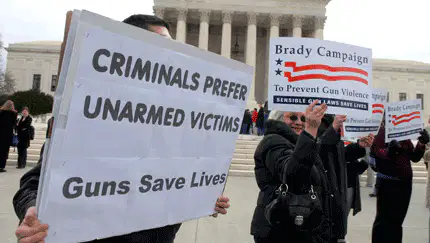
Use the photo to help you answer the question.
To which amendment in the Bill of Rights are these protests related?
a)
First Amendment
b)
Second Amendment
c)
Third Amendment
d)
Fifth Amendment
10.

The diagram shows some of the ways the executive branch can limit the power of the other branches.
What is another way in which the executive branch can check the legislative branch that is missing from the diagram?
a)
approving treaties
b)
impeaching judges
c)
vetoing a bill
d)
declaring acts of Congress unconstitutional
11.
The Framers included the Supremacy Clause in the Constitution for the purpose of
a)
giving the Federal Government complete authority over all actions of State governments.
b)
making the individual State governments more powerful than the Federal Government.
c)
helping to settle disputes between different levels of government in the federal system.
d)
making the Supreme Court the most powerful branch of the Federal Government.
12.
Before any new States can be admitted to the Union, they first have to
a)
sign away some of their lands to the Federal Government.
b)
create a State constitution that provides a republican form of government.
c)
allow Congress and the President to choose their State governor.
d)
agree to create a State government with a bicameral legislature.
13.
The Bill of Rights was added to the Constitution in order to
a)
spell out the basic duties of the Federal and State governments more clearly.
b)
detail appropriate governmental responses to common problems of citizens.
c)
appease Anti-Federalists by ensuring basic rights to citizens.
d)
pacify Federalists by stating that some rights of citizens are unwritten, but understood.
14.
Only 17 amendments have been added to the Constitution since the adoption of the Bill of Rights, in part because
a)
no major changes have occurred in the United States over the last 200 years.
b)
the method for the ratification of amendments is quite rigorous.
c)
the Bill of Rights fully guarantees all citizens their rights.
d)
Congress has not proposed any amendments since the 27th Amendment was ratified.
15.

Use the chart to answer the question.
If the President, Vice President, and leaders of Congress were all unable to hold office, who would assume the office of President?
a)
the Attorney General
b)
the Secretary of State
c)
the Secretary of Defense
d)
the Secretary of Homeland Security
16.
In which courts are most cases in the United States heard?
a)
federal courts
b)
state courts
c)
constitutional courts
d)
special courts
17.
Federal district court judges hear
a)
mostly criminal cases, with an occasional civil case.
b)
criminal cases only.
c)
civil cases only.
d)
both criminal and civil cases.
18.
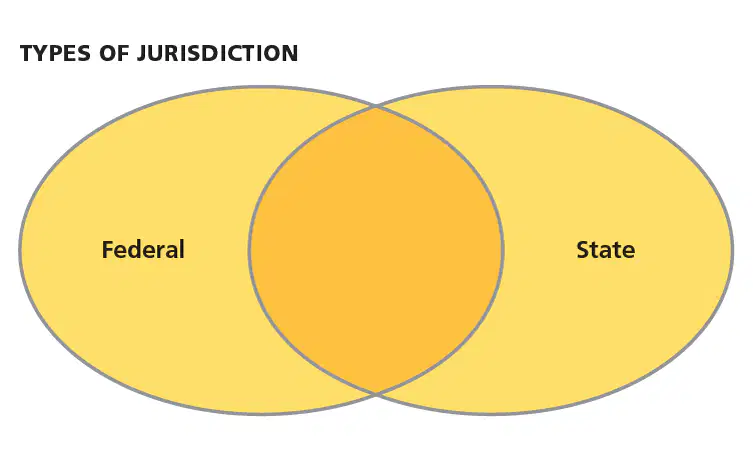
The type of jurisdiction shared by both Federal and State, missing from the middle section of this diagram, is known as
a)
Appellate
b)
Concurrent
c)
Exclusive
d)
Original
19.
What is the difference between original jurisdiction and appellate jurisdiction?
a)
Original jurisdiction refers to a case being heard in a federal court; appellate jurisdiction refers to a case being heard in a State court.
b)
Original jurisdiction refers to criminal or civil cases; appellate jurisdiction refers to only civil cases.
c)
Original jurisdiction refers to a case that could be heard in a federal or a State court; appellate jurisdiction refers to a case that must be heard in a federal court.
d)
Original jurisdiction refers to a court where a case is first heard; appellate jurisdiction refers to a case being heard after it was tried in a lower court.
20.
How are federal judges selected?
a)
The person is named to the bench by the President and confirmed by the Senate.
b)
The person is named to the bench by the President and does not need to be confirmed.
c)
The person is publicly elected to the bench and confirmed by the Senate.
d)
The person is nominated by the Senate and chosen by the President.
21.
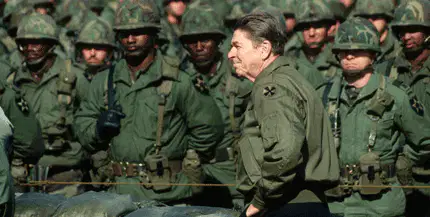
The photo shows President Ronald Reagan with some U.S. troops.
Which presidential role does this photograph illustrate?
a)
the President as commander in chief
b)
the President as chief administrator
c)
the President as chief economist
d)
the President as chief of state
22.
One major purpose of the 25th Amendment is to
a)
legally define the Vice President's foreign and domestic responsibilities should the President resign.
b)
legally establish that the Vice President will succeed to the presidency should that office become vacant.
c)
legally define the order of succession following the Vice President.
d)
legally establish a limit on the Vice President's number of terms in office.
23.
Which of the following are listed as formal duties of the Vice President in the Constitution?
a)
attend Cabinet meetings and execute national security policy
b)
be aware of military developments and strengthen relationships with allies
c)
support presidential policies and assist in the administration of the executive branch
d)
preside over the Senate and help decide presidential disability
24.
Which of the following BEST supports the practice of "balancing the ticket"?
a)
The practice helps ensure that the best qualified candidate is included on the ticket.
b)
The practice helps guarantee that the two major parties will have equal chances to win.
c)
The practice helps select the vice presidential candidates who are best equipped to become President.
d)
The practice helps broaden a campaign's appeal by attracting voters from a particular region.
25.
Identify and describe the three qualifications a presidential candidate must meet according to the U.S. Constitution.
4 lines
26.
What is the chief executive's power to reject a bill passed by a legislature?
a)
rule of law
b)
veto
c)
judicial review
d)
federalism
27.
What is a concept that the government and its officers are always subject to the law?
a)
rule of law
b)
veto
c)
judicial review
d)
federalism
28.
What is the power of a court to determine the constitutionality of a governmental action?
a)
rule of law
b)
veto
c)
judicial review
d)
federalism
29.
What is a system of government in which a written constitution divides power between a central, or national, government and several regional governments like States?
a)
rule of law
b)
veto
c)
judicial review
d)
federalism
30.
What is a change in, or addition to a constitution or law?
a)
amendment
b)
ratification
c)
treaty
d)
executive agreement
31.
What is the first ten amendments to the Constitution?
a)
Bill of Rights
b)
treaties
c)
executive agreements
d)
senatorial courtesies
32.
What is the group of persons chosen in each State and the District of Columbia every four years who make a formal selection of the President and Vice President?
a)
electoral college
b)
Bill of Rights
c)
formal amendment
d)
Cabinet
33.
What are those delegated powers of the National Government that are spelled out, expressly, in the Constitution?
a)
expressed powers
b)
implied powers
c)
reserved powers
d)
concurrent powers
34.
What are those delegated powers of the National Government that are suggested by the expressed powers set out in the Constitution; those "necessary and proper" to carry out the expressed powers?
a)
expressed powers
b)
implied powers
c)
reserved powers
d)
concurrent powers
35.
What are those powers that the Constitution does not grant to the National Government and does not deny the states?
a)
expressed powers
b)
implied powers
c)
reserved powers
d)
concurrent powers
36.
What are those powers that both the National Government and the States possess and exercise?
a)
expressed powers
b)
implied powers
c)
reserved powers
d)
concurrent powers
37.
Which of the following is MOST directly related to the idea that government should be restricted in what it can do?
a)
representative government
b)
ordered government
c)
limited government
d)
colonial government
38.

Use the chart comparing the Virginia and the New Jersey plans to answer the question.
A third difference between the plans was concerned with which topic?
a)
the way States would be represented in Congress
b)
the way a judiciary would be formed
c)
the way the government would raise money
d)
the way Congress would legislate power
39.

This chart shows one main feature of the Connecticut Compromise.
What was the compromise's other main feature?
a)
In the Senate, the States would be represented equally. In the House, the States would be represented based on size of territory.
b)
In the Senate, the States would be represented based on territory. In the House, the States would be represented equally.
c)
In the Senate, the States would be represented equally. In the House, the States would be represented based on population.
d)
In the Senate, the States would be represented based on population. In the House, the States would be represented based on the size of their economies.
40.
Read the excerpt and answer the question.
“We hold these truths to be self-evident, that all Men are created equal, that they are endowed by their Creator with certain unalienable Rights, . . .”
—The Unanimous Declaration of the Thirteen United States of America
Which of the following BEST paraphrases this statement?
a)
People must show allegiance to their king and country throughout their lives.
b)
People need to help others understand their basic rights as citizens.
c)
People owe their allegiance first to God, then to the monarch.
d)
People are born with certain rights that no one can take from them.
41.
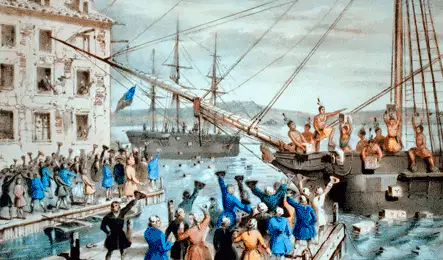
What historic event is shown in this painting?
a)
the First Continental Congress
b)
the Second Continental Congress
c)
the Boston Tea Party
d)
the American Revolution
42.
The weaknesses of the Articles of Confederation eventually led the States to determine it was necessary to establish
a)
a bicameral legislature.
b)
a national judicial system.
c)
a congressional voting policy based on population.
d)
a stronger national government.
43.
Describe what the Connecticut Compromise was and what it did.
4 lines
44.
What does the term popular sovereignty mean?
4 lines
45.
What is the purpose of a constitution and what are the advantages of a written constitution?
4 lines
46.
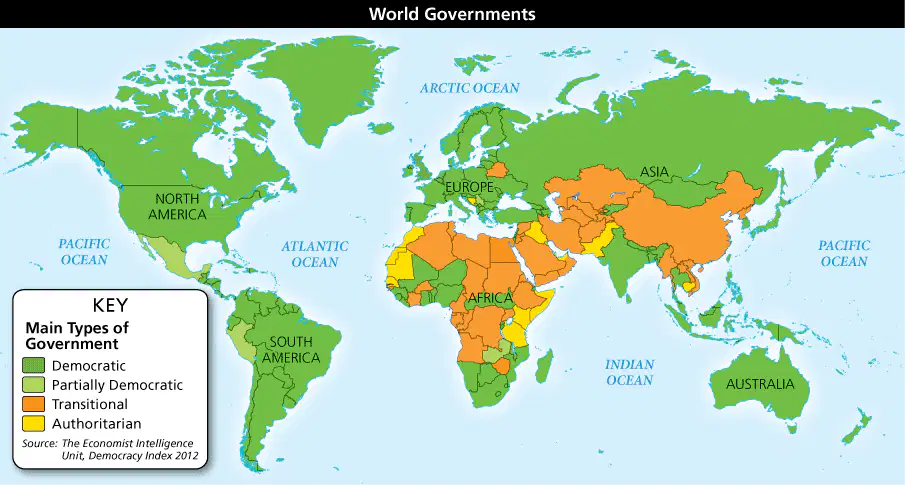
The map shows the types of governments used by nations across the world.
Which statement best describes the form of government that is most common in Europe and the Americas?
a)
Power is held by a small, ruling elite.
b)
The people elect officials to represent them in government.
c)
Rule of the country is passed down through family members.
d)
A single individual has absolute control over the government.
47.
What did John Locke mean when he said that government was based upon a social contract?
4 lines
48.
What is government?
a)
the services provided to a community, such as police protection, fire protection, and public health programs
b)
the laws that protect peoples’ rights and ensure the safety of a state’s citizens
c)
the institution through which a society makes and enforces its public policies
d)
the process by which public officials are elected to and removed from office
49.
What is the purpose of the separation of powers in a presidential form of government?
a)
to ensure that no branch has more power over another
b)
to ensure that political authority rests with the people
c)
to ensure that the executive branch is under the direct control of the legislative branch
d)
to ensure that local and national governments are co-equal partners
50.
How does democracy protect minority rights?
a)
by not allowing the passage of unsatisfactory public policies
b)
by recognizing that the minority usually represents the popular will
c)
by permitting the minority to overrule the majority on vital public issues
d)
by insisting that the majority listen to the arguments and ideas of the minority
100 %

