wayground logo

Free Printable Worksheets

Font size

S
M
L
XL
Worksheets

3 week test

Total questions: 48

Worksheet time: 1hrs 24mins

Name
Class
Date
1.
The switch from nomadic lifestyles to a settled agricultural lifestyle is this revolution.
a)
Cuneiform
b)
Industrial Revolution
c)
Neolithic Revolution
d)
Fertile Crescent
2.
Belief in one God
a)
Atheism
b)
Monotheism
c)
Animism
d)
Polytheism
3.
A powerful Greek military polis that was often at war. Would train its males at a young age to become warriors. Used slaves known as helots to provide agricultural labor.
a)
Athens
b)
Sparta
c)
Egypt
d)
Socrates
4.
Huge stone tombs with four triangle-shaped walls that met in a point on top
a)
Papyrus
b)
Hieroglyphics
c)
Thalamus
d)
Pyramids
5.
A form of writing developed by the Sumerians using a wedge shaped stylus and clay tablets.
a)
Cuneiform
b)
Hieroglyphics
c)
Egypt
d)
Pyramids
6.
The division of society by rank or class
a)
pyramids
b)
polytheism
c)
individual experience
d)
social hierarchy
7.
A democratic Greek polis who accomplished many cultural achievements, and who were constantly at war with Sparta. Direct Democracy
a)
Athens
b)
Mesopotamia
c)
Egypt
d)
Sparta
8.
Son of Philip II; received military training in Macedonian army and was a student of Aristotle; great leader; conquered much land in Asia Minor, Syria, Egypt, and Mesopotamia; goal was to conquer the known world
a)
Alexander the Great
b)
Athens
c)
Julius Caesar
d)
Socrates
9.
The structure shown here is a:
a)
palace
b)
monolith
c)
pyramid
d)
ziggurat
10.
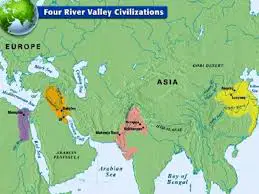
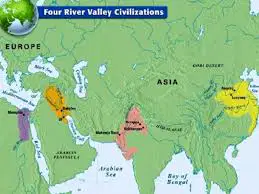
Name the River Valley Civilization shaded in purple on the map
a)
Egypt
b)
India
c)
Mesopotamia/ Sumer
d)
China
11.
Name the River Valley Civilization shaded in orange on the map
a)
Mesopotamia/ Sumer
b)
China
c)
India
d)
Egypt
12.
Name the River Valley Civilization shaded in pink on the map
a)
Egypt
b)
India
c)
Mesopotamia/ Sumer
d)
China
13.
Name the River Valley Civilization shaded in yellow on the map
a)
Egypt
b)
India
c)
Mesopotamia/ Sumer
d)
China
14.
Name the civilization: - Nile River - Hieroglyphics - Pyramids
a)
Egypt
b)
India
c)
Mesopotamia/ Sumer
d)
China
15.
Name the civilization: - Tigris and Euphrates - Cuneiform - City-States
a)
China
b)
Mesopotamia/ Sumer
c)
India
d)
Egypt
16.
Name the civilization: - Huang He (Yellow) River - Calligraphy writing - Paper and Silk
a)
Egypt
b)
India
c)
Mesopotamia/ Sumer
d)
China
17.
The war between Athens and Sparta that in which Sparta won, but left Greece as a whole weak and ready to fall to its neighbors to the north.
a)
Trojan War
b)
Peloponnesian War
c)
Neolithic Revolution
d)
Sparta
18.

Which of the following early civilizations gave women the highest status?

a)

Harappa

b)

Egypt

c)

Sumer

d)

Shang

19.

The world's first known codified laws came from which river valley civilization?

a)

Indus

b)

Tigris and Euphrates

c)

Huang He

d)

Nile

20.

The structure shown here is a:

a)

monolith

b)

palace

c)

pyramid

d)

ziggurat

21.

The picture shown here is an example of:

a)

cuneiform

b)

hieroglyphics

c)

quipu

d)

prints from cylindrical seals

22.

The "white kilt" symbolized higher social status within which early civilization?

a)

Mesopotamia

b)

Egypt

c)

Olmec

d)

Indus

23.

Hammurabi's Code is significant because:

a)

it established arbitrary consequences

b)

it was the world's first long-range communication system

c)

it established a consistent set of regulations

d)

it allowed scholars to decipher cuneiform writing

24.

Silk was a prominent product that was monopolized for centuries by which civilization?

a)

China

b)

Egypt

c)

India

d)

South America

25.

365 calendar, sun clock, number system, papyrus as writing material were the achievement of

a)

Ancient Egypt

b)

Ancient Greek

c)

Mesopotamia Civilization

d)

Persian Civilization

26.
What is Hammurabi's Code?
a)
story of Babylonian empire's creation by the gods
b)
written language of Babylonian Empire
c)
 collection of written laws from the Babylonian Empire
d)
book describing warfare from the Babylonian Empire
27.
Hammurabi's code is a famous system of laws because it ...
a)
is thought to be one of the earliest written set of laws
b)
led directly to the development of democracy
c)
had such lenient punishments
d)
was considered unfair, causing people to rebel in the world's first insurrection
28.

What is another name for the Paleolithic Age?

a)

Old Stone Age

b)

New Stone Age

c)

Age of the Cavemen

d)

Middle Ages

29.

What does "Nomad" mean?

a)

Someone with a permanent shelter

b)

Someone living in a village

c)

Someone who never moves from where they were born

d)

Someone who moves from place to place

30.
1.  What were the primary occupations of people during the Paleolithic Era?
a)
a.  Hunters & Gathers
b)
a.  Toolmakers
c)
a.  Farmers
31.
1.  What did the Neolithic Revolution bring about?
a)
a.  Storms
b)
a.  Drought
c)
a.  Agriculture
32.

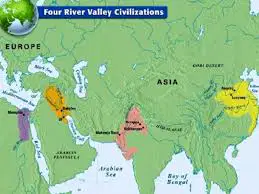
Name the River Valley Civilization shaded in purple on the map

a)

Egypt

b)

Mesopotamia/

Sumer

c)

India

d)

China

33.
Name the River Valley Civilization shaded in orange on the map
a)
Egypt
b)
Mesopotamia/
Sumer
c)
India
d)
China
34.
Name the River Valley Civilization shaded in pink on the map
a)
Egypt
b)
Mesopotamia/
Sumer
c)
India
d)
China
35.
Name the River Valley Civilization shaded in yellow on the map
a)
Egypt
b)
Mesopotamia/
Sumer
c)
India
d)
China
36.
Most early religious traditions can be categorized as -
a)
Monotheistic
b)
Polytheistic
c)
Atheistic
d)
Agnostic
37.

The ancient civilizations of Mesopotamia and Egypt were similar in that both cultures

a)

established trade routes to China

b)

used the ziggurat form for their temples

c)

developed along rivers

d)

used a hieroglyphic writing system

38.

The Neolithic Revolution occurred when people discovered how to -

a)

grow food and domesticate animals

b)

trade with others in the same river valley

c)

fight wars using metal weapons

d)

make stone temples for religious ceremonies

39.

A form of government in which citizens elect their leaders

a)

legion

b)

republic

c)

patricians

40.

What do we call the Roman age of peace, prosperity, and expansion?

a)

Golden Age

b)

Pax Romana

c)

Gupta Dynasty

d)

Tang and Song Dynasties

41.

Some Roman inventions are:

a)

Aqueducts

b)

Arches

c)

Representative government

d)

All of the above

42.
Who made himself dictator for life and was seen as a hero to the plebeians because he gave them land & food, but was power-hungry to the patricians?
a)
Julius Caesar
b)
Mark Antony
c)
Scipio
d)
Caesar Augustus
43.

Name of Roman Contribution pictured?

a)

Pantheon

b)

Parthenon

c)

Colosseum

d)

Forum

44.

Were farmers, merchants, laborers and artisans

a)

Patricians

b)

Plebeians

45.

Was the majority group of Rome

a)

Patricians

b)

Plebeians

46.

Citizens who could vote

a)

Patricians

b)

Plebeians

47.
Composed of 300 men that advised consuls and dictated political appointments.
a)
Consuls
b)
Senate
c)
Tribunes
d)
Tribal Assembly
48.
We were posted in the Forum for all to see, the recorded laws of Rome
a)
The Ten Commandments
b)
Hammurabi's Code
c)
The Twelve Taboos
d)
The Twelve Tables