
 Worksheets
Chemistry I Chapter 4 Test Review
Total questions: 50
Worksheet time: 25mins
Name
Class
Date
1.
A cathode ray tube consists of a stream of protons.
a)
True
b)
False
2.
In a neutral atom, the number of protons is always equal to the number of neutrons.
a)
True
b)
False
3.
An alpha particle is the equivalent of a Helium-4 nucleus.
a)
True
b)
False
4.
Nuclear decay can change one element into another one.
a)
True
b)
False
5.
Isotopes are forms of an element that have the same number of protons but a different number of electrons.
a)
True
b)
False
6.
An input of energy is required in order for nuclear decay to happen in an atom.
a)
True
b)
False
7.
Gamma decay is a form of nuclear radiation that consists entirely of energy, not matter.
a)
True
b)
False
8.
The stability of a nucleus is determined by the ratio of electrons to protons.
a)
True
b)
False
9.
The mass of a neutron is approximately equal to the mass of a proton.
a)
True
b)
False
10.
A proton is a subatomic particle carrying a charge equal to but opposite that of an electron.
a)
True
b)
False
11.
Which one is comprised of the other three?
a)
proton
b)
atom
c)
electron
d)
neutron
12.
Which has a charge of +1?
a)
proton
b)
atom
c)
electron
d)
neutron
13.
Which one(s) have a mass of 1 amu?
a)
electron
b)
proton
c)
proton and neutron
d)
electron and proton
14.

Which two are isotopes of one another?
a)
Atoms 1 & 2
b)
Atoms 2 & 3
c)
Atoms 1 & 3
d)
Atoms 1 & 4
15.

Which two have the same mass?
a)
Atoms 1 & 2
b)
Atoms 2 & 4
c)
Atoms 1 & 4
d)
Atoms 2 & 3
16.
Which is the smallest part of an element that retains all the properties of the element?
a)
proton
b)
neutron
c)
electron
d)
atom
17.
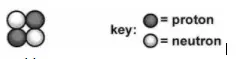
Which type of nuclear decay releases the type of particle shown?
a)
alpha
b)
beta
c)
gamma
d)
proton
18.
Which particle is massless
a)
alpha
b)
beta
c)
gamma
d)
sigma
19.
What particle curved towards the positively charged plate?
a)
alpha
b)
beta
c)
gamma
d)
photon
20.

How many neutrons are in an atom of chlorine?
a)
17
b)
18
c)
34
d)
35
21.

How many electrons are in a neutral atom of sodium?
a)
22
b)
11
c)
12
d)
23
22.
Which is the correct symbol for the atom with 42 protons and 49 neutrons?
a)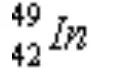
Option 4
b)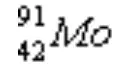
Option 2
c)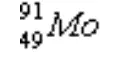
Option 3
d)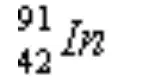
Option 4
23.
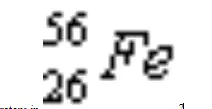
Which is the number of protons in
a)
26
b)
30
c)
56
d)
82
24.
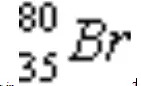
Which is the number of neutrons in
a)
35
b)
45
c)
80
d)
115
25.
Which element has 14 protons?
a)
Nitrogen
b)
Silicon
c)
Aluminum
d)
Sulfur
26.
According to the modern concept of the atom, which are located in the nucleus of an atom?
a)
electrons and protons
b)
protons only
c)
neutrons and electrons
d)
protons and neutrons
27.
An atom has 23 protons and 29 neutrons. Which is the correct chemical symbol for this atom?
a)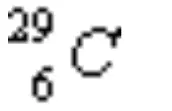
Option 1
b)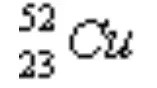
Option 2
c)
Option 3
d)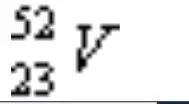
Option 4
28.
An industrially important element contains 26 electrons and rusts in the presence of air and moisture. Identify the element.
a)
Aluminum
b)
Iron
c)
Potassium
d)
Sodium
29.
In his latest dig, Dr. Butrell found an abundance of lead (Pb) in some ancient artifacts. What is the atomic number of lead?
a)
80
b)
81
c)
82
d)
83
30.
An atom ______________________________.
a)
is much larger than its nucleus
b)
is much lighter than its nucleus
c)
is much denser than its nucleus
d)
has a higher + charge than the nucleus
31.
Most of the mass of an atom is found in its _____________________.
a)
electron
b)
protons
c)
neutrons
d)
nucleus
32.
Atoms with the same number of protons but different number of neutrons are called ____________________.
a)
Isotopes
b)
STM
c)
Mass Number
d)
Atomic Number
e)
Charge
33.
Uranium is a naturally occurring element that emits particles and rays spontaneously through a process called _____________________.
a)
STM
b)
Radioactive Decay
c)
Mass Number
d)
Isotopes
e)
Atomic Number
34.
An alpha particle is _____________________ in charge.
a)
Positive
b)
STM
c)
Mass Number
d)
Isotopes
e)
Atomic Number
35.
A beta particle consists of a fast moving electron and has a(n) _____________________ charge.
a)
Negative
b)
STM
c)
Mass Number
d)
Isotopes
e)
Atomic Number
36.
In nanotechnology, individual atoms are seen using the ____________________ , an instrument that has led to the possibility of molecular manufacturing..
a)
STM
b)
Mass Number
c)
Isotopes
d)
Atomic Number
e)
Charge
37.
The number of protons in an atom is called the ____________________ of the element.
a)
Atomic Number
b)
STM
c)
Mass Number
d)
Isotopes
e)
Charge
38.
The number of protons plus the number of neutron in an atom is called the ____________________ of the element/isotope.
a)
Isotope
b)
STM
c)
Mass Number
d)
Atomic Number
e)
Charge
39.
An electric field will deflect radiation in different directions, depending on the _____________________ of the radiation.
a)
Charge
b)
STM
c)
Mass Number
d)
Isotopes
e)
Atomic Number
40.
Stated that Empty Space cannot exist
a)
Aristotle
b)
Democritius
c)
Dalton
d)
Crookes
e)
JJ Thompson
41.
Father of modern atomic theory
a)
Dalton
b)
Democritius
c)
Aristotle
d)
Crookes
e)
JJ Thompson
42.
won a Nobel prize for the discovery of the neutron
a)
Aristotle
b)
Democritius
c)
Chadwick
d)
Dalton
e)
Crookes
43.
Developed the Plum Pudding Model of the atom
a)
JJ Thompson
b)
Democritius
c)
Aristotle
d)
Dalton
e)
Crookes
44.
The 1st to propose that matter was not infinately divisible
a)
Democritius
b)
Aristotle
c)
Dalton
d)
Crookes
e)
JJ Thompson
45.
Used alpha particles to prove the existance of a positive nucleus
a)
Crookes
b)
Democritius
c)
Aristotle
d)
Dalton
e)
Rutherford
46.
Used his oil drop experiment to estimate the mass of an electron
a)
Milikan
b)
Democritius
c)
Aristotle
d)
Dalton
e)
Crookes
47.
Developed a model of the atom that relates electron arragement to reactivity
a)
Bohr
b)
Democritius
c)
Aristotle
d)
Dalton
e)
Crookes
48.
Stated that matter is made up of Earth Fire Air and Water
a)
Dalton
b)
Crookes
c)
Democritius
d)
Aristotle
e)
JJ Thompson
49.
Coined the term “atomos” which is where we get the English word Atom
a)
Dalton
b)
Aristotle
c)
Democritus
d)
Crookes
e)
JJ Thompson
50.
He used a series of magnets and cathode ray tubes to determine the charge and approximate mass of the electron
a)
JJ Thompson
b)
Democritius
c)
Aristotle
d)
Dalton
e)
Crookes
100 %

