
 Worksheets
Introduction to Philosophy - Passage Comprehension
Total questions: 61
Worksheet time: 31mins
According to the passage, what is the main difference between philosophy and mythology?
Philosophy seeks rational explanations for phenomena, while mythology explains them through stories of gods and supernatural beings.
Philosophy is based on religious rituals, while mythology is based on scientific experiments.
Philosophy only deals with mathematics, while mythology deals with history.
Philosophy is about creating legends, while mythology is about logical arguments.
What is the main focus of the current lesson, as described in the introduction?
The history of philosophy, how it has evolved, and how historical periods influenced philosophical investigations.
The main branches of science and their methodologies.
The impact of technology on modern society.
The structure and function of government systems.
The passage states that everyone can participate in the process of philosophizing.
True
False
According to the passage, why might some people find the historical part of philosophy unattractive?
Because it seems to involve memorizing dates and names.
Because it requires advanced mathematical skills.
Because it focuses only on modern technology.
Because it is entirely based on fictional stories.
Being a fan of history means you enjoy learning about past events.
Yes, I am a fan of history.
No, I dislike history.
I have never heard of history.
History is only about the future.
According to the passage, who is considered the first philosopher?
Tales de Mileto (Thales of Miletus)
Sócrates (Socrates)
Platón (Plato)
Aristóteles (Aristotle)
The passage states that all historians agree that philosophy was born from Greek influences.
True
False
What is the term used to describe the duality between Western and Eastern influences in philosophy, as mentioned in the passage?
Occidentalism versus Orientalism
Existentialism versus Essentialism
Materialism versus Idealism
Empiricism versus Rationalism
In antiquity, which civilizations were considered part of the 'East' according to the passage?
Mesopotamia and Egypt
Greece and Rome
China and Japan
Persia and Greece
According to the passage, where did the first great thinkers who systematized ideas originate?
In the West (Occident)
In the East (Orient)
In Africa
In South America
According to the passage, in which period did Greek philosophy emerge?
Classical period
Archaic period
Hellenistic period
Roman period
Fill in the blank: The Homeric Greece period (1100 to 800 B.C.) is known for the poems _______ and _______.
Iliad and Odyssey
Aeneid and Metamorphoses
Beowulf and Gilgamesh
Mahabharata and Ramayana
Which Greek city-states were formed during the Archaic period (800 to 500 B.C.)?
Athens, Sparta, Thebes, Megara, etc.
Rome, Carthage, Alexandria, Babylon
London, Paris, Berlin, Madrid
Beijing, Tokyo, Seoul, Bangkok
During the Classical Greece period (500 to 336 B.C.), which city dominated Greece and which philosophers are mentioned?
Athens dominated Greece; Plato and Aristotle are mentioned.
Sparta dominated Greece; Socrates and Pythagoras are mentioned.
Corinth dominated Greece; Heraclitus and Democritus are mentioned.
Thebes dominated Greece; Epicurus and Zeno are mentioned.
The Hellenistic period (336 to 146 B.C.) was marked by the decline of the polis.
True
False
What is the name of the period in Greek philosophy that marks the beginning of the separation between philosophy and mythical thinking, occurring in the 7th and 5th centuries B.C.?
Pre-Socratic or Cosmological Period
Hellenistic Period
Classical Period
Byzantine Period
Which of the following philosophers is NOT mentioned as a reference of the pre-Socratic period?
Tales de Mileto
Sócrates
Anaxímenes de Mileto
Pitágoras de Samos
According to the passage, what was the main focus of philosophers during the pre-Socratic period?
They questioned the origin and reason for things, such as where we come from and where we are going.
They focused on developing advanced mathematical theories.
They were primarily concerned with political systems and governance.
They concentrated on artistic expression and literature.
The Socratic or Anthropological Period (5th and 4th centuries B.C.) is characterized by Greek philosophers thinking about the place of man in the world.
True
False
Name two philosophers from the pre-Socratic period mentioned in the passage.
Tales de Mileto e Anaxímenes de Mileto
Sócrates e Platão
Aristóteles e Epicuro
Descartes e Kant
According to the passage, during which period did philosophical thought distance itself from cosmology and focus on ethics?
During the peak of Greek philosophy.
During the Renaissance period.
During the Enlightenment era.
During the early Middle Ages.
What do we know about the sophists according to the passage?
From their own writings
From the criticisms made by philosophers
From historical records
From oral traditions
The sophists were known for their skills in oratory and provoking debates, making them effective communicators and persuaders.
True
False
Why did philosophers criticize the sophists, according to the passage?
Because they believed sophists only stimulated debates of opinions, did not elevate knowledge, sought to convince regardless of the truth, and charged for discussions that philosophers thought should be spontaneous and accessible to all.
Because sophists were known for their scientific discoveries and philosophers disagreed with their methods.
Because sophists refused to participate in public debates and isolated themselves from society.
Because sophists promoted only religious teachings and ignored philosophical reasoning.
According to the comparison in Figure 1, what are philosophers in search of?
Several points of view
Truths
The measure of all things
Wealth
According to the comparison in Figure 1, what do sophists believe?
A) Things can only be true or false
B) The man is the measure of all things
C) In search of truths
D) There is only one point of view
Who were the main philosophers of the period mentioned in the passage?
Socrates and Plato
Aristotle and Confucius
Descartes and Kant
Nietzsche and Heidegger
According to the passage, how do we know about Socrates' ideas?
Through Plato, his student and disciple, since Socrates did not leave any written record of his ideas.
Through the books written by Socrates himself, which have survived to this day.
Through the official records maintained by the Athenian government.
Through the stories passed down orally by his family members.
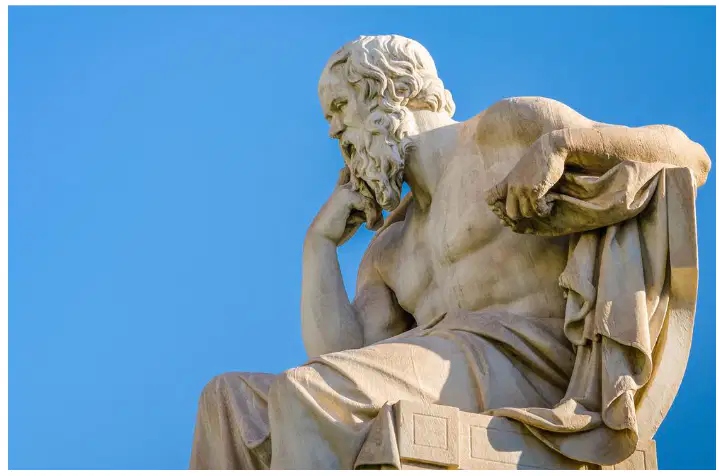
Who is depicted in Figure 2?
Socrates
Plato
Aristotle
Pythagoras
What is the 'Período sistemático' (Systematic Period) in philosophy? Fill in the blank: The 'Período sistemático' (IV to III century B.C.) is the period that ______ and systematizes what has already been thought.
reunites
forgets
destroys
ignores
According to the passage, which philosopher is considered the reference of the Systematic Period and was a disciple and critic of Plato?
Aristotle
Socrates
Pythagoras
Epicurus
The theory of knowledge, logic, and psychology originated from the Systematic Period in philosophy.
True
False
Which fields of contemporary philosophical investigation did Aristotle pioneer, according to the passage?
Logic, philosophy of language, linguistics, ethics, metaphysics
Biology, chemistry, astronomy, geology, medicine
Political science, sociology, psychology, anthropology, economics
Art, music, architecture, engineering, mathematics
According to the text, what does it mean to say that Aristotle was both a student and a critic of Plato?
A) Aristotle agreed with all of Plato's ideas.
B) Aristotle learned from Plato but did not agree with all his ideas.
C) Aristotle never learned from Plato.
D) Aristotle rejected philosophy entirely.
What does the text suggest is the essence of philosophy, as represented by Aristotle's attitude?
The essence of philosophy is represented by questioning and advancing ideas, not just accepting them.
The essence of philosophy is to memorize and repeat established doctrines.
The essence of philosophy is to avoid challenging traditional beliefs.
The essence of philosophy is to focus solely on practical matters and ignore abstract thinking.
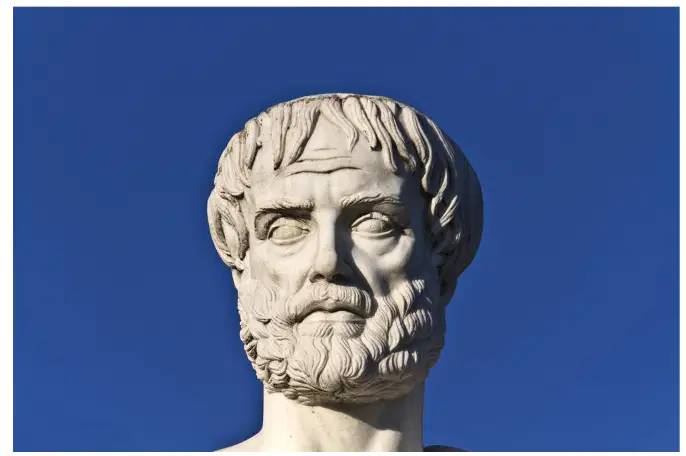
Who is depicted in the image?
Aristotle
Plato
Socrates
Alexander the Great
What is the Hellenistic Period (III to VI B.C.) characterized by, according to the text?
The rise of Greek city-states
The Roman world domination and the emergence of Christianity
The fall of the Roman Empire
The invention of democracy
During the Hellenistic period, philosophy focused on concepts such as ethics, human knowledge, and the relationships between man, nature, and ________.
God
Art
Wealth
Technology
According to the passage, which philosophical schools emerged as civilizations began to think and expand?
A) Stoicism, Epicureanism, and Skepticism
B) Platonism, Aristotelianism, and Sophism
C) Existentialism, Pragmatism, and Rationalism
D) Empiricism, Rationalism, and Idealism
Fill in the blank: Some reference philosophers from the Hellenistic period mentioned in the passage are ________, Arcesilau, Epicurus, Zeno of Citium, Cleanthes, Panaetius of Rhodes, and Seneca.
Pyrrho of Elis
Socrates
Plato
Aristotle
The study of the history of Greek philosophy corresponds to which stage of human development?
Childhood
Adulthood
Old age
Adolescence
Fill in the blank: The period from VI a.C. to VI d.C. in the history of philosophy is known as __________.
Classical or Ancient Philosophy
Modern Philosophy
Medieval Philosophy
Contemporary Philosophy
Fill in the blank: The period from I to VII in the history of philosophy is called __________.
Patristic Philosophy
Scholastic Philosophy
Modern Philosophy
Contemporary Philosophy
Fill in the blank: The period from VIII to XIV in the history of philosophy is called __________.
Medieval Philosophy
Modern Philosophy
Ancient Philosophy
Renaissance Philosophy
Fill in the blank: The period from XIV to XVI in the history of philosophy is called __________.
Renaissance Philosophy
Medieval Philosophy
Enlightenment Philosophy
Modern Philosophy
Fill in the blank: The period from XVII to XVIII in the history of philosophy is called __________.
Modern Philosophy
Ancient Philosophy
Medieval Philosophy
Contemporary Philosophy
Fill in the blank: The period from XVIII to the beginning of XIX in the history of philosophy is called __________.
Enlightenment Philosophy
Romanticism
Medieval Scholasticism
Existentialism
Fill in the blank: The period from the mid-XIX century to the present day in the history of philosophy is called __________.
Contemporary Philosophy
Medieval Philosophy
Ancient Philosophy
Renaissance Philosophy
Which periods of philosophy are grouped as 'Medieval'?
Patristic and Medieval
Renaissance and Modern
Enlightenment and Contemporary
Classical and Modern
Which periods of philosophy are grouped as 'Modern'?
Patristic and Medieval
Renaissance, Modern, and Enlightenment
Classical and Contemporary
Medieval and Enlightenment
Which period of philosophy is characterized by the valorization of theology, ontological and logical argumentation for the defense of the existence of one omnipotent God, and the development of theology as an independent discipline?
Filosofia Patrística
Filosofia Medieval ou Escolástica
Filosofia Renascentista
Filosofia Moderna
Which theme was mainly studied during the Medieval or Scholastic Philosophy period?
Fé (Faith)
Deus (God)
Humano (Human)
Razão (Reason)
The Renaissance Philosophy period is characterized by the predominance of ________, where man is valued, placed at the center of the universe, and defended in freedom and creative power.
Humanism
Scholasticism
Existentialism
Stoicism
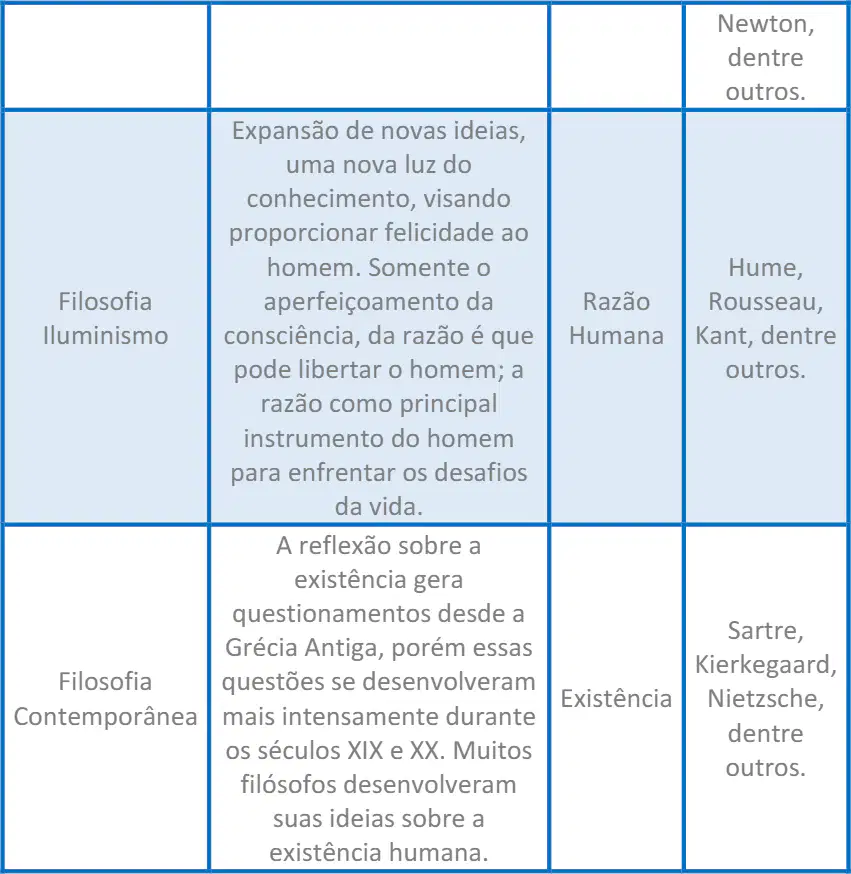
Fill in the blank: The main concept associated with Enlightenment Philosophy is _________.
Human Reason
Divine Revelation
Feudal Loyalty
Absolute Monarchy
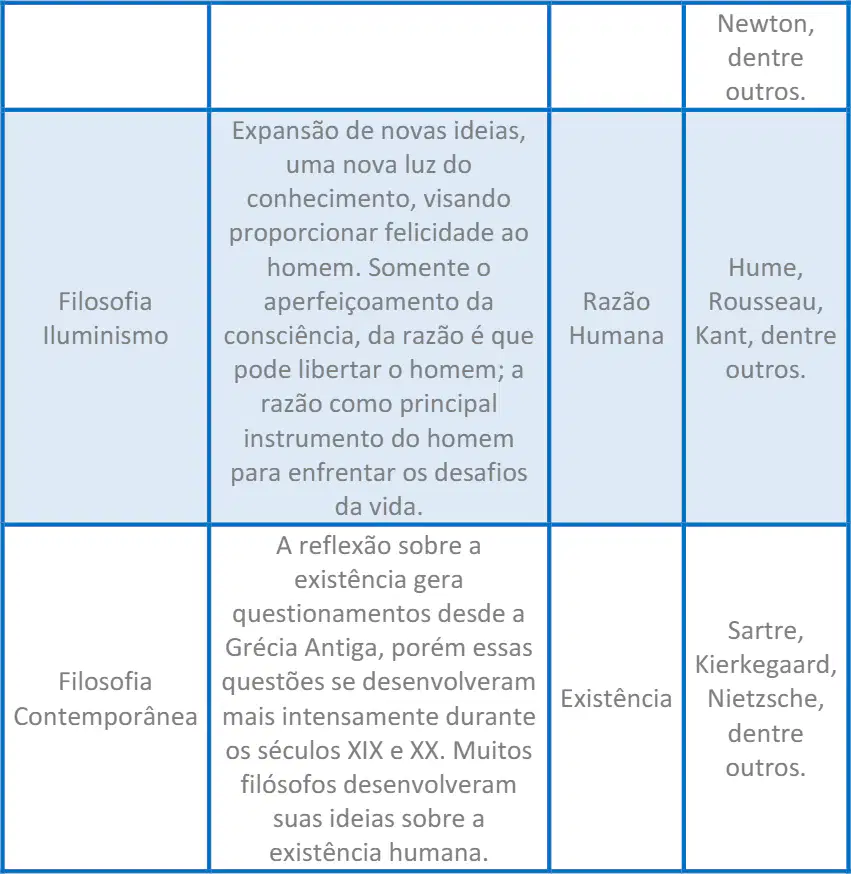
Fill in the blank: The main concept associated with Contemporary Philosophy is _________.
Existence
Dualism
Stoicism
Idealism
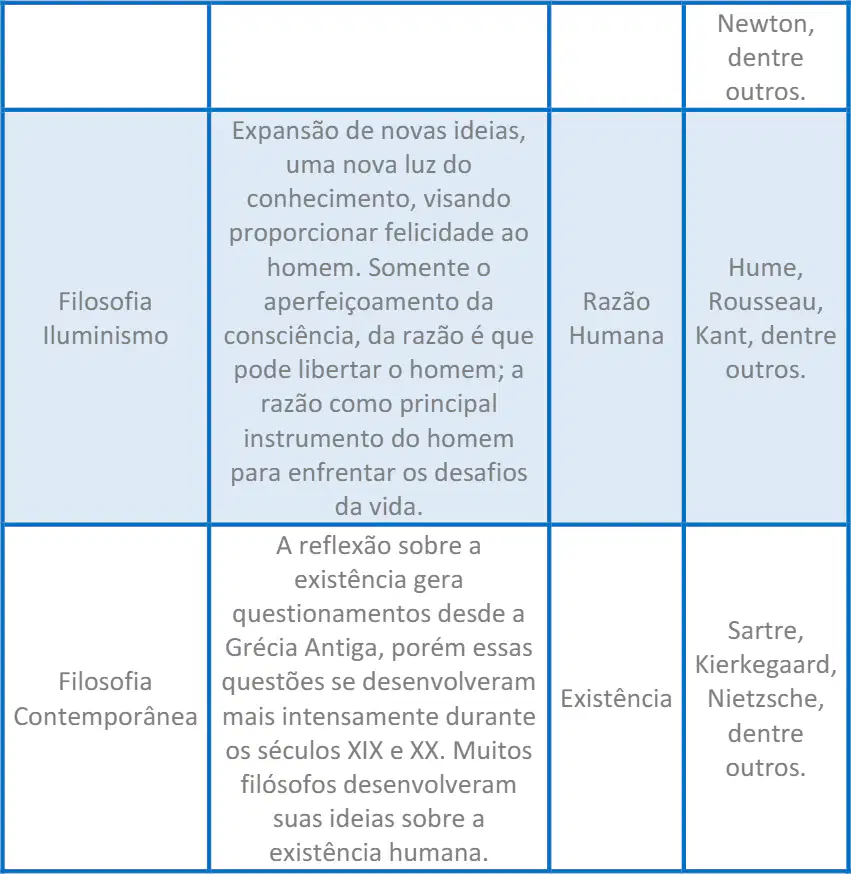
Fill in the blank: One of the main philosophers associated with Enlightenment Philosophy is _________.
Hume, Rousseau, Kant (any of these is correct)
Plato
Confucius
Socrates
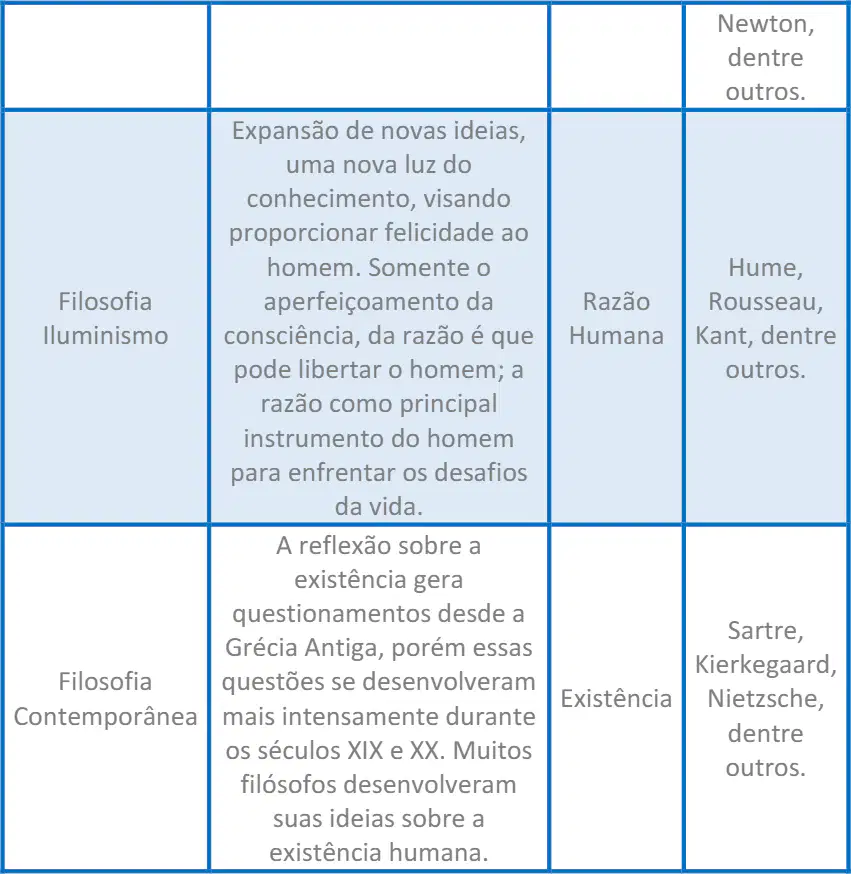
Fill in the blank: One of the main philosophers associated with Contemporary Philosophy is _________.
Sartre, Kierkegaard, Nietzsche (any of these is correct)
Plato
Aristotle
Confucius
A frase atribuída a Sócrates, 'Só sei que nada sei', mostra que:
Reconhecer a própria ignorância é um passo importante para o conhecimento.
Sócrates acreditava que sabia tudo.
A frase incentiva a ignorância completa.
Sócrates não valorizava o conhecimento.
According to the text, why is it important for psychology to follow the discussions and reflections made by philosophy?
Because it represents what people and societies are thinking, feeling, and consequently, suffering and worrying about.
Because philosophy provides all the scientific methods used in psychology.
Because psychology is only concerned with philosophical theories.
Because philosophy ignores the experiences of individuals.
Studying the history of philosophy is only about memorizing dates and names of thinkers.
True
False
What is the main idea discussed in the conclusion about studying the history of a phenomenon or philosophy?
That studying the history of a phenomenon or philosophy may seem pointless to some, but it helps understand the evolution of thought and the dedication of many people to these ideas.
That studying the history of a phenomenon or philosophy is only useful for historians and not for the general public.
That the history of a phenomenon or philosophy is always straightforward and easy to understand.
That studying the history of a phenomenon or philosophy is unnecessary because current knowledge is sufficient.

