
 Worksheets
REQ - 2K19 HANU
Total questions: 65
Worksheet time: 33mins
Who has the decisive role in reviewing software requirements?
Developer
Tester
User
Business Analyst
The defines the number of instances of entity B that can (or must) be associated with each instance of entity A.
Association
Relationship
Identifier
Cardinality
It is the non-functional requirements that “deliver” the functionality
True
False
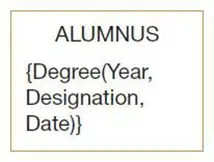
In the picture, 'Degree' is a
Object-typed, candidate key
Required, multi-valued attribute
Derived, composite attribute
Multi-valued, composite attribute
In an interview, open-ended questions have a pre-specified answer.
True
False
Which of the following is NOT a common source used to find out about the current issues in a system?
Management
The new system analyst
Information systems staff
Users of other systems
Similar attributes of different entity types should use names.
A. similar but distinguishing
B. dissimilar
C. similar and closely related
D. similar and consistent
What is at the core of business analysis?
A. Collection of information
B. The business analyst
C. Procedures
D. The project
Which of the following is NOT a characteristic of a good system analyst?
A. Impertinence
B. Attention to detail
C. Relax constraints
D. Great at finances
The rule specifies that an entity instance can simultaneously be a member of two (or more) subtypes.
A. Overlap
B. Partial specialization
C. Disjoint
D. Total specialization
Event that initiates a use case.
A. Trigger
B. Command
C. Click
D. Time
When working as a Business Analyst, understands the business, the existing systems and speaks the user’s language.
A. the former developer
B. former project manager
C. the former user
D. the subject matter expert
A relationship is a relationship between instances of two entity types and is the most common type of relationship encountered in data modeling.
A. Primary
B. Ternary
C. Secondary
D. Binary
How do you elicit customer input on the requirements?
A. Typical users are surveyed with questionnaires or interviewed in focus groups.
B. The developers are confident that they already know what to build.
C. We meet with people, sometimes one on one and sometimes in groups, and they tell us what they want.
D. A variety of elicitation techniques are used, including interviews and workshops with user class representatives, document analysis, and system interface analysis.
A can be best understood as data in motion, moving from one place in a system to another.
A. Data source
B. Data flow
C. Process
D. Data store
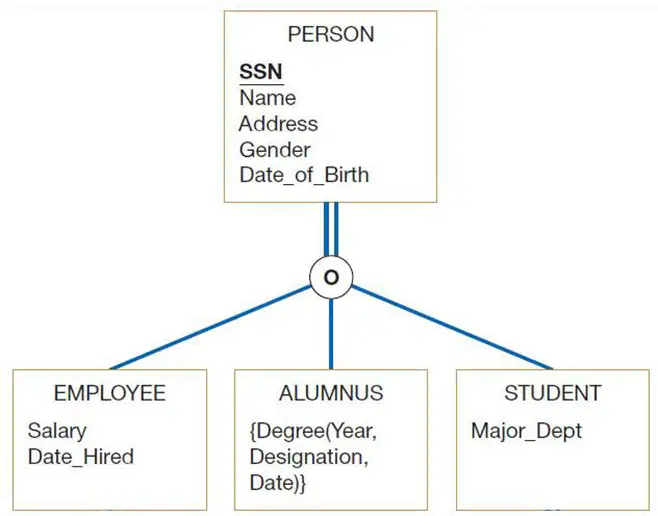
In the following E-R diagram, can there be another type of person who is not an employee, alumnus, or student?
A. Yes, because of the total specializatioN
B. Yes, because of the partial specialization
C. No, because of the partial specialization
D. No, because of the total specialization
In an interview, the interviewer knows all possible questions beforehand.
TRUE
FALSE
Which of the following is NOT a source of requirements gathering for the system analyst?
A. Procedures
B. Reports
C. Users of the current system
D. Market conditions
A(n) arises when one use case uses another use case and is shown diagrammatically as a dotted- line arrow pointed toward the use case that is being used.
A. System boundary
B. Include relationship
C. Connection
D. Extend relationship
A(n) is a named property or characteristic of an entity that is of interest to the organization.
A. Event
B. Instance
C. Attribute
D. Relationship
A ternary relationship is a simultaneous relationship among instances of entity type(s).
4
1
2
3
were developed to make systems developers' work easier and more consistent.
A. CASE tools
B. Modeling tools
C. Software designing tools
D. Data analysis tools
It is better to gather information from people, because they are always reliable.
TRUE
FALSE
Data cannot move directly from one data store to another data store. Data must be moved by a .
A. Data source
B. Process
C. Procedure
D. Flow chart
With only symbols, you can use DFDs to represent both physical and logical information systems.
5
6
4
3
A data flow has multiple directions of flow between symbols. It may flow in both directions between a process and a data store to show a read before an update.
TRUE
FALSE
are those that people expect without explicitly expressing them.
A. Invisible requirements
B. Hidden requirements
C. Assumed requirements
D. Implied requirements
Who has the primary responsibility for the design and analysis of information systems?
A. Systems analyst
B. Software engineer
C. Employees
D. Applications developer
Which of the following is a situation in which prototyping is useful for requirements determination?
B. When formal documentation of system requirements are needed
C. When stand-alone systems aren't needed
D. When tools and data are rapidly available to working systems
A(n) diagram shows the conditional logic for the sequence of system activities needed to accomplish a business process.
A. Business
B. Fork
C. Branch
D. Activity
Which tool enables you to quickly take basic requirecreate a workinments and g system with limited functionality?
A. User manual
B. CASE tools
C. Prototyping
D. JAD
A(n) is an attribute whose value can be computed from related attribute values.
A. Required attribute
B. Optional attribute
C. Derived attribute
D. Composite attribute
What is the type of the following requirement: "A new client must pay 30 percent of the estimated consulting fee and travel expenses in advance"?
A. User requirement
B. Business objective
C. Business rule
D. Functional requirement
A(n) is an association between the instances of one or more entity types that is of interest to the organization.
A. Attribute
B. Identifier
C. Relationship
D. Repeating group
Which of the following is the main benefit of system interface analysis?
A. It helps discover user and functional requirements.
B. It helps the business analyst understand business processes.
C. It helps identify priorities of system features.
D. It helps reveal functional requirements regarding the exchange of data between systems.
and are the two types of prototypes.
A. Evolutionary; throwaway
B. Long term; short-term
C. New process; old process
D.Throwaway; permanent
Things that must be true before a use case can start.
A. Preconditions
B. Minimal guarantee
C. Trigger
D. Success guarantee
The fundamental processes within requirements engineering do not include:
A. Specification
B. Optimization
C. Validation
D. Elicitation
In the picture, the relationship is
A. Ternary, partial specialization, disjoint
B. Unary, partial specialization, discrete
C. Unary, total specialization, discrete
D. Ternary, total specialization, disjoint
In the use case diagram, what is an external entity that interacts with a system?
A. Actor
B. Trigger
C. Data Store
D. Source
The shows the static structure of an object-oriented model: the object classes, their internal structure, and the relationships in which they participate
A. Object class
B. Data model
C. Class diagram
D. Object diagram
The rule specifies that if an entity instance of the super type is a member of one subtype, it cannot simultaneously be a member of any other subtype.
A. Business
B. Disjoint
C. Partial specialization
D. Overlap
A key is an attribute (or combination of attributes) that uniquely identifies each instance of an entity type.
A. Candidate
B. Unique
C. Primary
D. Primitive
An association between two use cases where one adds new behaviors or actions to the other.
A. Inclusion
B. Extend relationship
C. Include relationship
D. Extension
A(n) is an attribute that may take on more than one value for each entity instance.
A. Identifier
B. Candidate key
C. Multi-valued attribute
D. Single-valued attribute
Which of the below is a true statement regarding the systems development life cycle?
A. It is not possible to complete some activities in one phase in parallel with those of another phase.
B. The life cycle can be thought of as a linear process in which the end of the useful life of one system leads to the beginning of another project to develop a new version of or replace an existing system.
C. The life cycle can be thought of as a circular process in which the end of the useful life of one system leads to the beginning of another project to develop a new version of or replace an existing system.
D. The SDLC is not iterative.
A is a DFD that represents a system's major processes, data flows, and data stores at a high level of detail.
3
2
1
0
In system analysis, which of the following is NOT a component you need to understand?
A. The rules governing data
B. The size of the budget
C. Business objectives
D. The information people need to do their job
8. In conceptual modeling, a(n) is a person, place, object, event, or concept in the user environment about which the organization wishes to maintain data.
A. Entity
B. Attribute
C. Object
D. Dimension
People who have a vested interest in the system being developed.
A. Customer
B. Investor
C. Actor
D. Stakeholder
The rule specifies that an entity instance of the super type does not have to belong to any subtype.
A. Overlap
B. Disjoint
C. Partial specialization
D. Total specialization
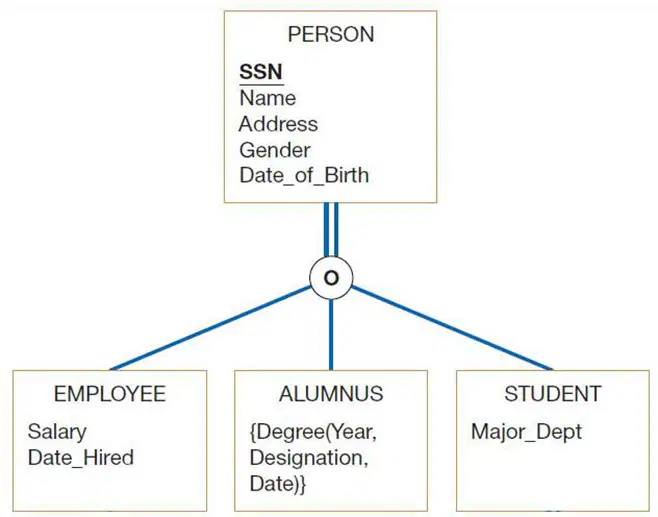
In the picture, the relationship is:
A. Strong specialization, override
B. Weak specialization, override
C. Partial specialization, overlap
D. Total specialization, overlap
An activity diagram cannot be used to .
A. Model the sequential and concurrent steps in a computation process
B. Model workflow but not business processes
C. Help in identifying extensions in a use case
D. Depict the flow of control from activity to activity
Which of the following is a drawback of the traditional waterfall SDLC approach?
A. It is too short of a process.
B. There are no criticisms.
C. The process is too chaotic.
D. Users are locked into requirements
A unary relationship is a relationship between the instances of entity type(s).
1
5
3
2
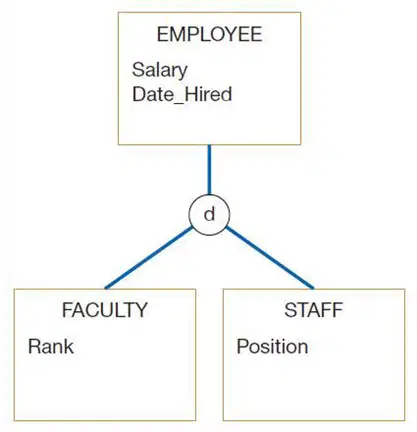
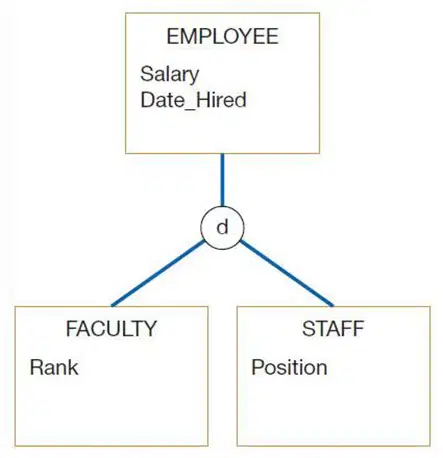
14. In the following E-R diagram, can an employee be something other than faculty or staff?
Yes, because of partial specialization
B. Yes, because of total specialization
C. No, because of total specialization
D. No, because of disjoint rule
Evolutionary prototyping is used to model parts of the system, and if the system is not what the customers expected, you throw away the system.
true
false
A is the work or actions performed on data so that they are transformed, stored, or distributed.
A. Flowchart
B. Data flow
C. Data store
D. Process
Which of the following CASE tools is useful in the analysis phase of the SDLC?
A. Documentation generators
B. Report generators
C. Diagramming
D. Form generators
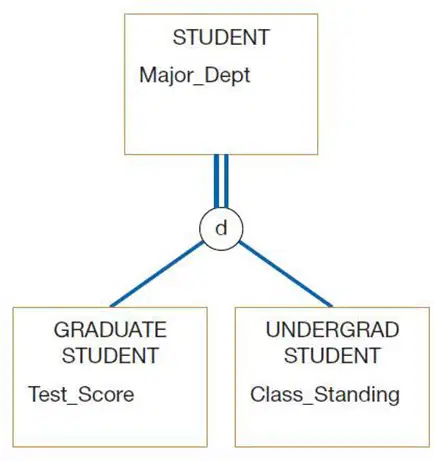
. In the picture, the relationship is:
A. Total specialization, disjoint
B. Strong specialization, disjoint
C. Partial specialization, disjoint
D. Weak specialization, discrete
The rule specifies that each entity instance of the super-type must be a member of some subtype of the relationship.
A. Association
B. Partial specialization
C. Total specialization
D. Overlap
are NOT a component of data flow diagram symbols.
A. Processes
B. Data programs
C. Data flows
D. Data stores
In throwaway prototyping there is never an intention to create a working system.
true
false
A is the origin and/or destination of the data, and these are sometimes referred to as external entities because they are outside the system.
A. Data flow
B. Data graph
C. Process
D. Source
A lists what it takes to satisfy stakeholders if the use case is completed successfully.
A. Minimal guarantee
B. Trigger
C. Precondition
D. Success guarantee

