
Font size
 Worksheets
U1 C3 Test Review
Total questions: 40
Worksheet time: 21mins
Which key characteristic of civilization does the decision to become scribes, warriors, and merchants rather than farmers best demonstrate?
The development of a culture
The development of infrastructure
The development of specialization
The development of a belief system
Which key characteristic of civilization most likely allowed members to decide to become scribes, warriors, and merchants rather than farmers?
The development of technology
The development of government
The development of a social structure
The development of a stable food supply
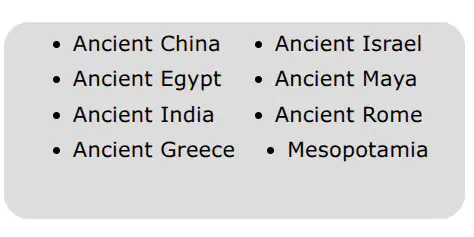
How was the physical geography of these ancient civilizations similar? (Choose 3)
They all developed near a water source.
They all developed in jungles.
They all developed in a warm climate.
They all developed in deserts.
They all developed in an area with some fertile soil.
Why did ancient civilizations develop in river valleys? (Choose 4)
Rivers provided a means of transportation.
Rivers provided water for drinking and irrigation.
The mountains around the valleys were too dry.
The valleys provided access to natural resources.
Frequent flooding replenished the soil with nutrients.
How did early civilizations develop a stable food supply?
through hunting
through gathering
through agriculture
through a nomadic lifestyle
Which items are considered to be primary sources? (Choose 3)
artifact
biography
dictionary
a letter
photograph
Which item is an example of a secondary source?
a diary
a textbook
a photograph
a journal entry
The river valley civilizations developed in the fourth millennium BCE. Which event allowed these civilizations to develop first?
the Agricultural Revolution
the failure of Ancient Rome
the creation of the first belief system
the creation of the first writing system
The characteristics of the old civilization that were handed down are its __________.
legacies
rituals
monuments
leaders

The wheels are an example of a __________ that the old civilization handed down.
government
infrastructure
social structure
technology

The single leader is an example of a __________ that the old civilization handed down.
government
infrastructure
social structure
technology

The grain storage buildings are an example of a __________ that the old civilization handed down.
government
infrastructure
social structure
technology
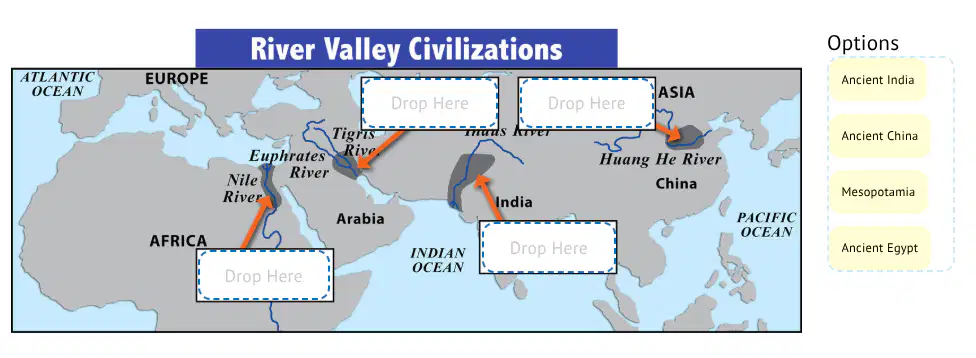
Which River Valley Civilization is located near the Nile River?
Ancient China
Ancient Egypt
Ancient India
Mesopotamia
Which River Valley Civilization developed between the Tigris and Euphrates Rivers?
Ancient China
Ancient Egypt
Ancient India
Mesopotamia
Which River Valley Civilization developed a long the Indus River?
Ancient China
Ancient Egypt
Ancient India
Mesopotamia
Which River Valley Civilization developed along the Huang He or Yellow River?
Ancient China
Ancient Egypt
Ancient India
Mesopotamia
People develop buildings and roads in cities
Culture
Infrastructure
Technology
Writing
People share values, goals and practices
Culture
Infrastructure
Technology
Writing
People develop tools and processes such as farming methods and metallurgy
Culture
Infrastructure
Technology
Writing
People keep track of knowledge by creating records
Culture
Infrastructure
Technology
Writing
Civilizations develop _________ that influence how people who have different jobs or other characteristics interact with each other.
Social Structures
Governments
Belief Systems
Civilizations develop ______ that help them explain the world around them.
Social Structures
Governments
Belief Systems
Civilizations develop ______ to address issues in societies and protect people's rights.
Social Structures
Governments
Belief Systems
Farmers in Southwest Asia lived near rivers to be near a water source.
This describes how geography influenced WHERE people live.
This describes how geography influenced HOW people live.
Farmers in Southwest Asia developed the world's first irrigation systems to bring water to their fields.
This describes how geography influenced WHERE people live.
This describes how geography influenced HOW people live.
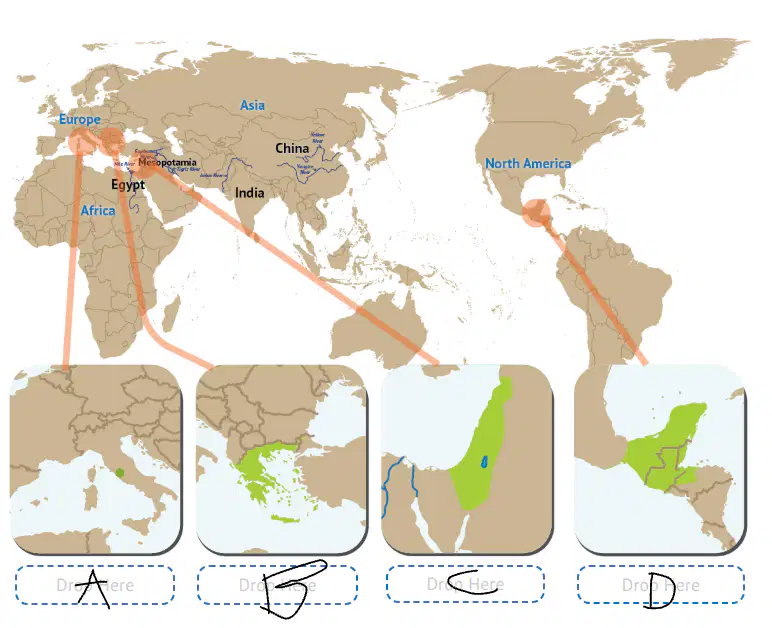
Which ancient civilization is location "A" on the map?
Israel
Greece
Maya Region
Rome
Which ancient civilization is location "B" on the map?
Israel
Greece
Maya Region
Rome
Which ancient civilization is location "C" on the map?
Israel
Greece
Maya Region
Rome
Which ancient civilization is location "D" on the map?
Israel
Greece
Maya Region
Rome
Select the characteristics that describe Ancient Greece.
The Tiber River was in its territory.
It was located on the Yuchatan Peninsula.
It was located near the Mediterranean Sea.
It was in a very mountainous area, which made farming difficult.
It was located near the Carribean Sea and the Pacific Ocean.
Select the characteristics that describe Ancient Isreal.
The Tiber River was in its territory.
It was located on the Yuchatan Peninsula.
It was located near the Mediterranean Sea.
The Jordan River was on the edge of its territory.
It was located near the Carribean Sea and the Pacific Ocean.
Select the characteristics that describe Ancient Maya.
The Tiber River was in its territory.
It was located on the Yuchatan Peninsula.
It was located near the Mediterranean Sea.
The Jordan River was on the edge of its territory.
It was located near the Carribean Sea and the Pacific Ocean.
Select the characteristics that describe Ancient Rome.
The Tiber River was in its territory.
It was located on the Yuchatan Peninsula.
It was located near the Mediterranean Sea.
The Jordan River was on the edge of its territory.
It was located near the Carribean Sea and the Pacific Ocean.
Which three ancient civilization were located near the Mediterranean Sea?
ancient Greece
ancient Rome
ancient Maya
ancient Israel
ancient China
A geographer creates a new map of ancient civilizations is an example of what type of source?
primary source
secondary source
tertiary source
An archaeologist finds an artifact from an ancient civilization.
primary source
secondary source
tertiary source
An anthropologist writes a new textbook about an ancient human society.
primary source
secondary source
tertiary source
A historian reads a written record of an ancient battle that was created by someone who was at the battle.
primary source
secondary source
tertiary source
A political scientist checks a database for a list of sources about the government of an ancient civilization.
primary source
secondary source
tertiary source
A student reviews an index to find out where he can find more information about the ancient civilizations his class was studying.
primary source
secondary source
tertiary source

