
 Worksheets
World History (A) Pre-Test
Total questions: 44
Worksheet time: 22mins
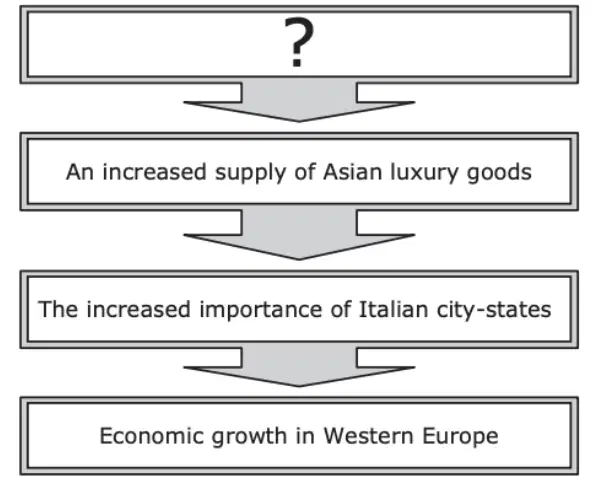
Which development triggered the sequence illustrated in the diagram?
The establishment of trade routes during the Crusades
A decrease in population due to the Black Death
The introduction of new foods from the Americas
A religious dispute sparked by the Protestant Reformation
How did the Black Death significantly affect European society in the Middle Ages?
It spurred medical advancements that extended life expectancy
It caused widespread economic and social disruption by drastically decreasing the workforce
It led to reduced prejudice against minority populations
It allowed the church to strengthen its authority
Which of the following contributed to the decline of the Roman Empire?
the widespread acceptance of monotheism
increasing conflicts due to a burgeoning middle class
political turmoil and internal discord
the development of a large bureaucratic system
In what way did the Berlin Conference shape the approach of European powers toward colonizing Africa?
By establishing partnerships with African leaders to enhance trade
By safeguarding the rights of Africans under colonial rule
By promoting the division of Africa into colonial spheres of influence
By creating regulations for joint-stock trading enterprises
Which statement most accurately characterizes the structure of feudal society in medieval Europe?
Universities granted degrees to students who completed their studies
Lords granted land to vassals (knights) in return for their military service
Craft guilds oversaw the standards of work produced by artisans
Minstrels performed in exchange for food and lodging
Which issue was a shared grievance for both the French and American revolutionaries?
Lack of rights for women
Mass hunger due to food shortages
Regular executions of citizens
Unfair taxation policies
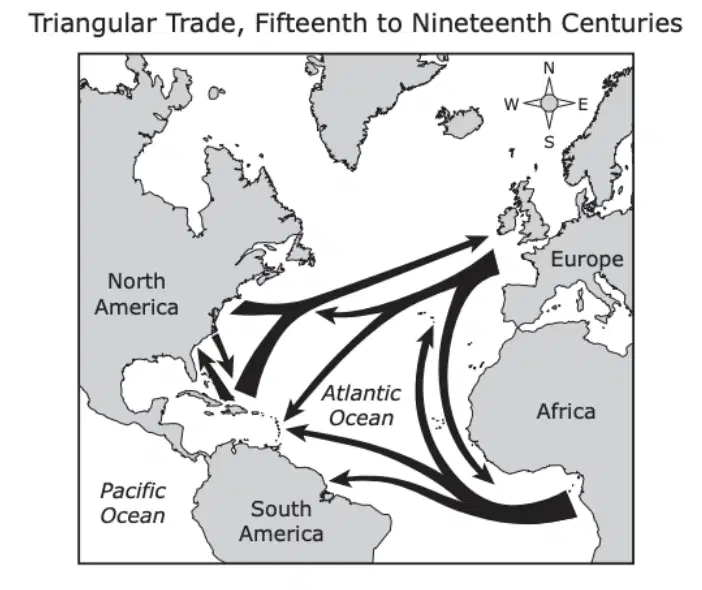
The map shows a trade route that helped expand the slave trade and also --
decreased the supply of natural resources in South America
weakened western Europe's authority over its colonies
encouraged industrial growth in West Africa
increased agricultural output in North America

Which of the following best completes the sequence shown in the diagram?
The establishment of the Safavid Empire in Persia
The Mongol Empire's advance into Russia
The founding of the Mughal Empire in India
The Ottoman Empire's movement into eastern Europe

Based on the passage, what was the main reason for the sharp reduction in the Native American population after 1492?
They were taken to Europe to work against their will
They experienced severe shortages of food
They exhausted the resources available to them
They were vulnerable to diseases introduced by Europeans
In what way did the Roman Catholic Church contribute to cultural cohesion in Western Europe during the early Middle Ages?
Challenging the legitimacy of Carolingian leaders
Introducing Christianity to Germanic tribes through missionary activities
Managing trade routes operated by Italian merchants
Sending armies to recapture cities from Byzantine rule
What was one major consequence of Martin Luther posting his 95 Theses on the church door in 1517?
a decrease in the expansion of overseas empires
the beginning of the Crusades in the Holy Land
a decline in the authority of the Roman Catholic Church
the emergence of absolute monarchs
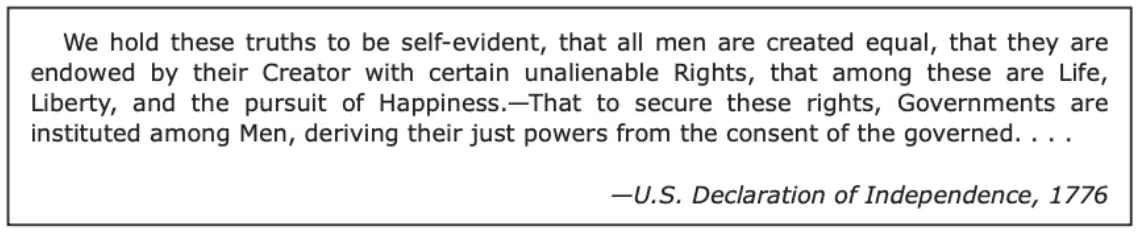
Which philosopher had the greatest impact on the ideas about government and rights described in the excerpt above?
Justinian Code
Writings of John Locke
Philosophy of Machiavelli
Theories of Jean-Jacques Rousseau
Which of the following was the most important result of the invention of the telescope?
It allowed cartographers to create more accurate maps
It led to the invention of eyeglasses
It played a role in understanding the human circulatory system
It offered proof in favor of the heliocentric theory of the solar system
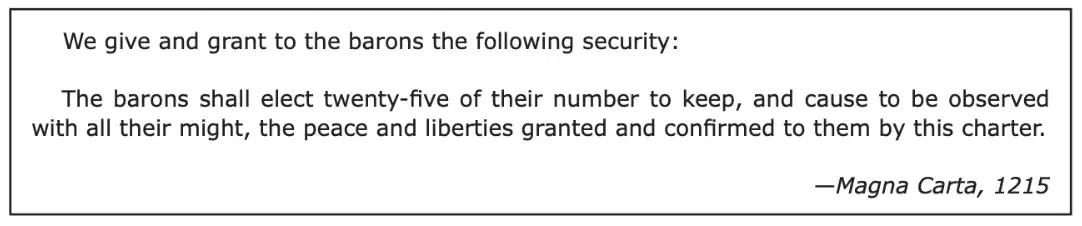
Which principle of government is demonstrated in the excerpt below?
Federalism
Separation of Church and State
Popular Sovereignty
Representative Government
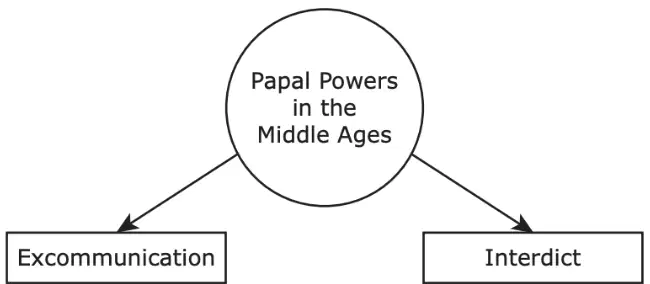
How did the powers illustrated in the diagram contribute to strengthening the authority of the Roman Catholic Church in western Europe?
These powers were exercised to punish monarchs and nobles who defied church laws and commands
These powers were used to force local populations to pay taxes for church support
These powers allowed nobles to appoint church leaders like bishops and abbots
These powers permitted church regions to collect funds for constructing cathedrals and schools
Which major development contributed to the start of the Commercial Revolution in Europe in the 1500s?
The implementation of mercantilist strategies to regulate trade with foreign colonies
The state seizure of agricultural land from aristocrats
The creation of financial institutions managed by the church
The transition from feudalism to industrial manufacturing
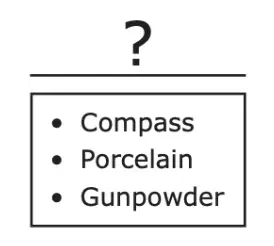
Which ancient culture is known for the invention of the following?
- Compass
- Porcelain
- Gunpowder
Muslims
Chinese
Greeks
Americans

Which excerpt from the Magna Carta most clearly expresses the idea of being tried by a group of one’s equals, known today as a jury trial?
No one will refuse or delay right or justice
No freeman shall be taken or imprisoned
Without credible witness
Lawful judgment of his peers
Why is Justinian's Code considered important in history?
It was a set of enhanced literary works
It created a different writing system
It founded a new school of thought
It organized laws into a comprehensive system
What was a main reason Japan wanted to restrict contact with foreigners?
Concern about Catholic missionaries attracting converts
Fear of diseases brought from Europe and Africa
Conviction that Japanese customs were superior
Desire to keep silk production methods secret
What was the reason behind Russia calling itself the "Third Rome"?
Its territory equaled that of the ancient Roman Empire before it split
It was governed by a senate and emperor, similar to Rome
It saw itself as the successor to the Roman and Byzantine Empires
It was the third empire to rule over the Italian Peninsula
How did the Crusades help pave the way for the expansion of global trade in later centuries?
They heightened religious divisions, resulting in increased warfare
They introduced Europeans to products from Asia, fueling a desire for international trade
They strengthened the power of nobles over kings
They promoted forced labor practices, influencing future colonialism
Technological advances such as the astrolabe and magnetic compass played a key role in the expansion of...
Renaissance thinking
Sea exploration
Colonial governments
Gunpowder weaponry
Westernization refers to which of the following processes?
the global spread of European cultural and social practices
the expansion of colonial control into new territories
the introduction of Asian goods and technologies to Europe
the replacement of monarchies with democratic governments
What was the significance of shoguns in the history of Japan?
They held large estates as feudal landowners
They led naval expeditions to foreign territories
They acted as dominant military rulers over a unified Japan
They played key roles in Japan's business community
Humanist philosophy placed a strong focus on the significance of...
Religious ceremonies
The individual
Monarchical power
Overseas conquest
Which historical movement was sparked by Martin Luther's teachings?
The Renaissance
The Reformation
The Counter-Reformation
The Commercial Revolution
Which of the following best explains the relationship between lords and serfs in the Manorial System?
Lords provided protection and a place to live for the serfs
Lords did not offer any protection to free peasants
Serfs typically purchased most of their necessities from outside the manor
Only male peasants were required to serve the lord
What was one major problem the Roman Catholic Church struggled with during the Middle Ages?
Despite the Church's encouragement, many priests remained unmarried and childless
Many bishops focused more on their spiritual duties than on their feudal obligations
The practice of selling indulgences was common among many bishops
There was widespread refusal among people to pay tithes to the Church
How did patrons help promote the growth of the arts during the Renaissance period?
by creating artworks themselves
by establishing legal organizations
by funding humanist schools
by providing financial backing to artists and writers
Which of the following was NOT an effect of the Black Death?
Trade declined
The Church lost some of its influence
The population grew rapidly
More serfs left their manors
What was a significant consequence of Johann Gutenberg's development of the printing press?
It enabled rulers to distribute laws to their people
It increased the price of the bible and sparked renewed religious enthusiasm
It allowed religious authors to reinterpret older texts
It lowered book prices and helped knowledge spread more widely
How did the approach of humanists toward traditional beliefs differ from that of medieval scholars?
Humanists questioned established traditions to form independent perspectives
Humanists relied exclusively on religious texts for answers
Humanists looked to political leaders for spiritual guidance
Humanists combined outside philosophies to address issues
What is the primary emphasis of the humanist movement?
A philosophy that follows Christian teachings without deviation
An economic theory focused on advancing technology and markets
A movement that highlights human capabilities and values classical literature
A political belief system based on democratic values
How did the rise of a middle class in Italian city-states help foster the Renaissance?
By supporting military campaigns
By using their wealth to influence politics
By providing financial support to artists and writers
By accumulating wealth to establish colonies abroad
Which abundant natural resource in Britain played a significant role in the beginning of the Industrial Revolution?
Coal
Silver
Steam
Rubber
Which industry were the first British factories mainly associated with during the 18th century?
Carriage assembly
Textile production (spinning and weaving)
Tin and copper mining
Book printing and publishing
Which of the following is the most significant achievement of the Napoleonic Code introduced in 1804?
Establishing legal equality among citizens
Reinstating noble privileges
Granting absolute authority to the emperor
Creating a representative government
The French Revolution sparked the growth of which movement across Europe?
royalism
capitalism
nationalism
imperialism
How did Napoleon Bonaparte's actions contribute to the rise of independence movements in South America?
He provided ships and weapons to the revolutionaries
He set an example of democratic rule by resisting the French monarchy
He instructed future leaders in guerrilla warfare techniques
He weakened Spanish control over its colonies by invading Spain
What was one reason Great Britain was the first nation to undergo industrialization?
A government that safeguarded property ownership
A society with a high population density
An empire that ensured access to coal resources
A strong adherence to free market ideals
What were the main reasons French factories relied more on waterpower than steam power during the industrial revolution?
France thought steam engines would harm the environment too much
France lacked plentiful coal supplies
France valued its rivers as a key natural resource
France did not have the capability to produce steam engines
Which European nation became a leader in heavy industry, chemicals, electrical equipment, and weapons production by the late 1800s?
France
Germany
Great Britain
Russia
In what way did industrialization most profoundly change the structure of social classes in Western countries?
A new capitalist upper class arose and shaped cultural developments
The majority of people entered the middle class for the first time
Industrialization led to the creation of a separate working class as a new lower tier
Relations between employers and employees became more equal in the workplace

