
 Worksheets
HEALTH AND SAFETY MOCK A
Total questions: 50
Worksheet time: 25mins
A plumber is asked by their employer to manually move a new cast iron bath which is considered as being too heavy to lift, what action should be taken?
Report the matter to the health and safety inspector.
Advise the employer that the bath is too heavy to lift.
Organise a local scrap dealer to remove the bath.
Arrange for the bath to be lifted by mechanical means.
Under the Electricity at Work Regulations (Regulation 14) work on or near live circuits is only allowed when
plumber’s are equipped with electrical testing equipment
suitable precautions have been taken to prevent injury
the work of the plumber is supervised by an electrician
the Electrical Safety Council has been informed.
Under the Work at Height Regulations 2005 an employer has a duty to
prevent employees under 21 yrs from working at height
provide a safety harness if working from a ladder
prevent employees from working at heights over 9 metres
consider other options to avoid working at height where possible.
On a mobile tower scaffold, the distance from the guardrail to the working platform must be between
0.3 and 0.35 m.
0.47 and 0.95 m.
0.75 and 1.0 m.
1.25 and 1.50 m.
A plumber has a serious cut to their finger, the injury should be recorded in the accident book by the
plumber or a person acting on their behalf
Health and Safety Inspector
medical representative from the hospital
site manager or supervisor.
A casualty should be placed in the recovery position if
they are suffering from shock
they are unconscious
there has been loss of blood
there are suspected broken bones.
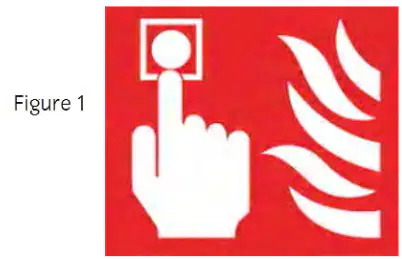
What specific message is being presented by the safety sign in figure 1?
Fire alarm call point.
Flammable liquid.
Water extinguisher.
Explosive material.
The acronym ‘PAT’ when used in relation to electrical equipment stands for
Potential Amperage Test
Portable Appliance Test
Portable Appliance Trial
Potential Amperage Trial.
With regard to the manual lifting of loads, an employer’s legal responsibility is to
record any lifting activities in the site diary
report any lifting activities to the HSE
assess the risk involved in the task
forbid anyone to lift a load over 50 kg.
The Asbestos at Work Regulations require that any work on site involving asbestos, other than very minor work, should normally be carried out by
the main contractor in charge of the site
a licensed asbestos contactor
the Health and Safety Inspector
anyone who has all the necessary Personal Protective Equipment.
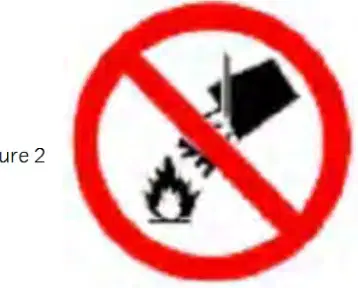
What specific message is being presented by the safety sign in figure 2?
Naked flames prohibited.
Explosive atmosphere.
Don’t extinguish with water.
Only extinguish with water.
Which one of the following can an employee do to help prevent accidents?
Know what to do if someone gets injured.
Know how to put someone in the recovery position.
Report any unsafe conditions to the correct person.
Find out the location of the first aid kit.
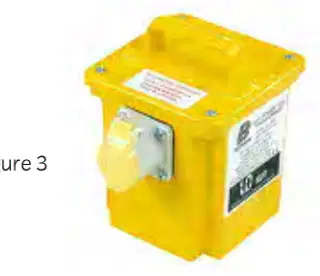
The purpose of the item of equipment in figure 3 is to
reduce a 415 V supply to 240 V
reduce a 240 V supply to 110 V
increase a 110 V supply to 230 V
increase a 55 V supply to 110 V.
What is the safest method of providing temporary electrical lighting when working on site?
110 V temporary electrical supply.
240 V temporary electrical supply.
415 V temporary electrical supply.
Temporary lighting is not permitted on site.
Which one of the following items of access equipment should have toe boards fitted?
Pole ladder.
Roof ladder.
Step ladder.
Mobile tower scaffold.
The Health and Safety at Work Act (Health & Safety at Work Order) requires that an employer must have a written Health and Safety Policy when
employing five or more people
working as a sole trader
told to by the Health & Safety Executive
an accident has happened on site.
Which one of the following is part of the safe manual lifting procedure?
Keep a straight back.
Keep the knees straight.
Keep the feet close together.
Lift the weight using the back.
One of the responsibilities of an employer under the Health and Safety at Work Act (Health & Safety at Work Order) is to provide PPE, which one of the following items is classified as PPE?
Lunch and tea breaks.
Dust mask.
Colour blindness test.
Cordless power tools.
19 Accidents which result in more than three days absence from work must be reported to the
HSE
HSC
appropriate Trade Union
d. DTI.
When working in an excavation, what precautions should be taken to prevent the possibility of a dumper truck from accidentally driving into the trench?
Cordon off the excavation with warning tape and post warning signs.
Provide the driver of the dumper truck with a site map.
Check that the dumper truck driver has passed the HGV test.
Place vehicle stop blocks in front of the trench.
What should be the first action following a minor burn to the hand?
Cool the burn area with clean cold running water.
Wash with soap and hot water.
Cover the burn with something dry.
Apply antiseptic cream to the burn.
What first action should be taken by a plumber before starting work on any electrical circuit?
The circuit should be isolated by a qualified electrician.
Contact the building control department for permission to do the work.
Advise the local electricity company that the supply is being switched off.
The circuit must be completely isolated from the supply.
Which one of the following abbreviated regulations relates to the reporting of accidents on site?
RIDDOR Regulations.
COSHH Regulations.
HSWA Regulations.
PUWER Regulations.
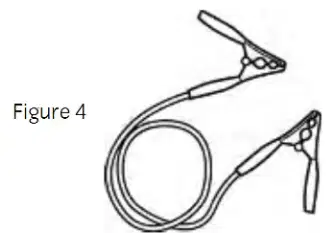
The item of equipment shown in figure 4 is most likely to be used
as temporary earth continuity bonding whilst removing a section of metal pipework
as a quick method of connecting a live cable to an appliance to check if it is working following repair work
for temporarily bridging the supply prior to the consumer unit and an appliance when the mcb has tripped
for connecting between the live and neutral on the ring main when carrying out a circuit polarity test.
25 Chrysotile is most likely to be found in
sheet lead flashings
asbestos guttering
fibreglass insulation
self cleaning flux.
What is the maximum height in metres that a tower scaffold can be erected before it has to be secured to a building?
6.
7.
8.
The maximum height identified by the manufacturer.
The person responsible for providing safety helmets for plumbers to use on a construction site is the
plumbing employer
individual plumber
construction site foreman
client or customer.
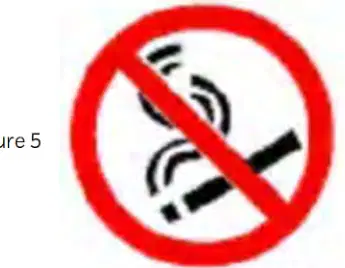
What group of safety signs is represented by the symbol design in figure 5?
Warning signs.
Prohibition signs.
Mandatory signs.
Information signs.
Which one of the following regulations specifically covers employees working with chemicals?
The Provision and Use of Work Equipment Regulations.
The Control of Substances Hazardous to Health Regulations.
The Construction (Health, Safety and Welfare) Regulations.
The Construction (Design and Management) Regulations.
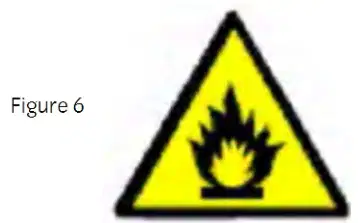
What group of safety signs is represented by the symbol design in figure 6?
Warning signs.
Prohibition signs.
Mandatory signs.
Information signs.
A fire involving flammable gases is categorised as
class A
class B
class C
class D.
Substances such as acids and alkalis, which are especially dangerous to the eyes and lungs (breathing), are classified as
toxic
corrosive
flammable
explosive.
Which one of the following combination of tools is recommended for safely taking up floorboards?
Hammer and wrecking bar.
Hammer and wood chisel.
Hammer and bolster chisel.
Angle grinder and wrecking bar.
What is the most likely risk of injury when cutting large diameter copper pipe using hand-held pipe cutters?
Dermatitis from handling the copper pipe.
Cuts to the fingers from the inside burr of the pipe.
Wrist injury from excessive twisting of the handle.
Eye injury from copper shards flying off.
When manually lifting sheet lead coils, which one of the following items of PPE should be used?
Goggles.
Respiratory equipment.
Hand protection.
Hearing protection.
A plumber’s first action in the event of an emergency on site should be to
follow the site emergency procedure
stop work and leave the site immediately
phone the health and safety inspector
contact a family member to report the situation.
The term used to identify the hazards associated with a work activity measured against the likelihood of an accident taking place is known as a
risk ratio
risk assessment
danger assessment
risk factor.
A fire involving wood is categorised as
class A
class B
class C
class D.
When working in a dusty environment, as well as goggles, what other specific item of PPE should be made available?
Ear defenders.
Safety harness.
Respiratory protection.
PAT testing equipment.
The term used to describe those that may be affected by a work activity or process is
risk exposure
risk control
risk liability
risk assessment.
Poisons such as hydrogen sulphide and cyanide are classified as
toxic
corrosive
flammable
explosive.
Under what circumstances can an operative be excused from wearing PPE on site?
If the weather is extremely hot.
If the supervisor gives permission.
When PPE has not been made available.
Operative must wear PPE when required to do so.
The main purpose of an assembly point on a construction site is
to enable annual PAT testing of all site electrical equipment
for a safe area for workers in the event of site evacuation
as an area for health and safety training and assessment events
to enable the main contractor to address all site workers.
When working in excavations on site, how often should the excavation be inspected by a competent person?
At the start of each workday.
At the start of each week.
At least twice a month.
At least every two months.
For a person to be allowed to operate a circular saw they must be
over 16 years old
over 18 years old
over 21 years old
trained and competent to do so.
A plumber finds that the on/off switch on an 110 V electric drill is faulty, what first action should be taken?
Try and fix the fault temporarily.
Stop work and inform the supervisor.
Notify the Health and Safety Inspector.
Tape the switch in the on position.
Which one of the following materials gives off toxic fumes when burnt?
Cardboard.
Polystyrene.
Plywood chippings.
Timber shavings.
When reporting a fire, an essential piece of information that should be passed on to the Fire Service is
the name of the gas supplier to the site
the direction the wind is blowing
who or what is responsible for starting the fire
details of any flammable materials stored on site.
Substances such as loft insulation are classified as
toxic
corrosive
flammable
irritants.
A fire involving flammable liquids is categorised as
class A
class B
class C
class D.

