
NEW
Font size
 Worksheets
Unit 1 Test
Total questions: 24
Worksheet time: 12mins
Which procedure would best allow a scientist to observe a chemical property of hydrochloric acid (HCl) solution?
cooling the HCl solution until it becomes solid, and measuring this temperature
adding zinc to the HCl solution and observing whether or not bubbles are produced
placing a conductivity probe into a beaker of HCl solution to determine if it conducts electricity
measuring the mass of and volume of a sample of HCl solution to find its density
Suppose that a substance in a beaker is heated over a burner in a science lab. Which observation would most likely indicate that a chemical change has occurred in the substance?
If the substance is a liquid or solid, an increase in temperature would indicate a chemical change.
If the substance is a liquid, a change of some of the liquid to gaseous form would indicate a chemical change.
If the substance is a solid, a change of some of the solid to liquid form would indicate a chemical change.
If the substance is a liquid or solid, production of an odor would indicate a chemical change.
Based on the above description of transpiration and photosynthesis, which type of change happens to water during each process?
In transpiration, because some of its properties change, water undergoes a physical change but keeps its identity. In photosynthesis, because its identity changes, water undergoes a chemical change.
In transpiration, because some of its properties change, water undergoes a chemical change but keeps its identity. In photosynthesis, because its identity changes, water undergoes a physical change.
In transpiration, because its physical properties change, water undergoes a physical change and loses its identity. In photosynthesis, because it keeps its identity, water undergoes a chemical change.
In transpiration, because its chemical properties change, water undergoes a chemical change and loses its identity. In photosynthesis, because it keeps its identity, water undergoes a physical change.
Tijuan mixed a solid and a liquid together in a beaker. He determined that a chemical change occurred. If his conclusion is correct, which substances could he have been observing and why?
ice mixed into warm oil, because the change of state that occurred when the ice melted cannot be reversed
baking soda mixed into vinegar, because the production of bubbles indicates that a new substance formed
sugar mixed into hot water, because the disappearance of solid indicates that the chemical identity of the sugar changed
sand mixed into water, because when sand was added the mass of the beaker increased
If two items are equal in size, the denser one will
be lighter.
be heavier.
have more volume.
have less volume.
What is the density of a 700 kg object with a volume of 649 m³? (Density: D = m/v.)
0.927 kg/m³
0.4543 kg/m³
1.079 kg/m³
4.543 kg/m³
The density of an object is 0.835 g/cm³. If its volume is 34 cm³, what is the mass of the object? (D = m/v)
0.02 g
0.41 g
28.39 g
40.72 g

A column is filled with four different liquids of different densities. A red liquid, a blue liquid, a green liquid, and a purple liquid are all added into the column. This chart shows the densities of the liquids. In what order would the liquids arrange themselves, from top to bottom?
blue, red, purple, green
purple, green, red, blue
purple, green, blue, red
blue, red, green, purple
Which describes a feature of the physical changes of all substances?
can dissolve in water
can conduct heat and electricity
rearranges atoms to form new substances
does not change the identity of a substance
Which would show an example of how physical changes are reversible?
cutting a gold bar in two pieces and then putting the pieces next to each other
burning a match and then relighting it
melting tin and then cooling it into a mold
combining sodium and chlorine to make the new material of table salt
Which is most likely a physical change?
cutting a substance into four pieces
burning a substance into ash and smoke
reacting a substance chemically to form a new substance
combining a substance with water to make rust
The density of solid aluminum is 2.70 g/cm³. If a 1 g piece of aluminum is dropped in water (1.00 g/cm³), what will happen?
It will sink to the bottom.
It will float to the top.
It will hover in the middle.
It will move up and down.
Who is known as the 'father of modern chemistry' because he first organized all known elements into four different groups?
Johann Wolfgang Döbereiner
Antoine Lavoisier
Dmitri Mendeleev
Henry Moseley
The elements in group 17 (halogens) all have the same
atomic number.
atomic mass.
number of possible isotopes.
number of valence electrons.
While looking at xenon (Xe) on the periodic table, a student needs an element with a smaller atomic mass in the same group. Where should the student look?
directly up
directly down
directly to the left
directly to the right

This is how sodium appears in the periodic table. The arrow is pointing to sodium’s
number of neutrons.
chemical symbol
atomic mass
combined number of electrons and protons.
Atom A and Atom B have the same number of protons, but not the same number of neutrons. Which statement describes these atoms?
Atom A and Atom B are isotopes of the same element.
Atom A and Atom B are different elements.
Atom A and Atom B have different atomic numbers.
Atom A and Atom B have the same mass number.
An atom of zinc has atomic number 30 and mass number 65. How many protons does an uncharged zinc atom have?
30
35
65
95
Scientists are working with two different samples of mercury; they are different isotopes. Which property must be different?
the atomic number
the electric charge
the element name
the mass number
When a neutral atom loses two electrons, it becomes a
positive ion.
negative ion.
positive isotope.
negative isotope.
What are the two parts of an atom?
the nucleus and the proton cloud
the neutron and the electron cloud
the neutron and the proton cloud
the nucleus and the electron cloud
Which argument best explains the charge of an atomic nucleus?
An atomic nucleus is positively charged because it is composed of neutrons.
An atomic nucleus is positively charged because it is composed of protons.
An atomic nucleus is negatively charged because it is composed of electrons.
An atomic nucleus is negatively charged because it is composed of neutrons.
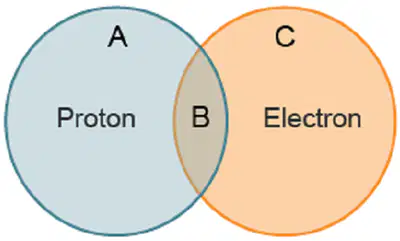
The Venn diagram compares protons with electrons. Which shared property belongs in the region marked "B”?
Is found in the nucleus
Has mass of 1 amu
Orbits the nucleus
Is electrically charged
Which statement describes a property of a proton?
is found outside the nucleus
has a positive charge
has less mass than an electron
is repelled by electrons

