
Font size
 Worksheets
Skeletal System Study Guide
Total questions: 49
Worksheet time: 27mins
Which one of the following is not a component of the skeletal system?
bones
joints
cartilages
ligaments
fat
How many bones make up the skeletal system?
206
300
360
606
650
Hematopoiesis takes place in the bones. This is the production of
fat cells
blood cells
cartilage cells
bone cells
nerve cells
These two minerals are important to and stored in the bones.
Calcium and oxygen
Phosphorus and oxygen
Phosphorus and calcium
Potassium and calcium
Calcium and iron
This type of bone tissue is dense, homogeneous, and makes up the outer part of a bone.
Spongy bone
Compact bone
Medullary bone
Osteobone
Sesamoid bone
The sternum and skull bones are types of
Long bones
Short bones
Flat bones
Irregular bones
The medullary cavity in the shaft of a long bone contains
Yellow marrow, which is mostly fat, in adults
Red marrow, which is mostly for blood cell formation, in infants
Both a & b
Neither a nor b
Mature bone cells that make up most of the bone structure are called
Osteocytes
Osteoblasts
Osteoclasts
Lamellae surround these – the tubes where blood vessels run through the bone.
Sharpey’s fibers
Central/Haversian canals
Lacunae
Osteocytes
This substance in bones provides flexibility and tensile strength.
Collagen
Fat
Keratin
Calcium
Bone markings reveal where muscles, tendons, and ligaments were attached and where blood vessels and nerves passed.
True
False
The joints between the bones in the skull are
Fat
Sesamoid
Sutures
Condyloid
The only movable joint in the skull is associated with the
Parietal bone
Xiphoid process
Mandible
Zygomatic bone
Bones such as the humerus, femur, tibia, and ulna may be classified as
Long bones
Short bones
Flat bones
Irregular bones
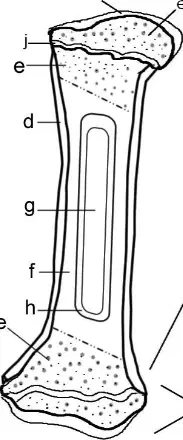
Using the image of the bone to the right, what does the letter “d” (the outer covering of the bone) represent?
Endosteum
Periosteum
Epiphysis
The outer covering of the bone is secured to the bone by hundreds of pieces of connective tissue called
Hyaline cartilage
Epiphyseal plate
Sharpey’s or perforating fibers
Articular cartilage
These cells are responsible for breaking down bone.
Osteocytes
Osteoblasts
Osteoclasts
Which one is true about the appendicular skeleton?
It contains more bones than the axial skeleton.
It is the central axis of the body
It includes the arms and legs
Only a and c
All of the above
The paranasal sinuses
Are hollow portions of the bones surrounding the nasal cavity
Lighten the skull
Give resonance and amplification to your voice
All of the above
Located in the temporal bone of the skull is a canal that leads to the middle ear. It is called the
Foramen magnum
Styloid process
External acoustic meatus
Acromion
The vertebral column
Transmits the weight of the body to the lower limbs.
Supports the skull
Extends down to the pelvis
All of the above
This is the only bone in the body that does not articulate with another bone – it serves as a moveable base for the tongue.
Mandible
Talus
Hyoid bone
Atlas
The C1 vertebra allows you to nod “yes.” It is also known as
Axis
Talus
Hyoid
Atlas
The lowest part of the sternum is the
Manubrium
Xiphoid process
Body
Also known as a “soft spot” on a baby, this is the name of the fibrous membrane that connects the cranial bones in a baby, thus allowing the brain to grow.
Fontanelle
Mandible
Hyoid
Patella
Which statement about the ribs is not true?
The human body has 12 pairs of ribs.
None of the false ribs attach to the sternum.
They articulate with the vertebral column.
Some attach to the sternum by costal cartilage.
The large opening at the base of the occipital bones, which allows the spinal cord to connect to the brain is called the
Foramen magnum
Styloid process
External acoustic meatus
Acromion
The spinal column is made up of vertebrae – what is the correct breakdown and order from top to bottom of those vertebrae?
7 cervical vertebrae, 12 thoracic vertebrae, 5 lumbar vertebrae
5 cervical vertebrae, 12 thoracic vertebrae, 7 lumbar vertebrae
12 thoracic vertebrae, 5 lumbar vertebrae, 7 cervical vertebrae
12 lumbar vertebrae, 7 cervical vertebrae, 5 thoracic vertebrae
The pectoral girdle is
Another name for the pelvis
Composed of the clavicle and scapula
Very limited in regards to motion and flexibility
Strongly reinforced with ligaments, so it is hard for it to dislocate.
The human body has more ___ vertebrae than any other type.
b. Cervical
a. Thoracic
c. Lumbar
d. Sacral
Which statement about the pelvic girdle is not true?
It protects the reproductive organs, bladder, and part of the large intestine.
It is made of lightweight bone and lots of cartilage.
It supports the weight of the entire upper body.
It differs between males and females.
The bones in the lower back are known as
Cervical vertebrae
Thoracic vertebrae
Carpal vertebrae
Lumbar vertebrae
This is the largest bone of the body.
Humerus
Tibia
Skull
Pelvis
Femur
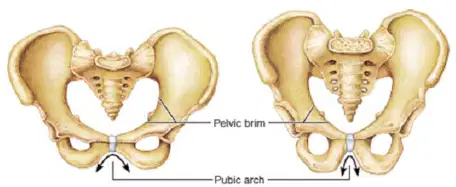
Which pelvis in the picture is female?
Right
Left
Which bone is more medial?
Tibia
Fibula
A fracture is
A bruised bone
A torn tendon
A dislocated bone
A broken bone
Which vertebrae experience the most stress?
Lumbar
Thoracic
Cervical
Where two bones meet is known as
Joint
Cavity
Fontanelle
Sinus
Phalanges are bones found in the _______.
fingers and toes
skull
rib cage
pelvis
Radius is a bone located in the _______.
forearm
thigh
chest
skull
Sacrum is a bone found at the base of the _______.
spine
skull
rib cage
shoulder
Scapula is commonly known as the _______ bone.
shoulder blade
knee
elbow
ankle
Sternum is also called the _______ bone.
breastbone
collarbone
shinbone
skull
Tarsals are bones found in the _______.
foot
hand
skull
chest
Thoracic Vertebrae are part of the _______.
spine
skull
pelvis
rib cage
Tibia is a bone located in the _______.
lower leg
upper arm
chest
skull
True rib refers to ribs that are directly attached to the _______.
sternum
scapula
clavicle
vertebrae
Ulna is a bone found in the _______.
forearm
thigh
skull
chest
Label the adult long bone!
epiphyseal line
medullary cavity
proximal epiphysis
articular cartilage
distal epiphysis
spongy bone
compact bone
yellow bone marrow
endosteum
periosteum

