
 Worksheets
FINAL LISTENING AND READING TEST 1
Total questions: 50
Worksheet time: 25mins
Name
Class
Date
1.
1.What time will the train leave?
a)
6:30
b)
6:45
c)
7:00
2.
2.Where is the girl’s bag?
a)
A. In the classroom
b)
B. In the car
c)
C. In the kitchen
3.
3.Which sport does the boy like best?
a)
Football
b)
Swimming
c)
Tennis
4.
4. How much is the ticket?
a)
£3
b)
£5
c)
£8
5.
5. What will the weather be like tomorrow afternoon ?
a)
Sunny
b)
Cloudy
c)
Rainy
6.

Children’s Club Information: Open: every (a) afternoon
7.

Age: from (a) to 12 years old
8.

Activities: games, (a) , and art
9.

Cost: £ (a) per month
10.

Contact: phone number (a)
11.
1.Tom is going to the beach on Saturday.
a)
True
b)
False
12.
2.Anna prefers going shopping.
a)
True
b)
False
13.
3.They decide to meet at the bus station.
a)
True
b)
False
14.
4.The bus leaves at 9:30.
a)
True
b)
False
15.
5.They will take food with them.
a)
True
b)
False
16.
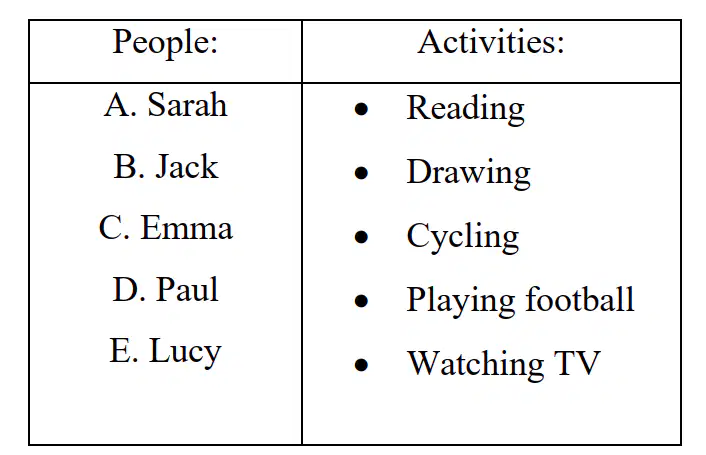
A. Sarah
a)
Reading
b)
Playing football
c)
Drawing
d)
Watching TV
e)
Cycling
17.
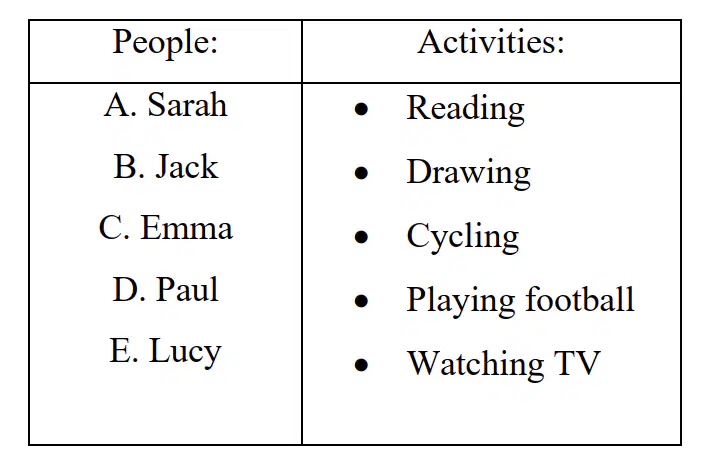
B. Jack
a)
Reading
b)
Playing football
c)
Drawing
d)
Watching TV
e)
Cycling
18.
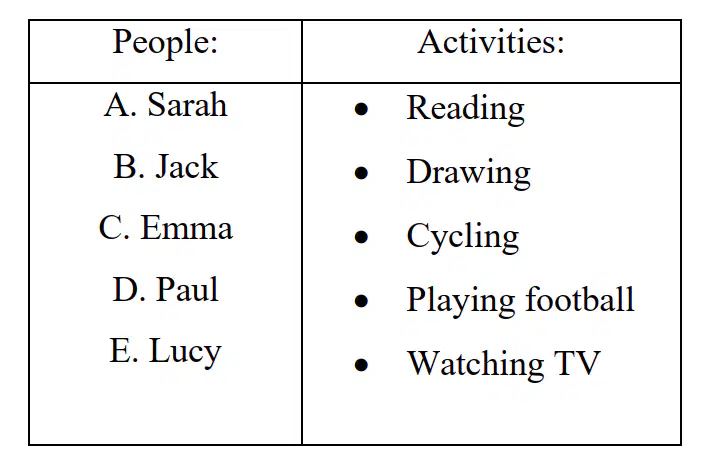
C. Emma
a)
Reading
b)
Playing football
c)
Drawing
d)
Watching TV
e)
Cycling
19.
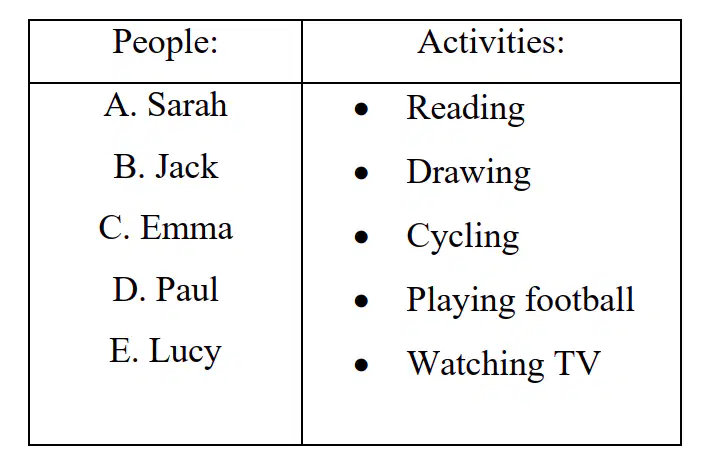
D. Paul
a)
Reading
b)
Playing football
c)
Drawing
d)
Watching TV
e)
Cycling
20.
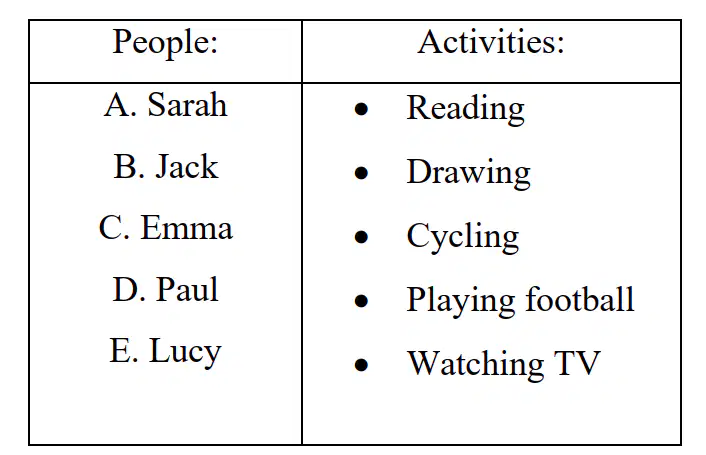
E. Lucy
a)
Reading
b)
Playing football
c)
Drawing
d)
Watching TV
e)
Cycling
21.
1. Where are they going first?
a)
A. The lion cage
b)
The penguin pool
c)
The monkey house
22.
2. What time does the zoo close?
a)
4:00
b)
5:00
c)
6:00
23.
3. How many students are going on the trip?
a)
20
b)
25
c)
30
24.
4. How much is the ticket for each student?
a)
£2
b)
£3
c)
£5
25.
5. What should they bring with them?
a)
A hat
b)
A raincoat
c)
Sunglasses
26.
6. Where will they eat lunch?
a)
In the park
b)
In the café
c)
On the bus
27.
7. What animal does Anna want to see most?
a)
Elephants
b)
Giraffes
c)
Tigers
28.
8. Who is bringing the camera?
a)
The teacher
b)
Tom
c)
Anna
29.
9. What transport will they use?
a)
Train
b)
Bus
c)
Car
30.
10. What time will they return home?
a)
3:30
b)
4:00
c)
4:30
31.
The Olympic Games are the most famous international sporting event, held every four years. They bring together thousands of athletes from all over the world. The modern Olympics began in 1896 in Athens, Greece, although the original ancient Games had already been organised in Olympia more than two thousand years earlier.
At the first modern Olympics, only 14 countries took part, and there were fewer than 250 athletes, all men. Over time, the Games grew larger, and in 1900 women were allowed to compete for the first time. Today, more than 200 nations send athletes, and the number of sports has also increased greatly.
The Olympics are not only about sport. They are also a symbol of peace and international cooperation. Every four years, a new country hosts the Games, and this gives nations an opportunity to share their culture. For example, in 2008 the Games were in Beijing, in 2012 in London, in 2016 in Rio de Janeiro, and in 2021 in Tokyo.
However, the Games have also faced challenges. Some people criticise the cost, as organising the Olympics is extremely expensive. Others worry about political issues or the environmental impact. Still, the Olympics continue to inspire millions of people around the world.
1. Where were the first modern Olympics held?
a)
Rome
b)
Olympia
c)
Athens
32.
The Olympic Games are the most famous international sporting event, held every four years. They bring together thousands of athletes from all over the world. The modern Olympics began in 1896 in Athens, Greece, although the original ancient Games had already been organised in Olympia more than two thousand years earlier.
At the first modern Olympics, only 14 countries took part, and there were fewer than 250 athletes, all men. Over time, the Games grew larger, and in 1900 women were allowed to compete for the first time. Today, more than 200 nations send athletes, and the number of sports has also increased greatly.
The Olympics are not only about sport. They are also a symbol of peace and international cooperation. Every four years, a new country hosts the Games, and this gives nations an opportunity to share their culture. For example, in 2008 the Games were in Beijing, in 2012 in London, in 2016 in Rio de Janeiro, and in 2021 in Tokyo.
However, the Games have also faced challenges. Some people criticise the cost, as organising the Olympics is extremely expensive. Others worry about political issues or the environmental impact. Still, the Olympics continue to inspire millions of people around the world.
2. When were women first allowed to compete?
a)
1896
b)
1900
c)
2012
33.
The Olympic Games are the most famous international sporting event, held every four years. They bring together thousands of athletes from all over the world. The modern Olympics began in 1896 in Athens, Greece, although the original ancient Games had already been organised in Olympia more than two thousand years earlier.
At the first modern Olympics, only 14 countries took part, and there were fewer than 250 athletes, all men. Over time, the Games grew larger, and in 1900 women were allowed to compete for the first time. Today, more than 200 nations send athletes, and the number of sports has also increased greatly.
The Olympics are not only about sport. They are also a symbol of peace and international cooperation. Every four years, a new country hosts the Games, and this gives nations an opportunity to share their culture. For example, in 2008 the Games were in Beijing, in 2012 in London, in 2016 in Rio de Janeiro, and in 2021 in Tokyo.
However, the Games have also faced challenges. Some people criticise the cost, as organising the Olympics is extremely expensive. Others worry about political issues or the environmental impact. Still, the Olympics continue to inspire millions of people around the world.
3. About how many countries take part in the Olympics today?
a)
14
b)
200
c)
250
34.
The Olympic Games are the most famous international sporting event, held every four years. They bring together thousands of athletes from all over the world. The modern Olympics began in 1896 in Athens, Greece, although the original ancient Games had already been organised in Olympia more than two thousand years earlier.
At the first modern Olympics, only 14 countries took part, and there were fewer than 250 athletes, all men. Over time, the Games grew larger, and in 1900 women were allowed to compete for the first time. Today, more than 200 nations send athletes, and the number of sports has also increased greatly.
The Olympics are not only about sport. They are also a symbol of peace and international cooperation. Every four years, a new country hosts the Games, and this gives nations an opportunity to share their culture. For example, in 2008 the Games were in Beijing, in 2012 in London, in 2016 in Rio de Janeiro, and in 2021 in Tokyo.
However, the Games have also faced challenges. Some people criticise the cost, as organising the Olympics is extremely expensive. Others worry about political issues or the environmental impact. Still, the Olympics continue to inspire millions of people around the world.
4. What do the Games also represent, apart from sport?
a)
Friendship and peace
b)
Money and business
c)
Tourism only
35.
The Olympic Games are the most famous international sporting event, held every four years. They bring together thousands of athletes from all over the world. The modern Olympics began in 1896 in Athens, Greece, although the original ancient Games had already been organised in Olympia more than two thousand years earlier.
At the first modern Olympics, only 14 countries took part, and there were fewer than 250 athletes, all men. Over time, the Games grew larger, and in 1900 women were allowed to compete for the first time. Today, more than 200 nations send athletes, and the number of sports has also increased greatly.
The Olympics are not only about sport. They are also a symbol of peace and international cooperation. Every four years, a new country hosts the Games, and this gives nations an opportunity to share their culture. For example, in 2008 the Games were in Beijing, in 2012 in London, in 2016 in Rio de Janeiro, and in 2021 in Tokyo.
However, the Games have also faced challenges. Some people criticise the cost, as organising the Olympics is extremely expensive. Others worry about political issues or the environmental impact. Still, the Olympics continue to inspire millions of people around the world.
5. Why do some people criticise the Olympic Games?
a)
They are too easy to organise
b)
They cost a lot and can cause problems
c)
Too few athletes join
36.
The Olympic Games are the most famous international sporting event, held every four years. They bring together thousands of athletes from all over the world. The modern Olympics began in 1896 in Athens, Greece, although the original ancient Games had already been organised in Olympia more than two thousand years earlier.
At the first modern Olympics, only 14 countries took part, and there were fewer than 250 athletes, all men. Over time, the Games grew larger, and in 1900 women were allowed to compete for the first time. Today, more than 200 nations send athletes, and the number of sports has also increased greatly.
The Olympics are not only about sport. They are also a symbol of peace and international cooperation. Every four years, a new country hosts the Games, and this gives nations an opportunity to share their culture. For example, in 2008 the Games were in Beijing, in 2012 in London, in 2016 in Rio de Janeiro, and in 2021 in Tokyo.
However, the Games have also faced challenges. Some people criticise the cost, as organising the Olympics is extremely expensive. Others worry about political issues or the environmental impact. Still, the Olympics continue to inspire millions of people around the world.
6. The ancient Olympic Games were held more than 2,000 years ago.
a)
True
b)
False
37.
The Olympic Games are the most famous international sporting event, held every four years. They bring together thousands of athletes from all over the world. The modern Olympics began in 1896 in Athens, Greece, although the original ancient Games had already been organised in Olympia more than two thousand years earlier.
At the first modern Olympics, only 14 countries took part, and there were fewer than 250 athletes, all men. Over time, the Games grew larger, and in 1900 women were allowed to compete for the first time. Today, more than 200 nations send athletes, and the number of sports has also increased greatly.
The Olympics are not only about sport. They are also a symbol of peace and international cooperation. Every four years, a new country hosts the Games, and this gives nations an opportunity to share their culture. For example, in 2008 the Games were in Beijing, in 2012 in London, in 2016 in Rio de Janeiro, and in 2021 in Tokyo.
However, the Games have also faced challenges. Some people criticise the cost, as organising the Olympics is extremely expensive. Others worry about political issues or the environmental impact. Still, the Olympics continue to inspire millions of people around the world.
7. In 1896, both men and women competed in Athens.
a)
True
b)
False
38.
The Olympic Games are the most famous international sporting event, held every four years. They bring together thousands of athletes from all over the world. The modern Olympics began in 1896 in Athens, Greece, although the original ancient Games had already been organised in Olympia more than two thousand years earlier.
At the first modern Olympics, only 14 countries took part, and there were fewer than 250 athletes, all men. Over time, the Games grew larger, and in 1900 women were allowed to compete for the first time. Today, more than 200 nations send athletes, and the number of sports has also increased greatly.
The Olympics are not only about sport. They are also a symbol of peace and international cooperation. Every four years, a new country hosts the Games, and this gives nations an opportunity to share their culture. For example, in 2008 the Games were in Beijing, in 2012 in London, in 2016 in Rio de Janeiro, and in 2021 in Tokyo.
However, the Games have also faced challenges. Some people criticise the cost, as organising the Olympics is extremely expensive. Others worry about political issues or the environmental impact. Still, the Olympics continue to inspire millions of people around the world.
8. The Olympic Games take place every four years.
a)
True
b)
False
39.
The Olympic Games are the most famous international sporting event, held every four years. They bring together thousands of athletes from all over the world. The modern Olympics began in 1896 in Athens, Greece, although the original ancient Games had already been organised in Olympia more than two thousand years earlier.
At the first modern Olympics, only 14 countries took part, and there were fewer than 250 athletes, all men. Over time, the Games grew larger, and in 1900 women were allowed to compete for the first time. Today, more than 200 nations send athletes, and the number of sports has also increased greatly.
The Olympics are not only about sport. They are also a symbol of peace and international cooperation. Every four years, a new country hosts the Games, and this gives nations an opportunity to share their culture. For example, in 2008 the Games were in Beijing, in 2012 in London, in 2016 in Rio de Janeiro, and in 2021 in Tokyo.
However, the Games have also faced challenges. Some people criticise the cost, as organising the Olympics is extremely expensive. Others worry about political issues or the environmental impact. Still, the Olympics continue to inspire millions of people around the world.
9. The Games have only been hosted in Europe.
a)
True
b)
False
40.
The Olympic Games are the most famous international sporting event, held every four years. They bring together thousands of athletes from all over the world. The modern Olympics began in 1896 in Athens, Greece, although the original ancient Games had already been organised in Olympia more than two thousand years earlier.
At the first modern Olympics, only 14 countries took part, and there were fewer than 250 athletes, all men. Over time, the Games grew larger, and in 1900 women were allowed to compete for the first time. Today, more than 200 nations send athletes, and the number of sports has also increased greatly.
The Olympics are not only about sport. They are also a symbol of peace and international cooperation. Every four years, a new country hosts the Games, and this gives nations an opportunity to share their culture. For example, in 2008 the Games were in Beijing, in 2012 in London, in 2016 in Rio de Janeiro, and in 2021 in Tokyo.
However, the Games have also faced challenges. Some people criticise the cost, as organising the Olympics is extremely expensive. Others worry about political issues or the environmental impact. Still, the Olympics continue to inspire millions of people around the world.
10. Many people around the world feel inspired by the Olympics.
a)
True
b)
False
41.
Last Sunday, our teacher (1) ______ us on a picnic by the river. We left school early in the morning and arrived (2) ______ about 8 o’clock. The weather was sunny, and everyone (3) ______ very cheerful.
First, we played some games on the grass. While we (4) ______, a few students prepared the food. They spread a big blanket (5) ______ the ground and put sandwiches, fruit, and drinks on it.
After lunch, some of my classmates went swimming in the river. I didn’t swim because I (6) ______ my swimsuit at home. Instead, I sat with my best friend and we talked (7) ______ our summer plans.
In the afternoon, our teacher asked us to clean up the area. We collected all the rubbish and threw it (8) ______ the bins nearby. Everyone was tired, but we (9) ______ a wonderful time together. Finally, we got back to school (10) ______ the evening, feeling happy and relaxed.
a)
1.take
b)
1.took
c)
1.taking
42.
Last Sunday, our teacher (1) ______ us on a picnic by the river. We left school early in the morning and arrived (2) ______ about 8 o’clock. The weather was sunny, and everyone (3) ______ very cheerful.
First, we played some games on the grass. While we (4) ______, a few students prepared the food. They spread a big blanket (5) ______ the ground and put sandwiches, fruit, and drinks on it.
After lunch, some of my classmates went swimming in the river. I didn’t swim because I (6) ______ my swimsuit at home. Instead, I sat with my best friend and we talked (7) ______ our summer plans.
In the afternoon, our teacher asked us to clean up the area. We collected all the rubbish and threw it (8) ______ the bins nearby. Everyone was tired, but we (9) ______ a wonderful time together. Finally, we got back to school (10) ______ the evening, feeling happy and relaxed.
a)
2.at
b)
2.in
c)
2.on
43.
Last Sunday, our teacher (1) ______ us on a picnic by the river. We left school early in the morning and arrived (2) ______ about 8 o’clock. The weather was sunny, and everyone (3) ______ very cheerful.
First, we played some games on the grass. While we (4) ______, a few students prepared the food. They spread a big blanket (5) ______ the ground and put sandwiches, fruit, and drinks on it.
After lunch, some of my classmates went swimming in the river. I didn’t swim because I (6) ______ my swimsuit at home. Instead, I sat with my best friend and we talked (7) ______ our summer plans.
In the afternoon, our teacher asked us to clean up the area. We collected all the rubbish and threw it (8) ______ the bins nearby. Everyone was tired, but we (9) ______ a wonderful time together. Finally, we got back to school (10) ______ the evening, feeling happy and relaxed.
a)
3.is
b)
3.was
c)
3.were
44.
Last Sunday, our teacher (1) ______ us on a picnic by the river. We left school early in the morning and arrived (2) ______ about 8 o’clock. The weather was sunny, and everyone (3) ______ very cheerful.
First, we played some games on the grass. While we (4) ______, a few students prepared the food. They spread a big blanket (5) ______ the ground and put sandwiches, fruit, and drinks on it.
After lunch, some of my classmates went swimming in the river. I didn’t swim because I (6) ______ my swimsuit at home. Instead, I sat with my best friend and we talked (7) ______ our summer plans.
In the afternoon, our teacher asked us to clean up the area. We collected all the rubbish and threw it (8) ______ the bins nearby. Everyone was tired, but we (9) ______ a wonderful time together. Finally, we got back to school (10) ______ the evening, feeling happy and relaxed.
a)
4.played
b)
4.playing
c)
4.were playing
45.
Last Sunday, our teacher (1) ______ us on a picnic by the river. We left school early in the morning and arrived (2) ______ about 8 o’clock. The weather was sunny, and everyone (3) ______ very cheerful.
First, we played some games on the grass. While we (4) ______, a few students prepared the food. They spread a big blanket (5) ______ the ground and put sandwiches, fruit, and drinks on it.
After lunch, some of my classmates went swimming in the river. I didn’t swim because I (6) ______ my swimsuit at home. Instead, I sat with my best friend and we talked (7) ______ our summer plans.
In the afternoon, our teacher asked us to clean up the area. We collected all the rubbish and threw it (8) ______ the bins nearby. Everyone was tired, but we (9) ______ a wonderful time together. Finally, we got back to school (10) ______ the evening, feeling happy and relaxed.
a)
5.on
b)
5.in
c)
5.at
46.
Last Sunday, our teacher (1) ______ us on a picnic by the river. We left school early in the morning and arrived (2) ______ about 8 o’clock. The weather was sunny, and everyone (3) ______ very cheerful.
First, we played some games on the grass. While we (4) ______, a few students prepared the food. They spread a big blanket (5) ______ the ground and put sandwiches, fruit, and drinks on it.
After lunch, some of my classmates went swimming in the river. I didn’t swim because I (6) ______ my swimsuit at home. Instead, I sat with my best friend and we talked (7) ______ our summer plans.
In the afternoon, our teacher asked us to clean up the area. We collected all the rubbish and threw it (8) ______ the bins nearby. Everyone was tired, but we (9) ______ a wonderful time together. Finally, we got back to school (10) ______ the evening, feeling happy and relaxed.
a)
6.leave
b)
6.left
c)
6.leaving
47.
Last Sunday, our teacher (1) ______ us on a picnic by the river. We left school early in the morning and arrived (2) ______ about 8 o’clock. The weather was sunny, and everyone (3) ______ very cheerful.
First, we played some games on the grass. While we (4) ______, a few students prepared the food. They spread a big blanket (5) ______ the ground and put sandwiches, fruit, and drinks on it.
After lunch, some of my classmates went swimming in the river. I didn’t swim because I (6) ______ my swimsuit at home. Instead, I sat with my best friend and we talked (7) ______ our summer plans.
In the afternoon, our teacher asked us to clean up the area. We collected all the rubbish and threw it (8) ______ the bins nearby. Everyone was tired, but we (9) ______ a wonderful time together. Finally, we got back to school (10) ______ the evening, feeling happy and relaxed.
a)
7.to
b)
7.about
c)
7.with
48.
Last Sunday, our teacher (1) ______ us on a picnic by the river. We left school early in the morning and arrived (2) ______ about 8 o’clock. The weather was sunny, and everyone (3) ______ very cheerful.
First, we played some games on the grass. While we (4) ______, a few students prepared the food. They spread a big blanket (5) ______ the ground and put sandwiches, fruit, and drinks on it.
After lunch, some of my classmates went swimming in the river. I didn’t swim because I (6) ______ my swimsuit at home. Instead, I sat with my best friend and we talked (7) ______ our summer plans.
In the afternoon, our teacher asked us to clean up the area. We collected all the rubbish and threw it (8) ______ the bins nearby. Everyone was tired, but we (9) ______ a wonderful time together. Finally, we got back to school (10) ______ the evening, feeling happy and relaxed.
a)
8.into
b)
8.on
c)
8.at
49.
Last Sunday, our teacher (1) ______ us on a picnic by the river. We left school early in the morning and arrived (2) ______ about 8 o’clock. The weather was sunny, and everyone (3) ______ very cheerful.
First, we played some games on the grass. While we (4) ______, a few students prepared the food. They spread a big blanket (5) ______ the ground and put sandwiches, fruit, and drinks on it.
After lunch, some of my classmates went swimming in the river. I didn’t swim because I (6) ______ my swimsuit at home. Instead, I sat with my best friend and we talked (7) ______ our summer plans.
In the afternoon, our teacher asked us to clean up the area. We collected all the rubbish and threw it (8) ______ the bins nearby. Everyone was tired, but we (9) ______ a wonderful time together. Finally, we got back to school (10) ______ the evening, feeling happy and relaxed.
a)
9.have
b)
9.had
c)
9.having
50.
Last Sunday, our teacher (1) ______ us on a picnic by the river. We left school early in the morning and arrived (2) ______ about 8 o’clock. The weather was sunny, and everyone (3) ______ very cheerful.
First, we played some games on the grass. While we (4) ______, a few students prepared the food. They spread a big blanket (5) ______ the ground and put sandwiches, fruit, and drinks on it.
After lunch, some of my classmates went swimming in the river. I didn’t swim because I (6) ______ my swimsuit at home. Instead, I sat with my best friend and we talked (7) ______ our summer plans.
In the afternoon, our teacher asked us to clean up the area. We collected all the rubbish and threw it (8) ______ the bins nearby. Everyone was tired, but we (9) ______ a wonderful time together. Finally, we got back to school (10) ______ the evening, feeling happy and relaxed.
a)
10.on
b)
10.in
c)
10.at
100 %

