
NEW
Font size
 Worksheets
1st 6 week assessment 9.19.25
Total questions: 52
Worksheet time: 42mins
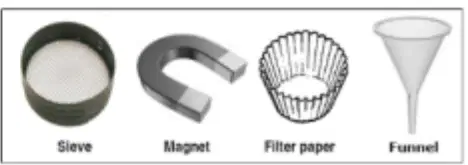
A student has a mixture of rocks, sand, and iron paper clips. The student wants to separate the mixture into three piles: rocks, sand, and paper clips. Which tools should be used to separate the mixture into the three piles?
filter paper and funnel
sieve and magnet
magnet and filter paper
sieve and funnel
Students dissolve 25 g of sugar in 580 g of water. What is the mass of the sugar that is in the solution after it has been completely dissolved in the water?
0 g
25 g
580 g
605 g
A student wants to investigate what would happen if she stirred 4 different powdered solids into water. To conduct her investigation, she measured 15 g of each substance, stirred them each into their own 200 mL beakers of water, and let them sit for 5 minutes. She recorded her observations from the investigation in the table below. Substance Observations After 5 Minutes F Floated to the top, the water is clear G Sank to the bottom, the water is clear H Sank to the bottom, the water is cloudy J Powder not visible, the water changed color Based on the observation in the table, which powder substance created a solution when stirred in water?
Substance F
Substance G
Substance H
Substance J
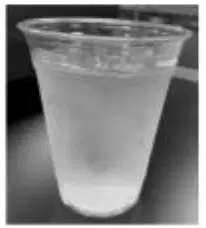
A student placed a cup of ice water on his desk and went to lunch. When he returned to his desk after lunch, he noticed that the cup had drops of water on the outside. Which of the following BEST explains why there were water drops on the outside of the cup?
The lights in the room caused the water to evaporate and move to the outside of the cup.
The cup started to sweat as the temperature of the ice in the cup increased.
The water vapor in the room condensed into liquid water on the outside of the glass.
The water in the glass froze and melted on the outside of the glass.
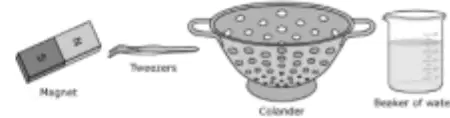
The pictures show tools that can be used for separating mixtures. Select the mixture that is paired with the correct separating tool.
salt and pepper - tweezers
pieces of cork and pebbles - beaker of water
safety pins and iron nails - magnet
sand and iron filings - colander
You add a spoonful of salt to a glass of water. You can’t see the individual salt particles, but you notice that the water tastes salty. Which of the following BEST describes what happens to the salt particles in the water?
Particles spread out and mix evenly throughout the water.
Particles stay in a solid lump and sink to the bottom.
Particles rise to the top and form a layer.
Particles disappear completely.

A class is observing a pond environment. They record the following observations. Object | Physical State | Color | Action in Water Rock | Solid | Grey | Sink Lily Pad | Solid | Green | Float Wood Log | Solid | Brown | Float Sand | Solid | Brown | Sink Which observed objects would be less dense than water?
Rock and Sand
Lily pad and Rock
Wood log and Sand
Lily pad and Wood Log
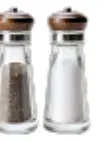
A fifth-grade class mixed salt and pepper in a bowl. The salt and pepper grains were the same size. What would be the easiest way for the students to separate the salt and pepper?
Separate the pepper from the salt by using tweezers.
Use a strainer with a wire screen to remove the salt.
Stir the mixture in water, then use a filter to remove the pepper.
Use a magnet to attract the pepper then remove it from the mixture.
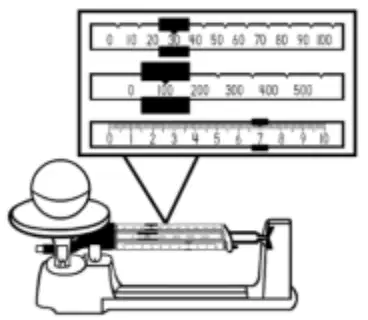
The mass of the sphere is grams?
130 g
317 g
173 g
The student used a magnet in this investigation to test for the presence of iron in the cereal. What would be evidence that supports the cereal contains iron?
Small pieces of cereal are attracted to the magnet.
The cereal dissolves completely in water.
The cereal changes color when mixed with milk.
The cereal floats on water.
The picture below shows a pot with a liquid that is being heated on a burner. What would happen if a large amount of cold water were added to the pot?
The water would stop boiling.
The water would increase in temperature.
The water would boil faster because there was more liquid.
There would be no change in temperature.
A student combines a solid and liquid to make a solution and then the solid disappears. Based on the conservation of matter, what happened to the solid?
It was destroyed and then was created again.
It turned into a gas and then was destroyed.
It dissolved but is still present in the solution.
It turned into energy but is still present in the solution.
A teacher wears protective gloves to lift a metal pan filled with boiling water from a hot plate. Why are protective gloves necessary?
The metal pan reduces thermal energy.
The metal pan conducts thermal energy.
The metal pan insulates thermal energy.
The metal pan creates thermal energy.
You have a sealed plastic bottle filled with air and another filled with water. When you squeeze both bottles, it is easier to squeeze the one with air. Why is it easier to squeeze the bottle filled with air than the one filled with water?
A. Air particles are close together and difficult to compress.
B. Water particles are close together but can be compressed easily.
C. Water particles are fixed in position and cannot move.
D. Air particles are far apart and can be pushed closer together.
Students use a circuit to investigate the properties of 6 objects. The buzzer makes a sound if an object completes the circuit. The circuit and observations are shown.
eraser, toothpick, cotton ball
eraser, paper clip, safety pin
toothpick, paper clip, safety pin
paper clip, safety pin, aluminum foil


The water and oil separate from each other.
Is this an example of a Solution?
Yes
No

Even after mixing the rocks sink to the bottom and do not dissolve.
Is this an example of a solution?
Yes
No

Is Trailmix an example of a Mixture?
Yes
No

The sand sinks to the bottom of the ocean water.
Is this an example of a Solution?
Yes
No

What is a mixture?
elements chemically combined
a combination of different things
it is found on the Periodic Table
it is made of chemical

This us a mixture because:
then combined, the candies still have their original properties
the individual colors can be separated from each other
both of these
neither of these

Two or more solid substances are combined, but they do not form a new substance.
Mixtures
Solutions
What is the role of a solvent in a solution?
To dissolve the solute
To increase the pressure
To decrease the temperature
To act as a filter


A bobber floats on the water because it is....
more dense than the water
less dense than the water
the same density as the water
to show you when you have a bite

Rocks sink because they are
the same density as the water
less dense than the water
more dense than the water
because they're round
Light travels in _______ until it strikes an object or moves from one medium to another.
zig zag
straight line
scatter
starburst

a change that alters a substance without changing its chemical composition or its identity
Chemical Change
Physical Change
Chemical and Physical Change
Matter


chemical change or physical change?
chemical change
physical change
What does reflection mean?
absorbing
going through an object
bouncing off
disappear
When light bounces off a rough surface, the reflection _________.
scatters
disappears
goes straight
absorbs
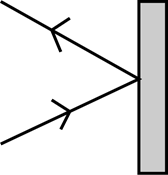
In the illustration, the light ray striking the object is-


What is happening in this picture?
Reflection
Refraction


When you look on the surface of a lake, the light is______.
refracted
transmitted
absorbed
reflected

What is happening in this picture?
the light is being refracted from mirror to mirror
the light is being transmitted
the light is being reflected off each mirror
the light is being absorbed by each mirror


What happens when light hits a mirror?
The light goes through the mirror.
You see a rainbow.
The light stops.
The light bounces off the mirror in a new direction.



