
 Worksheets
ELW Science Bootcamp Form B
Total questions: 55
Worksheet time: 21mins
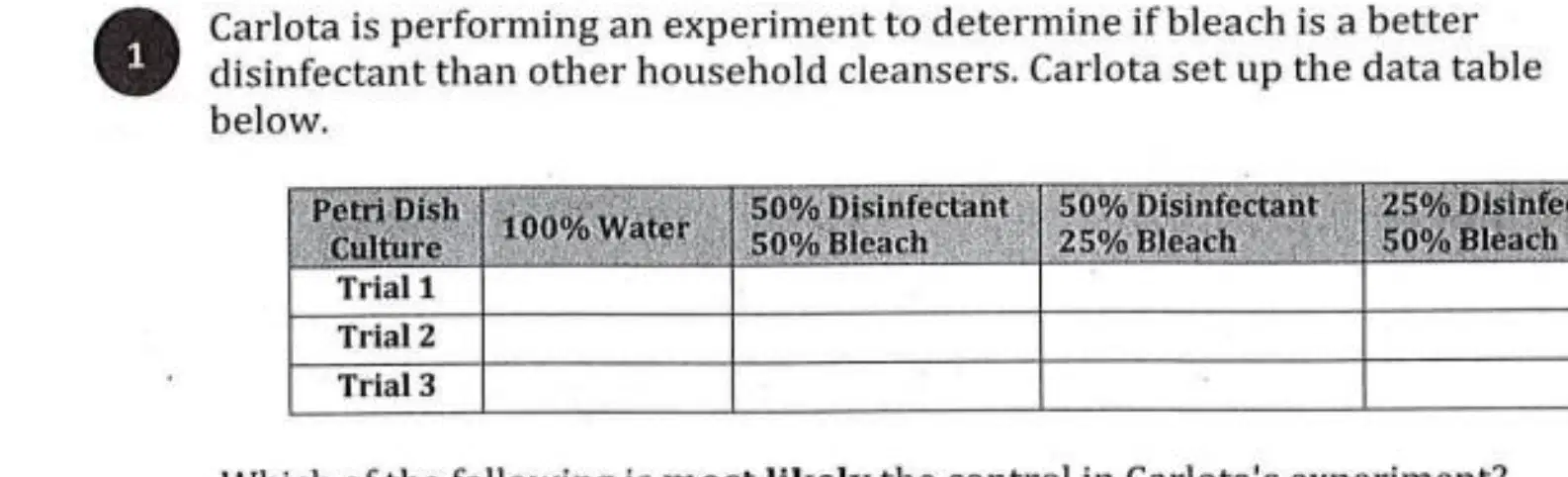
Carlota is performing an experiment to determine if bleach is a better disinfectant than other household cleansers. Carlota set up the data table below. Which of the following is most likely the control in Carlota's experiment?
100% Bleach
100% Disinfectant
100% Water
50% Disinfectant / 50% Bleach
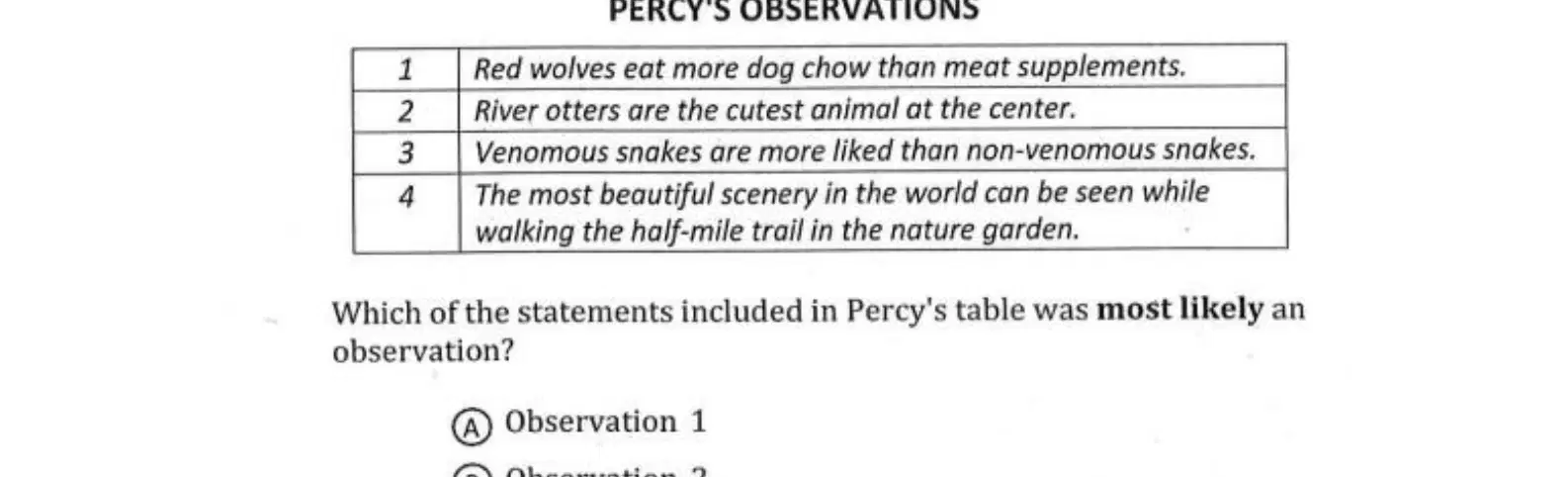
Percy's class visits the local nature center with an assignment to make observations. Percy records his observations in the table below. When the teacher grades Percy's table, she notes that three of the four statements recorded by Percy were personal opinions and not observations. Which of the statements included in Percy's table was most likely an observation?
Observation 1
Observation 2
Observation 3
Observation 4
Linda is designing an experiment to investigate the chemical properties of a metal. Which statement best describes why it is important that Linda write down her experimental procedure?
The experiment can be modified by others.
The data will help people decide what type of metal is required for use.
The exact experiment can be repeated, and the results may be compared.
The data will show people which chemical properties are more common.
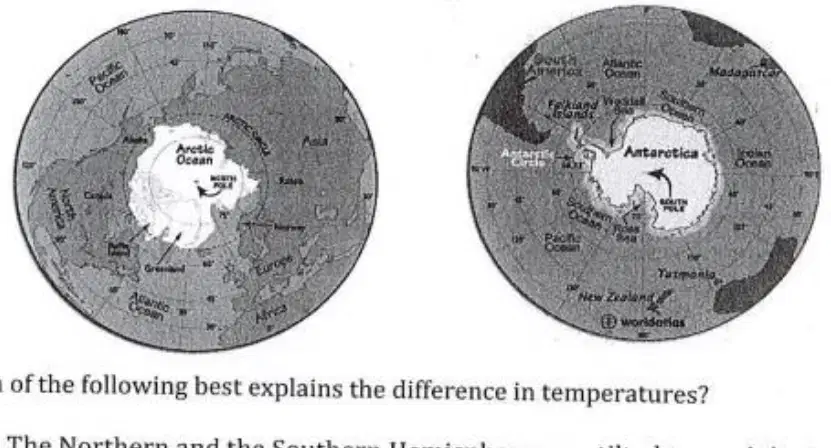
Liza lives in Canada, while her best friend Libby lives in New Zealand. Liza and Libby e-mail each other at least once a week. This week, during the second week in July, Libby reports the temperature to be 10°F, while Liza brags about swimming in Canada's 85°F weather. Which of the following best explains the difference in temperatures?
The Northern and the Southern Hemispheres are tilted toward the Sun, so Liza and Libby are experiencing summer.
The Northern Hemisphere has tilted away from the Sun, so Liza is experiencing summer; meanwhile, the opposite occurs in the Southern Hemisphere, where Libby lives.
The Southern Hemisphere is tilted toward the Sun, so Liza is experiencing summer; meanwhile, the opposite occurs in the Northern Hemisphere where Libby lives.
The Northern Hemisphere is tilted toward the Sun, so Liza is experiencing summer; meanwhile, the opposite occurs in the Southern Hemisphere, where Libby lives.
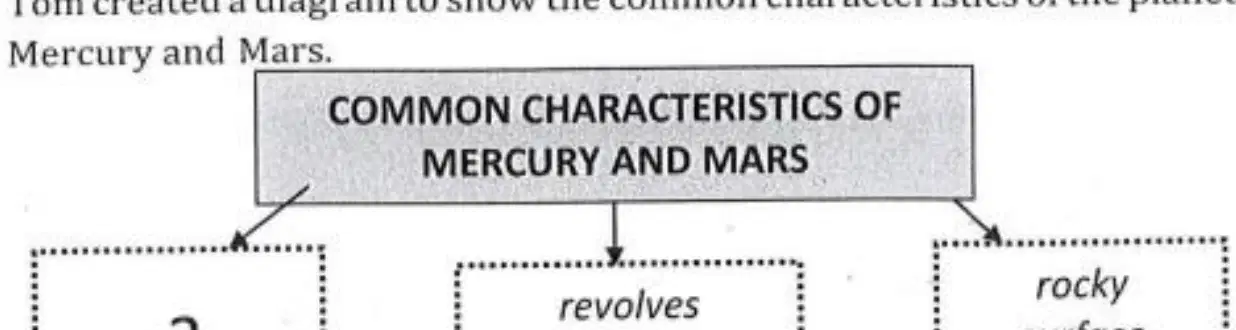
Tom created a diagram to show the common characteristics of the planets Mercury and Mars. Which common characteristic should Tom write in the empty space of the diagram?
made of gas and ice
rotates around the Sun
inner planets
located between the asteroid belt and Pluto
Pablo cannot break a mineral sample into pieces with his bare hands but observes that he can break it using a hammer and a chisel. What physical property of the mineral sample is Pablo investigating?
hardness
luster
color
cleavage
There are many different natural resources found on Earth. Which of the following can be described as a nonrenewable resource?
crude oil
water
wind
Sun
Which of the following gases do plants require to carry out the process of photosynthesis?
nitrogen
oxygen
carbon dioxide
helium
Jonathan performed an experiment to demonstrate the effect of temperature on dissolving rates. He placed tablets of the same mass in three beakers that contained the same volume of water. The water in each beaker had different temperatures, including 10°, 50°, and 90° F. Jonathan repeated the experiment five times. Which of the following best describes why Jonathan repeated the experimental trials five times?
Jonathan enjoyed experimenting on things that affect dissolving rates.
Jonathan wanted to impress the teacher by using more trials in his investigation.
Jonathan knew that a greater number of experimental trials would produce more reliable results.
Jonathan carried out five experimental trials so that he could publish his results as a scientific law.
Which of the following areas would lead to the greatest amount of soil erosion?
an area that has been urbanized for over 100 years
a heavy rainfall in an area with very few plants
a rock falling down a steep slope in a tropical rainforest
an area where soil conservation practices are utilized
Condensation is the process where water vapor rises, cools, and turns back into its liquid state. Which of the following is an example of condensation?
nine inches of snowfall
water on the blades of grass quickly disappear
continuous rainfall for three hours
water appears on the outside of a glass of cold water
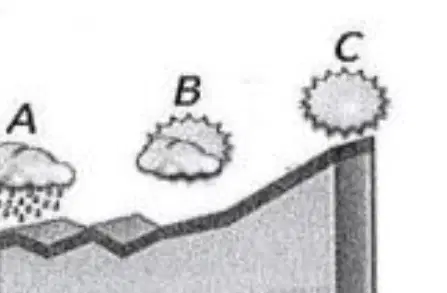
Which of the following best describes the barometric pressure at positions A, B, or C on the diagram below?
The air pressure is the highest at position A in the diagram
The air pressure is the highest at position B in the diagram
The air pressure is the lowest at position A and the highest at position C
The air pressure is the same at positions A, B, and C
Environmental conditions are crucial to the survival of organisms. For example, when seasonal conditions change, animals such as geese, salmon, and whales travel long distances in search of a new habitat. Which of the following terms is used for this type of adaptation?
migration
hibernation
camouflage
socialization

Ms. Stokes's fifth grade class assignment was to have students identify liquid water from the substances listed in the diagram below. Ms. Stokes gave the clue that 1 milliliter (ml) of water equals exactly 1 gram (g) of mass. Which of the following substances is most likely liquid water?
Substance #1
Substance #2
Substance #3
Substances #2 and #3
Which of the following is best used for separating one mixture from another?
similarities in physical properties
similarities in chemical properties
differences in chemical properties
differences in physical properties
Which of the following describes a chemical change that is affected by temperature?
burning coal for the production of electricity
chopping wood from a tree trunk
melting gold into a piece of jewelry
water evaporating from a plant leaf
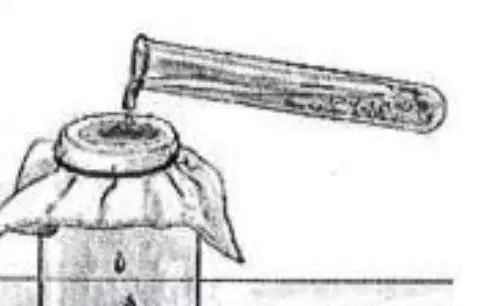
Mixtures can be separated through a variety of methods. Which of the following methods is most likely being demonstrated in the picture below?
a mixture being separated with a sieve
a mixture separated based on magnetic attraction
the separation of liquids from solids through filtration
the separation of liquids from solids through manual sorting
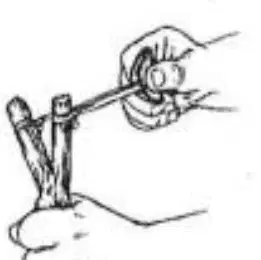
Energy has the ability to cause motion or create change. There are several forms of energy that allow an object or system to do work on another object or system. Which of the following is the form of energy being illustrated in the picture below?
electrical energy
heat energy
chemical energy
mechanical energy
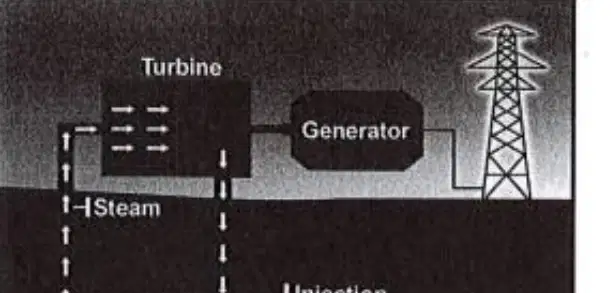
Which of the following best describes the motion involved in harnessing geothermal energy to be used to power homes and businesses?
moving water generates a strong gravitational force used to produce electricity
moving steam generated from the heat in the ground produces electricity
moving forces of wind are used to produce mechanical energy
moving electromagnetic waves create radiant energy that produces heat and electricity
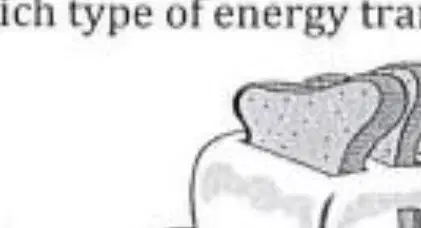
Which type of energy transformation is represented by the toaster below?
electrical to sound energy
electrical to light energy
electrical to mechanical energy
electrical to heat energy
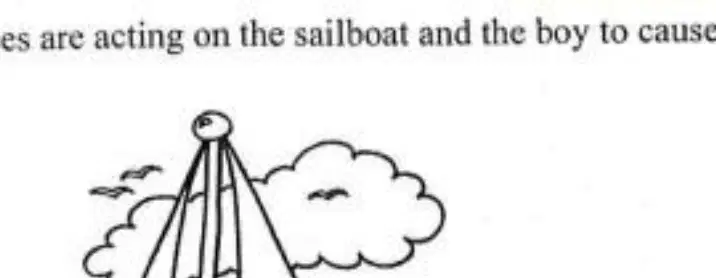
Which forces are acting on the sailboat and the boy to cause the boat to move forward?
The pull of gravity on the boy
The push of the wind against the sails on the boat
The push of the boat against the boy
A, B, and C
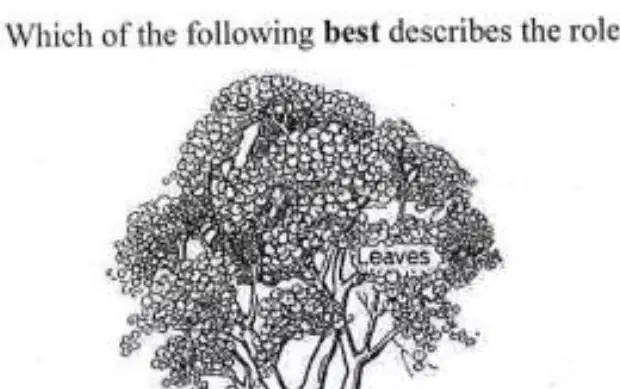
Which of the following best describes the role of the plant roots?
to hold up the leaves for energy absorption
to take in carbon dioxide and release oxygen
to develop into new plants
to absorb water and nutrients from the soil
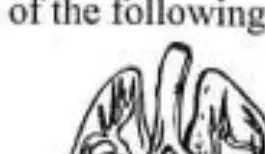
Which of the following best identifies the organ below and its function in the human body?
Stomach: responsible for breaking down food
Pancreas: responsible for making enzymes and hormones
Heart: responsible for pumping blood throughout the body
Lungs: responsible for pulling in oxygen and releasing carbon dioxide
Plants and animals both have physical structures which provide support to the organism. Which two organs listed below provide support to plants and animals?
waxy coverings and skin
stems and skeletal systems
xylem and arteries
stomata of the leaves and lungs or gills
Which of the following best describes the difference between the life cycle of flowering and non-flowering plants?
Flowering plants: pollination, seeds produce flowers, seeds contain embryos, embryos grow into new plants. Non-flowering plants: produce flowers and seeds.
Flowering plants: produce no flowers, no seeds (in most cases), yet they reproduce into new plants. Non-flowering plants: pollination, flowers produce seeds, seeds contain embryos, embryos grow into new plants.
Flowering plants: pollination, flowers produce seeds, seeds contain embryos, embryos grow into new plants. Non-flowering plants: produce no flowers, no seeds (in most cases), yet they reproduce into new plants.
There are no differences between flowering and non-flowering plants.
The Sun provides the energy to producers in the food chain. Which of the following describes the transfer of energy from the producer to the consumer?
from the caterpillar to the oak leaf
from ground beetle to the shrew
from the Sun to oak leaf
from oak leaf to caterpillar
A chemist places a solution into a beaker half-filled with an unknown liquid. Which of the following would be an indicator that a chemical change has occurred?
the mixture produces a color change
the liquids separate into two layers
the mixture hardens and forms a solid
the glass beaker cracks into several pieces
A shipping company has two boxes that are the same size. Both boxes are filled with the exact same cotton balls. Box 1 has twice as many cotton balls as Box 2. Which statement correctly describes the two boxes of cotton balls?
The two boxes of cotton balls have the same mass.
The two boxes of cotton balls have the same volume but different masses.
The two boxes of cotton balls have the same mass and volume.
The two boxes of cotton balls have different masses and volumes.

Birds' beaks are used to help them obtain food and are shaped according to what the bird eats. Which of the following best describes this type of adaptation?
migrations
hibernations
physical adaptations
seasonal changes
Water is a major agent of change on Earth. Which of the following processes does rainwater go through to cause rocks to break apart?
Freezing and expanding
melting and contracting
condensing and expanding
evaporating and contracting
A food chain shows how living things rely on each other for food and how energy is moved from one living thing to another. Which of the following best describes the role of the corn in this food chain?
decomposer
consumer
producer
herbivore
Which of the following is the substance that decomposers return to the Earth?
oxygen
carbon dioxide
nutrients
water
Which of the following best explains why the pencil looks different when placed in the glass of water?
the wavelength of light gets longer as it passes through the water
Light cannot pass through the glass of water
The amount of light increases as it passes through glass
Light is refracted at an angle as it moves from a gas to a liquid
Which of the following best explains what will happen when two magnets below are placed closer together?
The like poles of the magnets will attract each other.
The like poles of the magnets will repel each other.
The opposite poles of the magnets will attract each other.
The opposite poles of the magnets will repel each other.
Which of the following statements describes the planet Mars?
It is bigger than Earth and farther from the Sun.
It is bigger than Earth and closer to the Sun.
It is smaller than Earth and farther from the Sun.
It is smaller than Earth and closer to the Sun.
Earth has many types of climate zones. The map below shows the temperate climate zones found near the equator. Which of the following best describes this type of climate zone?
Tropical heat and arctic cold
low temperatures and precipitation formed as ice
direct sunlight and rainy days
no sunlight and year-round darkness
According to the Sun and Earth Cycle diagram on your paper, what are the correct phases of the Moon around the Sun?
Full Moon, first Quarter, New Moon and Third Quarter
New Moon, third Quarter, Full Moon, and Fourth Quarter
First Quarter, New Moon, Second Quarter, and Full Moon
New Moon, First Quarter, Full Moon, and Third Quarter
The diagram shows the gases that enter and leave a plant during the process of photosynthesis. Which gases do arrows A and B represent?
Arrow A is nitrogen, and arrow B is oxygen
Arrow A is oxygen, and Arrow B is nitrogen
Arrow A is oxygen, and arrow B is carbon dioxide
Arrow A is carbon dioxide, and arrow B is oxygen.
Veronica made this model of the Sun-Earth-Moon system using a cherry for the Moon, an apple for the Sun, and a watermelon for the Earth. How could Veronica improve her model?
Use the cherry to represent the Sun and the apple for the Moon
Use a piece of string for the Earth
Make the Moon larger than the Earth
Use the watermelon to represent the Sun and the apple for the Earth.
The diagram for this question illustrates two instruments used in weather forecasting. Which of the following best describes the weather instruments in the diagram.
hygrometer and compass
wind vane and rain gauge
thermometer and rain gauge
anemometer and barometer
What process is most likely responsible for the steep carvings of the canyon?
Flowing water eroded the rocks slowly over many years.
Hot magma melted the rock slowly over many years.
Strong winds eroded the rock layers over time.
One massive flood carved out the rocks.
Which organism in the table on your paper is sorted incorrectly?
The snake is in the wrong category; it is a vertebrate.
The bee is in the wrong category; it is a vertebrate.
The crab is in the wrong category; it is a vertebrate.
The stork is in the wrong category; it is an invertebrate.
Which statement best describes the diagram of the Earth-Moon-Sun system seen on the diagram in your packet?
The Earth is rotating around the Sun, and the Moon is rotating around the Earth.
The Sun is rotating around the Earth, and the Moon is rotating around the Earth.
The Earth is revolving around the Sun, and the Moon is revolving around the Earth.
The Sun is revolving around the Earth, and the Moon is revolving around the Earth.
Which of the following bodies is the closest star to Earth?
the Sun
the moon
Polaris
Orion
Chemical energy involves the reaction of molecules. Which activity is NOT an example of chemical energy?
burning a piece of coal
lunch being digested in the stomach
sunbathing on a beach
turning on a gasoline-powered lawnmower
Which of the following best describes how air rising over a mountain produces precipitation?
cold air rises, expands, and warms
cold air rises, compresses, and warms
hot air rises, expands and cools
hot air rises, compresses and cools
A control group is important to every investigation because it is the comparison to the variable being tested. Which of the following represents a control group?
plants grown in a garden with experimental compost
plants grown in a garden with a newly developed lighting system
plants grown in a garden without changing any of the factors required for the growing process
plants grown in a garden using various mixtures of potting soils and fertilizers
Which statement best explains why there are fewer carnivores living in the tundra than in the desert?
the frozen ground of the tundra keeps plants from taking root in the soil.
the warm forests of the tundra receive too much rainfall.
there is too much energy available at the producer level.
There are too many resources available to carnivores in the tundra.
Which of the following is an example of weathering?
rocks being moved by landslides
sand being carried down the beach
soil being carried in a fast-moving river
rocks being broken apart by rainwater
Which BEST describes the function of the esophagus?
It carries oxygen from the nose to the stomach
It carries food from the mouth to the stomach
It carries food from the stomach to the mouth
It carries food from the stomach to the intestines
Which of the following is the BEST explanation for the migration of Bighorn Sheep, during the winter, from the top of the Rocky Mountains to the lower ranges of the mountains?
Very little vegetation is left at the top of the mountain
Very few animals remain at the top of the mountain
Very few predators remain at the top of the mountain.
very few decomposers remain at the top of the mountain.
Which factor most likely slows down a rolling marble on a concrete surface?
the pull of gravity on the marble
the air resistance against the marble
balanced forces on the marble
the friction between the marble and the concrete floor
Which living organisms in the diagram of the ecosystem use the energy from sunlight to make their own food?
the beetle
the ant
the berries
the muskrat
Use the table in your booklet to answer questions 54 and 55
A student measured and recorded the growth of two bean plants every three days for 15 days. According to the data table, which problem is being tested?
Do bean plants grow better when watered every three days?
Do electric fields affect the growth of bean plants?
Does fertilizer added to the soil lead to taller bean plants?
How tall do bean plants grow?
Based on the data collected in the table, which of the following statements is the BEST conclusion for this experiment?
Bean plants grow best with lots of water and sunlight.
Exposing bean plants to electric fields does not affect plant growth.
Exposing bean plants to electric fields doubles growth.
It takes fifteen days to grow bean plants.

