
NEW
Font size
S
M
L
XL
 Worksheets
SY 25-26 Q1 - Benchmark Review
Total questions: 52
Worksheet time: 4hrs 20mins
Name
Class
Date
1.
A1.F-IF.A.2
A gym charges a $30 membership fee plus $15 per class. The total cost is given by C(x)=30+15x, where x is the number of classes.
If you spend $120, how many classes did you take?
a)
4
b)
5
c)
6
d)
7
2.
A1.F-IF.A.2
A water tank is being filled at a constant rate. The amount of water after t minutes is W(t)=5t+120 liters.
How much water is in the tank after 25 minutes?
a)
125 L
b)
245 L
c)
230 L
d)
250 L
3.
A1.F-IF.A.2
A concert ticket seller earns a flat fee of $50 plus $8 for every ticket sold. The total earnings are given by E(t)=50+8t, where t is the number of tickets.
If the seller earned $186, how many tickets did they sell?
a)
15
b)
16
c)
17
d)
18
4.
A1.F-IF.A.2
f(x)=2x+3 represents the cost of buying x sandwiches.
What is the cost of 5 sandwiches?
a)
11
b)
12
c)
13
d)
14
5.
A1.F-IF.A.2
The taxi fare is given by C(m)=4+3m, where m is the number of miles.
What is the fare for 6 miles?
a)
18
b)
20
c)
21
d)
22
6.
A1.F-IF.A.2
A dog gains w(t)=5t+10 pounds after t months.
How much does the dog weigh after 4 months?
a)
20
b)
25
c)
28
d)
30
7.
A.1.F-IF.A.1
A set of ordered pairs representing a function is shown {(4,6) , (-2,5), (1,3)}. Identify is the domain of the function?
a)
{-2 , 1}
b)
{3,5,6}
c)
{-2,1,4}
d)
{-2,1,3,4,5,6}
8.
A.1.F-IF.A.1
A function of x consisting of three ordered pairs of the form (x,y) is shown. {(2,4),(3,6), (5,-8)}. Identify the domain of the function?
a)
{2,3,5}
b)
{4,6,-8}
c)
{2,3,6,-8}
d)
{2,3,5,6, -8}
9.
A.1.F-IF.A.1
Each set of ordered pairs shown represents a function {(-5,9) , (1,8) , (-7, 10)}. Identify the range of the function.
a)
{-5,1,-7}
b)
{8,9,10}
c)
{1, 8, 9}
d)
{1, -5, 9, 10}
10.

A1.F-IF.A.1
The graph of a function is shown below. Which number is an element of the domain of the function?
a)
-4
b)
-2
c)
0
d)
4
11.
A1.F-IF.A.1
Which graph represents a function?
a)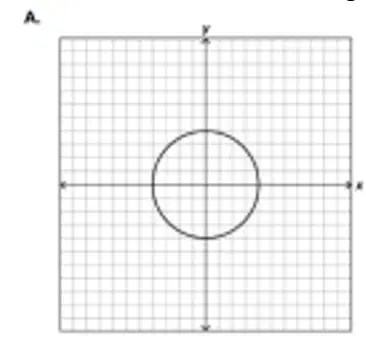
Option 1
b)
Option 2
c)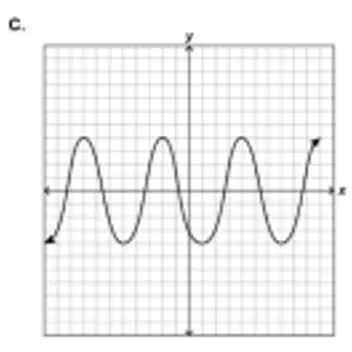
Option 3
d)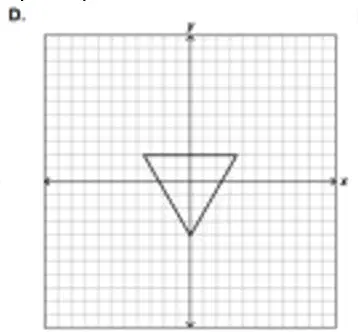
Option 4
12.
A1.F-IF.A.3
If the first term of an arithmetic sequence is 3 and the common difference is 4, what is the 10th term?
a)
39
b)
40
c)
43
d)
47
13.
A1.F-IF.A.1
Which graph represents a function?
a)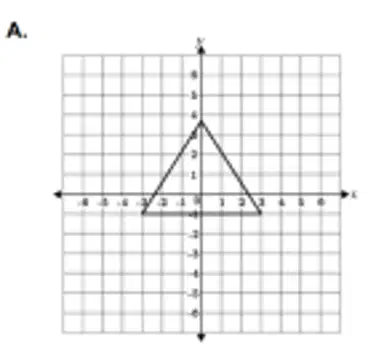
Option 1
b)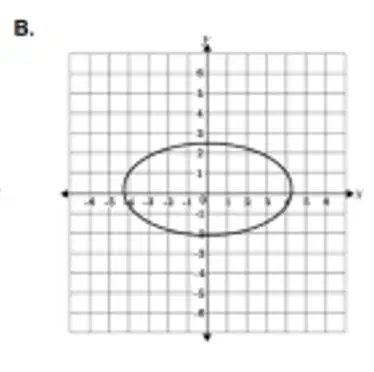
Option 2
c)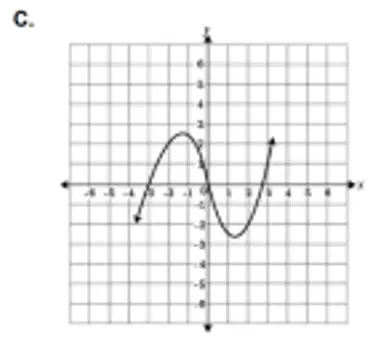
Option 3
d)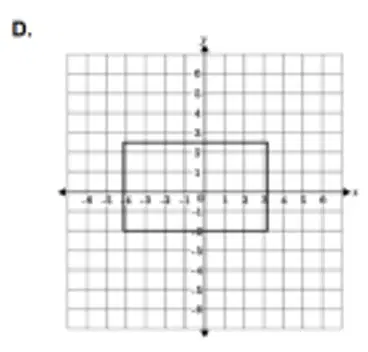
Option 4
14.
A1.F-IF.A.3
If the first term of the arithmetic sequence is -9 and the common difference is 12, then what is the 11th term of the sequence?
a)
111
b)
123
c)
135
d)
147
15.
A1.F-IF.A.3
If the first term of the arithmetic sequence is 7 and the common difference is -5, then what is the 14th term of the sequence?
a)
-58
b)
58
c)
72
d)
67
16.
A1.F-IF.A.3
If the first term of the arithmetic sequence is 3 and the 6th term is 43, then what is the common difference of the sequence?
a)
8
b)
7
c)
6
d)
5
17.
A1.F-IF.A.3
What is the 9th term of the sequence (5x+9)?
a)
63
b)
72
c)
45
d)
54
18.
A1.F-IF.A.3
Identify the 21st term of the sequence (185 – 3n)?
a)
122
b)
125
c)
119
d)
128
19.
A1.F-IF.A.3
Solve for the 8th term of the sequence: 4n – (2n – 1)?
a)
11
b)
6
c)
18
d)
17
20.
A1.F-IF.A.3
Create the explicit formula for the sequence: 2, 8, 14, …
a)
Option 1
b)
Option 2
c)
Option 3
d)
Option 4
21.
A1.F-IF.A.1
The four sets of ordered pairs shown represent four different functions.
Set 1
{(2, 4), (−3, 2), (5,−1), (1,−5), (4, 0)}
Set 2
{(6, 4), (2,−6), (4,−8), (−9,−5), (0, 3)}
Set 3
{(−5, 4), (2,−4), (4,−7), (1,−5), (6,−2)}
Set 4
{(7, 0), (5,−1), (6,−3), (2,−5), (−9, 0)}
If the ordered pair (−9,−1) is added to each set, select all of the relations which will still be functions.
a)
1 and 3
b)
2 and 4
c)
1 and 4
d)
2 and 3
22.
A1.F-IF.A.3
Given the sequence: 25, 21, 17, 13,...
Write the explicit equation that models the sequence.
a)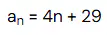
Option 1
b)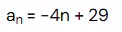
Option 2
c)
Option 3
d)
Option 4
23.
A1.F-IF.A.1
Given the relation: (2,5),(3,7),(4,9),(5,11), what is the domain?
a)
{5,7,9,11}
b)
{2,3,4,5}
c)
{3,4,5,7}
d)
{2,5,3,7}
24.
A1.F-IF.A.1 Given the mapping diagram below, what is the range? Input:
1→4
2→5
3→6
a)
{1,2,3}
b)
{1,2,3,4,5,6}
c)
{4,5,6}
d)
{2,4,6}
25.
A1.F-IF.A.1 Given the chart below, what is the domain? x y
0 2
1 4
2 6
3 8
a)
{2,4,6,8}
b)
{0,1,2,3}
c)
{0,2,4,6}
d)
{1,2,3,4}
26.
A1.F-IF.A.1 Is the given relation, a function?
Why? {(-2, 6), (-1, 6), (0, 3), (1,5)}
a)
Yes, each individual x-value maps to an individual y-value.
b)
Yes, all sets of ordered pairs are functions.
c)
No, both -2 and -1 map to 6
d)
No, a relation is not a function.
27.
A1.F-IF.A.1
A function of x contains the five ordered pairs of the form (x, y). Four of these points are given below. (-2, 7), (0, 3), (1, -4), (5, -2) Which ordered pair could represent the fifth point?
a)
(1, 9)
b)
(5, 7)
c)
(3, -4)
d)
(0, -8)
28.

A1.F-IF.A.1
Which statement is true?
a)
Only Graph A is a function.
b)
Only Graph B is a function.
c)
Both graphs are functions.
d)
Neither graph is a function
29.
A1.F-IF.A.1
Which graph passes the Vertical Line Test?
a)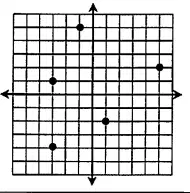
Option 1
b)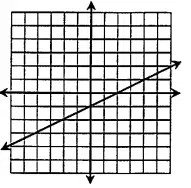
Option 2
c)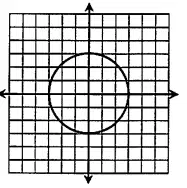
Option 3
d)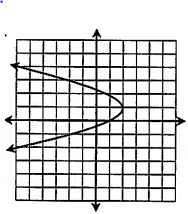
Option 4
30.
A1.F-IF.A.1
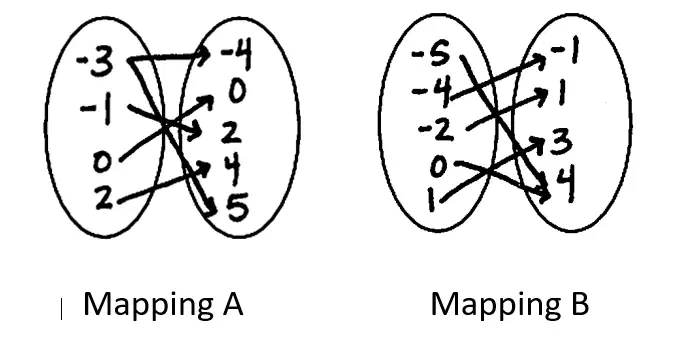
Which mapping shows a function?
a)
Mapping A
b)
Mapping B
c)
Both Mapping A and Mapping B
d)
Neither Mapping A nor Mapping B
31.
A1.F-IF.A.1
Is the relation a function? Why?
{(-5,-5), (-3,-3), (0,0), (3,3), (5,5)}
a)
No, the ordered pairs repeat the same value for both x and y.
b)
No, there are too few ordered pairs to be a function.
c)
Yes, each y-value is unique.
d)
Yes, each x-value is unique.
32.
A1.F-IF.A.3
An arithmetic sequence is given below.
2, 9, 16, 23, …
Which is the explicit formula for the nth term?
a)
Option 1
b)
Option 2
c)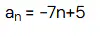
Option 3
d)
Option 4
33.

A1.F-IF.A.3
Below are different sequences of numbers. Which ones are considered arithmetic, and what is the correct reason?
a)
1, 2, and 4 — because each has the same difference between consecutive terms.
b)
1 and 3 — because both increase in a predictable way.
c)
2 and 4 — because they both decrease at a constant rate.
d)
1, 2, and 3 — because all three follow a rule for generating terms.
34.

A1.F-IF.A.3
Find the first five terms of the sequence given the rule below.
a)
2, 5, 8, 11, 14
b)
2, 3, 4, 5, 6
c)
2, 6, 10, 14, 18
d)
2, 4, 6, 8, 10
35.
A1.F-IF.A.3
The function below describes an arithmetic sequence, where A(n) is the nth term and n is the term number.
A(n) = 6 + 3(n - 1)
Which table best fits the sequence?
a)
Option 1
b)
Option 2
c)
Option 3
d)
Option 4
36.
A1.F-IF.A.3
An arithmetic sequence is given by:
−33,−24,−15,−6,…
What are the next three terms in the sequence?
a)
-1, 7, 15
b)
3, 12, 21
c)
-5, 2, 9
d)
-65, -73, -81
37.
A1.F-IF.A.3
A new employee starts with a salary of $28,000. Every year, they receive a raise of $1,800. What will be their salary in the 8th year?
a)
$41,400
b)
$42,600
c)
$43,400
d)
$40,600
38.
A1.F-IF.A.3
A concert sells 500 tickets on the first day. Every day, sales increase by 50 tickets. How many tickets are sold on the 12th day?
a)
1,000
b)
1,050
c)
1,100
d)
1,150
39.
A1.F-IF.A.3
A recovering heart attack patient is told to get on a regular walking program. The patient is told to walk a distance of 5 km the first week, 8 km the second week, 11 km to the third week, and so on. How many miles will the patient walk during the 10th week?
a)
32 km
b)
29 km
c)
36 km
d)
42 km
40.
A1.F-IF.A.3
Consider the sequence:
4,9,14,19,…
Classify the sequence as arithmetic or geometric, and identify its common difference or ratio.
a)
Arithmetic sequence with d = 4
b)
Arithmetic sequence with d = 5
c)
Geometric sequence with r = 1/5
d)
Geometric sequence with r = 5
41.

A1.F-IF.A.2
a)
-1
b)
-9
c)
-7
d)
-3
42.
A1.F-IF.A.2
Given the function f(x) = 2x+7, what is f (3)?
a)
13
b)
14
c)
17
d)
20
43.
A1.F-IF.A.2
What is f(0) for the function f(x) = −4x+12?
a)
12
b)
0
c)
-12
d)
4
44.
A1.F-IF.A.2
For the function f(x) = 5 − 2x, what is f (4)?
a)
3
b)
-6
c)
-7
d)
-3
45.

A1.F-IF.A.2
a)
10
b)
12
c)
8
d)
14
46.
A1.F-IF.A.2
A function H(d) = 2d + 5 models the height H in centimeters of a plant after d days. What is the height of the plant after 7 days?
a)
19 cm
b)
21 cm
c)
23 cm
d)
29 cm
47.
A1.F-IF.A.2
The function G(s) = 10s + 50 represents a student’s grade G after s hours of study. If a student studies for 3 hours, what is their grade?
a)
80
b)
90
c)
100
d)
110
48.
A1.F-IF.A.2
The function V(y) = 20000 − 1500y represents the value V of a car y years after purchase. What is the value of the car after 4 years?
a)
$8,000
b)
$10,000
c)
$12,000
d)
$14,000
49.
A1.F-IF.A.2
Given g(x) = 4x - 7 and g(x) = 13, find x.
a)
g(-9) = 29
b)
x = 5
c)
g(-9) = -43
d)
x = 5/4
50.
A1.F-IF.A.2
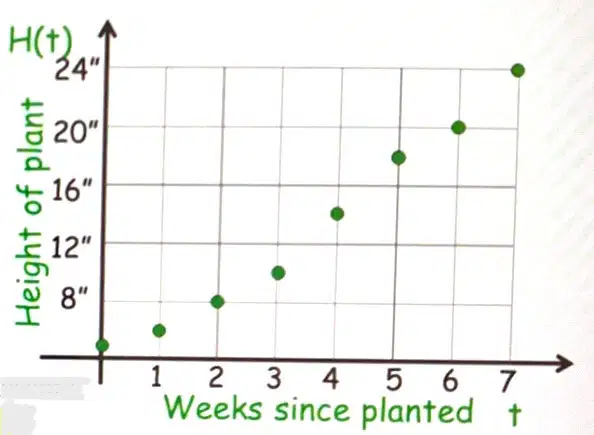
Based on the given figure, what does ℎ(5) = 18 represent?
a)
The height of the plant after 5 weeks is 18 inches
b)
The height of the plant after 18 weeks is 5 inches
c)
The height of the plant is 5 inches after 18 weeks
d)
The height of the plant is dependent on the week it was planted
51.
A1.F-IF.A.2
A factory produces widgets according to W(d)=250d+600, where d is the number of days.
How many widgets are made after 14 days?
a)
3000
b)
4000
c)
4100
d)
4200
52.
A1.F-IF.A.2
A bus rental costs $150 plus $12 per person. The total cost is modeled by C(p)=150+12p.
If the total cost is $246, how many people rode the bus?
a)
6
b)
7
c)
8
d)
9
Reset

