
 Worksheets
A2 Physics Mega Quiz
Total questions: 498
Worksheet time: 11hrs 19mins
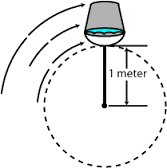
Centrifugal force is a ______
force that pushes you to the outside of a circle during uniform circular motion.
fictitious force that is really just the linear motion of an object in uniform circular motion.
The force that keeps the planets in orbit
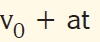
What is the velocity formula for uniform circular motion?


A) No, if the speed is constant then the acceleration is equal to zero. B) No, an object can accelerate only if there is a net force acting on it.
C) Yes, although the speed is constant, the direction of the velocity can be changing.
D) Yes, if an object is moving it can experience acceleration
A) Both vectors point in the same direction.
B) The vectors point in opposite directions.
C) The vectors are perpendicular.
D) The question is meaningless, since the acceleration is zero
A) in the same direction as the velocity vector.
B) in the opposite direction of the velocity vector.
C) is directed toward the center of the circular path. D) is directed away from the center of the circular path.
B) in the opposite direction of the motion of the object.
C) is directed toward the center of the circular path. D) is directed away from the center of the circular path.
Which law determines the direction of an object's velocity as it is moving in uniform circular motion?
Newton's First Law
Newton's Second Law
Newton's Third Law
The Universal Law of Gravitation
Which law determines the direction of an object's acceleration as it is moving in uniform circular motion?
Newton's First Law
Newton's Second Law
Newton's Third Law
The Universal Law of Gravitation
The term centripetal means
circular motion
center accepting
center seeking
center fleeing
The term centrifugal means
circular motion
center accepting
center seeking
center fleeing
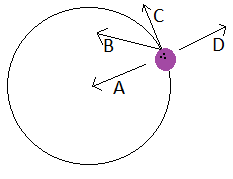
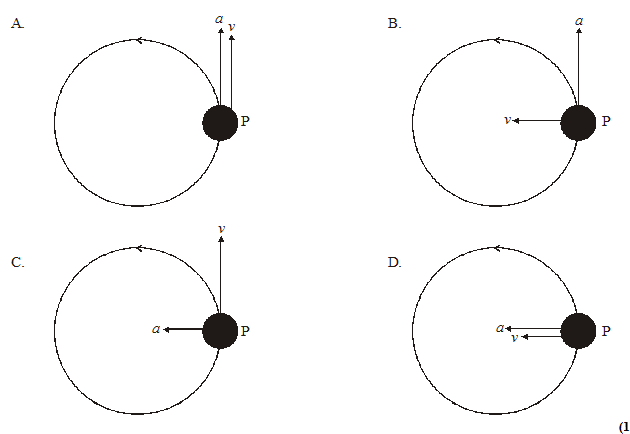
A 10kg car travels at a constant speed of 20.0 m/s around a horizontal circular track. Which diagram correctly represent the direction of the car's velocity (v) and the direction of the centripetal force (Fc) acting on the car at a particular moment?


Identify the force that determines the centripetal force as a car is turning a corner.
Friction Force
Tension Force
Normal Force
Centripetal Force


A tennis ball on a string is spun clockwise around a circle. After the string breaks, which path will the tennis ball follow?
Path I
Path II
Path III
Path IV
•A student on an amusement park ride moves in a circular path with a radius 3.5 m once every 8.9s. The student moves at an average speed of
0.39 m/s
1.2 m/s
2.5 m/s
4.3 m/s
Is the centrifugal force a real force acting on your body in the gravitron?
Yes, you are pushed outwards from the center
No, it just feels like you are being pushed out, but no force is actually pushing you outwards
Maybe...
Bigfoot is always the answer

A body, B, is moving at constant speed in a horizontal circular path around point P. Which diagram shows the direction of the velocity (v) and the direction of the centripetal force (Fc) acting on the body?
1
2
3
4
•What is the centripetal acceleration of a toy ball on the end of a 1.44 meter long string if it is moving at 12 meters per second?
0.12 m/s^2
8.33 m/s^2
0.173 m/s^2
100 m/s^2
•What is the centripetal acceleration acting on a 2000 kilogram airplane if it turns with a radius of 1000 meters while moving at 300 meters per second?
180,000 m/s^2
0.3 m/s^2
90 m/s^2
600 m/s^2
•What is the centripetal force acting on a 2000 kilogram airplane if it turns with a radius of 1000 meters while moving at 300 meters per second?
90000N
600N
1.8x10⁵N
1.77x10⁶N
in the direction of the object's motion
in the opposite direction of the object's motion
towards the center of the circle
towards the outside of the circle
Newton's law of gravitation
Kepler's first law
Kepler's second law
Kepler's third law
In Fields, The constant of proportionality, G, is called the
gravitational field strength
universal constant of gravitation
Gibb's free energy
acceleration due to gravity
The units of G are
N m2 kg2
N m−2 kg−2
N m2 kg−2
N m−2 kg2
Newton's Law of Gravitation assumes the masses are point masses. This means that the masses have zero (a)
The value of G is
6.67x10⁻¹¹
6.67x10¹¹
6.67x10⁻¹
6.67x101
True or false:
m s−2 = N kg−1True
False
True or false:
You and the Earth exert an equal magnitude gravitational force on each other.
True
False
The path which a small mass would follow towards a large mass is called the line of force or (a)
The symbol for gravitational field strength is
GF
gfs
g
G
The unit for gravitational field strength is
N s−2
N kg−1
m s−2
N kg
Which definition is correct?
Gravitational potential energy is the energy of an object due to its position in a gravitational field.
Gravitational potential energy is the energy of an object due to its position in a magnetic field.
Gravitational potential energy is the energy of an object due to its position in a field.
Gravitational potential energy is the acceleration of an object due to its position in a gravitational field.
The gravitational potential energy is zero at
just above the surface
the surface
infinity
just before infinity
The gravitational potential, V, at a point is the work done to move a small object from (a) to that point
Surfaces of constant potential are called
(a)
True or false:
True
False
Which equation shows the gravitational potential, V?
V = − r2G M
V = − rG M
V = r2G M
V = rG M
The radius of the Earth is 6400 km
The mass of the Earth is 6 x 1024 kg
G = 6.67 x 10⁻¹¹ N m2 kg−2
Which is the correct approximation for the escape velocity of the Earth?
12.0 km s−1
11.5 km s−1
11.2 km s−1
10.8 km s−1
What is the time period of a geostationary satellite?
24 h
12 h
0 h
6 h
Two isolated masses m1 and m2 are separated by a distance r. Which expression gives the gravitational field strength caused by m1 at m2?
G m1m2 / r
G m1 m2 / r2
G m1 / r2
G m2 / r2
What is numerically equal to the gravitational field strength at a point P on the Earth's surface?
the acceleration of free fall at P.
the change in potential energy per unit distance from P.
the force acting on any body placed at P.
the work done in bringing unit mass from infinity to P.
Which statement about a uniform gravitational field is true?
Its magnitude is the same in all directions.
The gravitational potential has the same value at all points within it.
Its direction is opposite to the direction of motion of a test mass released in it.
Its field strength is the same at all points within it.
At the Earth's surface, the gravitational field strength is about lO N kg-1. At a point outside the Earth and a distance x from its centre, the field strength is about 5 N kg-1. Which expression gives an approximate value for the radius of the Earth?
x/5
x / 2 √2
x / 2
x / √2
The gravitational potential energy is zero at
just above the surface
the surface
infinity
just before infinity
Which equation shows the gravitational potential, V?
V = − r2G M
V = − rG M
V = r2G M
V = rG M
Consider a body of mass m which needs to be moved from an orbit of radius 2R to 3R. What is the energy required
GMm/R
GMm/R2
GMm/6R2
GMm/6R
At the Earth's surface, the gravitational field strength is about lO N kg-1. At a point outside the Earth and a distance x from its centre, the field strength is about 5 N kg-1. Which expression gives an approximate value for the radius of the Earth?
x/5
x / 2 √2
x / 2
x / √2
Gravitational potential energy, 𝑈 stored in a test mass 𝑚 placed at a distance 𝑟 from the center of planet 𝑀 is defined as the ____________ by gravitational force in bringing a test mass from infinity to that point.
energy
power
velocity
work done
Gravitational PE= (a) x mass
Which equation represents general gravitational potential energy?
Eg = GMm/r2
Eg = -GMm/r2
Eg = GMm/r
Eg = -GMm/r
As the distance between an object and Earth increases,
the gravitational constant G increases
the gravitational constant G decreases
the gravitational potential energy relative to Earth approaches infinity
the gravitational potential energy relative to Earth approaches zero
Planet N has a gravitational potential –V at its surface. Planet M has double the density and double the radius of planet N. Both planets are spherical and have uniform density.
What is the gravitational potential at the surface of planet M?
–16V
–8V
–4V
–0.2V

X and Y are two stars of equal mass M. The distance between their centres is d.
What is the gravitational potential at the mid-point P between them?


Which one of the following could be a unit of gravitational potential?
N
J
N kg–1
J kg–1
Mars has a diameter approximately 0.5 that of the Earth, and a mass of 0.1 that of the Earth.
The gravitational potential at the Earth’s surface is −63 MJ kg–1.
What is the approximate value of the gravitational potential at the surface of Mars?
−13 MJ kg–1
−25 MJ kg–1
−95 MJ kg–1
−320 MJ kg–1

For an ideal gas several assumptions are made about the particles including
they collide elastically with each other and the container wall
they experience significant intermolecular forces
the volume they occupy as individual particles is insignificant compared to the volume of the container
there are a very large number of particles inside the container
An ideal gas has a density of 2.0 kgm-3 at a pressure of 2.2 x 10⁵ Pa and a temperature of 295 K. Calculate the mean square speed of the gas atoms.
330 kms-1
110 000 ms-1
373 ms-1
19 ms-1

In the equation of state for an ideal gas pV = nRT
n = number of particles in the gas
p = pressure of the gas
R = the molar gas constant 8.31 JK-1mol-1
T = temperature in degrees celcius

This is the
root mean square speed
mean square speed
mean square root speed
squared root mean speed
Rewriting the equation of state gives : pV = NkT
where:
N = the number of moles x 6.022 x 10²³
V = volume occupied by the gas
T = temperature in degrees celsius
k = 1.38 x 10⁻² JK-1
Given the equation Ek = 3/2 kT, calculate the temperature of Helium atoms that are able to leave the atmosphere with a speed of 1.1 x 10⁴ms-1. The mass of an individual Helium atom is 6.6 x 10⁻²⁷kg. (k = 1.38x10⁻²³)
1.9 x 10⁴ K
1.9 x 10³ o C
1.5 x 10² K
200 K
The mean square speed of atoms of Neon gas at 273 K with density 0.900 kgm-3 is 3.4 x 10⁵ ms-1. Calculate the r.m.s. of the same gas at 546 K.
820 ms-1
680 000 ms-1
240 ms-1
340 000 ms-1
For an ideal gas at constant temperature and density ρ what effect would doubling the density have on the mean square speed?
none
mean square speed would double
mean square speed would halve
mean square speed would quadruple
For an ideal gas at constant temperature and pressure p at volume V, what affect would halving the pressure have on the volume?
volume would double
volume would halve
volume would triple
none
For an ideal gas trapped inside a container of fixed volume, which of these statements is true?
all particles are moving rapidly and randomly
particles exchange momentum with the wall over very short time frames
all particles are moving idly and haphazardly
the particle volume accounts for most of the space in the container
Select all true statements
nR = Nk
NA = 6.022 x 10²³
k = R/NA
3/2RT = NAEk
An ideal gas has a density of 2.0 kgm-3 at a pressure of 2.2 x 10⁵ Pa and a temperature of 295 K. Calculate the root-mean-square speed of the gas atoms.
570 ms-1
110 000 ms-1
373 ms-1
19 ms-1
Which of the following is the ideal gas equation?
pV = nRT
pT = nRV
pR = nRV
pn = VRT
How many atoms are there in a mole of helium gas?
6.02 × 10¹³
6.02 × 10²³
1.20 × 10¹⁴
1.20 × 1024
Which assumptions are made in the kinetic theory of gases?
No forces between molecules.
Volume of molecules is negligible.
Molecules move in sync all the time.
Molecules collide inelastically with each other.
A bar of gold has a mass of 1.00 kg. Calculate the number of moles of gold in the bar. (Relative atomic mass of gold = 197.)
1.97 × 10⁻³ mol
0.197 mol
5.08 mol
5.08 × 10⁻³ mol
In the equation
pV=31Nm<c2>
what is the origin of the factor 31 ?
molecules move in 1-dimensional space
molecules move in 2-dimensional space
molecules move in 3-dimensional space
molecules move in 4-dimensional space
What is the graph we'll get if we plot mean kinetic energy Ek of a molecule of an ideal gas against thermodynamic temperature T ?
straight line with positive gradient
straight line with negative gradient
quadratic curve
circle
The following gases are at the same temperature. Which molecule will have the slowest r.m.s. speed?
hydrogen
carbon dioxide
oxygen
helium
A bar of gold has a mass of 1.00 kg. Calculate the number of atoms of gold in the bar. (Relative atomic mass of gold = 197.)
3.1 × 1024
3.06 × 1024
5.08 × 10²³
3.08 × 10²²
All of the following are properties of ideal gases except:
Small amounts of energy are lost during collisions between gas molecules
Volume occupied by molecules is negligible compared to the volume occupied by the gas
Gas molecules do not interact with each other except during collisions
Gas molecules do not interact with each other except during collisions

How many diagrams showing relationships between pressure, volume, and temperature below is/are incorrect for ideal gases?
None
Only one
Only two
Only Three
At a given temperature T and pressure P, a person's lung holds a set volume of V of air. Given that air is roughly 20% oxygen, how many moles of oxygen are in his lungs?
0.2*(PT/RV)
5*(PT/RV)
0.2*(PV/RT)
5*(PV/RT)
Gases found in the environment are most likely to exhibit properties similar to that of ideal gases under conditions of:
low temperatures and high pressures
high temperatures and high pressures
high temperatures and low pressures
low temperatures and low pressures
Assume an experiment vessel which is well fitted with a piston. The airtight piston has negligible mass and can move up and down freely. There is 1 mol of an ideal gas contained within the vessel under the piston at pressure of 100 kPa. The piston rests at 10 cm from the base of the vessel. The pressure in the vessel increases to 200 kPa as force is applied to the piston. What would be the new resting position of the piston from the base of the vessel? Assume the temperature is held constant at 300 K throughout the experiment.
5 cm
2 cm
1 cm
8 cm
The behavior of which of these real gases will be reflected most closely with the ideal gas law?
CO2
Ar
CH4
He
Assuming ideal gas properties, which of the following occupies the most volume at 273 K and 1 atm of pressure?
One mole of hydrogen gas
They all occupy the same volume
One mole of oxygen gas
One mole of nitrogen gas
Atmospheric air is comprised, roughly, of 80% nitrogen and 20% oxygen. A 100 L sample of atmospheric air is kept at 300 K and 100 kPa. How many moles of oxygen molecules are found in this gas sample? Use R = 10 (L kPa)/(mol K)
4/5
2/3
3/2
1/5

Process B on the PV diagram is an ______________ process.
adiabatic
isobaric
isochoric
isothermal
which of the following laws is applicable for the behaviour of perfect gas...
Boyle's law
Charle's Law
Gas Lussac law
All of the above
A thermodynamic system where no exchange of heat takes place between system and surrounding is...
Isothermal process
Adiabatic process
Isobaric process
Isochoric process
dQ=dU+dW refers to which law of Thermodynamic?
(a)
A thermodynamic system where no exchange of heat takes place between system and surrounding is...
Isothermal process
Adiabatic process
Isobaric process
Isochoric process
Heating a closed, steel container is an example of an
Adiabatic process
Isovolumetric process
Isothermal process
Isobaric process
Which of the following equations is the equation for calculating the work done by a gas in a piston?
W=Fd
W=PΔV
ΔV=Ad
A=πr2
For an isovolumetric process, which of the following statements is correct?
a. Work, heat, and internal energy all undergo changes.
b. Work and heat balance each other, so that there is no change in internal energy.
c. No energy is transferred as heat; internal energy change is due to work.
d. No work is done; internal energy change is due to heat.
For an isothermal process, which of the following statements is correct?
a. Work, heat, and internal energy all undergo changes.
d. No work is done; internal energy change is due to heat.
c. Work and heat balance each other, so that there is no change in internal energy.
d. No energy is transferred as heat; internal energy change is due to work.
For an adiabatic process, which of the following statements is correct?
a. Work, heat, and internal energy all undergo changes.
b. Work and heat balance each other, so that there is no change in internal energy.
c. No energy is transferred as heat; internal energy change is due to work.
d. No work is done; internal energy change is due to heat.
Symbol that indicates that energy is released.
U
Q
-Q
W
In an adiabatic process, what equals zero?
Q
W
ΔU
T
The PV diagram for an adiabatic process looks similar to the PV diagram for...
... Isochoric process
...Isothermal process
... Isobaric process
It does not look similar to any of these charts
Pistons moving in a car is an example of an adiabatic process
True
False
In Isothermal process which property remains constant
Volume
Pressure
Concentration
Temperature
What is the name of the process in which pressure remains constant.
Isochoric process
Adiabatic process
Isobaric process
Isolated process
Process B on the PV diagram is an ______________ process.
adiabatic
isobaric
isochoric
isothermal
which of the following laws is applicable for the behaviour of perfect gas...
Boyle's law
Charle's Law
Gas Lussac law
All of the above
A thermodynamic system where no exchange of heat takes place between system and surrounding is...
Isothermal process
Adiabatic process
Isobaric process
Isochoric process
dQ=dU+dW refers to which law of Thermodynamic?
(a)
A thermodynamic system where no exchange of heat takes place between system and surrounding is...
Isothermal process
Adiabatic process
Isobaric process
Isochoric process
Heating a closed, steel container is an example of an
Adiabatic process
Isovolumetric process
Isothermal process
Isobaric process
Which of the following equations is the equation for calculating the work done by a gas in a piston?
W=Fd
W=PΔV
ΔV=Ad
A=πr2
For an isovolumetric process, which of the following statements is correct?
a. Work, heat, and internal energy all undergo changes.
b. Work and heat balance each other, so that there is no change in internal energy.
c. No energy is transferred as heat; internal energy change is due to work.
d. No work is done; internal energy change is due to heat.
For an isothermal process, which of the following statements is correct?
a. Work, heat, and internal energy all undergo changes.
d. No work is done; internal energy change is due to heat.
c. Work and heat balance each other, so that there is no change in internal energy.
d. No energy is transferred as heat; internal energy change is due to work.
For an adiabatic process, which of the following statements is correct?
a. Work, heat, and internal energy all undergo changes.
b. Work and heat balance each other, so that there is no change in internal energy.
c. No energy is transferred as heat; internal energy change is due to work.
d. No work is done; internal energy change is due to heat.
Symbol that indicates that energy is released.
U
Q
-Q
W
In an adiabatic process, what equals zero?
Q
W
ΔU
T
The PV diagram for an adiabatic process looks similar to the PV diagram for...
... Isochoric process
...Isothermal process
... Isobaric process
It does not look similar to any of these charts
Pistons moving in a car is an example of an adiabatic process
True
False
In Isothermal process which property remains constant
Volume
Pressure
Concentration
Temperature
What is the name of the process in which pressure remains constant.
Isochoric process
Adiabatic process
Isobaric process
Isolated process
A simple Pendulum has a period T on the earth. What is the Period T of this same pendulum on the moon, where the acceleration due to gravity is 1/6 that of the earth.
T/sqrt6
T/6
sqrt(6)*T
6T
A particle moves in a circular motion according to the functions x=Acos(wt) and y=Asin(wt), where A=2.0 meters and w=3.0 rad/second. What is the magnitude of the particles centripetal acceleration.
2 m/s^2
18 m/s^2
24 m/s^2
0 m/s^2
An enormous pendulum-driven clock, located on the earth, is set into motion by releasing its 10 meter long simple pendulum from a maximum angle of less then 10 degrees relative to the vertical. At what what approximate time t will the pendulum have fallen to a perfectly vertical orientation?
pi/10 seconds
pi/5 seconds
pi/4 seconds
pi/2 seconds
The mass m is attached to the bottom of a string of negligible mass and length L to form a simple pendulum. The mass is pulled back a small angle and released so that the pendulum swings back and forth with simple harmonic motion. Which of the following statements is true of this pendulum?
The acceleration of m is a minimum when displacement is a minimum.
The period of the pendulum varies as a function of m.
The Kinetic energy of the pendulum is a maximum when its displacement is a maximum.
The frequency of the pendulum varies with angle.
In simple harmonic motion, when is the speed the greatest?
When the potential energy is a maximum
When the displacement is a maximum
when the potential energy is zero
when the magnitude of the acceleration is a minimum
The total mechanical energy of a simple harmonic oscillating system is
zero as it passes the equilibrium point
a minimum when it passes through the equilibrium point
a non-zero constant
zero when it reaches the maximum displacement
A mass on a spring undergoes SHM. When the mass is at its maximum distance from the equilibrium position, which of the following statements about it are true?
Its speed is zero
Its acceleration is zero
Its kinetic energy is a maximum
Its total mechanical energy is zero
Two simple pendulum, A and B, are each 3.0 m long, and the period of a pendulum A is T. Pendulum A is twice as heavy as Pendulum B. What is the period of pendulum B.
T sqrt2
T/sqrt2
2T
T
An object is attached to a vertical sprig and bobs up and down between points A and B. Where is the object located when its kinetic energy is a maximum?
midway between A and B
at either A or B
one-fourth of the way between A and B
none of the above
A leaky faucet drips 40 times in 30.0 s. What is the frequency of the dripping?
1.6 Hz
0.63 Hz
1.3 Hz
0.75 Hz
What is Hooke’s Law?
Force is inversely proportional to displacement.
Force is directly proportional to displacement.
Force is inversely proportional to the square of displacement.
Force is directly proportional to the square of displacement.
Which equation defines Hooke’s Law?
F = x
F = k x
F = ½ k x
F = ½ k x2
Which equation defines Elastic Potential Energy?
U = x
U = k x
U = ½ k x
U = ½ k x2
Which equation defines work done by the spring?
U2 – U1
U2 + U1
U1 – U2
U1 + U2

What force causes the spring and block system to move back and forth?
Gravitational force
Friction
Spring force
External force

Which equation defines the acceleration of the spring and block system?
a=−kx
a=−mkx
a=kx
a=mkx
For a simple harmonic oscillator, which of the following pairs of vector quantities CAN’T both point in the same direction? (The position vector is the displacement from equilibrium.)
position & velocity
velocity & acceleration
position & acceleration
None of them.

In simple harmonic motion, the maximum displacement is called...
period
frequency
amplitude
position
In simple harmonic motion, the time to make one complete oscillation is called…
period
frequency
amplitude
position

At which position is the acceleration of an oscillating object equal to zero?
A
B
C
D
At which position is the kinetic energy of an oscillating object maximum?
A
B
C
D
A block on the end of a horizontal spring is pulled from equilibrium at x = 0 to x = A and released. What total distance does it travel in one full cycle of its motion?
½ A
A
2 A
4 A

Which equations defines the total energy of simple harmonic motion?
½ mv2
½ kx2
½ mv2 + ½ kx2
½ kA2
Which are true for Simple Harmonic Motion (SHM)?
The acceleration is constant.
The restoring force is proportional to the displacement.
The frequency is independent of the amplitude.
The energy is dependent on amplitude.
Resonance results in a/an increased
frequency
period
amplitude
restoring force
To get an oscillator into resonance, the driving force must
(select all that apply)
have a large amplitude
be applied at the natural frequency of the oscillator
have a very high frequency

Refer to the graph below of the displacement x versus time t for a particle in simple harmonic motion. Which of the following graphs shows the kinetic energy K of the particle as a function of time t for one cycle of motion?


A block on a horizontal frictionless plane is attached to a spring, as shown below. The block oscillates along the x-axis with simple harmonic motion of amplitude A.
Which of the following statements about the block is correct?
At x = 0, its velocity is zero.
At x = 0, its acceleration is at a maximum.
At x = A, its Force is at a maximum
At x = A, its velocity is at a maximum.
At x = A, its acceleration is zero.
A block on a horizontal frictionless plane is attached to a spring, as shown below. The block oscillates along the x-axis with simple harmonic motion of amplitude A.
Which of the following statements about energy is correct? Select two answers.
The potential energy of the spring is at a minimum at x = 0.
The potential energy of the spring is at a minimum at x = A.
The kinetic energy of the block is at a minimum at x =0.
The kinetic energy of the block is at a minimum at x =A.
The kinetic energy of the block is always equal to the potential energy of the spring.

A pendulum with a period of 1 s on Earth, where the acceleration due to gravity is g, is taken to another planet, where its period is 2 s. The acceleration due to gravity on the other planet is most nearly
g/4
g/2
g
2g
4g

An ideal massless spring is fixed to the wall at one end, as shown above. A block of mass M attached to the other end of the spring oscillates with amplitude A on a frictionless, horizontal surface. The maximum speed of the block is vm. The force constant of the spring is
Mg/A
Mgvm/2A
M(vm)2/2A
M(vm)2/A2
M(vm)2/2A2
What is the relationship between frequency and period?
f = t/n
f = 1/T
f = 2 T
f = T/2


What is the amplitude of the wave shown in the image?
30 cm
20 cm
15 cm
10 cm

The graph shows the reducing amplitude of a body in Simple Harmonic Motion (SHM).
This reduction in amplitude is known as ...
dumping
damping
dampening
doodling

What is the period of the wave shown in the image?
10 sec
20 sec
30 sec
40 sec

Which of the pendulums would have the shortest period?
1
2
3
4
5
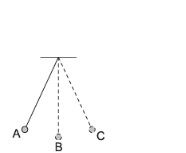
A pendulum oscillates as shown. At which of the following position(s) is the kinetic energy equal to the total energy?
A
B
C
Not enough information given.
An object of mass 𝑚 is attached to a horizontal spring, stretched to a displacement 𝐴 from equilibrium and released, undergoing harmonic oscillations on a frictionless surface with period 𝑇 . The experiment is then repeated with a mass of 4𝑚. What’s the new period of oscillation?
2T
T
4T
T√2
A block attached to the lower end of a vertical spring oscillates up and down. If the spring obeys Hooke’s law, the period of oscillation depends on which of the following?
I. Mass of the block
II. Amplitude of the oscillation
III. Force constant of the spring
I only
II only
I and II
I and III

A block of mass 0.5kg on a horizontal surface is attached to a horizontal spring of negligible mass and spring constant 50N/m. The other end of the spring is attached to a wall, and there is negligible friction between the block and the horizontal surface. When the spring is unstretched, the block is located at x=0m. The block is then pulled to x=0.3m
and released from rest so that the block-spring system oscillates between x=−0.3m and x=0.3m. What is the magnitude of the acceleration of the block and the direction of the net force exerted on the block when it is located at x=0.3m?


A student attaches a block to a vertical spring so that the block-spring system will oscillate if the block-spring system is released from rest at a vertical position that is not the system’s equilibrium position. The system oscillates near Earth’s surface. The system is then taken to the Moon’s surface, where the gravitational field strength is nearly 1/6 that of the gravitational field strength near Earth's surface. Which of the following claims is correct about the period of oscillation for the system?
The system has a longer period on Earth than on the Moon.
The system has a shorter period on Earth than on the Moon.
The system has the same period on Earth as the Moon.
The period of oscillation cannot be determined without knowledge of the spring constant, the mass of the block, and the exact gravitational field strength near Earth’s surface and the Moon’s surface.
What is the unit of charge?
Newton
Joule
Coulomb
Farad
What is the direction of electric field at a given point?
It has same direction as the force experienced by a negative charge at a given point.
It has same direction as the force experienced by a positive charge at a given point.
It depends on the sign of charge.
It always points towards the center of the charge.
What is the unit of electric field?
C
N/C
C/N
Cm
What is the equation for the electric field of a point charge?
E=r2kQ
E=rkQ
E=r3kQ
E=kQr

Four point charges of equal magnitude but difference signs are arranged on the corners of a square as shown left. Which of the vectors shown represents the direction of the net force acting on the charge at the upper left-hand corner of the square due to the other charges?
A
B
C
D

The ratio qBqc is?
9/4
1/1
4/9
1/4

Which of the following statements must be true of the signs of the charges?
only qA and qB have the same sign.
only qA and qC have the same sign.
only qB and qC have the same sign.
Charges qB and qC have difference signs.

Which of the following is true about the sign of charge qA?
The sign of qA must be same as qB.
The sign of qA must be same as qC.
The sign of qA must be same as either qB or qC, whichever has the greater magnitude.
It is possible that qA could be either positive or negative.

Which statement accurately describes the charged particles in Diagram A?
The particles have opposite charges:
Blue: Negative Red: Positive
The particles repel one another.
The particles have like charges:
Blue: Negative Red: Negative
The particles attract one another.
The particles have opposite charges:
Blue: Positive Red: Negative
The particles attract one another.
The particles have like charges:
Blue: Positive Red: Positive
The particles attract one another.
Electrical field lines of a negatively charged object flow _______________.
Inwards
Outwards
Clockwise
Counter-Clockwise
If a charged particles has very dense field lines, that means the particle has a ___________ charge.
Strong
Weak
Neutral
None of the above.


The electric field lines for a positive charge is always directed away from the charge. True or False?
True
False
Which graph best represents the relationship between the strength of an electric field and distance from a point charge?


Based on the arrangement of the electric field lines in the diagram, what are the charges?
both charges are the same
the charges are opposite
they are neutral; no charge

Which statement best describes the electric fields in the image?
The charges are neutral.
Both charges are negative, so the field lines are alike.
The field lines move toward a positive charge and away from a negative charge.
The field lines move away from a positive charge and toward a negative charge.
Where can an electric field be found?
below a force field
in a gravitational field
in the space surrounding a charged object
outside of a magnetic field

Which diagram correctly shows the field lines between two like charges?
A
B
Both
Neither

The net force due to different charges around a single charge can be determined using superposition principle. True or False?
True
False
Electric field is directly proportional to the charge and inversely proportional to the magnitude of electric force. True or False?
True
False

What is the symbol for electric field strength?
B
E
F
T

Where would you find a uniform electric field?
around a single charge
between two charged metal plates
inside a coil that carries a current
around a magnet
Which of the following features of an electrostatic line of force is NOT correct?
It is an imaginary line which a positive charge would describe if it is free to move
The tangent drawn at any point on a curved line of force shows the direction of the electric field intensity at that point
It is sometimes curved
It can cross another line of force in a region of intense electric field

With respect to the capacitor, which relationship is true? •
C = Q×V
V = C×Q
V = Q/C
Q = C/V
How is the capacitance (C) of a parallel-plate capacitor affected by the charge on the plates ?
C depend on the charge on the plates
C is vanished when there are plates
C does not depend on the charge on the plates
C is accumulated on one side only
How is the capacitance of a parallel-plate capacitor affected by the potential difference across the capacitor ?
C depend on the potential difference across the capacitor
C does not depend on the potential difference across the capacitor
C partially depend on the potential difference across the capacitor
C sometime depend on the potential difference across the capacitor
How is the capacitance of a parallel-plate capacitor affected by the area of each plate?
C is directly proportional to the area A of each plate
C is inversely proportional to the area A of each plate
C is partially proportional to the area A of each plate
C is fully proportional to the area A of each plate
How is the capacitance of a parallel-plate capacitor affected by the distance between the plates ?
C is directly proportional to the area A of each plate
C is inversely proportional to the distance d between the plates
C is partially proportional to the area A of each plate
C is not affected by the area A of each plate
How is the capacitance of a parallel-plate capacitor affected by filling the space between the plates with an insulator ?
C stable when the space between the plates is filled with an insulator, εr >1
C reduces when the space between the plates is filled with an insulator, εr >1
C increases when the space between the plates is filled with an insulator, εr >1
C fluctuate when the space between the plates is filled with an insulator, εr >1
The plates of a parallel-plate capacitor are 2.50mm apart, and each carries a charge of magnitude 80.0nC. The plates are in vacuum. The electric field between the plates has a magnitude of 4.00x10⁶V/m. What is the potential difference between the plates?
2.00x10⁴V
1.75x10⁴ P.D.
1.00x10⁻⁴P
1.00x10⁴V
not solvable! because capacitor has no potential difference because it should have an insulator in between.
from question 16:
The plates of a parallel-plate capacitor are 2.50mm apart, and each carries a charge of magnitude 80.0nC. The plates are in vacuum. The electric field between the plates has a magnitude of 4.00x10⁶V/m.
What is the area of each plates?
2.26x10⁻³cm2
2.26x10⁻³m2
22.6m2
2.26cm2
none of the above
The plates of a parallel-plate capacitor are 2.50mm apart, and each carries a charge of magnitude 80.0nC. The plates are in vacuum. The electric field between the plates has a magnitude of 4.00x10⁶V/m.
what is the capacitance?
zero
same as potential difference 4.00pF
8.99pF
8pF
8.00x10⁻⁹F
Is it correct to say that the capacitance is inversely proportional to the area of the parallel plates?
True
False
Capacitor is a device use to store energy. Therefore a solar cell is a type of capacitor.
True
False
With respect to the capacitor, which relationship is true? •
C = Q×V
V = C×Q
V = Q/C
Q = C/V
How is the capacitance (C) of a parallel-plate capacitor affected by the charge on the plates ?
C depend on the charge on the plates
C is vanished when there are plates
C does not depend on the charge on the plates
C is accumulated on one side only
How is the capacitance of a parallel-plate capacitor affected by the potential difference across the capacitor ?
C depend on the potential difference across the capacitor
C does not depend on the potential difference across the capacitor
C partially depend on the potential difference across the capacitor
C sometime depend on the potential difference across the capacitor
How is the capacitance of a parallel-plate capacitor affected by the area of each plate?
C is directly proportional to the area A of each plate
C is inversely proportional to the area A of each plate
C is partially proportional to the area A of each plate
C is fully proportional to the area A of each plate
How is the capacitance of a parallel-plate capacitor affected by the distance between the plates ?
C is directly proportional to the area A of each plate
C is inversely proportional to the distance d between the plates
C is partially proportional to the area A of each plate
C is not affected by the area A of each plate
How is the capacitance of a parallel-plate capacitor affected by filling the space between the plates with an insulator ?
C stable when the space between the plates is filled with an insulator, εr >1
C reduces when the space between the plates is filled with an insulator, εr >1
C increases when the space between the plates is filled with an insulator, εr >1
C fluctuate when the space between the plates is filled with an insulator, εr >1
If the capacitance is 47μF, and the voltage difference across the capacitor terminals is 6V, then the energy stored in that capacitor is:
846×10-6Joule
846×10-7Joule
846×10-9Joule
846×10-3Joule
What does the following represent?
⊗⊗⊗⊗⊗⊗⊗⊗⊗⊗⊗⊗⊗⊗⊗⊗
⊗⊗⊗⊗⊗⊗⊗⊗⊗⊗⊗⊗⊗⊗⊗⊗
⊗⊗⊗⊗⊗⊗⊗⊗⊗⊗⊗⊗⊗⊗⊗⊗
Multiplied by a billion
A piece of modern art
Uniform magnetic field directed into the screen away from you
Uniform magnetic field directed out of your screen at you

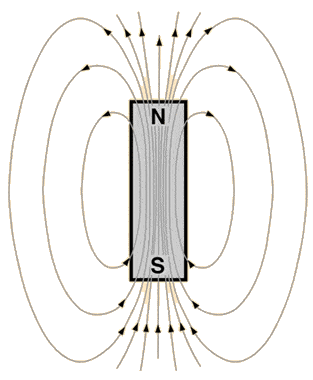
Are the magnetic field lines in the picture correct?
Yes, because they point from north to south.
No, because they point from north to south (they're supposed to go the other way).
Yes, because the North pole is on the left in all pictures.
No, because the North pole is on the left in all pictures (it's supposed to be on the right).

The strongest part of a magnet is...
the bars .
the force field.
the poles.
the middle.
⊙⊙⊙⊙⊙⊙⊙⊙⊙⊙⊙⊙⊙⊙⊙
⊙⊙⊙⊙⊙⊙⊙⊙⊙⊙⊙⊙⊙⊙⊙
⊙⊙⊙⊙⊙⊙⊙⊙⊙⊙⊙⊙⊙⊙⊙
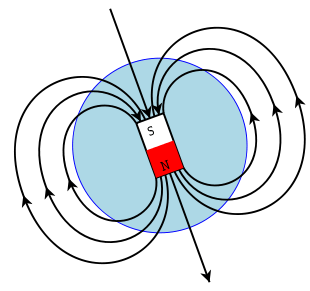
The area of magnetic force around a magnet is known as its _____________.
magnetic field
magnetic declination
magnetic fan lines
magnetic tan lines


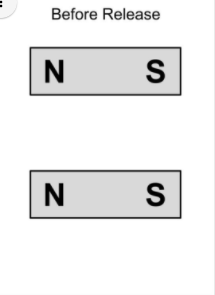
Looking at the field lines in this picture, these two magnets are ________
Attracting
Repelling
Attracting and Repelling
Doing nothing


⊙⊙⊙⊙⊙⊙⊙⊙⊙⊙⊙⊙⊙⊙⊙
⊙⊙⊙⊙⊙⊙⊙⊙⊙⊙⊙⊙⊙⊙⊙
⊙⊙⊙⊙⊙⊙⊙⊙⊙⊙⊙⊙⊙⊙⊙
⊗⊗⊗⊗⊗⊗⊗⊗⊗⊗⊗⊗⊗⊗⊗⊗
⊗⊗⊗⊗⊗⊗⊗⊗⊗⊗⊗⊗⊗⊗⊗⊗
⊗⊗⊗⊗⊗⊗⊗⊗⊗⊗⊗⊗⊗⊗⊗⊗
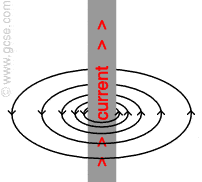
What is the shape of a magnetic field around a wire?
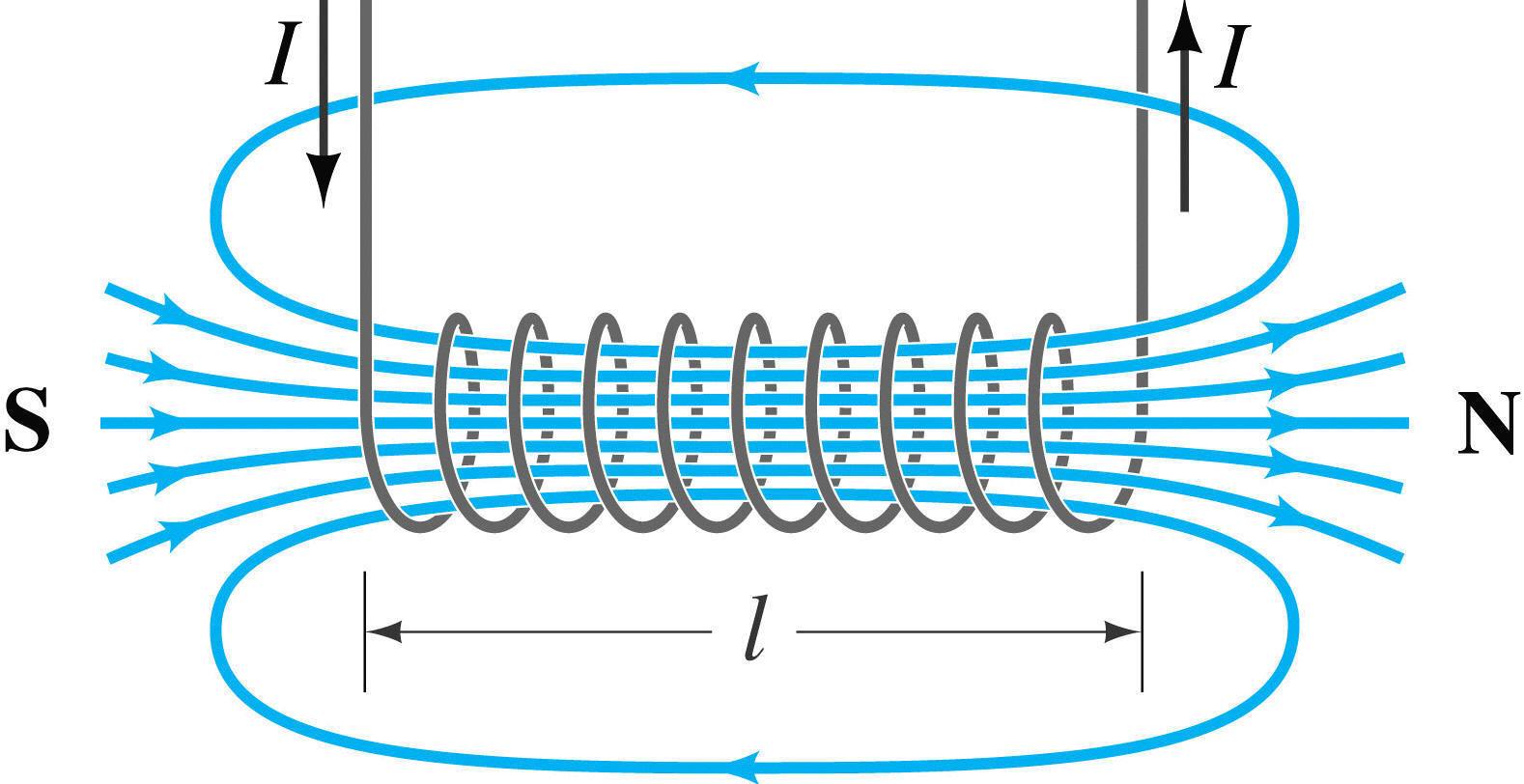
What is the shape of a magnetic field around a solenoid?


Using the right hand grip rule, A represents the direction of the
current
magnetic field
Using the right hand rule, B represents the direction of the
current
magnetic field
Which equation describes the strength of the magnetic force exerted on a current-carrying wire?
Σ F=ma
FB=qvBsinθ
FE=qE
FB=ILBsinθ
What is the symbol for magnetic field?
I
B
M
F
What is the UNIT for magnetic field?
T
A
B
unitless
Which equation describes the strength of a magnetic field produced by a solenoid (current-carrying loops of wires)?
B=2πRμoI
B=ILsinθFB
B=qvsinθFB
B=L μoIN
Which variable describes the number of loops in a solenoid?
L
B
N
R

Dylan puts two magnetic toy trains very close to each other on a track. What will happen next, and why?
The trains will not move because the magnets are not touching.
The trains will move closer to each other because the magnetic force will pull the trains together.
The trains will move away from each other because the magnetic force will push the trains apart.
The trains will move away from each other because the magnets are not touching.


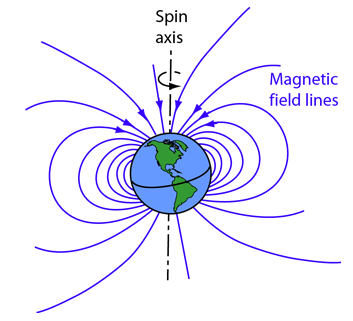
If the proton is released at the equator and falls toward the earth under the influences of the gravity, the magnetic force on the proton will be toward the
north
south
east
west
All of the following have the same units except:
inductance.
capacitive reactance.
impedance.
resistance.
A resistor is connected to an AC power supply. On this circuit, the current
leads the voltage by 90°.
lags the voltage by 90°.
is in phase with the voltage.
none of the given answers
A pure inductor is connected to an AC power supply. In this circuit, the current
leads the voltage by 90°.
lags the voltage by 90°.
is in phase with the voltage.
none of the given answers.
If the frequency of the AC voltage across an inductor is doubled, the inductive reactance of that inductor
increases to 4 times its original value.
increases to twice its original value.
decreases to one-half its original value.
decreases to one-fourth its original value.
What is the phase angle between the voltages of the inductor and capacitor in a RLC series circuit?
zero
90°
180°
270°

Which of the following diagrams is the correct phasor diagram for VR, VL and V?


Quantity of charge can be measured in
time (s)
Ampere (A)
coulombs (C)
Joule (J)
The formula for inductive reactance is
ωL1
ωC
ωC1
ωL
The equations for alternating emf and alternating current in a circuit containing capacitor are
V = V0 sin ωt, I = I0 sin(ωt−2π)
V=V0 sin ωt , I = I0 sin(ωt +2π)
V = V0 sinωt, I =I0 sin ωt
V = V0 sin(ωt +2π), I = I0 sin ωt

What happens at resonance?
Current is maximum
Impedance is maximum
Resistance is maximum
Power factor is maximum
A Capacitor blocks
Only a.c.
Only d.c.
Both ac and dc
None of these
The instantaneous current in an ac circuit is i=2.0 sin314t, what is its frequency?
100 Hz
60 Hz
50 Hz
2π
The instantaneous current in an ac circuit is i=2.0 sin314t, what is rms value of the current.
1.414 A
2.828A
1 A
2 A
Average power dissipated in an ideal inductor in a.c. circuit is:
Infinite
100
0
1

A
B
C
D

A
B
C
D

A
B
C
D

A
B
C
D

A
B
C
D

A
B
C
D

A
B
C
D

A
B
C
D

A
B
C
D

A
B
C
D

A
B
C
D

A
B
C
D

A
B
C
D
A
B
C
D
A
B
C
D
A
B
C
D
A
B
C
D
A
B
C
D
A
B
C
D
A
B
C
D
A resistor is connected to an AC power supply. On this circuit, the current
leads the voltage by 90°.
lags the voltage by 90°.
is in phase with the voltage.
none of the given answers
The instantaneous current in an ac circuit is i=2.0 sin314t, what is rms value of the current.
1.414 A
2.828A
1 A
2 A
What is alternating current
the process of inducing an emf (voltage) with a change in magnetic flux
Electric currents whose direction and magnitude change periodically depending on time are called alternating current
Steady current which delivers the same average power as the a.c. to a resistive load.
Making a rectified current more steady (or smooth) by placing a capacitor in parallel with the resistor
The electricity in our house is
AC
DC
BC
AD
An electric current that continually reverses direction over time is known as a(n)
direct current
alternating current
simple current
If an electric bulb is connected to an AC source, which of the following statement is true about the phase difference between the voltage across the bulb and current flowing in it?
In phase.
Not in phase.
The voltage is leading the current.
The current is leading the voltage.
Which of the following general equations represent AC current
I=Iosin(2πft)
I=Iosin(f2πt)
I=Iocos(ωt)
I=Iocos(t)
Which is the correct equation of
Vrms ?Vrms=Vo
Vrms=Vo2
Vrms=2Vo
Vrms=2Vosin 2t
The highest value reached by the voltage or current in one cycle is called:
Instantaneous value
Peak to peak value
Peak value
Root mean square value
rms value of ac current is the equivalent direct current which produces
the same average energy
the same power dissipation
the same rate of current flow
the same rate of power use
A pure resistor is connected to an a.c. source where its current is given by I=5.0 sin 628t. Which of the following statements is not true about the circuit?
The peak value of current flowing through the resistor is 5.0 A
The root mean square current flowing through the resistor is 3.5 A
The frequency of the current flowing through across the resistor is 120 Hz
The equivalent direct current which gives the same average heating power in the resistor is 3.5 A
A sine wave has a peak value of 354 V, What is the RMS value?
250 V
500 V
354 V
200V
A power supply has a peak value of 433 Volts sine wave, what is the effective dc voltage of this power supply?
306 V
433 V
612 V
220 V

What is the Peak voltage of the signal shown on the multimeter?
1000 V
1414 V
1500 V
707 V
Photoelectrons will be ejected from a material surface if?
The threshold frequency is greater than the photon frequency
The work function is less than the photon energy
The intensity of light is high enough
The wavelength of photon is maximum
A monochromatic light beam with a quantum energy of 9.0 eV is incident upon a photocell. The work function of the photocell is 4.1 eV. What is the maximum kinetic energy of the electron.
4.2 eV
4.4 eV
4.7 eV
4.9 eV
In an experiment, photoelectric effect is observed in metal A when light with frequency (f ) falls on the metal. If the light frequency used in this experiment is doubled, the photoelectrons
Will not be ejected
Will be ejected as observed in the previous
Will be ejected with greater number of photoelectrons
Will be ejected with greater kinetic energy
A metal surface is struck with light of λ = 400 nm, releasing a stream of electrons. If the 400 nm light is replaced by λ= 300 nm light of the same intensity, what is the result?
More electrons are emitted in a given time interval
Fewer electrons are emitted in a given time interval
Emitted electrons are more energetic
Emitted electrons are less energetic
A metal surface is struck with light of λ = 400 nm, releasing a stream of electrons. If the light intensity is increased (without changing λ ), what is the result?
More electrons are emitted in a given time interval
Fewer electrons are emitted in a given time interval
Emitted electrons are more energetic
Emitted electrons are less energetic
True or False? The wavelength and frequency of all waves are inversely proportional to each other.
True
False
If waves can behave like particles, then particles can behave like a wave. This is the idea behind...
Quantization of Energy
Photoelectric Effect
Compton Effect
deBroglie Waves
Uncertainty Principle
When light of specific frequencies is shined on a surface, electrons are ejected from the surface. This is the idea behind...
Quantization of Energy
Photoelectric Effect
Compton Effect
deBroglie Waves
Uncertainty Principle
The energy of an emitted photon can be calculated from ...
Plancks constant x frequency of the photon
h x c / wavelength of the light emitted
the difference in the energy levels
all of the above
De Broglie equation
relates the momentum of a mass to its wavelength
relates the energy of a mass to its wavelength
relates the frequency of a mass to its wavelength
relates the work function of a mass to its wavelength
the minimum frequency for which the photoelectric effect can occur is called the
absolute frequency
cut off frequency
Lyman frequency
threshold frequency
Planck's constant can be found ...
energy of a particle x speed of light / wavelength
energy of a particle x speed of light / frequency of light
energy of a particle x wavelength / speed of light
slope of the cut-off voltage vs frequency graph
Wave -particle duality is supported by...
electrons behaving as particles with ordinary matter
electrons behaving as waves when travelling through space
the photo electric effect
all of the above
The electron volt is a measure of
charge
velocity
electric potential
momentum
energy
What is the energy of a photon of wavelength 400 nm?
2.95 eV
3.00 eV
3.09 eV
3.12 eV
An electron is moving freely with kinetic energy 10 eV. It's de-Broglie wavelength is


A ____ is a discrete, quantized bundle of energy
Photoelectric effect
Photon
Quantized
Proton
The energy of photoelectrons emitted from a metal surface can be increased by
using monochromatic, polarized light
using light of longer wavelength
using light of higher intensity
using light of higher frequency
Who proposed that electrons are only found in specific, discrete circular orbits around the nucleus?
Alber Einstein
Erwin Schrodinger
Ernest Rutherford
Niels Bohr

thermionic emission

The arrows in this energy diagram depict...
Absorption of light energy because the arrows are pointed up.
Emission of light energy because the arrows are pointed up.
Absorption of light energy because the arrows are pointed down
Emission of light energy because the arrows are pointed down

Which are absorption arrows?
a, b, c, d
e, f, g, h
a, e, b
d, c, h

The arrows in this diagrams depict...
Emission of light energy
Absorption of light energy
Absorption and Emission of light energy
Neither absorptions and emission of light energy
What is the photoelectric effect?
The emission of electrons from the surface of a metal upon the absorption of electromagnetic radiation
The emission of protons from the surface of a metal upon the absorption of electromagnetic radiation
The emission of photons from the surface of a metal upon the absorption of electromagnetic radiation
The emission of neutrons from the surface of a metal upon the absorption of electromagnetic radiation
What are photoelectrons?
Electrons emitted from the surface of a metal upon the absorption of electromagnetic radiation
Protons emitted from the surface of a metal upon the absorption of electromagnetic radiation
Photons emitted from the surface of a metal upon the absorption of electromagnetic radiation
Neutrons emitted from the surface of a metal upon the absorption of electromagnetic radiation
What does the photoelectric effect provide evidence for?
Light is quantised, or carried in discrete packets
Light is continuous and has no discrete packets
Light is a wave and not a particle
Light is a particle and not a wave
What determines whether a photoelectron is emitted?
The frequency of the light
The intensity of the light
The wavelength of the light
The speed of the light
When an electron absorbs energy, it moves ________.
from a higher energy level to a lower energy level
from a lower energy level to a higher energy level
in a circle
toward the nucleus
When an electron moves from a higher energy level to a lower energy level, it ____________.
it releases energy in the form of light
it absorbs energy in the form of light
it breaks in half
it releases a sonic boon
A ground state electron is
freshly crushed into a fine powder.
in the highest possible energy level.
in the lowest possible energy level.
constantly emitting light.
In the speed of light equation, c stands for
frequency
wavelength
the speed of light
Carbon
If waves can behave like particles, then particles can behave like a wave. This is the idea behind...
Quantization of Energy
Photoelectric Effect
Compton Effect
deBroglie Waves
Uncertainty Principle
A ____ is a discrete, quantized bundle of energy
Photoelectric effect
Photon
Quantized
Proton
A monochromatic light beam with a quantum energy of 9.0 eV is incident upon a photocell. The work function of the photocell is 4.1 eV. What is the maximum kinetic energy of the electron.
4.2 eV
4.4 eV
4.7 eV
4.9 eV
In an experiment, photoelectric effect is observed in metal A when light with frequency (f ) falls on the metal. If the light frequency used in this experiment is doubled, the photoelectrons
Will not be ejected
Will be ejected as observed in the previous
Will be ejected with greater number of photoelectrons
Will be ejected with greater kinetic energy
Planck's constant can be found ...
energy of a particle x speed of light / wavelength
energy of a particle x speed of light / frequency of light
energy of a particle x wavelength / speed of light
slope of the cut-off voltage vs frequency graph
the minimum frequency for which the photoelectric effect can occur is called the
absolute frequency
cut off frequency
Lyman frequency
threshold frequency
De Broglie equation
relates the momentum of a mass to its wavelength
relates the energy of a mass to its wavelength
relates the frequency of a mass to its wavelength
relates the work function of a mass to its wavelength
The energy of an emitted photon can be calculated from ...
Plancks constant x frequency of the photon
h x c / wavelength of the light emitted
the difference in the energy levels
all of the above

The figure above shows part of the energy level diagram for a hypothetical atom. Which of the transitions indicated produces the most energetic photons?
A
B
C
D
E
The ground state of a certain type of atom has energy -E0 . What is the wavelength of a photon with enough energy to ionize an atom in the ground state and give the ejected electron a kinetic energy of 2E0?
2hc/E0
hc/3E0
hc/2E0
hc/E0
Which graph best shows the maximum kinetic energy K of the photoelectrons as a function of the frequency of incident light?


The approximate work-function of this material is
1.5 eV
2.0 eV
2.7 eV
4.0 eV
6.0 eV
What does the slope of this graph represent?
The work-function of the material
Planck's constant in eV-s
the cut-off frequency of the material
Planck's constant in J-s
the kinetic energy of the electrons


The work function is determined by:
The threshold frequency is determined by:
Photoelectric effect provides the evidence for the ______ nature of radiation.
dual
wave
particle
electromagnetic
What is the energy, in eV, of a photon that has a wavelength of 620 nm?
1eV
2eV
3eV
4eV
What is the energy, in eV, of a photon that has a wavelength of 620 nm?
1eV
2eV
3eV
4eV
A metal with a work function of 3.5 eV is exposed to photons with an energy of 3.7 eV. What is the maximum kinetic energy of the emitted photoelectrons?
0.2 eV
0.9 eV
1.1 eV
7.7 eV
What is the maximum kinetic energy of electrons emitted from caesium (Cs), when light of frequency 1x 10¹⁵ Hz falls upon the metal? (work function for Cs is 2.0eV)
8.0x10⁻¹⁹ J
4.0 eV
2.0 x10⁻¹⁹ J
2.0 eV

Use the graph to find the threshold frequency.
−12×10-19 Hz
0 Hz
2×10¹⁵ Hz
4×10¹⁵ Hz

This type of particle is a high speed electron released from a nucleus that turns a neutron into a proton
α particle
β−particle
β+particle
Gamma ray
What device acts as the source and the detector of ultrasound waves
A Transducer
A Microphone
A Speaker
An Oscilloscope
As an ultrasound pulse moves through tissue in a patient's body it will not undergo a change in
Frequency
Amplitude
Phase
Wavelength
What is ultrasound?
Sound waves above the range of human hearing
Sound waves within the range of human hearing
Sound waves below the range of human hearing
Which scan is used to see fetal movement in pregnant women
PET scan
CT scan
Ultrasound scan
MRI scan
Which of the following is the most penetrating wave on the EM spectrum?
Microwave
Radiowave
Visible light
Gamma rays
Which of the following absorb x-rays the most?
Soft tissue
Organs
Bones
Skin
CT scans give us more detailed 2-D and 3-D views of...
Organs
Bones
Soft tissue
Blood vessels
During a CT scan, the x-ray detector rotates around you.
True
False
Which of the following is a x-ray image?


Which of the following is a CT scan image?

What is the Piezo-Electric effect?
Causing a crystal to shrink and expand at the same frequency using direct current
Causing a crystal to shrink and expand at the same frequency using alternating current
Causing a crystal to shrink and expand at the same frequency using alternating voltages
Passing electricity through a body and giving it a charge
Acoustic impedance is a product of ...
Density x Distance
Density x Voltage
Speed of Sound x Distance
Density x Speed of Sound
The most common piezoelectric material used in ultrasound imaging is
Quartz
Barium Titanate
Lead Metaniabate
Lead Zirconate Titanate
The purpose of the coupling gel is to
Eliminate reflection at the skin's surface due to air
Increase the impedance between the skin and transducer
Decrease the wavelength of sound so that it will be transmitted better into the body
All of the above
A highly compressible medium, such as air, has a low speed of sound, while a less compressible medium, such as bone, has a higher speed of sound.
True
False
A high-frequency ultrasound beam (small wavelength) provides better resolution and image detail than a low- frequency beam
True
False

Calculate the HVT(half value thickness) for bone absorbing ultrasound if the coefficient of absorption is 0.13 cm-1.
5.3 cm
0.21 cm
2.1 cm
8.2 cm
PET stands for (a) Emission Tomography
When an electron and positron meet and destroy each other it is called...
destruction
combustion
emission
annihilation
Isotopes used in PET scanning should have a...
very short half-life (seconds)
long half-life (days)
medium half life (minutes)
The PET scanner detects at least three pairs of gamma rays to locate a tumour. This is called...
detection
triangulation
echolocation
annihilation
PET scans use x-rays.
True
False
PET scans require an incision.
True
False
Which of the following lists the electromagnetic waves in order of increasing frequency?
X-rays, visible light, radio waves
gamma rays, microwaves, UV rays
infrared rays, x-rays, gamma rays
UV rays, visible light, gamma rays
A wave with a high freqency will have a ______ wavelength and _____ energy
short, low
long, high
short, high
long, low
PET scan patients are injected with a special substance called a
gammatracer
raytracer
radiotracer
UVtracer
Radiotracers can be stored for a long time before they are used
true
false
Small, focused doses of high energy radiation passes through the subject, casting a "shadow" on the machine's sensors
MRI
X-Ray
CT
PET
Ultrasonography
A sectional X-ray. Okay for soft tissues. Great for dense tissues.
MRI
X-Ray
CT
PET
Ultrasonography
high frequency vibrations are focused on the subject. The vibrations are reflected back to the sensor.
MRI
CT
PET
Ultrasonography
X-Ray
Which of the following is an X-ray


Produces grainy images of soft tissues. Used exclusively on abdominal structures because it cannot pass through bone.
MRI
X-Ray
CT
PET
Ultrasonography
What is the usual frequency of waves used for ultrasound scanning?
15 kHz
<10 kHz
12 kHz
>20 kHz
An X-rays beam passes through 2 cm of bone and 3 cm of soft-tissue. What is the ratio of transmitted intensity to incident intensity, I0IT ? (μbone=3.0 cm−1, μmuscle=0.90 cm−1)
2.5×10⁻³
1.7×10⁻⁴
6.0×10³
0.067
What of the following are disadvantages of CT scan compared to conventional X-rays scan?
better contrast
more expensive
CT image is 3D
greater dose
Fat has density 925 kg m−3. Speed of sound in fat is 1450 m s−1. What is the acoustic impedance of fat?
0.34 × 10⁶ kg m−2 s−1
1.43 × 10⁶ kg m−2 s−1
1.34 × 10⁶ kg m−2 s−1
4.31 × 10⁶ kg m−2 s−1
A pulse of ultrasound is incident normally on the boundary of muscle and bone. What is the ratio of I0Ir where I0 is incident intensity and Ir is reflected intensity?
( Zmuscle=1.7×10⁶ kg m−2 s−1 , Zbone=6.4×10⁶ kg m−1s−2 )
0.66
0.34
0.58
0.42
What is a CAT scan?
A scan for you cat
Catalysed Anatomical Scanning - an X-Ray that detects higher rates of metabolic reactions
Complete Arterial Topography - multiple X-Rays that take 3D images of the body's arterial topography
Computerised Axial Tomography - multiple X-Ray images that can be combined to give 3D images
Have a lead grid to absorb scattered rays.
Put the detection plate as close to the patient as possible.
Have a lead grid to absorb as many x rays as possible.
Put the detection plate as close to the patient as possible.
Have a lead grid to absorb as many x rays as possible.
Put the detection plate as close to the patient as possible.
Have a lead grid to absorb scattered rays.
Put the detection plate as close to the patient as possible.

The reason 2 gamma ray photons are produced during positron - electron annihilation is
to balance the mass-energy
to conserve momentum
to conserve the total charge
to balance the number of quarks
The photon has an antiparticle
called the lepton
called the positron
called the meson
false
Ensuring the x-ray beam is parallel and removing any scattered x-rays improves
contrast
depth of view
brightness
power
Astronomical Unit (AU)
distance from Earth to Sun-used to measure distances within our solar system (ex. distance between Mars and Jupiter)
distance light travels in one year-used to measure distances outside our solar system (ex. measuring distances between stars/galaxies)
Theory of early astronomers. Earth is at the center of the universe. The sun and planets would revolve around the Earth.
Sun is at the center of the solar system.
Light Year
distance from Earth to Sun-used to measure distances within our solar system (ex. distance between Mars and Jupiter)
distance light travels in one year-used to measure distances outside our solar system (ex. measuring distances between stars/galaxies)
Theory of early astronomers. Earth is at the center of the universe. The sun and planets would revolve around the Earth.
Sun is at the center of the solar system.
'Spectrum of frequencies emitted due to electron transitions from a higher energy level to a lower one' is the definition of which key term?
Continuous spectrum
Absorption spectrum
Transition spectrum
Emission spectrum
Which of the following are evidence for the big bang?
Cosmic microwave background radiation
Doppler effect
Static electricity
Isotropic

What is a comet?
Large rocky ball of ice that orbits the sun
Cluster of billions of stars
Lumps of rock or iron that orbit the sun
Minor planets
Sirius and Canopus are the 2nd and the 3rd brightest stars after the Sun.
Canopus has a much greater luminosity than Sirius but is it is dimmer than Sirius. This is because Canopus is much (a) .
Which of the following is the correct relationship for Wein's displacement law?
λmaxT= constant
fmaxT= constant
Tλmax= constant
Tfmax= constant
The peak of the distribution of wavelength of the electromagnetic radiation emitted by the Sun is in the region of ________.
infrared
X-rays
visible light
microwave
What phenomenon leads to the idea that the Universe is expanding?
redshift
greenshift
blueshift
purpleshift
Light from almost all galaxies are red-shifted. This means that the galaxies _____ .
are not moving
are moving away from us
are moving towards us
are moving around us.
One absorption line observed from a distant star has a wavelength of 722 nm. This line has a wavelength of 705 nm in the lab. What is the speed of the star?
7.2×10⁶ m s-1
3.6×10⁶ m s-1
4.2×10⁶ m s-1
7.6×10⁶ m s-1
Hubble's law states that ......
the recession speed of a galaxy is not related to the its distance from the Earth
the recession speed of a galaxy is directly proportional to its distance from the Earth
the recession speed of a galaxy is inversely proportional to its distance from the Earth
the recession speed of a galaxy is inversely proportional to the square of its distance from the Earth
Which of the following statements is true according to the Big Bang theory? (Select all.)
The universe started from a single point.
Galaxies are moving away from each other because of the expansion of
The universe will continue to expand in size forever.
The early universe is much smaller and hotter.
What is the current best estimate of the age of the Universe?
14,000 years (14 kyr)
14,000,000 years (14 Myr)
14,000,000,000 years (14 Gyr)
14,000,000,000,000 years (14 Tyr)
Which of the following states that: The greater the distance to a galaxy, the greater the galaxies recessional speed and therefore its comological redshift?
Hubble's Law
Einsteins Theory of Relativity
String Theory
Inflationary Model of the Universe
What is the name of the galaxy in which we live?
Snickers
Andromeda
Polaris
Milky Way
What is meant by cosmic background radiation?
It is radiation of distant quasars.
It is radiation from hot gas in intergalactic space.
It is radiation created by the early universe.
It is radiation leftover from supernovas.
What is Hubble's Law?
What is the Doppler Effect?
Red-Shift: Light moving _____
Blue-Shift: Light moving _____
What is the current accepted age of the universe according to many Big Bang cosmologists?
10.4 billion years
15.4 billion years
20.9 billion years

The diagram below shows the spectral lines for an element.
Which diagram best represents the spectral lines of this element when its light is observed coming from a star that is moving away from Earth?


The diagram shows a standard spectrum (the star’s fingerprint) compared to a spectrum produced from a distant star.
Which conclusion can be made by comparing the standard spectrum to the spectrum produced from this distant star?
The star’s spectral lines have shifted toward the blue end of the spectrum and the star is moving toward Earth.
The star’s spectral lines have shifted toward the blue end of the spectrum and the star is moving away from Earth.
The star’s spectral lines have shifted toward the red end of the spectrum and the star is moving toward Earth.
The star’s spectral lines have shifted toward the red end of the spectrum and the star is moving away from Earth.

In the diagram, the spectral lines (fingerprint) of hydrogen gas from three galaxies, A, B, and C, are compared to the spectral lines of hydrogen gas observed in a laboratory.
What is the best conclusion that can be made about the movement of galaxies A, B, and C?
Galaxy A is moving away from Earth, but galaxies B and C are moving toward Earth.
Galaxy B is moving away from Earth, but galaxies A and C are moving toward Earth.
Galaxies A, B, and C are all moving toward Earth.
Galaxies A, B, and C are all moving away from Earth.
The Doppler effect predicts that light from a source moving away from Earth will have
shorter wavelengths.
longer wavelengths.
Calculate the peak wavelength of an object with a surface temperature of 5000 K using Wein's Displacement Law.
580 nm
4500 nm
2000 nm
3500 nm
If the peak wavelength of an object is 600 nm, what is its surface temperature according to Wein's Displacement Law?
7000 K
5500 K
3000 K
4833 K
λmaxT = constant is the equation of
Stefan-Boltzmann's law
Hubble's law
Wien's displacement law
Big Bang theory
In Stefan-Boltzmann's expression, L=4πσ2r2T4 , σ is
radius of the star
luminosity of the star
surface temperature of the star
Stefan-Boltzmann constant = 5.67 ×10⁻⁸ Wm−2K−4
The surface temperature of the sun is 5800 K and wavelength of light at peak intensity is 500 nm.
The wavelength at peak intensity for Sirius-B (a white dwarf star) is 120 nm.
What is the surface temperature of Sirius-B in Kelvin?
(a)
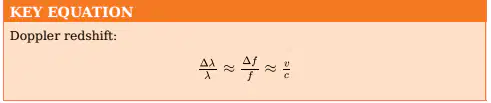
In the laboratory, an emission spectral line is observed at a wavelength of 656.4 nm.
The same spectral line, in the spectrum from a distant galaxy, has a wavelength of 663.1 nm.
Calculate the speed v of the galaxy.
3.06×10⁶ ms−1
2.9×10⁸ ms−1
3.06×10⁸ ms−1
2.9×10⁶ ms−1
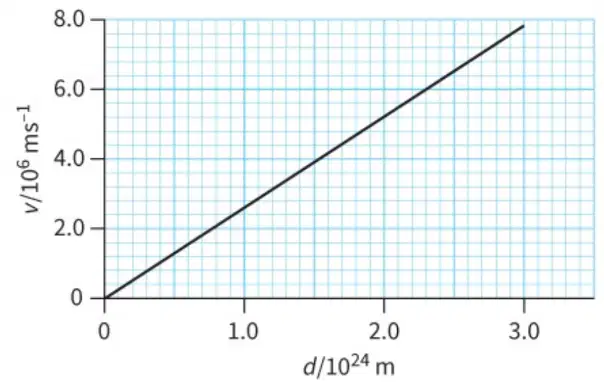
The gradient of this graph shows you
the luminosity L of the star
the Stefan-Boltzmann constant, σ
the Hubble constant, H0
the product of peak wavelength and surface temperature,
λmaxT
Standard candle is:
The total radiant power emitted from the star.
An astronomical object of unknown luminosity.
An astronomical object of known luminosity.
an idealised object that absorbs all incident electromagnetic radiation falling on it.

