
 Worksheets
DFT-16/09/2025- ANATOMY D2
Total questions: 20
Worksheet time: 15mins
A 28-year-old male presents to the emergency department with a severe, throbbing left-sided headache, fever, and periorbital edema. Three days prior, he had aggressively squeezed a painful pustule on his left nasal ala. On examination, he has unilateral proptosis, complete ptosis, and diplopia on attempted lateral gaze of the left eye. What is the most likely diagnosis?
Cavernous sinus thrombosis
Orbital cellulitis
Bacterial meningitis
Acute maxillary sinusitis

The "dangerous area of the face" is a concept emphasizing the risk of intracranial septic emboli from superficial facial infections. What is the primary anatomical reason for this direct pathway of infection?
Valveless communication between the facial vein and the cavernous sinus
Abundant anastomoses with the external carotid artery branches
Extensive lymphatic drainage into the submandibular and deep cervical nodes
Direct contiguity with the pterygoid plexus of veins via the maxilla
A 55-year-old male undergoes a superficial parotidectomy for a pleomorphic adenoma. Three weeks post-surgery, he complains of numbness specifically over the angle of his mandible and the skin overlying the parotid gland. He denies any facial drooping or difficulty with mastication. Which of the following nerves was most likely iatrogenically injured?
Great auricular nerve
Auriculotemporal nerve
Marginal mandibular nerve
Supratrochlear nerve
During mastication, the integrity of which of the following nerves is crucial for preventing the bolus of food from accumulating in the oral vestibule between the teeth and the cheek?
Buccal branch of the facial nerve
Mental nerve
Zygomatic branch of the facial nerve
Lacrimal nerve
A 58-year-old male, one year post-superficial parotidectomy, presents with unilateral facial flushing and sweating in the preauricular region, exclusively triggered during meals. He denies pain but finds the symptom socially bothersome. Which pathophysiological mechanism is responsible for this presentation?
Parasympathetic secretomotor fibers aberrantly innervating dermal sweat glands
Synkinetic reinnervation between motor branches of the facial nerve (CN VII).
Focal hypersensitivity of denervated sympathetic receptors.
Neurogenic inflammation from trigeminal nerve sensitization.
A patient with a large retropharyngeal abscess develops rapid clinical deterioration with signs of acute mediastinitis. This life-threatening inferior spread of infection is most directly facilitated by extension through which fascial space?
Danger space
Pre-tracheal space
Carotid sheath
Retropharyngeal space proper
During a thyroidectomy, meticulous dissection is required near a ligamentous thickening of the pre-tracheal fascia that tethers the thyroid gland to the cricoid cartilage. This structure is a critical landmark due to its intimate relationship with the recurrent laryngeal nerve. What is this fascial modification?
Suspensory ligament of Berry
Axillary sheath
Pharyngobasilar fascia
Alar fascia
A 45-year-old male undergoes an excisional biopsy of a firm, palpable lymph node located in the posterior triangle of the neck, superior to the clavicle and posterior to the sternocleidomastoid muscle. Two weeks post-operatively, he complains of a persistent dull ache in his shoulder, difficulty lifting his arm above 90 degrees to comb his hair, and notes that his shoulder blade "sticks out." On examination, there is shoulder droop and weakness in shrugging against resistance. Which anatomical triangle was most likely breached, leading to iatrogenic nerve injury?
Occipital triangle
Subclavian (supraclavicular) triangle
Carotid triangle
Submental triangle
A 48-year-old female undergoes a total thyroidectomy for a large multinodular goiter. Twelve hours post-operatively, she develops acute inspiratory stridor and respiratory distress, requiring emergency re-intubation. Laryngoscopy reveals bilateral vocal cords in a paramedian position. Which muscle’s iatrogenic paralysis is the most likely cause of this life-threatening airway compromise?
Posterior cricoarytenoid
Cricothyroid
Genioglossus
Cricopharyngeus
During the interpretation of a lateral cervical spine radiograph for a foreign body ingestion, a radiopaque object is visualized anterior to the vertebral body of C5. Based on standard anatomical relations, within which subdivision of the pharynx is this object most likely located?
Laryngopharynx
Oropharynx
Nasopharynx
Esophagus
Which of the following foramina is located entirely within a single cranial bone and transmits a nerve that provides purely special sensory innervation?
Optic canal
Foramen rotundum
Opening of the internal acoustic meatus
Foramen magnum
A 22-year-old male is brought to the emergency department after being struck on the side of the head with a cricket ball. He experienced a brief loss of consciousness, followed by a 30-minute period of lucidity where he complained only of a headache. Now, he is rapidly becoming drowsy with pupillary dilatation on the ipsilateral side. An urgent non-contrast CT scan reveals a biconvex, hyperdense collection in the temporoparietal region. What is the most likely source of the hemorrhage
Anterior division of the middle meningeal artery
Bridging cortical veins
Superior sagittal sinus
Ruptured saccular aneurysm of the anterior communicating artery
A 34-year-old female, 8 weeks postpartum, is brought to the emergency department with a history of a persistent, debilitating headache for three days, followed by a generalized tonic-clonic seizure. On examination, she is drowsy and has bilateral papilledema. An urgent MR venogram is performed, which reveals an isolated filling defect in the dural sinus located at the junction of the falx cerebri and tentorium cerebelli. Which dural venous sinus is most likely thrombosed?
Straight sinus
Superior sagittal sinus
Transverse sinus
Cavernous sinus
During a cadaveric dissection for neuroanatomy residents, a probe is passed through Dorello's canal at the apex of the petrous temporal bone. An injury at this specific location, before the nerve enters the cavernous sinus proper, would most likely result in an isolated deficit of which function?
Ipsilateral lateral rectus muscle abduction
Ipsilateral superior oblique muscle intorsion
Sensation to the ipsilateral cornea
Pupillary constriction in the ipsilateral eye
A 50-year-old patient diagnosed with Bell's palsy reports that food accumulates in the vestibule of their mouth and they have difficulty blowing out their cheeks. Paralysis of which of the following muscles is directly responsible for these specific signs?
Buccinator
Orbicularis oris
Risorius
Masseter
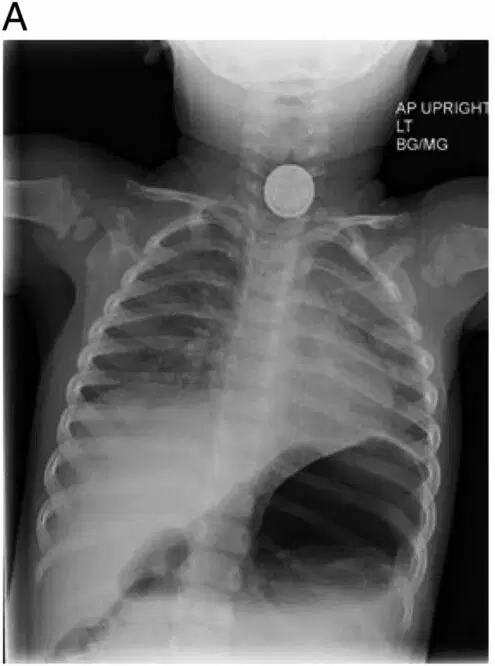
A 3-year-old child is brought to the emergency department with acute onset of dysphagia, refusing to eat, and excessive drooling. Anteroposterior and lateral radiographs of the neck and chest are obtained, as shown in the image. The anteroposterior view reveals a round, radiopaque object at the thoracic inlet. Based on this classic presentation and radiographic finding, what is the definitive location of the foreign body?
Esophagus
Trachea
Laryngopharynx
Mainstem bronchus
During submandibular gland surgery, which nerve is most at risk of injury because it loops directly under Wharton's duct?
Lingual nerve
Hypoglossal nerve
Marginal mandibular nerve
Inferior alveolar nerve
A 62-year-old male presents with dysphagia and a hoarse voice following a traumatic basal skull fracture involving the jugular foramen. On examination, touching the posterior pharyngeal wall on the left side with a tongue depressor elicits no response. However, touching the right side causes a brisk and symmetrical elevation of the palate. Which cranial nerve’s afferent function is most likely compromised?
Left glossopharyngeal nerve (CN IX)
Left vagus nerve (CN X)
Left trigeminal nerve (CN V)
Left hypoglossal nerve (CN XII)
The glossopharyngeal nerve, crucial for the sensory component tested in the gag reflex, traverses the skull base through a specific foramen. Which of the following anatomical landmarks is NOT a component of the bony margin of this foramen?
Mastoid process of the temporal bone
Jugular process of the occipital bone
Petrous part of the temporal bone
Foramen magnum
A 3-day-old neonate, born at 37 weeks gestation, presents with jitteriness and perioral cyanosis during feeding. Physical examination reveals micrognathia, low-set ears, and a systolic murmur. Laboratory investigations show a serum calcium level of 6.2 mg/dL. This patient's condition is most strongly associated with the maldevelopment of embryonic structures giving rise to which pair?
Inferior parathyroid glands and thymus
Superior parathyroid glands and palatine tonsils
Thymus and middle ear cavity
Sphenomandibular ligament and ultimobranchial body

