
 Worksheets
SS8 CA - The American Revolution
Total questions: 42
Worksheet time: 21mins

Which era correctly completes the title of the list?
War of 1812
Great Awakening
American Revolution
French and Indian War
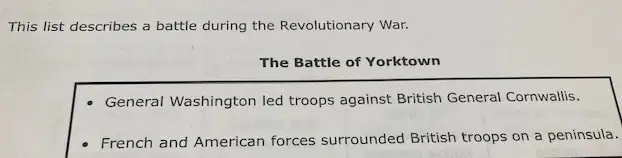
Which description of the battle correctly completes the list?
It was the second battle in the fight for independence.
It was the last major battle of the war.
It was the first battle fought in the North.
It was the turning point of the war.
Why is John Paul Jones a significant figure in U.S. history?
He is considered to be the best Union general in the Civil War.
He was the first chief justice of the U.S. Supreme Court.
He is considered to be a founder of the U.S. Navy.
He was the writer of the Declaration of Independence.
Which characteristics are associated with the American Revolution era?
Ideas of Thomas Paine inspired action
Conflict over issue of mercantilism
Conflict over the issue of slavery
Ideas of Jefferson Davis inspired action
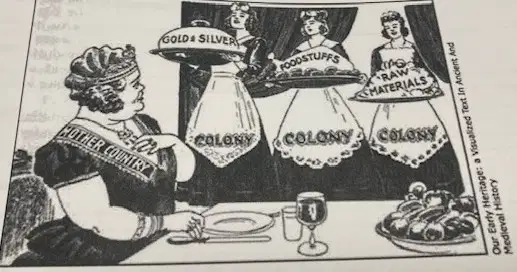
This cartoon shows a popular economic belief in Europe during the seventeenth and eighteenth centuries.
Mercantilism
Capitalism
Socialism
Feudalism
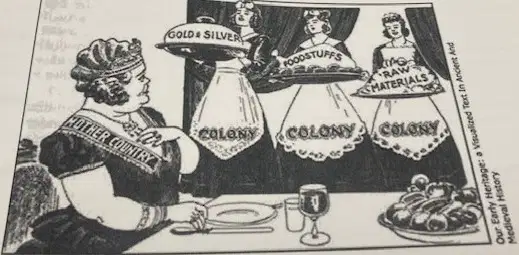
Which events in U.S. history are directly associated with this cartoon?
Passage of the Northwest Ordinance
Passage of the Navigation Acts
Boston Tea Party
Great Awakening
Shays's Rebellion

Which right completes the diagram?
Property
Happiness
Justice
Equality
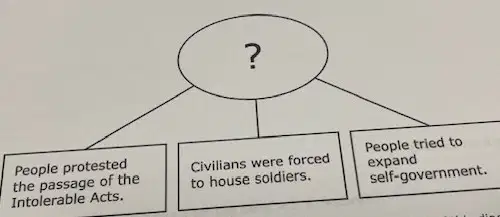
Which era in U.S. history correctly replaces the question mark for the title of this diagram?
Reconstruction
Sectionalism
The Revolutionary Period
The Early Republic
Why was the victory at Saratoga a turning point in U.S. history?
It convinced France to support the American cause.
The battle led to the signing of the Declaration of Independence.
The battle represented the end of the American Revolution.
It marked a major change in the leadership of the Continental Army.

What major era in U.S. history is referred to in the graphic?
Colonial
Civil War
Revolutionary
Reconstruction
Which action was taken by the leaders of the thirteen colonies in 1776?
Ratifying the U.S. Constitution
Writing the Articles of Confederation
Announcing independence from Britain
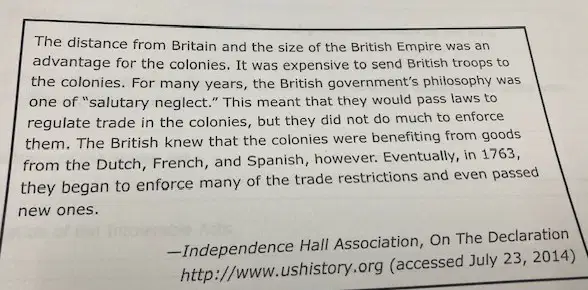
Based on the information in the excerpt the colonists had been violating what British policy for some time?
Stamp Act
Mercantilism
Free enterprise
Intolerable Acts
Why did the Proclamation of 1763 contribute to tensions between colonists and Great Britain?
It imposed taxes without colonial representation in Parliament.
It required all colonial goods to be sold directly to Great Britain.
It limited colonial expansion beyond the Appalachian Mountains
It replaced colonial legislatures with royal governors chosen by the King
Which of the following British actions led the American colonists to claim that taxes were imposed without their consent?
Passage of the Stamp Act
Creation of the Intolerable Acts
Administration of the Quebec Act
Enforcement of the Quartering Act
The British began imposing taxes on the colonists in 1765 to help pay the expenses of fighting the —
Spanish Armada
American Revolution
Battle of Tippecanoe
French and Indian War

Which answers correctly completes the following:
The text refers to colonial grievances regarding the British government imposing ______ on the colonies. This text was written as a response to the ____________.
taxes; Stamp Act
laws; Tea Act
troops; Intolerable Acts
tariffs; Townshend Acts
James Armistead helped to contribute to the American victory at Yorktown by —
leading an elite regiment of French soldiers at the battle
passing along information he had discovered while spying
encouraging soldiers to re-enlist after the winter at Valley Forge
donating significant amounts of money to help fund the Patriots
How did the French aristocrat the Marquis de Lafayette contribute to the American Revolutionary War?
He spied on British troops for the colonists
He negotiated the Treaty of Paris on behalf of the colonists
He commanded troops for the colonists against British forces
He provided funding from the French government for the colonists
Why would the writings of Mercy Otis Warren be informative to a historian?
She published the first novel set in colonial America.
She recorded the proceeding at the Boston Massacre trial.
She contributed to the writing of the Declaration of Independence.
She authored one of the earliest accounts of the Revolutionary War.
Many individuals contributed to the revolutionary cause, though the first to give his life to the cause was —
James Armistead
Crispus Attucks
Bernardo de Galvez
Haym Salomon
Thomas Paine contributed to the revolutionary cause by —
founding a navy to fight in the Revolutionary war
writing “Common Sense” to persuade others to join the Patriots
speaking out against the Stamp Act in his “Give Me Liberty” speech
recruiting Patriot fighters in New England known as the Green Mountain Boys
Where did General Washington camp the Continental Army for training over the bitter winter of 1777-8?
Valley Forge
Delaware
Gettysburg
New York City
Where were the first shots of the Revolutionary War fired?
Lexington
Plymouth
Saratoga
Boston
A significant accomplishment of the Second Continental Congress in 1776 was —
signing the Treaty of Paris
approving the Bill of Rights
creating the U.S. Constitution
writing the Declaration of Independence
The Treaty of Paris in 1783 recognized that the newly formed United States would be —
a constitutional monarchy
independent from British rule
an ally of the French government
granted British holdings in Canada
Which of the following battles is considered a turning point for the Americans in the Revolutionary War?
Battle of Saratoga
Battle of Yorktown
Battle of Lexington
Battle of Trenton
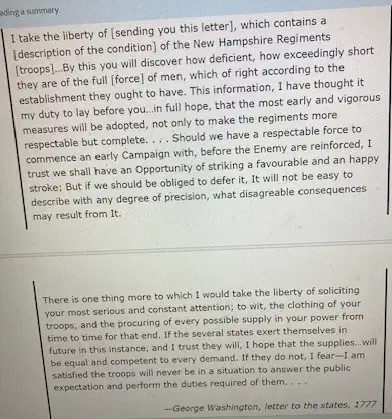
Part A
Which statement best summarizes the argument made by Washington?
All the troops needed in order to defeat the British was a few months of rest and relaxation at Valley Forge
His role as general allowed him to force any of the thirteen states to provide food and clothing to his troops.
The troops were in desperate need of supplies and more men, without which they would be unable to achieve victory.
Since the troops were regularly paid fair wages, they should be able to provide for their own food, arms, and clothing.
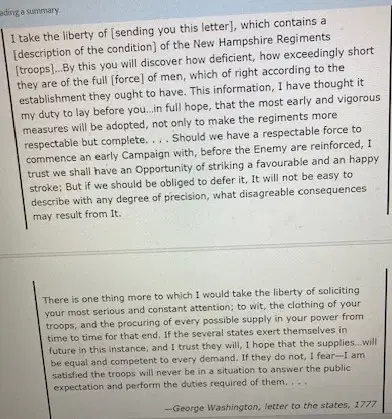
Part B
Which statement provides evidence for the answer to Part A?
“In full hope, that the most early and vigorous measures will be adopted, not only to make the regiments more respectable but complete”
“This information, I have thought it my duty to lay before you...”
“before the Enemy are reinforced, I trust we shall have an Opportunity of striking a
"and I trust they will, I hope that the supplies ... will be equal and competent to every demand. If they do not, I fear ... the troops will never be in a situation to answer the public expectation and perform the duties required of them"
Which of the following was a grievance listed in the Declaration of Independence?
Quartering of soldiers
Closing of Boston Harbor
Ending religious toleration
Disregarding freedom of speech
In the Declaration of Independence, unalienable rights are listed as —
life, liberty, and the pursuit of happiness
freedom, justice, and equality
property, security, and prosperity
peace, order, and good government
When Jefferson referred to unalienable rights in the Declaration of Independence, he was describing —
liberties belonging to all U.S. citizens
natural rights belonging to all humans
freedoms given by the local government
limitations on the rights of foreign-born citizens
Which of the following are considered unalienable rights according to the authors of the Declaration of Independence?
Peace, land, bread
Liberty, equality, fraternity
Life, liberty, pursuit of happiness
Justice, tranquility, common defense
The Founding Fathers are considered models of civic virtue because they —
established successful businesses while serving as statesmen
gained significant fame and fortune by participating in the revolution
sacrificed family time and their business interests to fight in the revolution
debated about how the constitution should be interpreted
In 1770, the lawyer and future president John Adams defended British soldiers accused of the Boston Massacre. How did this action serve as a model of civic virtue?
He devoted his life to public service.
He worked to reform the justice system.
He fought against oppressive government power.
He demanded representation from a republican government.
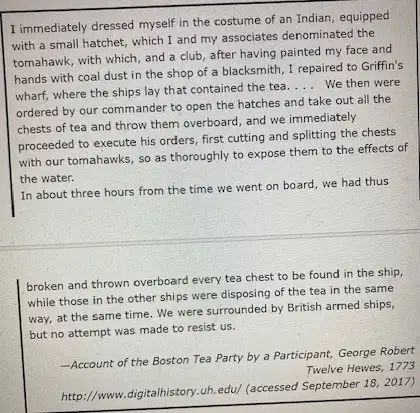
Which of the following caused the reaction described in the excerpt?
Disgust about the poor quality of tea the colonists were forced to buy
Anger about armed ships being in the harbor protecting the tea traders
Resentment of the British East India Company for monopolizing the tea trade
Dislike of the British customs officials who allowed tea shipments into Boston
Many of the protests and demonstrations that followed the Stamp Act and Intolerable Acts were examples of which of the following?
Boycott
Natural rights
Civil disobedience
Unalienable rights
Which of the following groups opposed the Declaration of Independence?
Patriots
Loyalists
Sons of Liberty
Continental Congress
Federalists argued that the U.S. Constitution should be interpreted by —
strictly reading the text
applying a judicial review from the courts
taking into account historical and social changes
looking to precedents from international court cases
Who is often considered the founder of the U.S. Navy?
John Paul Jones
George Washington
Benjamin Franklin
Nathaniel Bacon
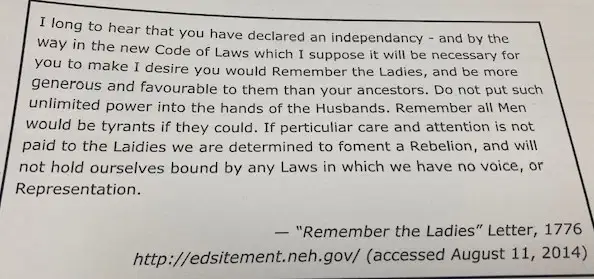
Which action is one way Abigail Adams worked to influence the development of government in the United States?
By leading a nonviolent march for women's rights
By encouraging her husband to support women's rights
By voting for representatives that supported women's rights
By conspiring to raise an armed rebellion for women's rights
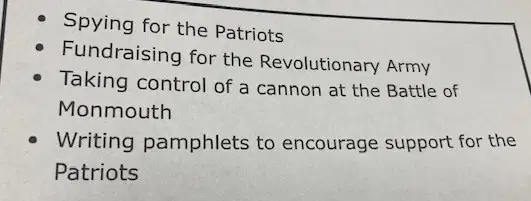
The actions listed in the box were contributions to the Revolutionary War made by —
French fighters
women patriots
military officers
enslaved people
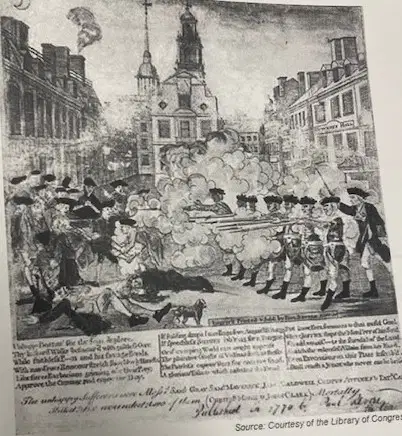
This famous work of art was created in response to the —
Boston Massacre
Boston Tea Party
siege at Bunker Hill
closing of Boston Harbor

