
NEW
Font size
 Worksheets
Science Quiz on States of Matter
Total questions: 34
Worksheet time: 19mins
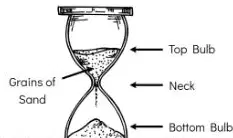
Which of the students' claims about the sand in the hourglass is correct?
Julia claims that the sand is a liquid substance, because when it flows from the top bulb into the bottom bulb, the volume remains fixed.
Anthony claims that the sand is a gas because the grains flow quickly, and do not create a fixed shape when they settle into the bottom bulb.
Chase claims that the sand is a solid substance, because the individual sand particles are solids that do not change shape as they flow into the bottom bulb.
Maria claims that the sand is a liquid substance, because when it flows into the bottom bulb, it settles to take the shape of the container.
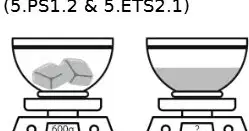
What is the mass of the bowl of butter after it is taken out of the microwave?
100 grams
500 grams
600 grams
400 grams
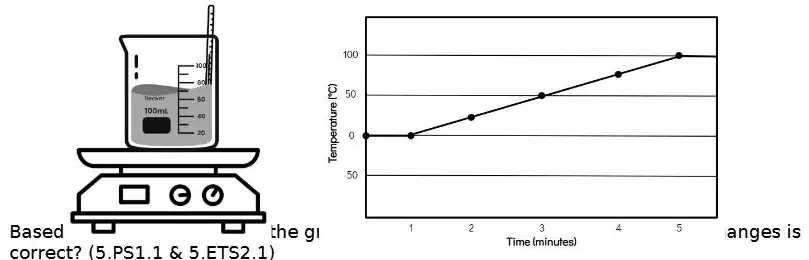
Based on the graph, which statement about the phase changes is correct?
The water was cooled from a solid to a liquid through the phase change of melting.
The water began as a liquid and cooled into a gas through the process of freezing.
The water began as a gas and heated to a liquid through the process of boiling.
The water began as a liquid, and heated to a gas through the process of boiling.
What is the correct scientific explanation for the droplets of water on the outside of Robbie's water bottle?
The liquid water molecules from inside the bottle have leaked out and collected on the outside of the bottle.
Water vapor molecules from the air touched the bottle, cooled, and condensed into liquid water droplets.
Liquid water molecules from the air touched the bottle, cooled, and condensed into solid water droplets.
Water vapor molecules from the air touched the bottle, heated up, and condensed into liquid water droplets.
What happens when yeast eats and digests sugar?
It releases oxygen gas.
It releases carbon dioxide gas.
It releases nitrogen gas.
It releases hydrogen gas.
What is the purpose of adding yeast when baking bread?
To make the bread taste sweet.
To give the bread a crunchy texture.
To help give bread its fluffy texture.
To make the bread last longer.
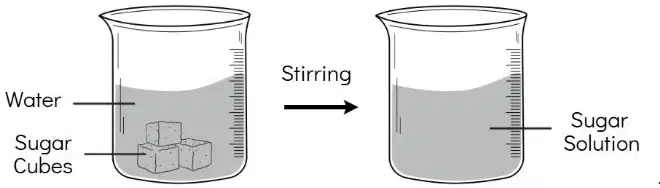
What is shown in Figure 1?
The addition of yeast to sugar solution.
The creation of a sugar solution.
The process of baking bread.
The release of carbon dioxide gas.
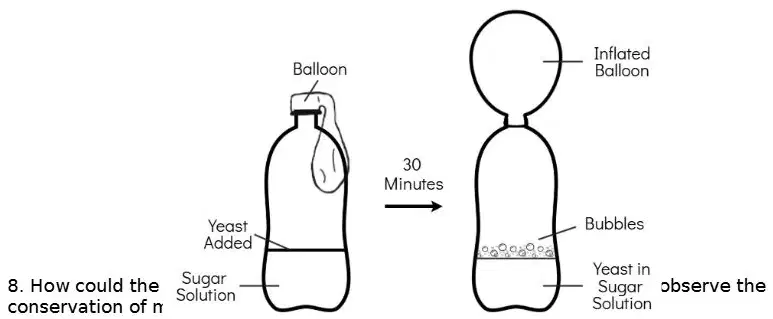
How could the conservation of mass be observed in the experiment with yeast and sugar solution?
Measure the mass of the yeast before and after adding it.
Measure the total mass of the setup before and after 30 minutes, then compare the two measurements.
Measure the mass of the yeast and compare it to the mass of the sugar solution.
Measure the mass of the balloon before and after 30 minutes.
Which student's claim did not make an accurate conclusion based the sugar added to warm water that appeared to disappear?
Bryson's claim about bubbles indicating a chemical change.
Rosa's claim about sugar dissolving into small particles.
Tyler's claim about sugar dissolving as a physical change and gas production as a chemical change.
Simone's claim about sugar being destroyed when dissolved.
What caused the change in volume when a cup of water was placed in direct sunlight?
A small amount of water leaked out of the cup.
The water evaporated due to heat.
The cup absorbed some of the water.
The water froze and expanded.
What happens to water when it is heated?
The water condenses into a gas.
Some of the water evaporates.
The water molecules become smaller.
The water turns into ice.
What could a student do to make salt dissolve faster in water?
Stir the mixture.
Place the beaker in the fridge.
Place the beaker on a hot plate.
Add more salt to the mixture.
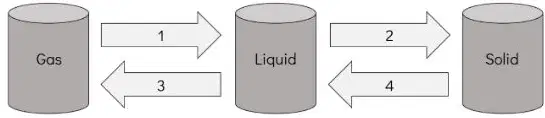
Which numbers represent the addition of heat in the diagram?
1 & 2
3 & 4
1 & 4
2 & 3
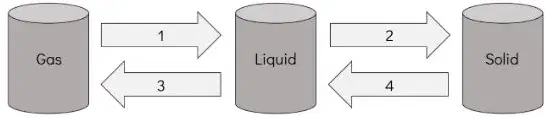
In the diagram, what happens at Arrow 4?
The substance is being cooled, causing it to freeze.
The substance is being heated, causing it to melt.
Heat is removed from the substance, causing it to condense.
The substance is being cooled, causing it to evaporate.
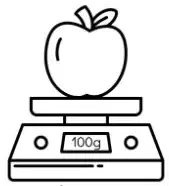
A 5th grade Science teacher is demonstrating the conservation of matter using an apple. He measures the mass of the whole apple as 100 grams before cutting it into two pieces. If one of the pieces measures 25 grams, what is the mass of the second piece?
25 grams
100 grams
75 grams
80 grams
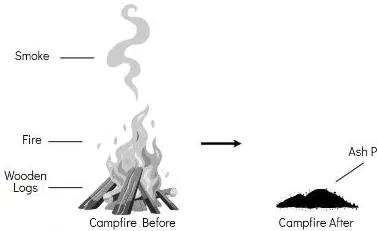
A Boy Scout troop is sitting around a campfire. They observe that after all of the wooden logs have burned, only a pile of ash remains. Which of their observations is correctly supported by a scientific explanation?
Ashes were produced because ashes are just small wood pieces created by the fire.
The wooden logs burned, but still have the same physical properties as the ash pile.
The pile of ashes produced by the burning logs was the result of a physical change.
Smoke and ash were produced when the wooden logs burned as a result of a chemical change.
According to the conservation of matter, what should happen to the mass before and after a chemical reaction?
It should increase
It should decrease
It should remain the same
It should double


Sodium reacts with water and causes it to burn. This is an example of a
Physical Property
Chemical Property

This model shows which state of matter?
Solid
Liquid
Gas
Plasma

This model shows which state of matter?
Solid
Liquid
Gas
Plasma

This model shows which state of matter?
Solid
Liquid
Gas
Plasma
Which process describes a liquid changing into a solid?
Condensation
Evaporation
Freezing
Melting
Which of the following is an example of a physical change?
Baking a cake
Rusting iron
Burning paper
Melting ice
What happens to the mass of water after it evaporates from an open container?
The mass doubles
The mass increases
The mass decreases
The mass stays the same
What is the process called when a gas changes into a liquid?
Evaporation
Condensation
Sublimation
Freezing
Which of the following is a physical change?
Rust forming on iron
Baking a cake
Cutting paper
Burning wood
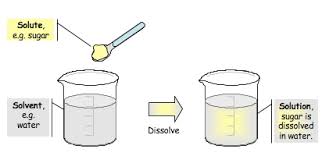
The ability of sugar to dissolve in water is called
malleability
Density
State
solubility


Which one of these is NOT soluble in water?
oil
salt
honey
sugar

Quentin made a poster showing some everyday substances. He plans to write the
properties underneath each picture.
Which of Quentin’s choices will dissolve in water?
oil
soil
sand
sugar

A student performs an experiment. The students wants to study the fastest way to dissolve sugar in tea. The student uses 50 milliliters of tea and adds 50 grams of sugar cubes for each trial. The student waits two minutes before making the observations shown in the table.
How can the experiment be changed to be sure that as much sugar as possible has dissolved?
A. Use larger sugar cubes in the 40 degree Celsius tea.
B. Stir the tea constantly at all three temperatures.
C. Use less water at all three temperatures.
D. Use a larger cup to hold the 50 degree Celsius tea.

In a science experiment, Kayo added 1 tbsp of sugar to a flask filled with water. The diagram below shows how Kayo’s experiment looked.
Which could Kayo do to speed up the dissolving process?
Add more sugar to the flask
Place the flask in an ice bath
Shake the flask back and forth
Remove some water from the flask

