
 Worksheets
Aims of PLC Training
Total questions: 53
Worksheet time: 27mins
Fill in the blank: The aim of this training is to introduce the basic hardware and software components of a ____________.
Programmable Controller (PLC)
Personal Computer (PC)
Microcontroller Unit (MCU)
Digital Multimeter (DMM)
Fill in the blank: The aim of this training is to detail the architecture and basic instruction set common to all ____________.
PLCs
microcontrollers
computers
robots
Fill in the blank: The aim of this training is to cover the advantages of the PLC over ____________ control systems.
hard-wired
wireless
digital
mechanical
Fill in the blank: The aim of this training is to examine practical applications of ____________.
PLCs
motors
sensors
hydraulics
Fill in the blank: The aim of this training is troubleshooting on ____________.
PLCs
motors
sensors
valves
Fill in the blank: At the end of the training, learners should be able to ________ PLC specifications.
Interpret
Ignore
Complicate
Misplace
Fill in the blank: At the end of the training, learners should be able to convert conventional relay logic to a ________ language.
PLC
Python
Assembly
HTML
Which of the following is a topic covered in the course contents?
Relay Ladder Logic
Photosynthesis
Ancient Civilizations
Thermodynamics
Which of the following is a topic covered in the course contents?
Programming and Peripheral Devices
Human Anatomy
Chemical Reactions
Ancient Rome
Which of the following is a topic covered in the course contents?
Troubleshooting and Maintenance
Cell Division
Renaissance Art
Human Anatomy
One of the advantages of PLCs is less _______.
wiring
power
cost
maintenance
Fill in the blank: Wiring between devices and relay contacts are done in the _______ program.
PLC
SCADA
HMI
DCS
Fill in the blank: PLCs are easier and faster to make _______.
changes
mistakes
errors
delays
Fill in the blank: Trouble shooting aids make programming easier and reduce _______.
downtime
costs
errors
complexity
Fill in the blank: Reliable components make PLCs likely to operate for years before _______.
failure
maintenance
upgrade
shutdown
PLCs were developed to replace ______ in the late 1960s.
relays
transistors
microprocessors
vacuum tubes
What was the primary goal of developing PLCs?
To increase costs
To eliminate the high costs associated with inflexible, relay-controlled systems
To make systems more complex
To reduce the use of computers
Fill in the blank: A Programmable Logic Controller (PLC) is a digitally operating electronic apparatus which uses a programming memory for the internal storage of instructions for implementing specific functions such as logic, sequencing, timing, counting and arithmetic to control through digital or analog modules, various types of ________ or process.
machines
networks
databases
websites
Name one area of application mentioned in the list: Manufacturing / Machining, Food / Beverage, Metals, Power, Mining, Petrochemical / Chemical.
Mining
Textiles
Aerospace
Pharmaceuticals
Name one area of application mentioned in the list: Manufacturing / Machining, Food / Beverage, Metals, Power, Mining, Petrochemical / Chemical.
Petrochemical / Chemical
Textile / Apparel
Aerospace / Aviation
Healthcare / Medical
Name one American brand of PLC from the following list: Allen Bradley, Texas Instruments, General Electric.
Allen Bradley
Siemens
Mitsubishi
Omron
Name one European brand of PLC from the following list: Siemens, Festo, Telemecanique.
Siemens
Mitsubishi
Omron
Delta
Name one Japanese brand of PLC from the following list: Mitsubishi, Toshiba, Fanuc.
Mitsubishi
Siemens
Allen-Bradley
Schneider Electric
What is a Unitary PLC?
A PLC with expandable inputs and outputs
A stand alone unit with a predefined number of inputs (IP) and outputs (OP) with no facility for expansion
A PLC used for large applications
A PLC that requires maximum IP's & OP's
Unitary PLCs are generally used for ________ applications which require minimum IP's & OP's. (e.g. an automated door)
small
large
complex
hazardous
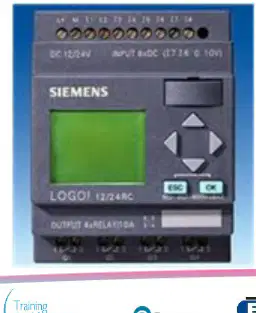
The example shown is a Siemens LOGO OBA6. How many input points (IP's) and relay output points (OP's) does it have?
8 IP's and 4 relay OP's
6 IP's and 2 relay OP's
10 IP's and 6 relay OP's
4 IP's and 8 relay OP's
True or False: A Unitary PLC has a facility for expansion.
True
False
What is a key advantage of Modular PLCs compared to Unitary PLCs?
They are less flexible
They are more flexible
They are smaller
They are more expensive
A modular PLC contains several different modules that can be coupled together to build a ________ controller.
customized
fixed
temporary
manual
What is the rack mounting type of PLC similar to, and how is it implemented differently?
The rack mounting type of PLC is similar to the modular concept, but is implemented differently, keeping each module separate and connected through a network.
The rack mounting type of PLC is similar to the fixed type, but is implemented by integrating all modules into a single unit.
The rack mounting type of PLC is similar to the distributed control system, but is implemented by using wireless communication only.
The rack mounting type of PLC is similar to the relay logic system, but is implemented by using only hardwired connections.
Which commercial unit is an industry-standard example of the rack mounting PLC type?
SLC 500
SLC 100
PLC 200
Modular 300
In rack mounting PLCs, modules are held in organized racks and can be removed and reinserted as needed.
True
False
What is the basic function of a typical PLC?
To read all field input devices, execute the user program, and control output devices as necessary for the process application.
To store data only.
To provide internet access.
To print documents.
The process of sequentially reading the inputs, executing the program in memory, and updating the outputs in a PLC is known as _________?
scanning
looping
paging
interrupting
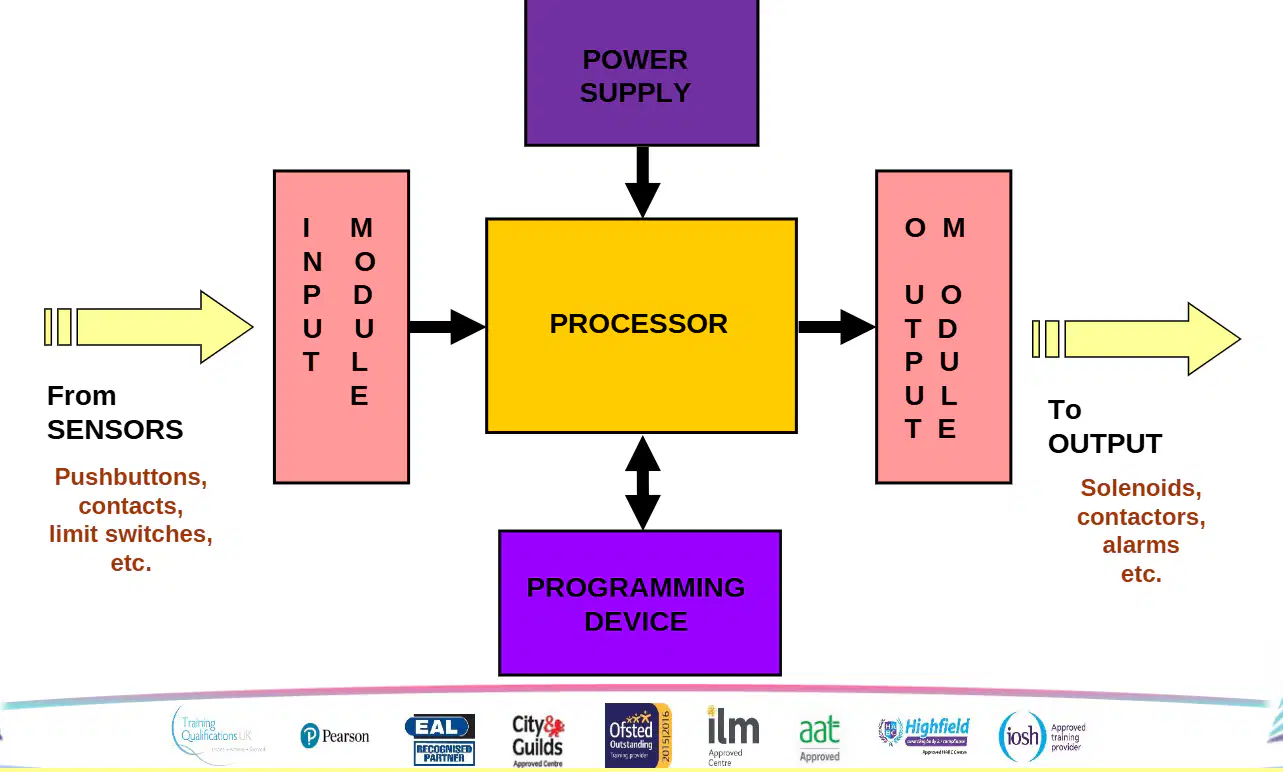
Which of the following is NOT a major component of a common PLC?
Power Supply
Processor
Output Module
Display Screen
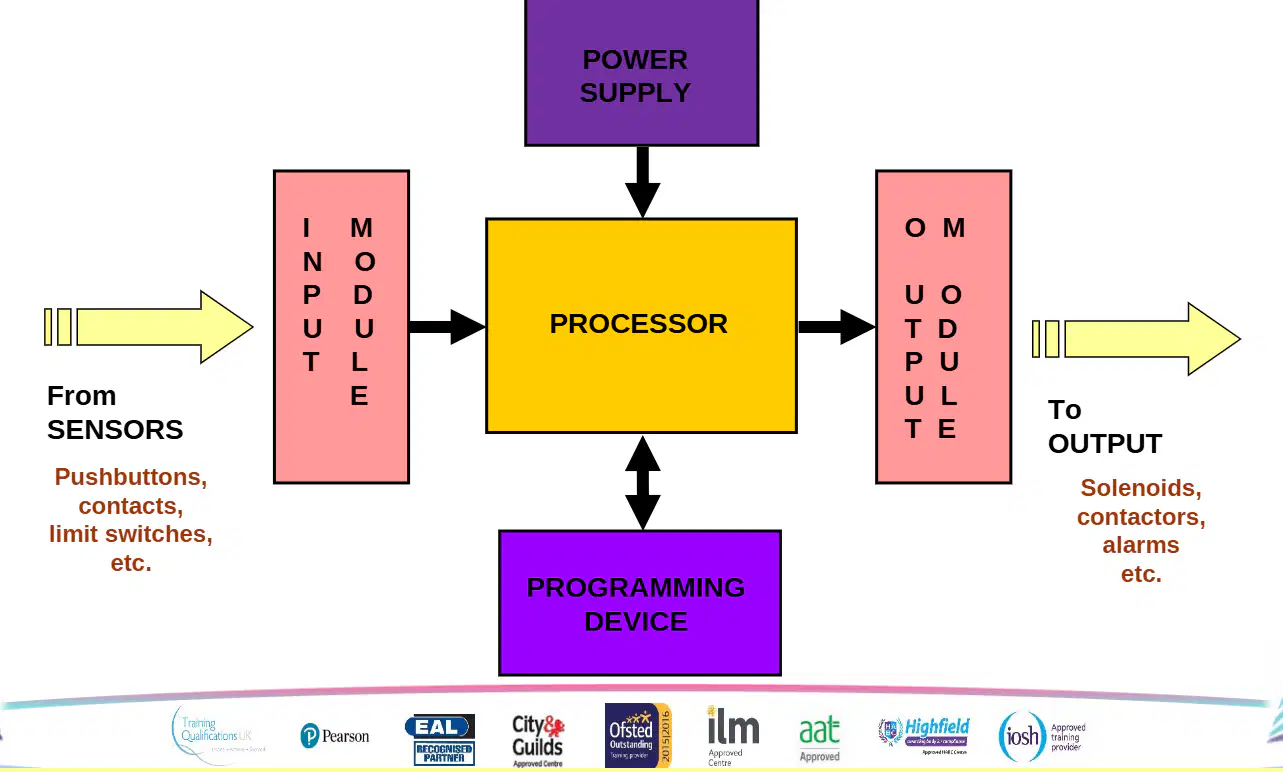
Fill in the blank: The ________ receives signals from sensors such as pushbuttons, contacts, and limit switches in a PLC system.
Input Module
Output Module
Power Supply
Processor
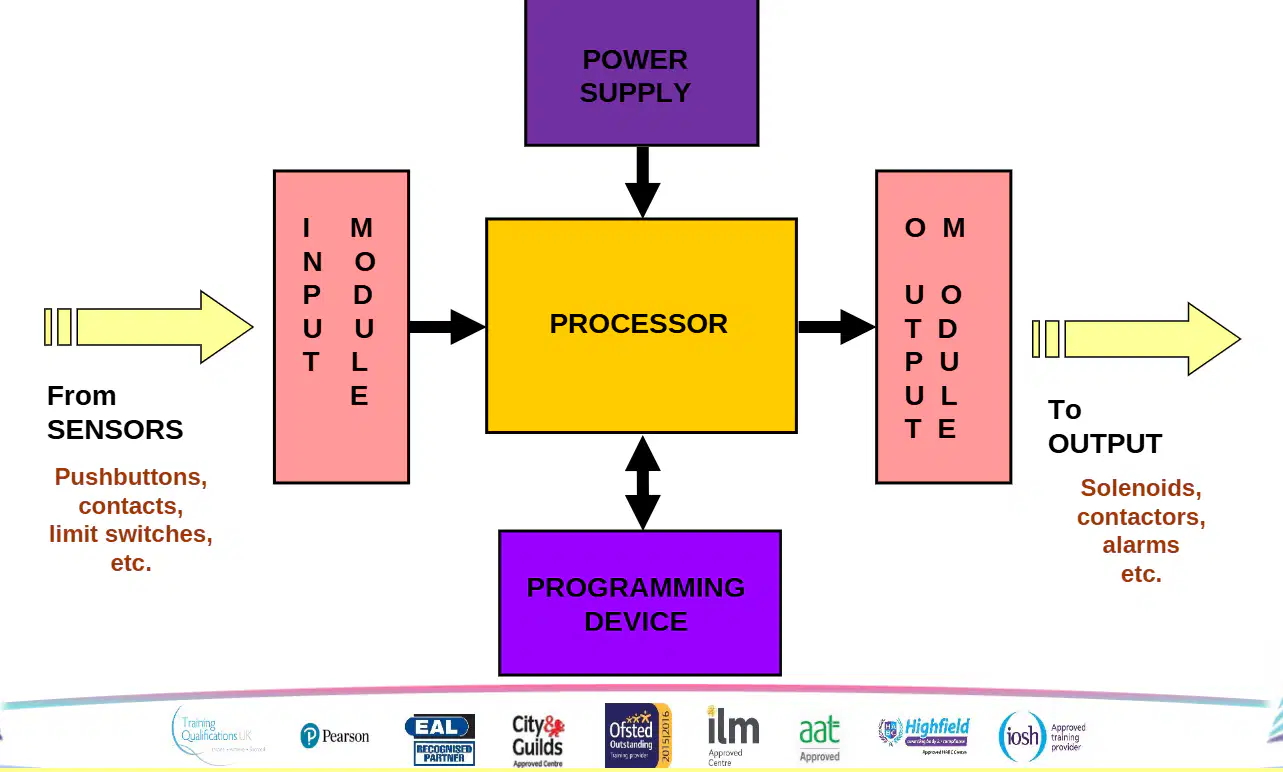
Which component of a PLC is responsible for executing the control program?
Power Supply
Processor
Output Module
Programming Device

Fill in the blank: The ________ supplies electrical power to the PLC system.
Power Supply
CPU Module
Input Module
Output Module
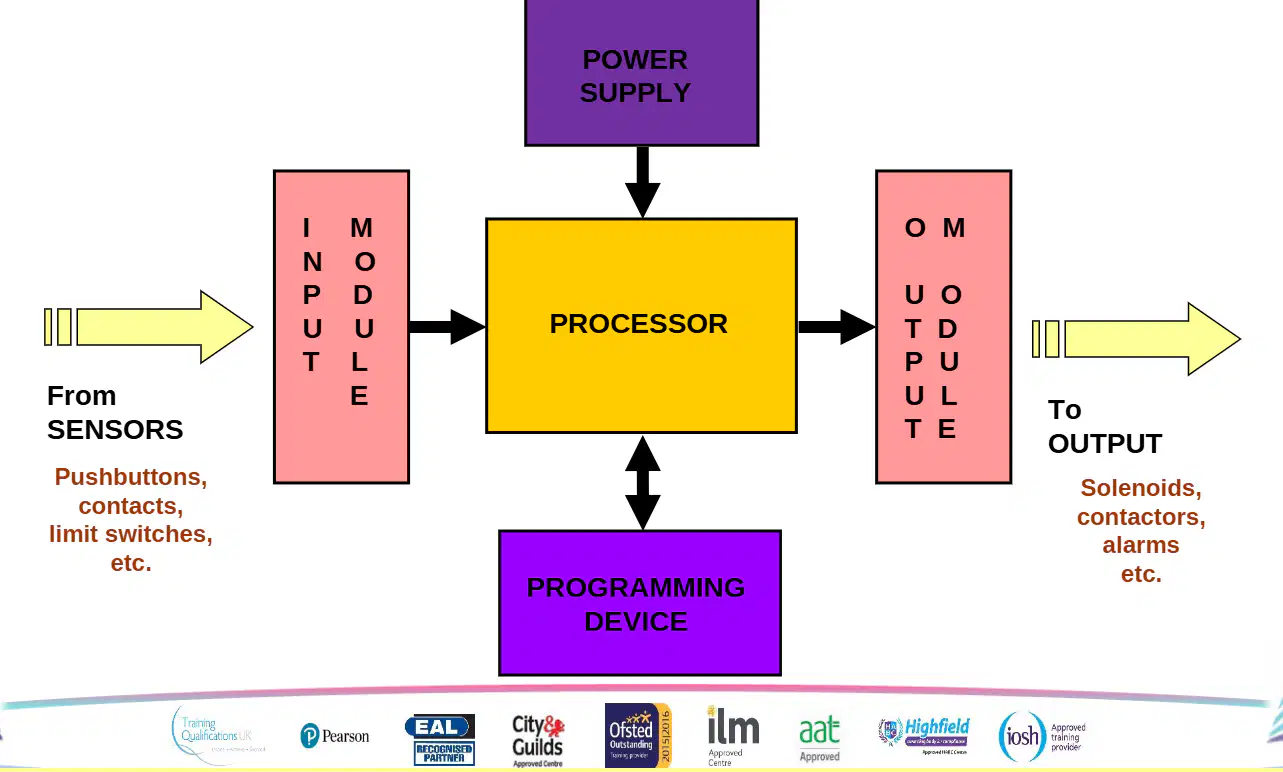
Which of the following is an example of an output device in a PLC system?
Pushbutton
Limit switch
Solenoid
Contact
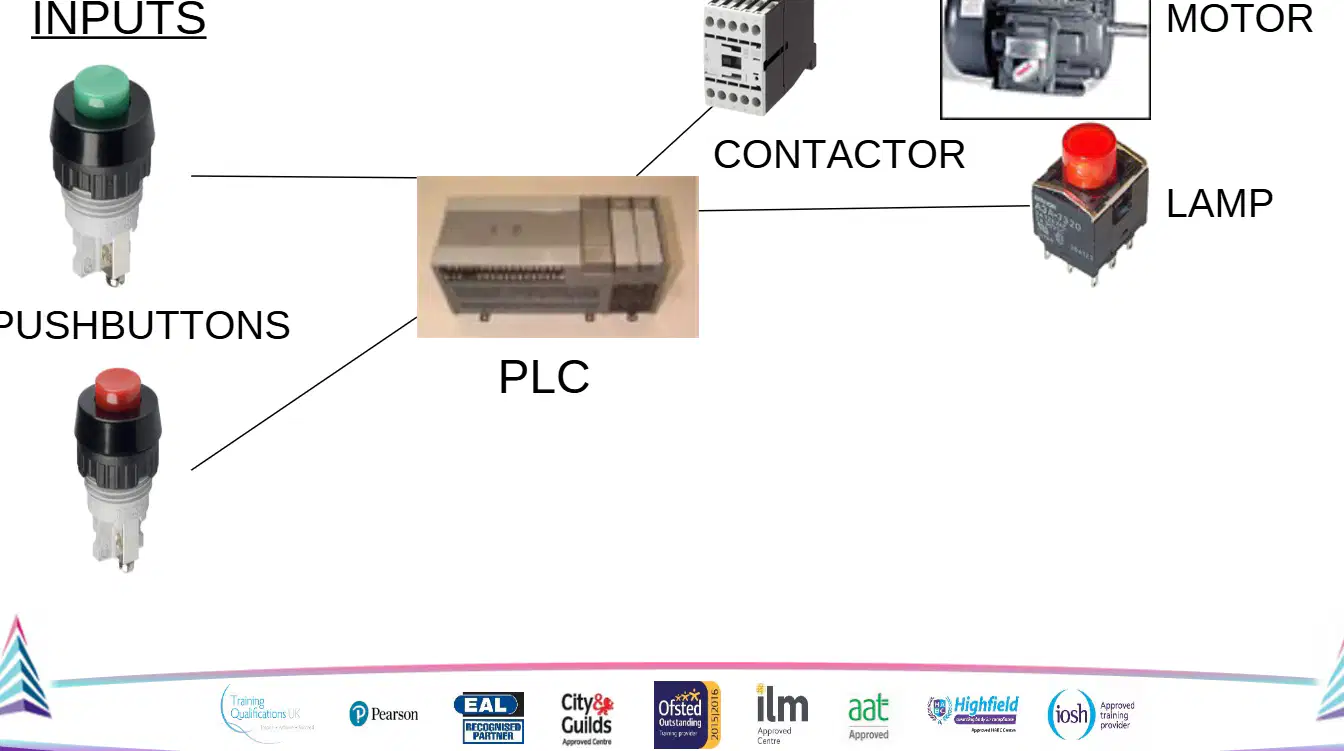
According to the diagram, which of the following is an input to the PLC?
Contactor
Pushbuttons
Motor
Lamp

According to the diagram, which of the following is an output from the PLC?
Pushbuttons
PLC
Contactor
None of the above
Fill in the blank: One of the items required when communicating with PLCs is a __________, such as a laptop or desktop PC.
Programming Terminal
Power Supply
Input Module
Relay Board
Fill in the blank: PLC manufacturers have their own specific __________ and license key required for working with PLCs.
software
hardware
manuals
protocols
Fill in the blank: A __________ is needed for connection from Laptop to PLC when working with PLCs.
Communication cable
Power supply
Cooling fan
Memory card
Fill in the blank: A backup copy of the __________ program (on diskette, CDROM, hard disk, flash memory) is required when working with PLCs.
ladder
spreadsheet
word processor
presentation
What is the function of the POWER SUPPLY in a common PLC?
It provides the voltage needed to run the primary PLC components and reduces and rectifies 230V ac to 24V dc.
It stores the program instructions for the PLC.
It processes the input and output signals of the PLC.
It connects the PLC to external communication networks.
What do I/O MODULES provide in a common PLC?
They provide signal conversion and isolation between the internal logic-level signals inside the PLC and the field’s high level signal. They also receive voltage signal, filter interference, and provide surge protection.
They store the PLC program and manage memory allocation for user data.
They generate the main power supply for the PLC and connected field devices.
They control the communication between multiple PLCs in a networked environment.
Fill in the blank: The ________ provides intelligence to command and govern the activities of the entire PLC systems. It performs the calculations and scanning processes.
Processor
Sensor
Actuator
Relay
Fill in the blank: The ________ is used to enter the desired program that will determine the sequence of operation and control of process equipment or driven machine.
Programming Device
Control Valve
Sensor Module
Power Supply
What is one type of programming device? Fill in the blank: Compatible computer terminal e.g. _____?
laptop
printer
router
scanner
What are General Purpose/Discrete/Digital I/O circuits usually used to drive?
Capacitive loads
Resistive loads such as indicating lights or electromagnetic loads such as relays, solenoids, valves, motor starters
Inductive loads only
None of the above
Noise suppression may or may not be included on General Purpose/Discrete/Digital I/O modules.
True
False
These loads can exhibit a large ________ current so need to be rated accordingly.
inrush
leakage
reverse
static

