
 Worksheets
Transformer Study Guide
Total questions: 52
Worksheet time: 50mins
The transformer is a device used to .......... the value of a voltage.
steady
resist
change
anchor

If a transformer reduces voltage, it is called a....................... transformer.
step left
step right
step up
step down
Why transformers work with A.C. current but not D.C.
A.C current produces changing magnetic field.
D.C current produces changing magnetic field.
D.C current is weak
A.C current is powerful
Which of the following does not change in a transformer?
Voltage
Current
Power
Frequency
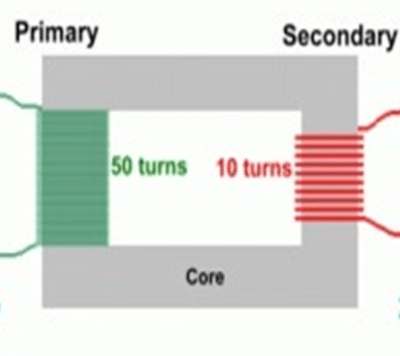
This picture is an example of a ________________.
Motor
Generator
Step-up transformer
Step-down transformer
Ratio of voltages is equal to ratio of _______________________.
number of iron sheets in core
number of coil
number of turns in coil
number of electromagnetic
A transformer has 100 turns in the primary coil and 25 turns in the secondary coil. When a 120 V is applied to the primary coil, what is the voltage in the secondary coil?
480V
30V
20V
450V
The function of a transformer is to ...
raise and lower the apparent power levels
transfer DC voltage from the primary winding to the secondary winding
increase or decrease A.C voltage or A.C current (Amps) levels
transform mechanical energy into electrical energy
What is the meaning of transformer?
Optimus Prime
A device that transfers electrical energy from one circuit to another
Autobots
Megatron
What is the material used for construction of transformer core?
Aluminium
Copper
Iron
Wood
Calculate potential difference in the secondary coil based on the information given below.
Vp = 240 V
Np = 20
Ns = 125
Vs ?
1500
500
1000
2000
The winding of wire around a core which is connected to a source of alternating current (AC) energy is called the ....... coil.
primary
secondary
tertiary
If a transformer increases voltage, it is called a ......... transformer.
step right
step left
step up
step down
If a transformer reduces voltage, it is called a....................... transformer.
step left
step right
step up
step down
What is transformer?
A device that control the incoming surge to the circuit
A device that transfer direct electrical energy from one circuit to another
A device that transfer alternating electrical energy from one circuit to another
There are two sides of transformer namely _____________ and ____________
(a)
There are two sides of transformer namely _____________ and ____________
(a)
A transformer having turns ratio of 300 : 2400. What type of transformer is this?
Step down transformer
Ideal transformer
Step up transformer
Can transformer works in DC circuit?
Yes
No
Mutual inductance is
interactions of one coils magnetic field on other coil as it induces a voltage in the adjacent coil
Interactions of one coils magnetic field on other coil as it induces a current in the adjacent coil.
Interactions of one coils magnetic field on other coil as it induces electrical energy in the adjacent coil
Induced voltage in primary and secondary winding depends on the following except for
Resistor, R
number of turns, N
magnetic flux
Frequency
A transformer is a device that changes the voltage of
a direct current
an alternating current
Two types of transformer are in terms of voltage
step-in transformer
step-out transformer
step-down transformer
step-up transformer

Calculate voltage in the secondary coil based on the information given below.
Vp = 240 V
Np = 20
Ns = 125
Vs ?
1500 Turns
1500 V
1500A
Transformer is always connected to ___________ supply.
A.C.
D.C.
Transformer transforms _________ from primary to secondary.
Only Current
Only Voltage
Both Voltage and Current
The core of a transformer is made up of:
iron
steel
copper
Electrical symbol of a TRANSFORMER


The following parts of the transformer are...
Emitter/base/ collector
Core/primary coil/secondary coil
Anode/Cathode
In a 12 V transformer connected to a regular 120 V /5 A line. the output current will be
50 A
20 A
1.2 A
In a transformer with 200 turns in the primary coil and 25 turns in the secondary coil the ratio will be...
1:8
8:1
12:1
Is the metal used to build the coils of transformers
Aluminum
copper
steel
The highest output voltage of a center tap transfomer with 10 V in one section is.
20 V
10 V
24 V
How do I know what amp my transformer is?
You have to measure voltage while you are measuring current to get power rating. The transformer will not be giving out the same voltage when shorted out thru a shunt resistor in a multimeter. Take another multimeter, set it up as voltmeter and measure the voltage while measuring current.
(a)
What is volt amps of a transformer?
Transformers are rated in volt amps (VA). It defines the limit of the magnetizing field inside the transformer. If this limit is exceeded, the transformer goes into saturation and ceases to function properly. This is especially important when the transformer has more than one secondary winding.
(a)
All permanent magnets have two
magnetic charges
magnetic fields
magnetic needles
magnetic poles
Like poles on a permanent magnet will
attract each other
repel each other
always interact
point in the same direction
What makes an electromagnet different than a permanent magnet.....select all that apply
it can be turned on and off
it does not need any electricity
its strength can be increased and decreased
its polarity can be reversed
Which way will NOT increase the strength of the magnetic field of an electromagent
increasing the current
using a stronger ferromagnetic core
winding the coils closer together
decreasing the number of loops
What type of materials are needed to create an electromagnet?
battery, light bulb, plastic straw
battery, coil of wire, iron core
generator, iron core, switch
switch, source of electricity, compass
Moving a permanent magnet through a coil of wire will
demagnetize the magnet
the wire will become an electromagnet
the magnet will become electrified
a current will be generated in the wire
A device that transforms electrical energy to mechanical energy is a
generator
motor
transformer
magnet
A transformer actually transforms
voltage
magnetic field lines
generators into motors
A step-up transformer increases
power
energy
neither
both
Electromagnetic induction occurs in a coil when there is a change in
electric field in the coil
magnetic field in the coil
voltage in the coil
Voltage can be induced in a wire by
moving the wire near a magnet
moving a magnet near the wire
changing the current in a nearby wire
all of these
none of these
What is electromagnetic induction?
The process of generating an electric current by changing the magnetic field around a conductor.
The movement of electrons in a circuit due to a battery.
The conversion of electrical energy into mechanical energy.
The attraction and repulsion between two magnets.
How is electromagnetic induction related to transformers?
Transformers use electromagnetic induction to transfer electrical energy between two coils of wire.
Transformers create electricity by using a chemical reaction.
Electromagnetic induction is not involved in the operation of transformers.
Transformers use electromagnetic induction to convert electrical energy into mechanical energy
Which component of a transformer does not actually make contact with the electrical energy but plays a crucial role in its operation?
Primary winding
Secondary winding
Magnetic core
Cooling system
What is the principle by which transformers operate?
Electromagnetic induction
Thermal induction
Piezoelectric effect
Capacitive coupling
Calculate potential difference in the secondary coil based on the information given below.
Vp = 240 V
Np = 20
Ns = 125
Vs ?
1500
500
1000
2000
Vp =10 , Np=5 and Ns=25 . What is the secondary voltage?
10
25
50
100

