
 Worksheets
Alcohol: An Overview
Total questions: 97
Worksheet time: 49mins
According to the overview, what may lower some health risks in older adults?
High levels of alcohol
Very low levels of alcohol, particularly red wine
No alcohol at all
Beer only
What percentage of Americans have tried an alcoholic beverage at least once during their lifetimes?
85.6 percent
62.3 percent
48.9 percent
73.1 percent
According to the overview, who typically drinks more regularly and in greater amounts?
Men
Women
Both equally
Children
Alcoholic beverages contain ethyl alcohol, also known as ________, which is fat soluble and absorbed throughout the entire gastrointestinal system.
ethanol
methanol
propanol
butanol
Alcohol enters your blood stream after the first sip.
True
False
The effects of alcohol can be seen within how many minutes?
1 minute
5 minutes
10 minutes
30 minutes
Which of the following factors influence how quickly your body absorbs alcohol?
Concentration of alcohol in the drink
Full or empty stomach
Mixing caffeine or sugar free diet drinks
Mood (stress and tension)
All of the above
A full stomach ________ absorption of alcohol, while an empty stomach ________ it up.
slows, speeds
speeds, slows
increases, decreases
decreases, increases
Mixing caffeine or sugar free diet drinks ________ absorption of alcohol.
speeds
slows
prevents
stops
Mood, such as stress and tension, can speed up absorption of alcohol.
True
False
Fill in the blank: ________ is an addictive drug produced by fermentation that is the intoxicating substance in alcoholic beverages.
Ethyl alcohol or ethanol
Methanol
Isopropyl alcohol
Acetone
Fill in the blank: The ________ is the process in which yeast organisms break down plant sugars to yield ethanol.
Fermentation process
Photosynthesis
Respiration
Transpiration
Fill in the blank: ________ is the process in which alcohol vapors are condensed and mixed with water to make hard liquor.
Distillation
Fermentation
Pasteurization
Filtration
Fill in the blank: ________ is the measure of the percentage of alcohol in a beverage; the proof is double the percentage of alcohol in the drink.
Proof
Volume
Density
Concentration
80 proof whiskey contains what percentage of alcohol?
20 percent
40 percent
60 percent
80 percent
According to Figure 9.1, what is the standard drink equivalent (in ounces) and approximate alcohol percentage for beer?
12 oz (~5% alcohol)
8 oz (~12% alcohol)
16 oz (~3% alcohol)
5 oz (~40% alcohol)
According to Figure 9.1, how many standard drinks are in 16 oz of beer?
1.3
0.8
2.0
1.8
According to Figure 9.1, what is the standard drink equivalent (in ounces) and approximate alcohol percentage for malt liquor?
8.5 oz (~7% alcohol)
12 oz (~5% alcohol)
5 oz (~12% alcohol)
1.5 oz (~40% alcohol)
According to Figure 9.1, how many standard drinks are in 22 oz of malt liquor?
2.5
1.0
4.0
0.5
According to Figure 9.1, what is the standard drink equivalent (in ounces) and approximate alcohol percentage for table wine?
5 oz (~12% alcohol)
12 oz (~5% alcohol)
1.5 oz (~40% alcohol)
8 oz (~20% alcohol)
According to Figure 9.1, how many standard drinks are in a 750-mL (25-oz) bottle of table wine?
5
2
8
10
According to Figure 9.1, what is the standard drink equivalent (in ounces) and approximate alcohol percentage for 80 proof spirits (gin, vodka, etc.)?
1.5 oz (~40% alcohol)
5 oz (~12% alcohol)
12 oz (~5% alcohol)
2 oz (~20% alcohol)
According to Figure 9.1, how many standard drinks are in a pint (16 oz) of 80 proof spirits?
11
4
8
16
About 20 percent of absorption occurs in the stomach.
True
False
About 80 percent of absorption occurs in the small intestine.
True
False
Which of the following is NOT a factor that influences absorption?
E) Metabolism
C) Food in your stomach
B) Amount consumed
A) Concentration and drink type
D) Eye color
Fill in the blank: About ___ percent of absorption occurs in the stomach.
20
5
50
80
Fill in the blank: About ___ percent of absorption occurs in the small intestine.
80
30
50
100
Two factors that influence absorption are:
Surface area and blood flow
Color and shape
Temperature and sound
Weight and height
Alcohol contains ___ calories per gram.
7
4
9
2
The breakdown of alcohol is fairly constant at about how many ounces per hour (about one standard drink)?
0.2 ounces
0.5 ounces
1.0 ounce
2.0 ounces
Unmetabolized alcohol circulates in the bloodstream until enough time passes for the body to ____ it down.
break
grow
paint
lift
What is the ratio of alcohol to total blood volume called?
Blood Alcohol Concentration (BAC)
Blood Pressure Index (BPI)
Plasma Volume Ratio (PVR)
Serum Glucose Level (SGL)
What is the legal limit for Blood Alcohol Concentration (BAC) in all states?
0.08 percent
0.05 percent
0.10 percent
0.15 percent
Which of the following tests are used to determine whether an individual is legally intoxicated?
Breath analysis (breathalyzer tests)
Urinalysis
Blood tests
All of the above
What is learned behavioral tolerance?
Learned behavioral tolerance is when an individual has learned to modify his behavior to appear sober even though BAC may be quite high.
Learned behavioral tolerance is when a person becomes immune to all effects of alcohol.
Learned behavioral tolerance is when someone can drink unlimited alcohol without any consequences.
Learned behavioral tolerance is when alcohol has no effect on a person's coordination or judgment.
According to the table 'The Psychological and Physical Effects of Alcohol', what are the psychological and physical effects at a Blood Alcohol Concentration (BAC) of less than 0.01%?
Negligible
Euphoria and loss of coordination
Slurred speech and impaired balance
Severe confusion and risk of coma
According to the table 'The Psychological and Physical Effects of Alcohol', what are the psychological and physical effects at a Blood Alcohol Concentration (BAC) of 0.01–0.04%?
Slight muscle relaxation, mild euphoria, slight body warmth, increased sociability and talkativeness
Severe confusion, vomiting, and possible loss of consciousness
Impaired balance, slurred speech, and delayed reaction time
Hallucinations, stupor, and risk of coma
According to the table 'The Psychological and Physical Effects of Alcohol', what are the psychological and physical effects at a Blood Alcohol Concentration (BAC) of 0.05–0.07%?
Lowered alertness, impaired judgment, lowered inhibitions, exaggerated behavior, loss of small muscle control
Euphoria, improved coordination, increased alertness, no loss of muscle control
Severe confusion, vomiting, inability to stand, risk of death
No noticeable effects, normal behavior, full muscle control
According to the table 'The Psychological and Physical Effects of Alcohol', what are the psychological and physical effects at a Blood Alcohol Concentration (BAC) of 0.08–0.14%?
Slowed reaction time, poor muscle coordination, short-term memory loss, judgment impaired, inability to focus
Euphoria, increased sociability, slight impairment of reasoning and memory
Coma, possible death, severe respiratory depression
No noticeable effects, normal behavior
According to the table 'The Psychological and Physical Effects of Alcohol', what are the psychological and physical effects at a Blood Alcohol Concentration (BAC) of 0.15–0.24%?
Blurred vision, lack of motor skills, sedation, slowed reactions, difficulty standing and walking, passing out
Euphoria, increased sociability, lowered inhibitions, mild impairment of reasoning and memory
No noticeable effects, normal behavior, no impairment
Severe confusion, stupor, possible coma, risk of death
According to the table 'The Psychological and Physical Effects of Alcohol', what are the psychological and physical effects at a Blood Alcohol Concentration (BAC) of 0.25–0.34%?
Impaired consciousness, disorientation, loss of motor function, severely impaired or no reflexes, impaired circulation and respiration, uncontrolled urination, slurred speech, possible death
Mild euphoria, relaxation, slight impairment of judgment and coordination
Increased heart rate, flushed skin, reduced inhibitions, talkativeness
Coma, complete loss of consciousness, possible death due to respiratory arrest
According to the table 'The Psychological and Physical Effects of Alcohol', what are the psychological and physical effects at a Blood Alcohol Concentration (BAC) of 0.35% and up?
Unconsciousness, coma, extremely slow heartbeat and respiration, unresponsiveness, probable death
Mild euphoria, relaxation, slight impairment of judgment
Increased heart rate, flushed skin, impaired motor skills
Confusion, dizziness, nausea, slurred speech
At which Blood Alcohol Concentration (BAC) range are the following effects observed: 'Lowered alertness, impaired judgment, lowered inhibitions, exaggerated behavior, loss of small muscle control'?
0.01–0.04%
0.05–0.07%
0.08–0.14%
0.15–0.24%
Blood Alcohol Concentration (BAC): A drinker’s BAC depends on _________.
Weight and body fat
Eye color and height
Favorite beverage
Time of day
Blood Alcohol Concentration (BAC): The water content in the ________ affects a drinker’s BAC.
body tissues
lungs
stomach
bones
Blood Alcohol Concentration (BAC): The concentration of alcohol in the ________ consumed affects BAC.
beverage
air
skin
clothes
Blood Alcohol Concentration (BAC): Alcohol concentration is higher in people with more body fat; women generally have more body fat than men.
True
False
Blood Alcohol Concentration (BAC): Women have half as much alcohol dehydrogenase as men.
True
False
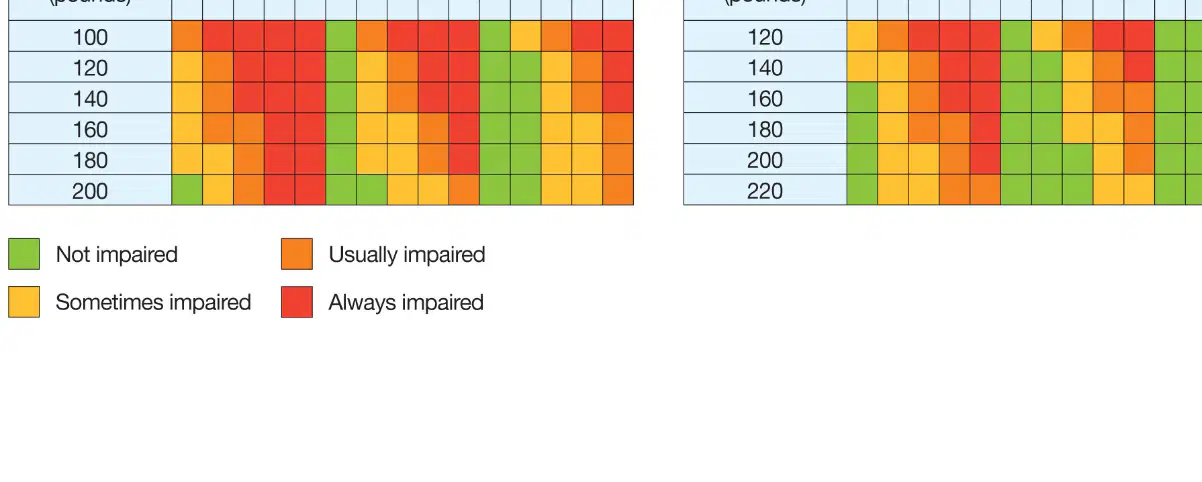
According to Figure 9.3, what does the green color in the chart represent?
Not impaired
Sometimes impaired
Usually impaired
Always impaired

According to Figure 9.3, a woman weighing 140 pounds who consumes 3 drinks in 1 hour is _________.
Always impaired
Never impaired
Below the legal limit
Able to drive safely

According to Figure 9.3, a man weighing 200 pounds who consumes 2 drinks in 5 hours is:
Not impaired
Sometimes impaired
Usually impaired
Always impaired

According to Figure 9.3, a woman weighing 120 pounds who consumes 4 drinks in 3 hours is _________.
Always impaired
Never impaired
Sometimes impaired
Impaired only if driving

According to Figure 9.3, which group is more likely to be impaired after consuming 3 drinks in 1 hour:
A) A woman weighing 100 pounds
B) A man weighing 200 pounds
Heavy drinking can lead to which of the following?
Hangovers
Blackouts
Both A and B
Neither A nor B
Both hangovers and blackouts are indicators of ________.
neural tissue damage
good health
increased intelligence
improved memory
Which of the following are symptoms of hangovers?
Headache
Muscle aches
Upset stomach
All of the above
Blackouts are temporary episodes of amnesia of people and events, especially while ________.
binge drinking
sleeping
studying
exercising
Damage to the brain’s hippocampus affects which of the following functions?
Memory and learning
Vision
Hearing
Smell
Short-term effects of Alcohol Use: Fill in the blank. Alcohol depresses ________ functions.
central nervous system (CNS)
digestive system
immune system
respiratory system
Short-term effects of Alcohol Use: What can happen to vital functions as a result of alcohol use?
They become stronger
They become noticeably affected, and in extreme cases, coma and death can result
They are not affected
They improve memory
Short-term effects of Alcohol Use: Alcohol is a diuretic, but water is pulled out of the ________, resulting in 'morning-after' headaches.
cerebrospinal fluid
bloodstream
liver
stomach
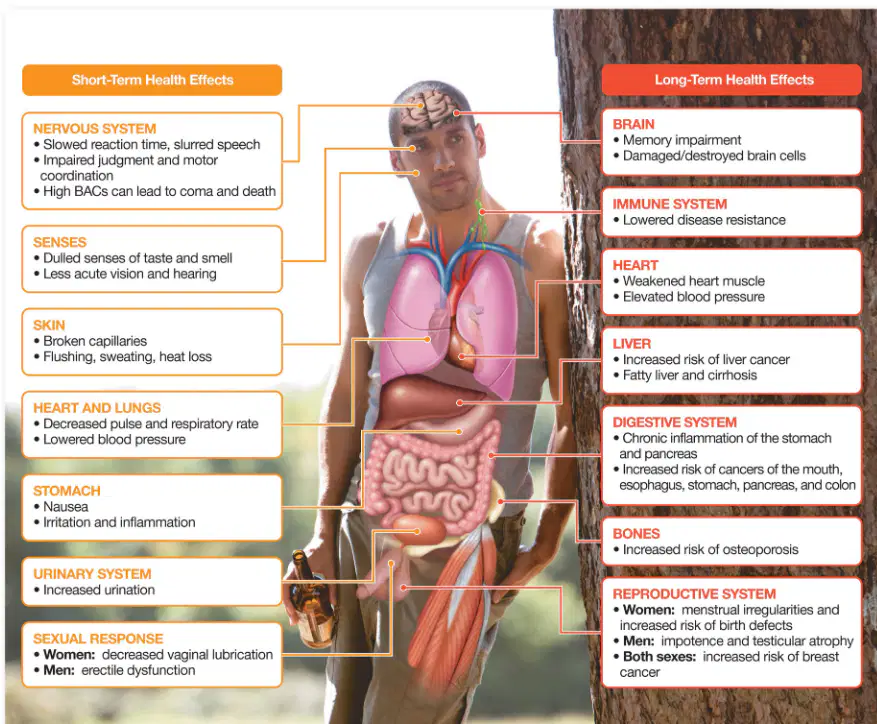
What is one short-term effect of alcohol on the nervous system?
Slowed reaction time, slurred speech, impaired judgment and motor coordination, or high BACs can lead to coma and death
Increased alertness and improved memory
Enhanced muscle strength and coordination
Permanent loss of vision
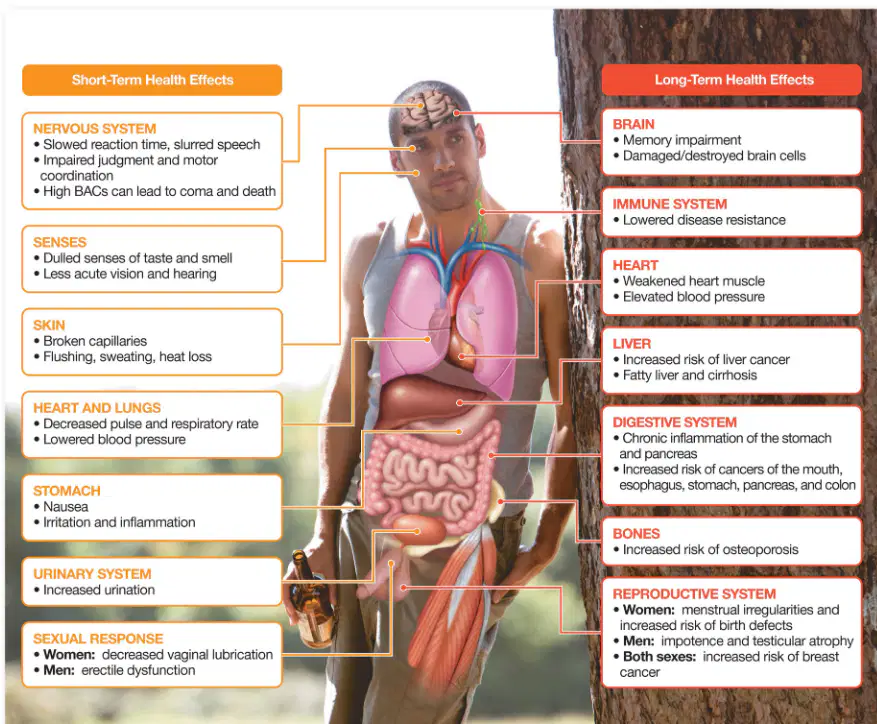
Which sense is dulled as a short-term effect of alcohol?
Taste and smell
Sight
Hearing
Touch
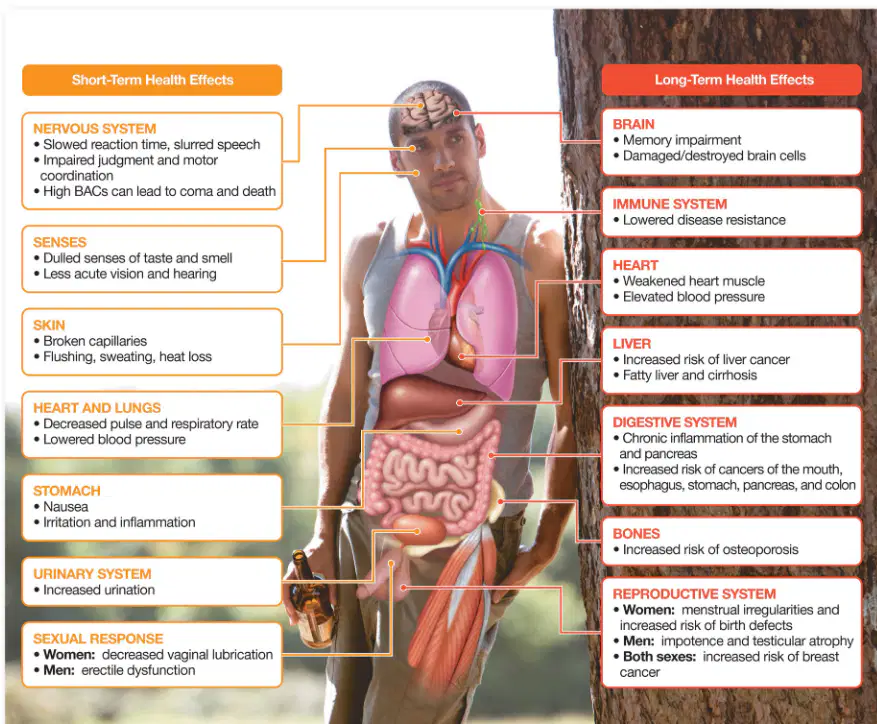
What is a short-term effect of alcohol on the skin?
Broken capillaries, flushing, sweating, heat loss
Increased hair growth
Permanent scarring
Development of moles
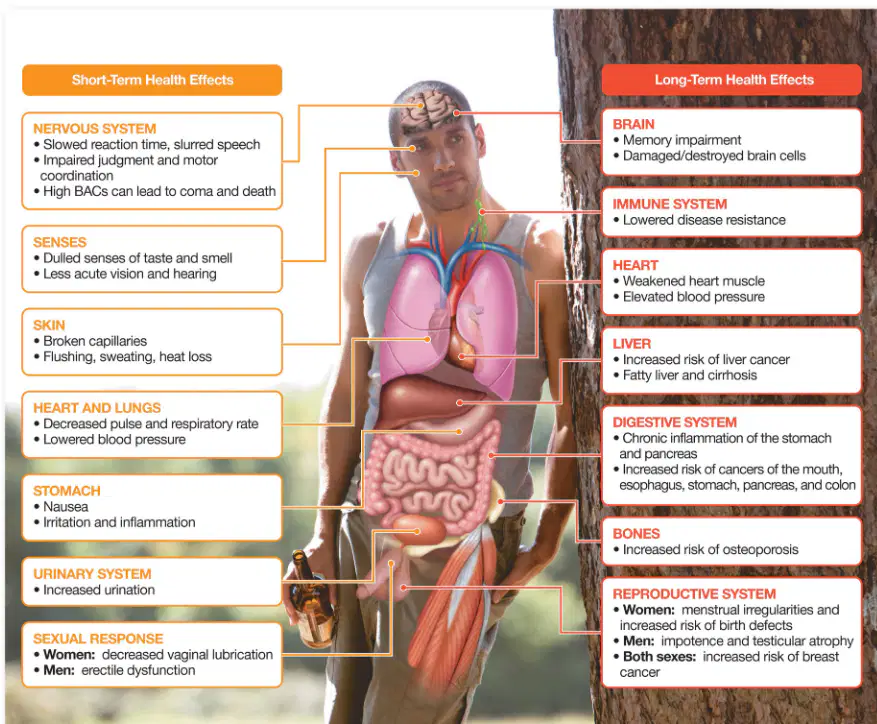
Alcohol can cause decreased pulse and respiratory rate as a short-term effect.
True
False
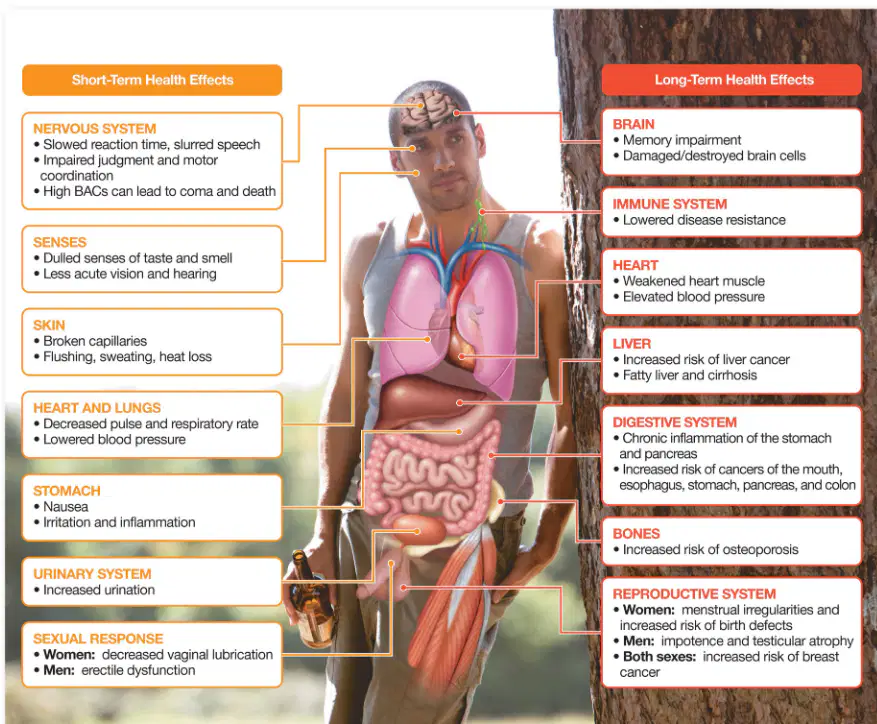
What is a short-term effect of alcohol on the stomach?
Nausea, irritation and inflammation
Increased bone density
Improved vision
Faster wound healing
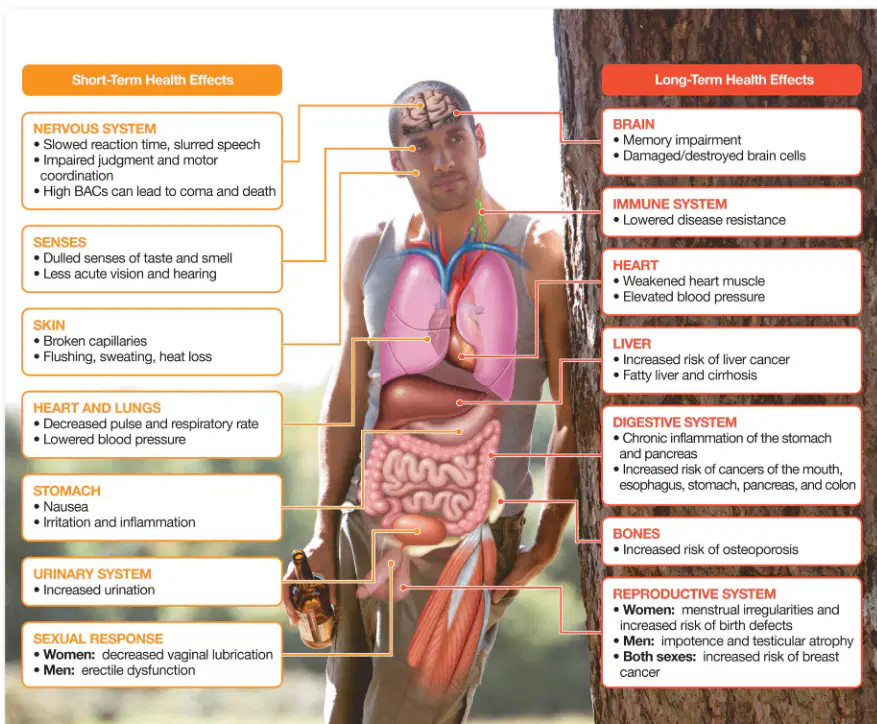
Increased urination is a short-term effect of alcohol on which body system?
Urinary system
Digestive system
Respiratory system
Nervous system
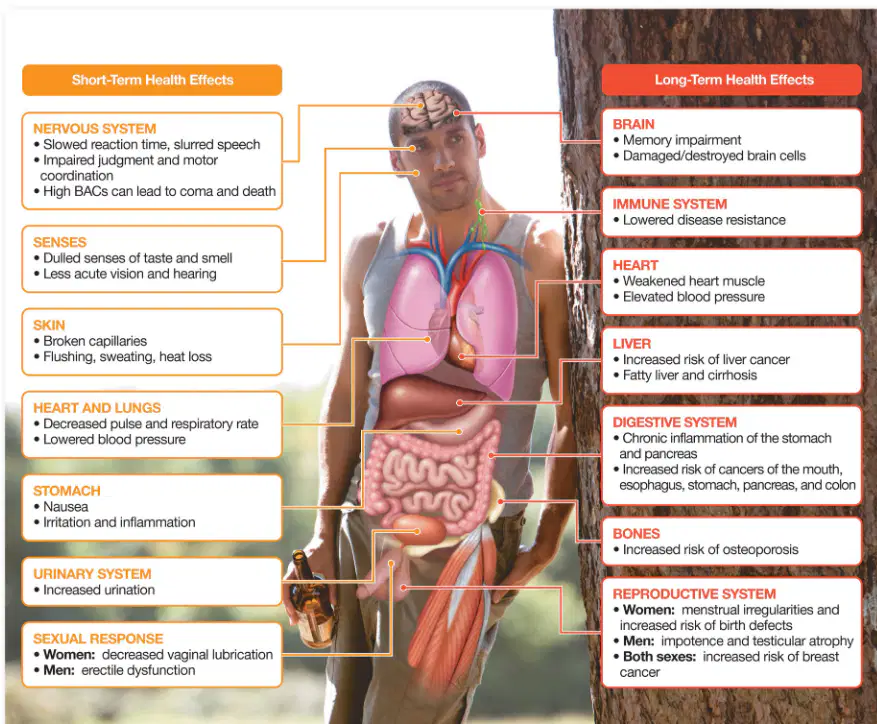
What is a short-term effect of alcohol on sexual response in women?
Decreased vaginal lubrication
Increased fertility
Enhanced memory retention
Improved muscle strength
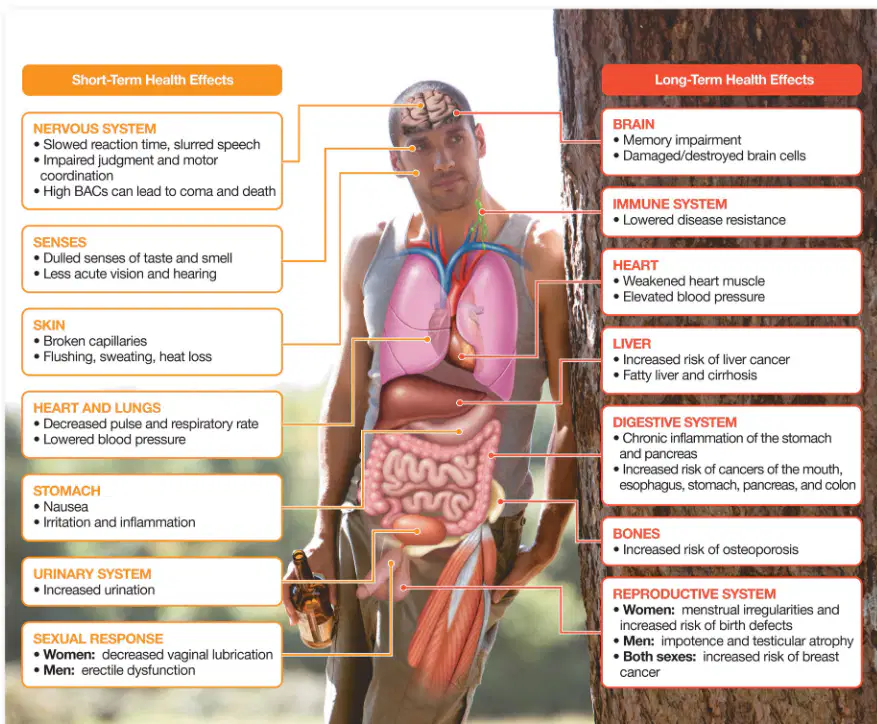
What is a short-term effect of alcohol on sexual response in men?
Erectile dysfunction
Increased fertility
Permanent loss of libido
Improved sexual performance
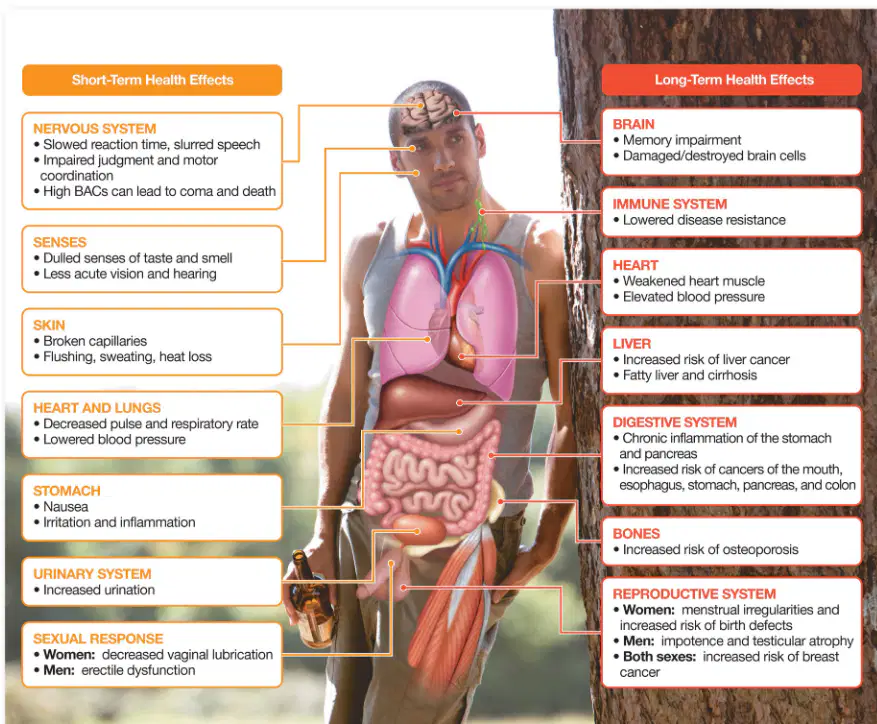
What is a long-term effect of alcohol on the brain?
Memory impairment, damaged/destroyed brain cells
Increased intelligence and focus
Improved vision and hearing
Enhanced muscle growth
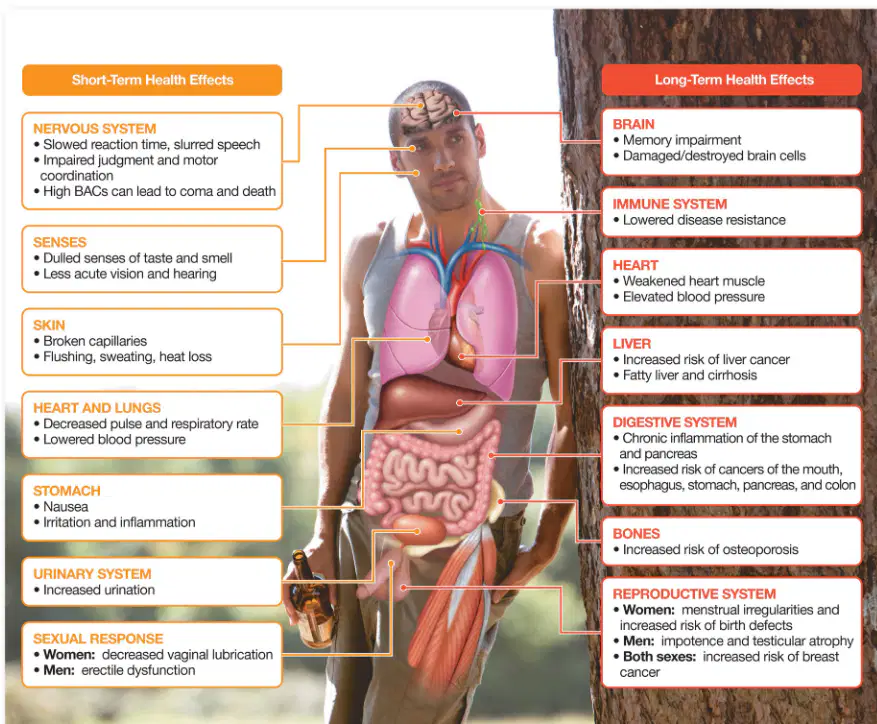
Lowered disease resistance is a long-term effect of alcohol on which system?
Immune system
Digestive system
Nervous system
Respiratory system
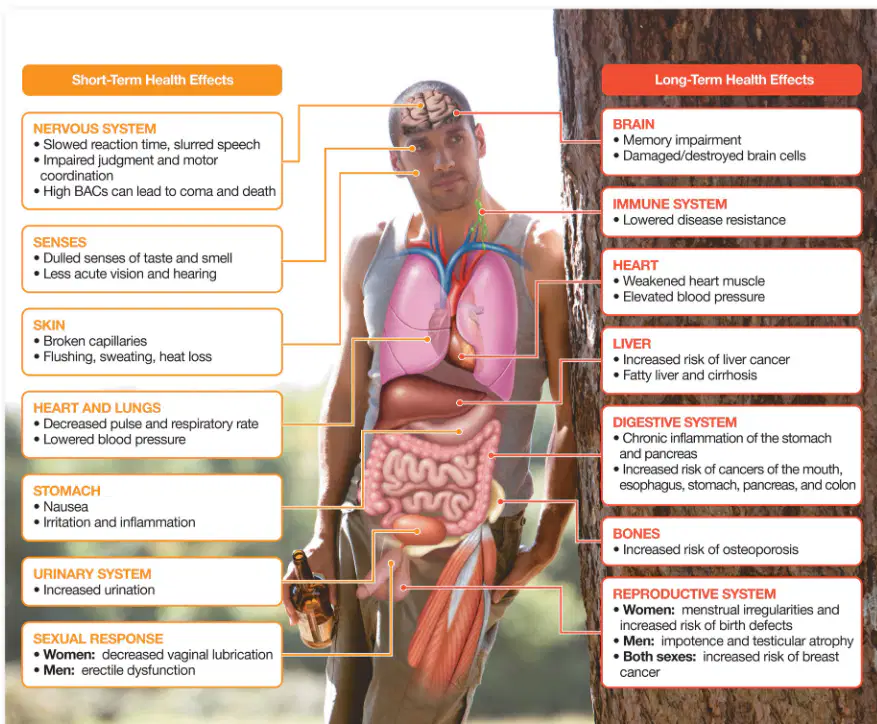
What is a long-term effect of alcohol on the heart?
Weakened heart muscle, elevated blood pressure
Improved heart function and lower cholesterol
Increased heart size and stronger contractions
Decreased risk of heart disease
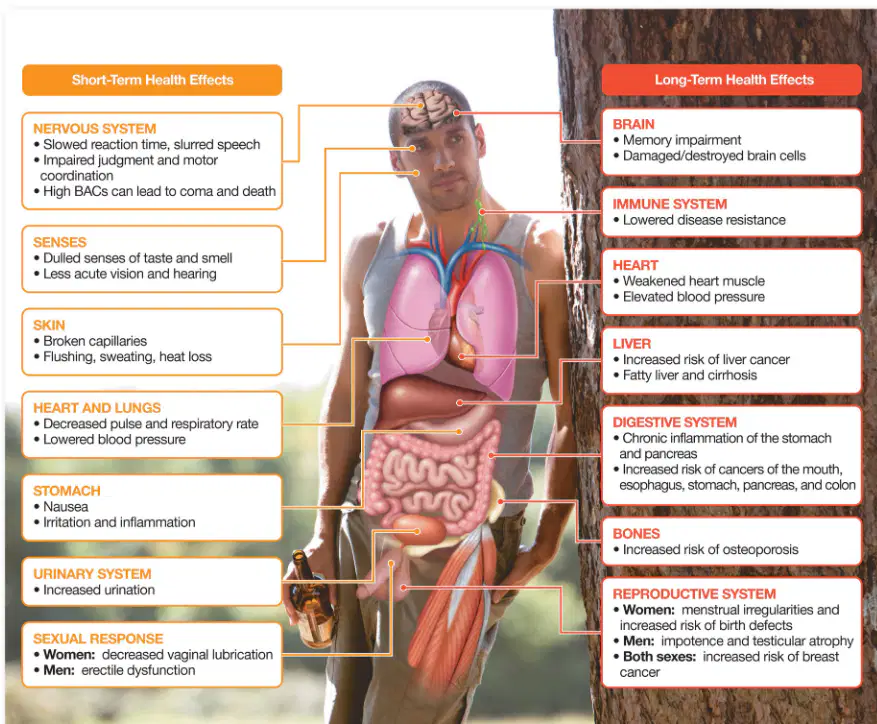
Alcohol increases the risk of which type of cancer in the liver?
Liver cancer
Pancreatic cancer
Stomach cancer
Colon cancer
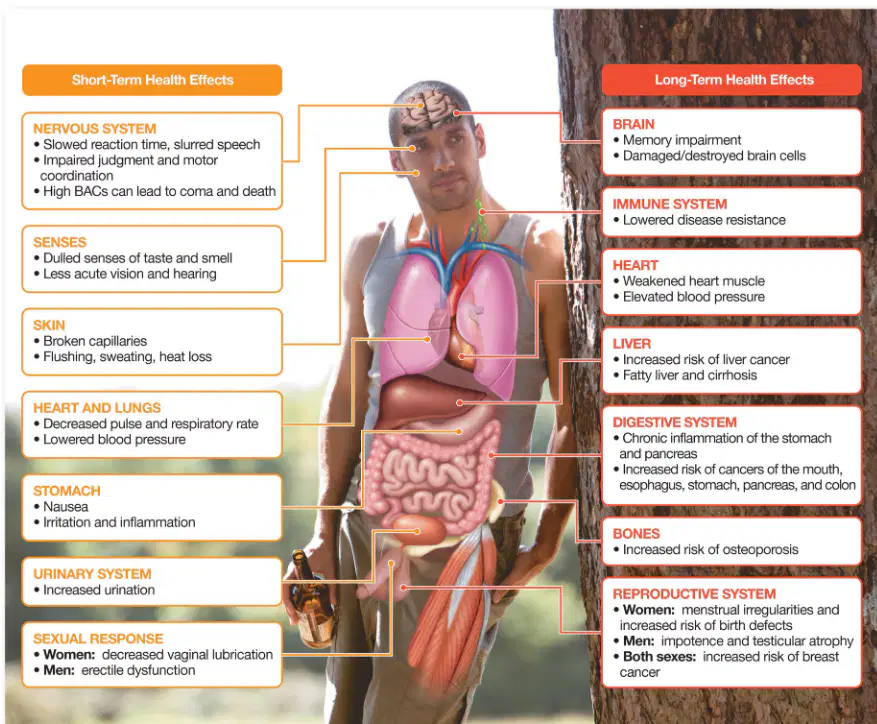
Chronic inflammation of the stomach and pancreas is a long-term effect of alcohol.
True
False
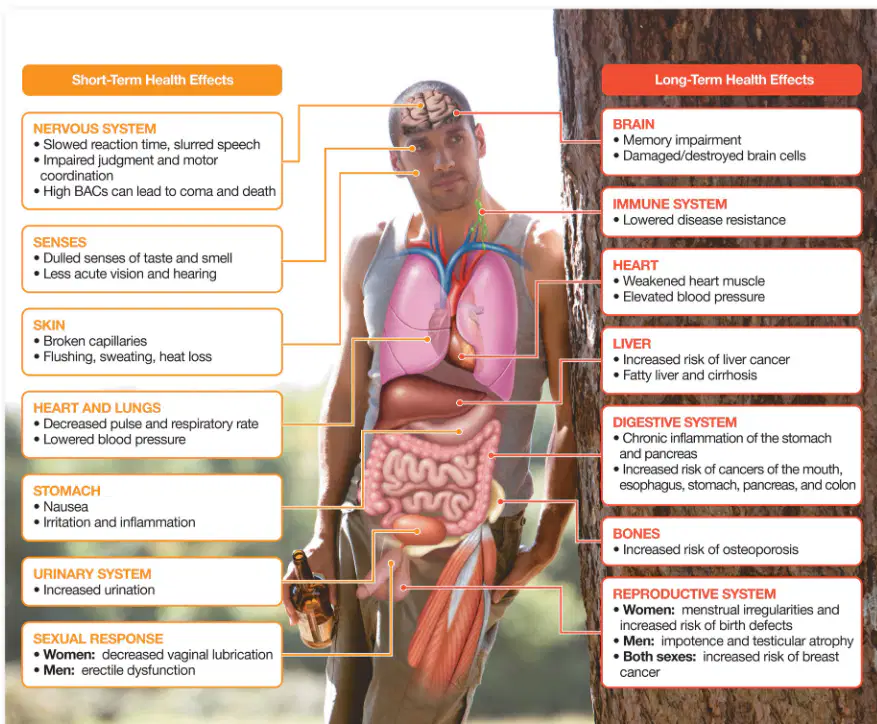
What is a long-term effect of alcohol on bones?
Increased risk of osteoporosis
Improved bone density
Faster bone healing
Stronger bone growth
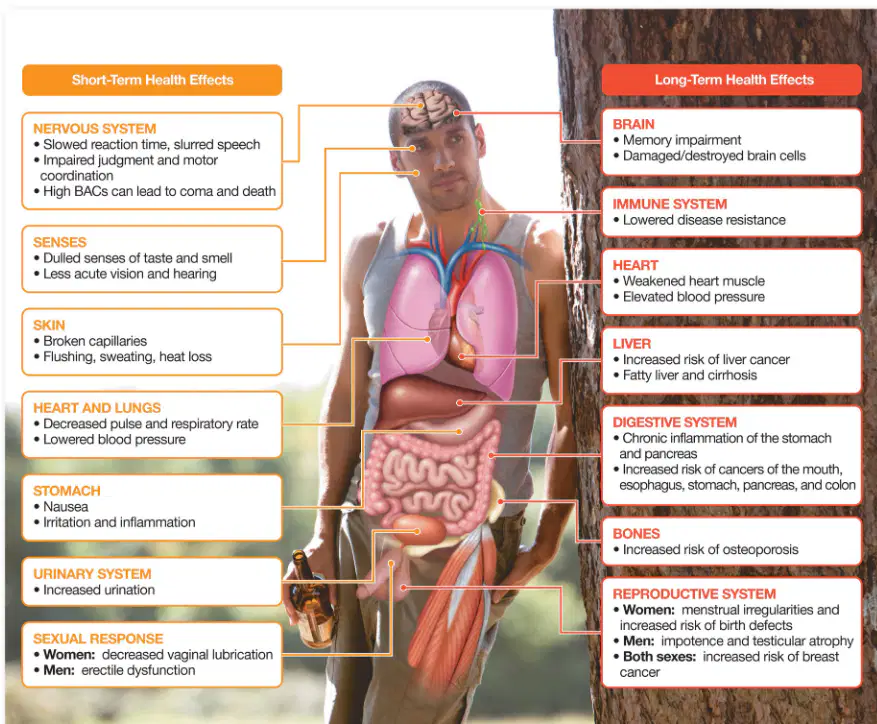
What is a long-term effect of alcohol on the reproductive system in women?
Menstrual irregularities and increased risk of birth defects
Improved fertility and hormonal balance
Decreased risk of reproductive cancers
Enhanced ovulation and regular cycles
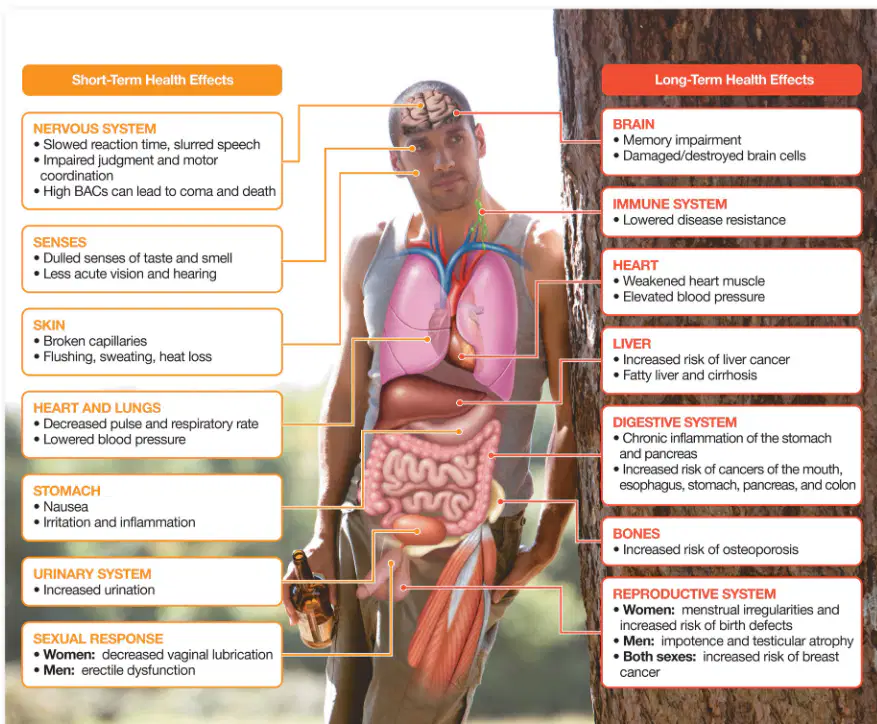
What is a long-term effect of alcohol on the reproductive system in men?
Impotence and testicular atrophy
Increased muscle mass
Improved vision
Enhanced memory
Which of the following is a short-term effect of alcohol?
Alcohol improves digestion
Alcohol irritates the gastrointestinal system
Alcohol strengthens the heart
Alcohol increases metabolism
Alcohol and Your Health (2 of 3) Brief drinking sprees of high amounts increase risk for ________ or total loss of heart rhythm.
irregular heartbeat
high blood pressure
liver failure
dehydration
What are congeners?
Forms of alcohol that metabolize more slowly than ethanol and are more toxic
A type of food additive
A vitamin found in alcohol
A type of enzyme that breaks down alcohol
Alcohol is involved in approximately what percent of fatal injuries during activities such as boating and swimming?
30 percent
50 percent
70 percent
90 percent
Alcohol and Your Health: Heavy drinking is associated with what type of violence?
Road rage
Dating violence
Workplace violence
School violence
Alcohol use by women makes them more vulnerable to what?
Heart disease
Sexual assault
Diabetes
High blood pressure
Alcohol poisoning, also known as acute alcohol intoxication, can be fatal.
True
False
What should you do immediately if you suspect someone has alcohol poisoning?
Give them coffee
Call 9-1-1
Let them sleep it off
Give them water
The amount of alcohol that causes unconsciousness is dangerously close to a ______ dose.
fatal
safe
therapeutic
minimal
BAC continues to rise even after a drinker is unconscious.
True
False
Which of the following is NOT a sign of alcohol poisoning?
Inability to be roused
Weak, rapid pulse
Cool, pale, or bluish skin
High energy and alertness
Until the COVID-19 pandemic struck, what was the third leading cause of death among Americans of all ages and the most frequent cause of death in young people under 35?
Heart disease
Accidents
Cancer
Diabetes
Alcohol-impaired drivers are involved in about ___ percent of traffic deaths, resulting in more than 10,500 deaths a year—roughly one traffic fatality every 50 minutes.
28
15
40
52
Over the past 20 years, the percentage of intoxicated drivers involved in fatal crashes has decreased for all age groups.
True
False
Despite preventative measures, the risk of being involved in an alcohol-related automobile crash remains substantial.
True
False
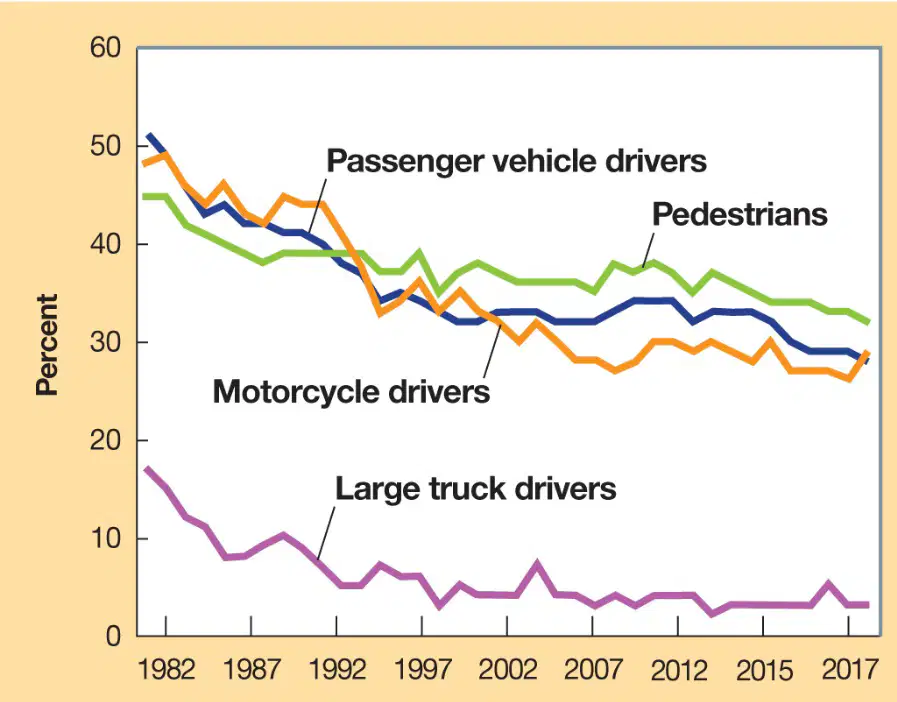
Refer to the graph titled 'Percentage of Fatally Injured Drivers With BACs Greater Than 0.08%, by Driver Age, 1982–2015.' Which group consistently had the lowest percentage of fatally injured drivers with BACs greater than 0.08% from 1982 to 2017?
Passenger vehicle drivers
Pedestrians
Motorcycle drivers
Large truck drivers
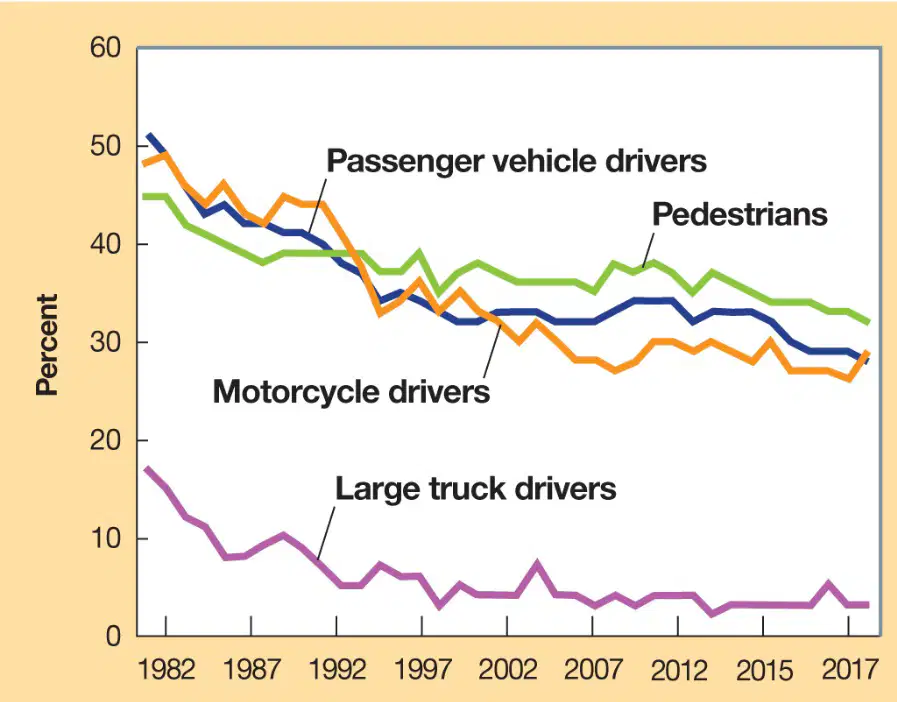
In 1982, the percentage of fatally injured passenger vehicle drivers with BACs greater than 0.08% was approximately ____ percent.
50
30
65
10
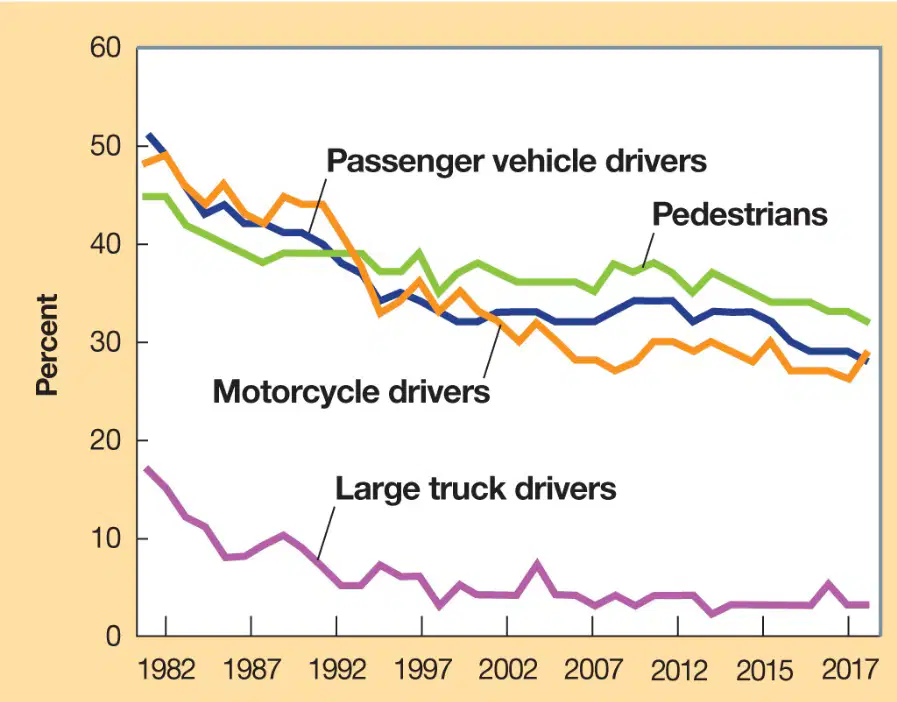
Refer to the graph titled 'Percentage of Fatally Injured Drivers With BACs Greater Than 0.08%, by Driver Age, 1982–2015.' True or False: The percentage of fatally injured motorcycle drivers with BACs greater than 0.08% was always higher than that of pedestrians between 1982 and 2017.
True
False
Which group showed the greatest decrease in the percentage of fatally injured drivers with BACs greater than 0.08% from 1982 to 2017?
Drivers aged 16-20
Drivers aged 21-24
Drivers aged 25-34
Drivers aged 35-44

