
NEW
Font size
 Worksheets
Chapter 15
Total questions: 34
Worksheet time: 17mins
One of the mRNA codons specifying the amino acid leucine is 5'-CUA-3'. Its corresponding anticodon is:
5'-CUA-3'.
3'-AUC-5'.
3'-GAU-5'.
3'-GAT-5'.
5'-GAU-3'.
Which of the following is a characteristic of uracil?
the ability to bond with adenine
the ability to bond with guanine
is a purine
the ability to bond with cytosine
contains two nitrogenous rings
Ribose differs from deoxyribose by having:
two attached bases.
one less oxygen.
an extra hydroxyl group.
an extra carbon in the ring.
None of the above
Adenine forms a complementary pair with __________ in RNA and __________ in DNA.
A. adenine; thymine
B. guanine; cytosine
C. cytosine; thymine
D. uracil; thymine
RNA synthesis is also known as:
elongation.
reverse transcription.
termination.
translation.
transcription.
The total number of three-base combinations of the four nucleic acid bases is:
20.
35.
45.
64.
1.5 x 10^5.
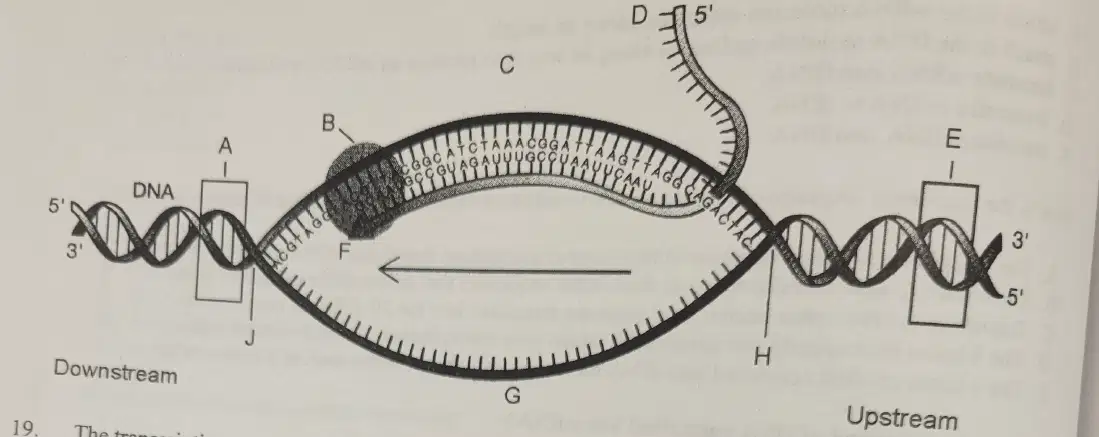
Use the figure to answer the following question. The transcription process begins at the area labeled:
A
D
E
G
None of the above
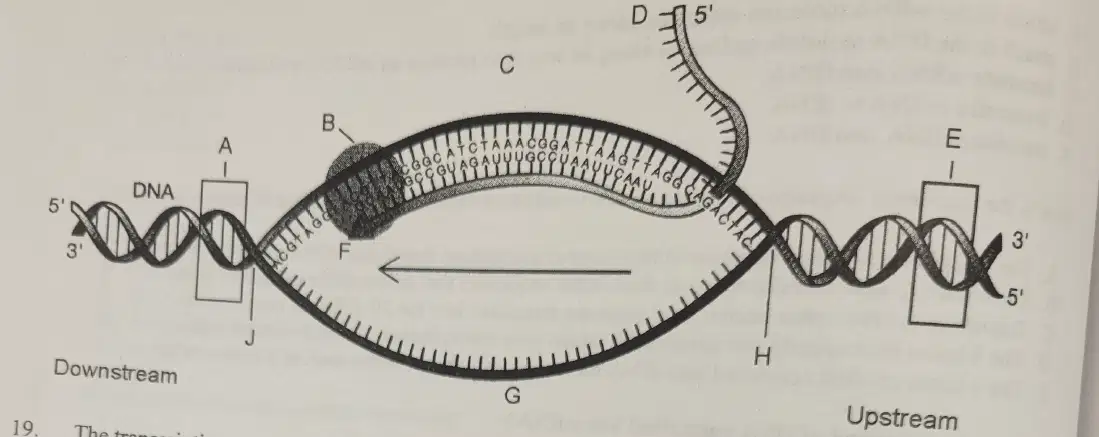
Use the figure to answer the following question. The process illustrated in the associated figure is:
DNA synthesis.
translation.
transcription.
a frame shift mutation.
protein synthesis.
Leader sequences contain signals that:
prevent enzymes from degrading the newly synthesized mRNA.
inhibit ribosome binding until the appropriate time.
initiate chain termination.
allow the ribosomes to be properly positioned to translate the message.
allow tRNA molecules to successfully bind to mRNA.
Which of the following serves as an "adapter" in protein synthesis and bridges the gap between mRNA and proteins?
tRNA
cDNA
rRNA
promoter sequences
DNA
The tRNA:
must be recognized by ribosomes.
must have an anticodon.
must have an attachment site for the amino acid.
must be recognized by a specific aminoacyl-tRNA synthetase that adds the correct amino acid.
All of the above

Which of the following numbered events represents the correct sequence of events of prokaryotic translation initiation?
1 → 2 → 3
1 → 3 → 2
2 → 1 → 3
2 → 3 → 1
3 → 2 → 1
Where is the amino-acid binding site located on the tRNA molecule?
in the middle of the loop
at the end of a "stem" that forms the 3' end of the molecule
in the first loop
along the longest stretch of base pairing in the molecule
Both A and C
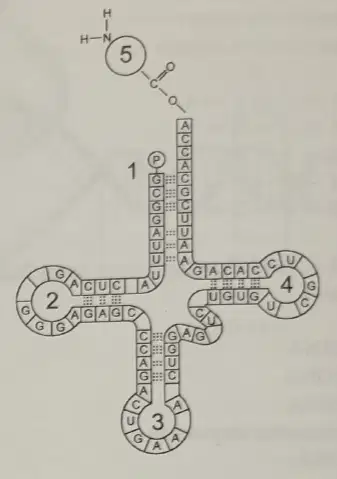
The portion of the molecule in the figure that contains the anti-codon is:
1.
2.
3.
4.
5.
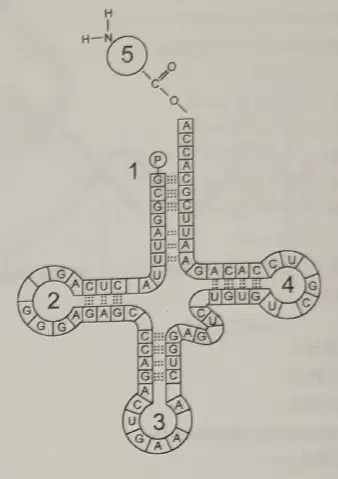
The portion of the molecule labeled 5 is:
the attached amino acid.
a double-stranded region.
a single-stranded region.
the anti-codon.
the codon.
Following peptide bond formation between the amino acid in the A site on the ribosome and the growing polypeptide chain, the tRNA in the A site:
releases the growing polypeptide chain.
picks up another amino acid to add to the chain.
moves to the P site of the ribosome.
forms a peptide bond with A site of the ribosome.
forms a covalent bond with the P site of the ribosome.
Translation is the process whereby the ________ moves in order to place the tRNA bound to the growing polypeptide chain in the ________ site, thereby freeing the ________ site for a new aminoacyl-tRNA.
mRNA; A; P
ribosome; P; A
tRNA; P; A
ribosome; A; P
tRNA; A; P
In all organisms, the AUG codon codes for:
initiation of translation.
termination of transcription.
termination of chain elongation.
formation of a peptide bond between adjacent amino acids.
a termination tRNA molecule.
Introns in pre mRNA are known to:
code for specific protein domains.
undergo self-excision, whereby they splice themselves out of the message.
be able to move within the mRNA, thereby giving rise to new exon combinations.
protect pre mRNA from enzyme degradation.
code for important amino acid sequences.
The wobble hypothesis states that:
more than one ribosome can bind to an mRNA molecule.
some amino acids are coded for by more than one codon.
there is more than one stop codon in the genetic code.
a particular amino acid may be linked to more than one type of tRNA molecule.
certain tRNA anticodons can pair with more than one codon sequence.
An mRNA "cap":
prevents translation.
facilitates binding of ribosomes.
marks the mRNA for degradation.
decreases the half-life of the mRNA.
protects newly synthesized mRNA from degradation.
Frameshift mutations result from:
the substitution of one base pair for another.
the substitution of more than one base pair.
the insertion or deletion of one or two base pairs.
the substitution of a stop codon for an amino acid-specifying codon.
the substitution of a start codon for an amino acid codon.
A flow diagram illustrating the flow of genetic information from DNA to protein should include which of the following sequences?
DNA → RNA → Protein
Protein → RNA → DNA
RNA → DNA → Protein
Protein → DNA → RNA
The process of translation of the genetic code involves which of the following cellular structures?
Ribosomes, tRNA, and mRNA
Nucleus, DNA polymerase, and rRNA
Golgi apparatus, lysosomes, and DNA
Mitochondria, centrioles, and lipids
The three-stage process of protein synthesis involves which of the following sequences?
Initiation, Elongation, Termination
Replication, Transcription, Translation
Transcription, Replication, Translation
Elongation, Termination, Replication
Transcription and translation occur simultaneously in prokaryotes, but not in eukaryotes because:
Eukaryotes have a nuclear membrane separating transcription and translation.
Prokaryotes lack ribosomes for translation.
Eukaryotes do not perform transcription.
Prokaryotes have DNA in the nucleus.
During protein synthesis, ribosomes:
attach to the DNA molecule and travel along its length.
attach to the mRNA molecule and travel along its length.
translate mRNA into tRNA.
transcribe mRNA to tRNA.
translate mRNA into DNA.
How is the four-letter language of nucleic acids converted into the 20-word language of amino acids?
The 4 nucleic acid bases combine in two-letter combinations that define different amino acids.
The 4 nucleic acid bases combine in three-letter sequences that define different amino acids.
Triplets of the two-letter nucleic acid bases are translated into the 20 different amino acids.
The 4 bases each specify one amino acid, which give rise to the remaining 16 amino acids.
The 4 bases are first converted into tRNA molecules, which can each attach to 5 amino acids.
Why is only one strand of DNA transcribed into mRNA?
Because mRNA is only required in small quantities.
Because transcribing both DNA strands would produce different amino acid sequences.
Because the other strand would produce the same amino acid sequence in reverse order.
Because all genes are located on the same DNA strand, while the other strand acts as protection.
Because the other strand is transcribed directly into amino acids.
Initiation of transcription requires:
a promoter sequence.
DNA polymerase.
an RNA primer.
a DNA primer.
Okazaki fragments.
A sequence of bases located upstream from a reference point, occurs:
towards the 3' end of the amino acid sequence.
towards the 5' end of the mRNA sequence.
towards the 3' end of the mRNA sequence.
towards the 5' end of the transcribed DNA strand.
towards the carboxyl end of the amino acid sequence.
How does the first nucleotide at the 5' end of a new mRNA chain differ from the other nucleotides in the chain?
The first nucleotide is always a uracil.
The first nucleotide is always a cytosine.
The first nucleotide retains its triphosphate group, while the others do not.
The first nucleotide does not retain its triphosphate group, while the others in the chain do.
Both A and C
Interrupted coding sequences include long sequences of bases that do not code for amino acids. These noncoding sequences called ___________, are found in ___________ cells.
exons; prokaryotic
introns; prokaryotic
exons; eukaryotic
introns; eukaryotic
none of the above
Substitution of one base pair for another can result in a ____________ mutation that results in the conversion of an amino acid specifying codon to a termination codon.
nonsense
frameshift
chromosolam
missense
None of the above

