

wayground logo

Free Printable Worksheets

NEW

Font size

S
M
L
XL
Worksheets

KMPk_BioD_Archaea, Bacteria, Protista & Fungi

Total questions: 30

Worksheet time: 16mins

Name
Class
Date
1.
What is biodiversity
a)
the number or variety of species in a particular region
b)
scientists who classify species, use an organism's physical appearance and genetic makeup to determine its species
c)
the variety of life across all levels of ecological organization
d)
decreases species diversity
2.
What are the 3 types of Biodiversity 
a)
sedimentary, metamorphic, and igneous
b)
genetic diversity, Ecosystem diversity, species diversity
c)
 ionic, covalent and metallic
d)
mRNA, tRNA, rRNA
3.
What is Species diversity?..?...
a)
the number or variety of species in the word or in a particular region 
b)
The range of genetic material present in a gene pool or population of a species.
c)
The variety of ecosystems that are present in the biosphere.
d)
A species whose numbers are so small that the species is at risk of extinction.
4.

What does it mean to be sessile?

a)

Able to move independently

b)

Made of many cells

c)

Eats plants

d)

Attached to a solid surface

5.
What does this picture represent?
a)
species diversity
b)
ecosystem diversity 
c)
genetic diversity
d)
biodiversity
6.

Bacteria divides into two identical cells through the process of....

a)

sexual reproduction

b)

asexual reproduction

c)

spore production

7.

Bacteria are found in many different shapes. What are the 3 most common shapes of bacteria.

a)

rod, sphere, spiral

b)

square sphere, spiral

c)

spiral, rectangle, sphere

8.

__________________ is a domain of prokaryotes that are genetically very different from bacteria and that have unique chemicals in their cell walls.

a)

Archaea

b)

Bacteria

c)

Protista

d)

Fungi

9.

______________ often live where nothing else can, such as in hot springs and in extremely acidic or salty habitats.

a)

Archaea

b)

Bacteria

c)

Protists

d)

Fungi

10.
What do Bacteria and Archaea have in common?
a)
Their ribosomes are very similar 
b)
They have a nucleus 
c)
They are single-celled 
d)
They have a cell wall with peptidogycan 
11.

the Gram-positive bacteria stain purple because

a)

they form endospore

b)

they have cellulose layer

c)

they have thick peptidoglycan layer

d)

they have thin peptidoglycan layer

12.

which of the following statements about the TWO Domains of Prokaryotes is NOT TRUE

a)

the lipid composition of the plasma membrane in archaebacteria is different from eubacteria

b)

both archaebacteria and eubacteria has cell wall but archaebacteria lack peptidoglycan

c)

of the two groups, eubacteria are more closely related to domain eukarya

d)

eubacteria includes the blue green algae
13.
Protists can be unicellular or multicellular.
a)
True
b)
False
14.

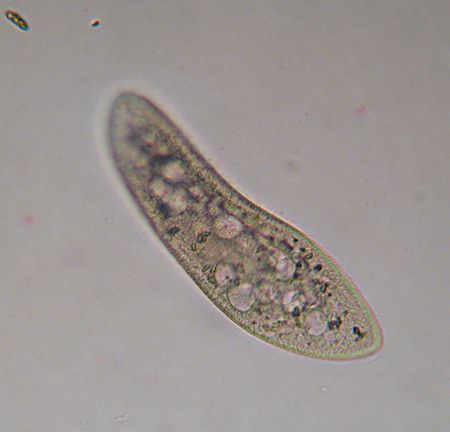
The image shows a Paramecium. What structure is utilized by the Paramecium for movement?

a)

Cilia

b)

Flagella

c)

Pseudopods

d)

Pili

15.

How is the Amoeba (seen in the image) able to move?

a)

Pseudopods

b)

Cilia

c)

Flagella

d)

Pili

16.

What is the function of the eyespot, seen in the diagram of a Euglena?

a)

Detects light

b)

Removes excess water

c)

Movement

d)

Photosynthesis

17.
Which kingdom contains decomposers? 
a)
Fungi
b)
Protist
c)
Plant
d)
Animal
18.
Archaebacteria can be found 
a)
almost anywhere
b)
in extreme environments
c)
in all 50 states
d)
nowhere, it is extinct
19.

The mode of nutrition found in most Protozoa is

a)

autotrophic

b)

chemotrophic

c)

photosynthetic

d)

heterotrophic

20.

Which of the following correctly pairs protists with its phylum?

a)

Amoeba sp. - Ciliophora

b)

Plasmodium sp. - Apicomplexa

c)

Euglena sp. - Rhizopoda

d)

Paramecium sp. - Euglenophyta

21.
Which of the following protists contain chloroplasts and are therefore autotrophic?
a)
Euglena
b)
Amoeba
c)
Paramecium
d)
Slime Mold
22.

Which is not true about fungi?

a)

All are consumers

b)

All are multicellular

c)

Are eukaryotic

d)

Can be useful to humans

23.

Fungi are like plants in many ways except fungi

a)

Do not have cellulose

b)

Do not grow upward out of the soil

c)

Cannot make their own food

d)

Do not have eukaryotic cells

24.
An antibiotic made from a species of thread-like fungus.
a)
lichen
b)
mold
c)
penicillin
d)
asprin
25.
Fungi cells walls are made of a material called ____.
a)
cellulose
b)
fibers
c)
hyphae
d)
chitin
26.
Which is NOT one of the main types of fungi?
a)
mushrooms
b)
breads
c)
yeasts
d)
molds
27.
A collective mass of hyphae are referred to as ____________
a)
parasitic
b)
fruiting
c)
mycelium
d)
spores
28.
The reproductive cells of fungi are called:
a)
pollen
b)
seeds
c)
spores
d)
mold
29.
Fungi reproduce
a)
sexually
b)
asexually
c)
both sexually and asexually
30.
What phyla do the "sac-like" fungi belong to?
a)
Zygomycota
b)
Ascomycota
c)
Basidiomycota
d)
Chytridiomycota
