
 Worksheets
Environmental Science Fall Midterm Review Part 1
Total questions: 30
Worksheet time: 15mins
Name
Class
Date
1.
Select the statement that provides evidence of the Big Bang Theory.
a)
Presence of light elements like hydrogen and helium in abundance
b)
Discovery of meteorites
c)
Discovery of millions of galaxies by Hubble Telescope
d)
Acceptance of idea that the Sun is the center of the solar system
2.
What does the 1755 Island Universe Hypothesis suggest about the Milky Way?
a)
It is the only galaxy in the universe
b)
It is one of many galaxies in a vast universe
c)
It is a nebula
d)
It is the center of the universe
3.
For what reason did the heliocentric model of the universe replace the geocentric model of the universe?
a)
The heliocentric model proved that the Earth rotates.
b)
The geocentric model did not predict the phases of the Moon.
c)
The geocentric model no longer predicted the positions of the constellations.
d)
The heliocentric model provided a simpler explanation of the motions of the planets.
4.
Which statement BEST explains how the Doppler shift provides evidence for the Big Bang Theory?
a)
The Doppler shift of light from distant galaxies implies that planets are moving away from Earth, suggesting the universe is expanding.
b)
The Doppler shift of cosmic microwave background radiation indicates that it originated from a hot, dense state and has shown a redshift over time.
c)
The Doppler shift of sound waves from distant galaxies suggests that the planets are moving closer to Earth, supporting the expansion of the universe.
d)
The Doppler shift of light from galaxies in different directions reveals a pattern of redshifts, supporting that the universe continues to expand from a central point.
5.
Throughout the years, scientists have had many different theories on how the Sun produces energy. At first they believed it was a giant ball of burning gas, then they believed it was shrinking due to gravity and releasing energy. Currently, they believe the reason the Sun has been able to release so much energy for such a long time is because of —
a)
nuclear fusion on the surface of the Sun converting hydrogen into helium
b)
nuclear fission in the core converting helium into hydrogen
c)
nuclear fusion in the core converting hydrogen into helium
d)
nuclear fission on the surface of the Sun converting helium into hydrogen
6.
R136a1 is a star in the R136 cluster, located in the Large Magellanic Cloud galaxy that revolves around the Milky Way. R136a1 is about 300 times more massive than the Sun and about 9 million times brighter. What would be the likely last stage of R136a1 in its life cycle?
a)
Black hole
b)
Blue giant
c)
Red giant
d)
Supernova
7.
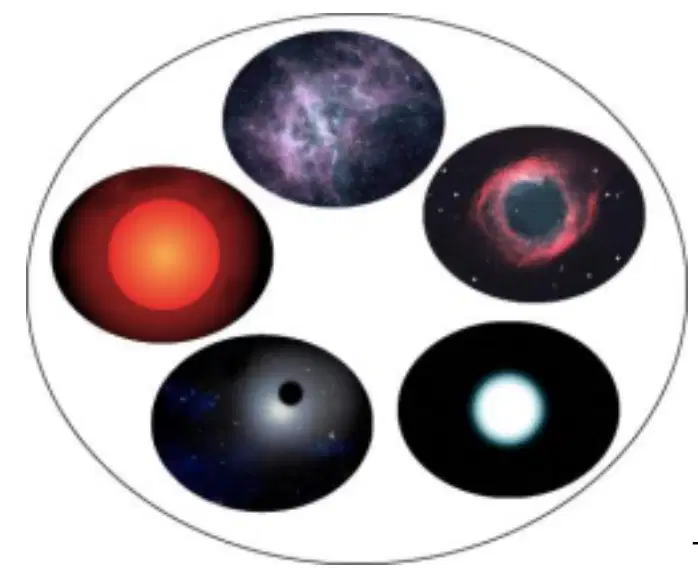
The image shows the various stages in the life cycle of Sun-like stars. Which describes the correct sequence of the stages in the life cycle of Sun-like stars?
a)
Average star → White dwarf → Black dwarf → Nebula → Red giant
b)
Planetary nebula → Nebula → Red giant → Average star → White dwarf
c)
Nebula → Average star → Red giant → Planetary nebula → White dwarf
d)
Red giant → Planetary nebula → Nebula → White dwarf → Black dwarf
8.
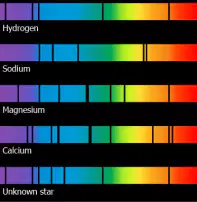
The diagram shows the spectrogram of some elements and an unknown star. Identify which element is present in the unknown star.
a)
Calcium
b)
Hydrogen
c)
Magnesium
d)
Sodium
9.
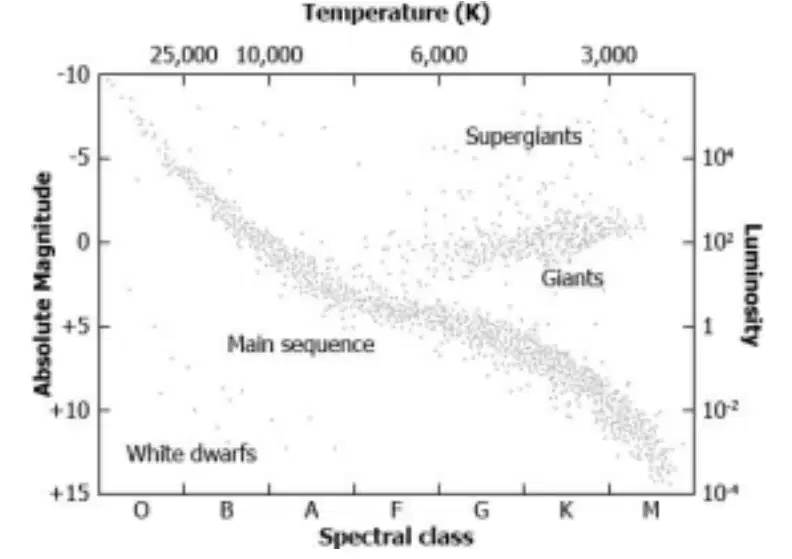
The image shows a Hertzsprung-Russell Diagram. If Rigel has a surface temperature of 6,000 K and an absolute magnitude of -7.4 M, which statement accurately describes the star?
a)
Rigel is in its longest life stage.
b)
Rigel is a hot, supergiant star.
c)
Rigel is a cool, giant star.
d)
Rigel is a dim star.
10.
Astronomers have observed that absorption bands in the spectra of distant stars are shifted towards the red end of the light spectrum. This observation provides evidence that:
a)
those stars are moving away from earth
b)
the universe is becoming warmer
c)
the universe is contracting
d)
the elemental composition of those stars is changing
11.
At which stage of a star's life cycle do heavier elements form?
a)
Nebula
b)
Supernova
c)
Protostar
d)
Black dwarf
12.
If a galaxy has a central bulge, well-defined arms, and active star formation, it is most likely a:
a)
Elliptical galaxy
b)
Irregular galaxy
c)
Spiral galaxy
d)
Lenticular galaxy
13.

The image shows the position of the Sun, the Moon, and the Earth during new moon and full moon phases.
Which statements about the relative positions of the Sun, the Moon, and the Earth during these phases are correct?
a)
During a full moon, Earth is between the Moon and the Sun.
b)
During a full moon and a new moon, Earth, the Moon, and the Sun don’t lie on the same line.
c)
During a new moon, Earth is at a lower position than the Moon and the Sun.
d)
During a new moon, the Moon is at a higher position than Earth and the Sun.
14.
The gravity of Earth is six times greater than that of the Moon. Based on the difference in gravity, which statement is true about the mass and weight of an object?
a)
The mass and weight of an object will be the same on the Moon.
b)
The mass of an object will be the same on Earth and on the Moon.
c)
The weight of an object will be less on Earth than on the Moon.
d)
The weight of an object will be the same on the Moon than on Earth.
15.
A friend sees a “half moon” in the sky and says it must be halfway through the moon’s cycle. Which explanation best describes why scientists actually call it a quarter moon?
a)
Because the moon looks only one-quarter as bright as the full moon
b)
Because the moon has completed one-quarter of its orbit around Earth
c)
Because one-quarter of the moon’s surface is visible from Earth
d)
Because it takes a quarter of the night for the moon to rise
16.
Astronomers find a galaxy with no defined shape and many regions of intense star formation. Which type is it most likely?
a)
Elliptical
b)
Irregular
c)
Spiral
d)
Lenticular
17.
Why do people see the moon in different shapes throughout the month?
a)
the Moon changes its shape
b)
the Moon is a flat surface
c)
the Moon revolves around the Earth
d)
the Moon is sometimes behind clouds
18.
What causes day and night on Earth?
a)
the revolution of the Earth around the Sun
b)
the tilt of the Earth’s axis
c)
the rotation of the Earth on its axis
d)
the tides
19.
Which statement is true about the planets?
a)
The four outer gas planets are larger in size compared to the four inner terrestrial planets.
b)
All of the planets revolve around the sun at the same speed.
c)
Each planet is an equal distance from one another.
d)
Starting with planet number nine, each planet decreases in size going towards the sun.
20.
Which of the following statements correctly describe the changes in the planetary model?
a)
The evidence obtained from Kepler's observations rejected Copernicus's theory completely.
b)
The evidence obtained from Galileo's observations led to the acceptance of the geocentric model.
c)
The evidence obtained from Kepler's observations improved Copernicus's theory by stating that planetary orbits are elliptical, not circular.
d)
The evidence from Copernicus's theory refined Ptolemy's concept of celestial bodies moving in circular orbit around Earth.
21.
Terrestrial planets are Earth-like planets. They have a solid surface and a core made of rocks and metals. Which statement is true for the terrestrial planets?
a)
They revolve around the Sun.
b)
They are farther to the Sun than the gas planets.
c)
There are three terrestrial planets.
d)
They are believed to have formed from the solar nebula.
22.
Compare the end stages of low-mass and high-mass stars. Which statement is correct?
a)
Both end as white dwarfs
b)
Low-mass stars explode as supernovae; high-mass stars fade into planetary nebulae
c)
Low-mass stars skip the main sequence stage entirely
d)
Low-mass stars end as white dwarfs; high-mass stars may end as neutron stars or black holes
23.
Why do scientists consider the Big Bang a theory rather than a proven fact?
a)
it offers an explanation for observed patterns in nature
b)
it provides photographic evidence of a historical event
c)
it predicts future events within the universe
d)
it provides a tentative account for a set of facts
24.
What is the correct order of the planets starting with the planet closest to the sun?
a)
Mars, Uranus, Earth, Neptune, Saturn, Jupiter, Mercury, Venus
b)
Neptune, Uranus, Saturn, Jupiter, Mars, Earth, Venus, Mercury
c)
Mercury, Venus, Earth, Mars, Jupiter, Saturn, Uranus, Neptune
d)
Mercury, Saturn, Earth, Jupiter, Venus, Neptune, Mars, Uranus
25.
Why does a star leave the main sequence stage?
a)
It gains more mass from nearby stars
b)
It runs out of hydrogen fuel in its core
c)
Its temperature becomes too high for fusion
d)
It moves closer to the galactic center
26.
What does the Steady State Theory propose about the universe?
a)
The universe is expanding
b)
The universe is contracting
c)
The universe is neither expanding nor contracting
d)
The universe is oscillating between expansion and contraction
27.
In a high-mass star’s life cycle, what event directly leads to the formation of a neutron star or black hole?
a)
Expansion into a supergiant
b)
Collapse after a supernova explosion
c)
Gradual cooling of the core
d)
Release of planetary nebula gas
28.
What are the two factors that Sir Isaac Newton identified as influencing a planet’s motion around the Sun?
a)
Inertia and velocity
b)
Gravity and speed
c)
Inertia and gravity
d)
Mass and distance
29.

A teacher shows her students a picture of the different phases of the Moon.
How does this information help the students better understand the phenomenon of moon phases?
a)
Demonstrates revolution of the Moon around the Sun
b)
Different portions of the Moon are seen in each phase
c)
Shows surface composition of the Moon
d)
The amount of light reflected by the Moon does not change
30.
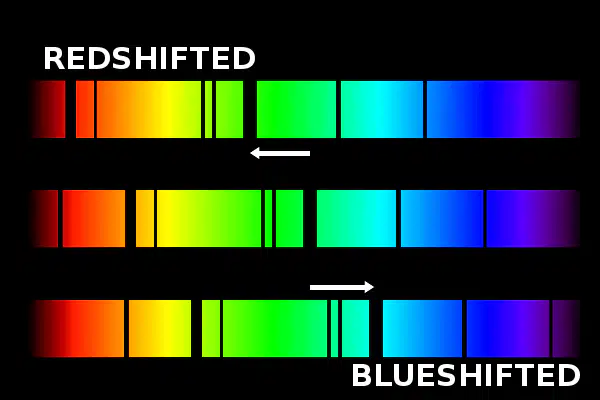
What does red shift in galaxies indicate?
a)
The galaxy is moving towards us
b)
The galaxy is moving away from us
c)
The galaxy is cooling down
d)
The galaxy is forming new stars
100 %

