
Font size
 Worksheets
Photoshop 22/24 Domain 1 Quiz
Total questions: 26
Worksheet time: 13mins
1. Knowing one’s __ includes knowing the demographics of those one’s work will be directed at. [Audience and Purpose]
target audience
subject matter
personal interests
work schedule
2. __ is a term used to define how long a project will take to complete, what will be created in the project, and how much it will cost. [Design Plans]
Scope
Budget
Timeline
Resource
3. Color mode __ is used for printing. Color mode RGB is used for web or video. [Design Plans]
CMYK
RGB
Grayscale
Indexed Color
4. Adding requirements to a project without getting agreement from those involved in the project is known as ____. [Design Plans]
scope creep
resource leveling
milestone slippage
risk mitigation
5. Being able to reasonably use a portion of a copyrighted work if it does not affect the profit of the copyright owner is ____. [Copyright, Permissions, and Licenses]
Fair Use
Public Domain
Copyright Infringement
Plagiarism
6. A __ represents an original work that was created from or based on a copyrighted work that already exists. [Copyright, Permissions, and Licenses]
derivative work
public domain
plagiarized copy
primary source
7. A legal term to describe a work of the mind is ____.
intellectual property
real estate
physical asset
personal injury
8. __ includes the provision that a work created from one’s original work must have the same license as the original work. [Copyright, Permissions, and Licenses]
Attribution-ShareAlike
Public Domain
Fair Use
Non-Commercial
The license type that allows others to utilize a designer’s work unaltered is ____. [Copyright, Permissions, and Licenses]
Attribution-NoDerivs
Attribution-ShareAlike
Attribution
Attribution-NonCommercial
What questions should be asked to help you determine the target audience? What age range is the target audience?
The age range of the target audience should be specified based on the project requirements.
The target audience is always between 18 and 25 years old.
The age range does not matter when determining the target audience.
The target audience should only include children under 12.
What questions should be asked to help you determine the target audience?
The gender of the target audience should be specified based on the project requirements.
The color of the logo should be decided before knowing the audience.
The budget of the project is not related to the audience.
The launch date of the product determines the audience.
What questions should be asked to help you determine the target audience? What type of education does the target audience have?
The type of education of the target audience should be specified based on the project requirements.
The target audience should always have a university degree.
The target audience must be experts in the field.
The education level of the target audience is not important at all.
What questions should be asked to help you determine the target audience? Is there a specific ethnicity?
The specific ethnicity of the target audience should be specified based on the project requirements.
The target audience is always the general public regardless of the project.
Ethnicity is never a factor in determining the target audience.
Only age and gender are important, not ethnicity.
What questions should be asked to help you determine the target audience? Is there a specific region of the country?
The specific region of the country of the target audience should be specified based on the project requirements.
The target audience is always from the northern region.
The region does not matter when determining the target audience.
All projects have the same target audience regardless of region.
What questions should be asked to help you determine the target audience?
The needs of the target audience should be specified based on the project requirements.
What is the budget for the project?
How many team members are involved?
What is the deadline for the project?
Graphic design enables which kinds of communication?
Visual and non-verbal communication
Only verbal communication
Mathematical communication
Auditory communication
For what three media types can Photoshop optimize images? Fill in the blank for each media type.
Web Print Video
Web Mobile Audio
Print . Audio Animation
Web Animation . Audio
What three things does the scope of a project define? Fill in the blank for each item.
What is to be created . How long it will take What the budget will be
Who will manage the team Where the project will be located What software will be used
What resources are available Who the stakeholders are What the risks are
How many meetings will be held What the team will eat When the project will be reviewed
What are the seven phases of design plans and the main features of designer–client communication at each phase?
Listening and asking questions
Ignoring client feedback
Focusing only on aesthetics
Skipping documentation
What are the seven phases of design plans and the main features of designer–client communication at each phase?
Presentations, diagrams, charts, and feedback
Only written contracts and invoices
Blueprints, construction, and delivery only
No communication required at any phase
What are the seven phases of design plans and the main features of designer–client communication at each phase?
Mock-ups, sketches, reviewing, and feedback
Brainstorming, budgeting, finalizing, and launching
Research, ideation, prototyping, and marketing
Planning, coding, testing, and deployment
What are the seven phases of design plans and the main features of designer–client communication at each phase?
Building several options and receiving feedback
Ignoring client input and proceeding independently
Focusing only on technical drawings without discussion
Skipping feedback and finalizing the design immediately
What are the seven phases of design plans and the main features of designer–client communication at each phase?
Reviewing plans, gauging reactions, and feedback
Ignoring client input and proceeding independently
Skipping communication until the final phase
Only discussing budget and timeline, not design details
What are the seven phases of design plans and the main features of designer–client communication at each phase?
Staging, approval, and receiving feedback
Brainstorming, prototyping, and finalizing only
Budgeting, marketing, and sales discussions
Only initial meeting and final delivery
What are the seven phases of design plans and the main features of designer–client communication at each phase?
Proofs, planning, approval, and feedback
Sketching, modeling, prototyping, and launching
Research, ideation, development, and marketing
Brainstorming, budgeting, testing, and delivery
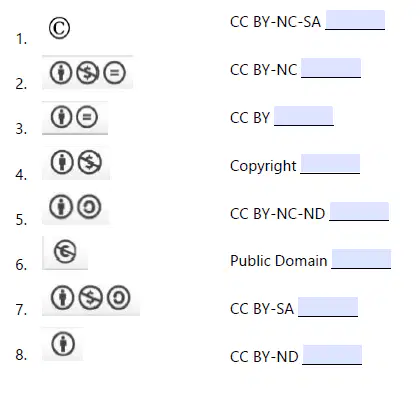
Match the following symbols to their licenses:
Copyright
1
CC BY-NC-ND
2
CC BY-ND
3
CC BY-NC
4
CC BY-SA
5

