
 Worksheets
Unit 3 Test- Financing Education
Total questions: 25
Worksheet time: 13mins
Name
Class
Date
1.
Which of the following statements is TRUE about the value of a college education?
a)
A high school graduate can expect to earn about the same as a college graduate.
b)
A college graduate can expect to earn, on average, about $40,000 more than a high school graduate over a career.
c)
If you start college but don't finish, your pay will be closer to the level of a high school graduate than the level of a college graduate.
d)
College is only valuable if you want to increase how much you earn.
2.
While researching college scholarships to apply for, you see an ad that says, "Enter a few pieces of information, pay $39.99 per month, and we guarantee to win you a scholarship. You don't even have to write an essay! Sign up today with just your name, social security number, and an email address!" How should you proceed?
a)
Sign up, but use a fake email address in case it's spam.
b)
Don't sign up, unless your parent says it's OK to use their credit card for the payments.
c)
Sign up, because at $40 per month, it will be a bargain if they win you thousands in scholarships.
d)
Don't sign up, because you should not pay money to win scholarships, and you should never enter your social security number into unknown websites.
3.
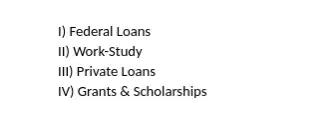
Rank these ways of paying for college from MOST attractive to LEAST attractive.
a)
II > I > IV > III
b)
IV > II > I > III
c)
III > I > II > IV
d)
IV > I > II > III
4.
Johnny is trying to calculate the NET PRICE of a school that he just got a financial aid offer from. Which of the following formulas should he use to calculate the net price?
a)
Sticker Price - (Savings + Grants)
b)
Sticker Price - (Grants + Scholarships)
c)
Sticker Price - (Grants + Scholarships + Work-Study)
d)
Sticker Price - (Grants + Scholarships + Loans)
5.
Janelle's family earns about $60,000 per year. She has been accepted to State U and Greenlawn College and is comparing their financial aid packages. State U has a sticker price of $28,000 and a net price of $12,000. Greenlawn College has a sticker price of $60,000 and a net price of $9,000. Which statement below is TRUE?
a)
Greenlawn College is providing Janelle with more grants and scholarships.
b)
State U has a lower net price than Greenlawn College.
c)
The sticker prices of both schools are impacted by a family's total annual income.
d)
If making a decision strictly based on cost, Janelle's best option is State U.
6.
Which loan type am I? I have limits on the amount that you can borrow based on your year in college. The federal government makes the interest payments on me while you are in college, and you make the interest payments on me after you graduate.
a)
Unsubsidized Federal Student Loan
b)
Private Student Loan
c)
Subsidized Federal Student Loan
d)
Institutional Student Loan
7.
Alicia is about to start her first year of college. She knows that while it may seem early, it's a good idea to think about ways she can minimize her total student loan debt while she is still in college. Which of the following steps will be MOST effective in helping her minimize her student loan debt and prepare for loan repayment once she graduates?
a)
Wait until after she graduates to contact her student loan servicer; there won't be much to discuss if she contacts them during her freshman year.
b)
Accept federal unsubsidized student loans first. Then, if she has any remaining balances to cover, accept federal subsidized student loans.
c)
Start researching repayment options and plans only when she is about to graduate.
d)
Make as many interest payments as possible while she is still in school to minimize her total debt after graduation.
8.

When filing the FAFSA online, you need...
a)
I & II only
b)
I, II, and IV only
c)
I, III, & IV only
d)
I, II, III, & IV
9.
Your friends are having a debate about rules of thumbs to use when it comes to student loan debt. Who is CORRECT?
a)
Miguel says, "You should borrow as much money as you can through private student loans, and then take out federal student loans."
b)
Dani says, "You should avoid student loans no matter what, even if that means you have to work long hours and can't take a full course load."
c)
Jason says, "You should generally limit your borrowing to what you expect to earn as a starting salary when you graduate from college, and avoid private student loans."
d)
Aisha says, "You should borrow all of the financial aid your college offers you in your financial aid offer, even if you don't need it all."
10.

When Emmanuel receives his Student Aid Report, it lists an Expected Family Contribution (EFC) of $8000 for the year. His family had only budgeted to give him $2000, so they are $6000 short. Which of the following is/are option(s) that Emmanuel and his family can take?
a)
I only
b)
I & II only
c)
I, II, III only
d)
I, II, III, & IV
11.
Julia is creating a budget for her freshman year of college and thinks she can use the same budget for the next three years of her college career. What do you tell her?
a)
"This is a good idea, because you're definitely going to have the same sources of income and categories for expenses throughout all four years of college."
b)
"This is a bad idea, because while the costs of tuition & room and board are guaranteed to stay the same, your sources of income may fluctuate."
c)
"This is a good idea, because you've invested so much time in creating a detailed budget - there's nothing to change! Now you're all set for your entire college career!"
d)
"This is a bad idea, because your income and expenses in each year will fluctuate. Your budget needs to reflect these annual changes."
12.
Susan has $40,000 of federal student loan debt and chooses to make a monthly payment of $200. Brian also has $40,000 in federal student loan debt and chooses to make a monthly payment of $350. Assuming both loans carry the same interest rate, which of the following statements is TRUE?
a)
Brian will pay LESS in interest over the term of his loan.
b)
Susan will pay LESS in interest over the term of her loan.
c)
Brian will pay MORE in total because he has a lower credit score than Susan does.
d)
Susan's loan repayment term is shorter than Brian's loan repayment term.
13.
Craig has heard that taking out federal student loans is always preferable to taking out private student loans, but he doesn't understand why. Which of the following would you tell Craig to explain the advantage of taking out a federal student loan over a private student loan?
a)
Federal student loans generally have more flexible and affordable repayment options compared to private loans.
b)
Federal student loans do not need to be repaid.
c)
Federal student loans have higher credit standards than private loans and require a co-signer.
d)
Federal student loans don't charge any interest for the entire term of the loan period.
14.
Which of the following statements about applying for grants and scholarships is TRUE?
a)
Colleges only offer merit-based (based on your accomplishments) scholarships and grants.
b)
While some grants and scholarships are guaranteed for all four years of attendance, others expire every year and must be reapplied for.
c)
Pell Grants are offered based on a student's academic performance.
d)
While the FAFSA is required for federal loans or grants, you don't need to complete it for university, community, or professionally sponsored scholarships.
15.

When discussing paying for college with your parents/guardians, it may be helpful to...
a)
I & II only
b)
II & III only
c)
I, II, & III only
d)
I, III, & IV only
16.
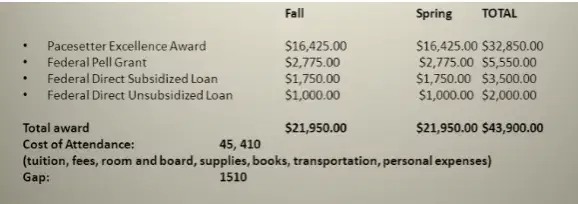
Tony just received the following financial aid offer from a school. Which of the following statements is TRUE?
a)
Tony is getting a total of $32,850 in "free money" for the entire year.
b)
Tony will benefit from making interest payments on his federal subsidized loan while he is still in school.
c)
Tony's financial aid offer meets the total cost of attendance for this school year.
d)
After taking grants and loans into account, Tony still needs to come up with $1,510 to cover the cost of attendance.
17.
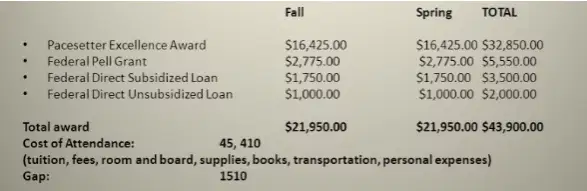
If Tony accepts all of the aid he is being offered in his financial aid offer, when and how can he expect to receive the money?
a)
Tony will receive the offers in the order that they are listed in the offer in his bank account.
b)
Tony will receive the Excellence Offer and the Pell Grant to his bank account; the loans will be applied to his total cost of attendance.
c)
Tony will receive all funds directly in his bank account within 48 hours of accepting the aid.
d)
The funds will first go to the college to cover Tony's total cost of attendance. If there are any leftover funds, they will go to Tony into an account he specifies, such as a bank account.
18.
In financial terms, when someone refers to the return on investment for a college education, the return refers to the _________________ and the investment is the _______________________.
a)
Increased earnings from attending college, time spent pursuing your degree
b)
Cost of your education and the time spent pursuing your degree, increased earnings from attending college
c)
Decreased earnings from attending college, stock market returns
d)
Increased earnings from attending college, cost of your education and the time spent pursuing your degree
19.
Keith's tuition, room & board, and fees for freshman year total $26,000. Keith has estimated an additional $2,000 for other expenses. Using scholarships, grants, and federal student loans, his financial aid package is $30,000. What option below is both realistic and financially responsible?
a)
Keith should accept all $30,000 of his financial aid offer, even though he needs only $28,000.
b)
Keith should only accept $26,000 of his financial aid offer, and then take out a private student loan for $2,000 to cover other expenses for his freshman year.
c)
Keith should accept only what he needs from his financial aid offer. If he decides to accept less, the best option for him is to decrease the amount he is taking out in federal student loans.
d)
Keith should not choose this college because he cannot afford it.
20.
Samira had some unexpected costs recently and is struggling to make her monthly payments on her federal student loans. Which of the following is the BEST course of action for her to take?
a)
Notify her student loan servicer immediately so she can discuss what options are available to her.
b)
Wait for 270 days so that her loans default. That way, she doesn't have to make any payments.
c)
Declare bankruptcy so that her loans are forgiven.
d)
Miss a payment for this month, but then make sure she makes the next month's payment on time.
21.
Maria has a monthly student loan payment of $350. Which of the following statements is TRUE about Maria's student loan payment?
a)
Maria's monthly loan payment is first applied to paying down the principal balance of the loan. The remaining portion of the payment is then allocated towards paying any accrued interest.
b)
All $350 of Maria's monthly payment is applied to the principal balance of the loan. She will pay the accrued interest in a lump sum when she makes her final monthly payment on the loan.
c)
Maria's monthly loan payment is first applied to any accrued interest. The remaining portion of the payment is then allocated towards paying down the principal balance of the loan.
d)
None of the above
22.
What is the relationship between the FAFSA, a Student Aid Report (SAR), and a Financial Aid Package?
a)
You receive a Financial Aid Package first. Then, you file the FAFSA and get your SAR.
b)
You submit a SAR to determine if you are eligible to file the FAFSA. If you are, you submit the FAFSA and then receive a Financial Aid Package.
c)
Schools use the answers you submitted in the FAFSA to create a Financial Aid Package for you, which is then sent to you in a SAR.
d)
The answers you submitted in your FAFSA are reported in your SAR. Schools then use your SAR to create a Financial Aid Package for you.
23.
If you do not choose a specific repayment plan for your federal student loans, you are automatically put on the __________________________________, which puts you on the track to pay back your loans in ______ years. If you are having trouble making your student loan payments, you can change the repayment plan you have. Or, if you need to, you can apply to STOP making payments towards your loans for a specific amount of time through two programs: deferment and forbearance. ___________________ is preferable to ___________________ because interest does not accrue on your subsidized loans.
a)
Standard Repayment Plan, 10, Forbearance, Deferment
b)
Graduated Repayment Plan, 10, Forbearance, Deferment
c)
Standard Repayment Plan, 10, Deferment, Forbearance
d)
Income-Driven Repayment Plan, 25, Deferment, Forbearance
24.
Samantha is in the second semester of her freshman year and is revisiting her budget to see if there are any areas she can reduce spending in to save more money. Samantha lives on campus, has a roommate, is signed up for the basic meal plan, and lives about a 2 hour car ride away from her family. Which of the following would be the most realistic option for Samantha to follow in her second semester to maximize her savings?
a)
Cut back on her meal plan so that she has only 14 meals per week, but dine out with friends 3x/week to make sure she has enough food.
b)
Give her used car back to her family so that she doesn't have to pay $80/month for gas, $102/month for car insurance, and other auto and maintenance fees. Although it is less convenient, she can take public transportation whenever she wants to go home.
c)
Put $5 from her work-study paycheck into a jar every week to build savings over time.
d)
Skip campus social events and save $55/month. However, Samantha will likely be the only from her floor who is not going so she will be on her own during that time.
25.
You take out a $7,000 UNSUBSIDIZED loan as a freshman with an interest rate of 4% per year. When you graduate four years later, approximately how much will you owe on the loan?
a)
$7,000
b)
$7,280
c)
$8,200
d)
$28,000
100 %

