
 Worksheets
Absolute Monarchy in France
Total questions: 62
Worksheet time: 31mins
What is an absolute monarchy?
A) A system where the monarch shares power with a parliament
B) A system of government where a monarch holds supreme authority
C) A government led by elected officials
D) A democracy
What is the concept of the 'divine right' of kings in an absolute monarchy?
Monarchs are chosen by the people
Monarchs claim authority directly from God
Monarchs are elected for a limited term
Monarchs must follow a constitution
Fill in the blank: In an absolute monarchy, the monarch's power is ________ and unchallenged.
unlimited
limited
shared
symbolic
Which of the following is NOT a key characteristic of absolute monarchy?
Monarch's power is unlimited and unchallenged
Ruler claims authority directly from God
There are constitutional restrictions on royal power
Accountable only to God, not earthly subjects
In an absolute monarchy, to whom is the monarch accountable?
The people
Parliament
God
The military
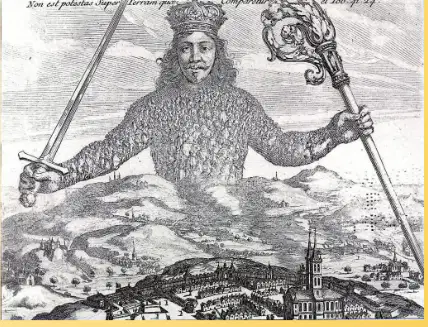
The image of the monarch holding a sword and scepter symbolizes which concept in the context of absolute monarchy?
The monarch's authority and power over the state
The monarch's role as a religious leader
The monarch's commitment to democracy
The monarch's military weakness
Being a monarch who believes God chose you to rule would most likely make you feel:
Confident in your authority and purpose
Uncertain about your right to rule
Indifferent to your responsibilities
Fearful of your subjects
Ruling with absolute power is often justified by which concept?
Divine right
Democracy
Separation of powers
Popular sovereignty
The belief discussed impacts political power by increasing royal power, fueling resistance movements, and is reflected in the quote: 'Those who make peaceful revolution impossible will make violent revolution inevitable.' - JFK. What is one major effect of this belief?
It can lead to violent revolution if peaceful change is suppressed.
It guarantees lasting peace and stability.
It eliminates the need for resistance movements.
It reduces royal power and authority.
What was the main conflict in the Wars of Religion in France?
Conflict between Catholics and Huguenots (Protestant Christians)
Conflict between Catholics and Jews
Conflict between Protestants and Muslims
Conflict between Catholics and Orthodox Christians
Who was Henry IV originally before converting to Catholicism?
Catholic
Huguenot
Protestant Christian
Noble
Fill in the blank: The Edict of Nantes (1598) granted _______ tolerance and ended the French Wars of Religion.
religious
economic
military
political
Cardinal Richelieu strengthened noble power during his role in centralizing royal authority.
True
False
What was one of the main effects of Cardinal Richelieu's policies?
Increased Huguenot political influence
Weakened noble power
Decentralized royal authority
Strengthened Protestant Christianity
What did Henry IV say to justify his conversion to Catholicism?
'Religion is power.'
'Paris is well worth a Mass.'
'Tolerance is key.'
'Nobles must be challenged.'
Which event ended the French Wars of Religion?
The spread of Protestant Christianity
The conversion of Henry IV
The Edict of Nantes (1598)
The rise of Cardinal Richelieu
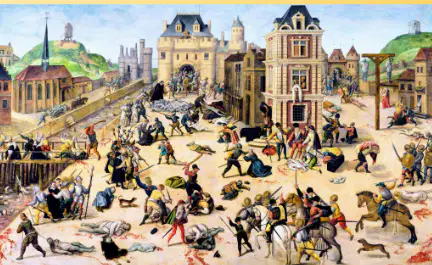
Look at the image of the historical scene in the bottom right. What event does this image most likely depict?
The coronation of Henry IV
The French Wars of Religion
The signing of the Edict of Nantes
The rise of Cardinal Richelieu
Who were intendants in the context of the rise of centralized monarchy?
Local farmers
Royal officials who managed provinces
Military generals
Merchants
What was one of the main purposes of introducing intendants?
To increase local independence
To increase royal control over local governance
To promote agriculture
To reduce taxes
Which of the following was NOT a part of Jean-Baptiste Colbert's economic reforms?
Strengthened national economy
Promoted French manufacturing and trade
Levée system - Organized national military recruitment
Abolished all taxes
Fill in the blank: Jean-Baptiste Colbert's economic reforms _______ the national economy.
strengthened
weakened
ignored
divided
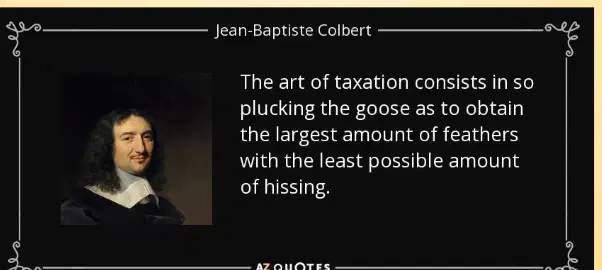
Jean-Baptiste Colbert once said, “The art of taxation consists in so plucking the goose as to obtain the largest amount of feathers with the least possible amount of hissing.” What did he mean by this statement?
Taxation should only be used during times of war.
Governments should raise as much money as possible while causing the least resistance among the people.
Citizens should not complain about paying taxes.
The wealthy should be completely exempt from taxation.
Who was known as 'The Sun King' and ruled France from 1643-1715?
Louis XIV
Louis XVI
Napoleon Bonaparte
Charles X
How many years did Louis XIV rule France?
72 years
50 years
60 years
40 years
Which of the following best describes Louis XIV's style of monarchy?
Constitutional monarchy
Absolute monarchy
Parliamentary monarchy
Federal monarchy
What phrase did Louis XIV famously claim, reflecting his belief that he was the living embodiment of France and its government?
Liberté, égalité, fraternité
L'État, c'est moi
Vive la France
Je suis le roi
Louis XIV reduced the political influence of the nobility during his reign.
True
False
What was one of the main purposes of the Palace of Versailles under Louis XIV?
Summer vacation home
Strategic political instrument to keep a close watch on nobility
Art museum
Military base
Fill in the blank: Louis XIV enforced a strict court _______ and etiquette that kept nobles trying to win the king’s favor.
hierarchy
rebellion
democracy
anarchy
Louis XIV strengthened his absolute monarchy by following the proven policies of _________.
Cardinal Richelieu
Napoleon Bonaparte
Voltaire
Jean-Jacques Rousseau
Louis XIV spent many hours each day attending to ________ affairs.
government
domestic
personal
military
Louis XIV expanded the _________?
bureaucracy
monarchy
parliament
military
Louis XIV appointed ________ who collected taxes, recruited soldiers, and carried out policies.
intendants
bourgeoisie
parlements
philosophes
Louis XIV gave many jobs to wealthy ________ men to cement his ties with the middle class.
middle-class
noble
foreign
rural
Louis XIV built the French ________ into the strongest in Europe.
army
navy
economy
parliament
All of Louis XIV's efforts to strengthen absolutism have what in common?
They centralized power under the monarchy.
They promoted democracy.
They limited the king's authority.
They increased the power of the nobility.
The most positive aspect of Louis XIV's rule was:
the strengthening of the French monarchy
the decline of French culture
the loss of French territories
the weakening of the French economy
The most negative aspect of Louis XIV's rule was:
his extravagant spending and creation of massive debt for France
his support for religious tolerance
his efforts to limit the power of the monarchy
his promotion of democratic reforms
The most significant political achievement of Louis XIV was:
the establishment of absolute monarchy in France
the signing of the Magna Carta
the unification of Germany
the abolition of serfdom in Russia
The most significant economic challenge during Louis XIV's rule was:
the heavy cost of wars and royal extravagance
the lack of overseas trade
the absence of a centralized government
the decline of agriculture
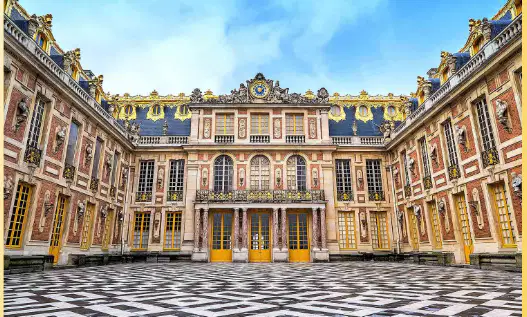
What was the Palace of Versailles constructed as?
A) A military fortress
B) A magnificent royal residence
C) A public park
D) A university
Which of the following was NOT a purpose of the Palace of Versailles?
A) Demonstrate royal wealth and power
B) Control nobility by keeping them close
C) Serve as a marketplace
D) Showcase France's cultural superiority
Fill in the blank: The Palace of Versailles was an architectural marvel representing ________ monarchy.
absolute
constitutional
federal
parliamentary
One of the purposes of the Palace of Versailles was to control the nobility by keeping them close.
True
False
Under Louis XIV, who were the notable figures in literature?
Molière, Racine
Voltaire, Rousseau
Victor Hugo, Balzac
Camus, Sartre
Who was associated with achievements in painting under Louis XIV?
Charles Le Brun
Jean-Baptiste Lully
André Le Nôtre
Molière
Who was the notable figure in music during the reign of Louis XIV?
Jean-Baptiste Lully
Wolfgang Amadeus Mozart
Ludwig van Beethoven
Johann Sebastian Bach
What cultural impact did Louis XIV establish in Europe?
Established French cultural dominance in Europe
Promoted Russian literature across Europe
Introduced Italian cuisine as the European standard
Spread English as the official language of diplomacy
Louis XIV's foreign policy included which of the following?
Promoting peace in Europe
Constant military campaigns
Reducing French territory
Avoiding conflicts
Fill in the blank: One of the impacts of Louis XIV's foreign policy was ________ wars.
frequent
rare
peaceful
short
Which of the following was NOT a goal of Louis XIV's foreign policy?
Sought territorial expansion
Challenged other European powers
Promoted democracy
Constant military campaigns
Fill in the blank: Louis XIV's foreign policy increased ________ territorial influence.
French
Spanish
English
Dutch
Louis XIV's foreign policy reshaped the European political landscape.
True
False
Absolute monarchy shaped modern government by:
centralizing power in the hands of one ruler
promoting democratic participation
encouraging separation of powers
limiting the authority of the monarch
Absolute monarchy is best compared to which of the following current political systems?
Democracy
Oligarchy
Republic
Dictatorship
Power and governance are important concepts in society. Which of the following best describes their relationship?
Power is the ability to influence or control others, while governance is the system by which power is exercised and decisions are made.
Power and governance are unrelated concepts in society.
Governance is only about making laws, not about power.
Power is only about wealth, not about governance.
Which of the following are characteristics of absolute monarchy?
The monarch holds all the power, rules by divine right, and laws are made by the monarch alone.
The monarch is elected by the people, has limited power, and shares authority with a parliament.
The government is run by elected officials, power is separated among branches, and citizens have voting rights.
The monarch must follow a constitution, power is shared with nobles, and laws are made by a legislative body.
Two significant impacts of Louis XIV's reign were:
Centralization of power and the expansion of French culture.
Decline of the monarchy and loss of French territory.
Rise of democracy and abolition of nobility.
Weakening of the French economy and end of absolute monarchy.
One way divine right influenced political power was:
It allowed monarchs to claim their authority came from God.
It encouraged democratic elections for leaders.
It limited the power of kings through constitutions.
It promoted equal rights for all citizens.
Absolute monarchy is best defined as:
A system where a king or queen has complete control over the government and is not limited by laws or a constitution.
A government where citizens vote directly on laws and policies.
A political system where power is shared between a monarch and an elected parliament.
A form of government where religious leaders control the state.
Self-Assessment: Understanding Louis XIV's role in centralizing power.
Louis XIV strengthened royal authority by centralizing power in the monarchy.
Louis XIV promoted local autonomy and reduced royal control.
Louis XIV decentralized the government by empowering regional nobles.
Louis XIV limited the monarchy's influence over the state.
Self-Assessment: The cultural achievements of his reign can be described as:
Advancements in art, literature, and architecture
Decline in artistic expression
Lack of literary works
Destruction of cultural heritage

