
 Worksheets
C1-Project Management Fundamentals Quiz
Total questions: 85
Worksheet time: 43mins
Owen is part of a company that wants to expand into new markets and achieve significant growth over the next five years. Which of the following best describes the strategic importance of project management for Owen's company?
It helps organizations achieve their long-term goals.
It is only useful for daily operations.
It focuses solely on financial management.
It is not relevant to organizational success.
Oliver is working at a company where he is assigned to lead a team for launching a new product, while his colleague Aiden manages the daily customer support services. How are Oliver's project and Aiden's operations different?
Projects are temporary and unique, while operations are ongoing and repetitive.
Projects and operations are both temporary.
Operations are unique, while projects are repetitive.
Projects and operations have no differences.
Sofia has been assigned to ensure that a new software development project is completed on time and within budget. Which of the following is a unique role of Sofia as the Project Manager?
Overseeing the completion of a specific project.
Managing daily business operations.
Handling only financial transactions.
Supervising only the marketing team.
Henry is preparing for his project management certification exam. He wants to know what the PMBOK framework includes. Which of the following options is correct?
12 principles and 8 performance domains.
5 financial rules and 3 marketing strategies.
10 leadership qualities and 4 business models.
7 sales techniques and 6 HR policies.
Alexander is managing a project and needs to ensure that the project stays within its planned scope, is completed on time, and does not exceed the budget. What project management concept is Alexander focusing on?
The balance between scope, time, and cost.
The relationship between marketing, sales, and HR.
The focus on only cost and quality.
The combination of leadership, teamwork, and communication.

Charlotte works at a company that is constantly facing new challenges and opportunities in the market. To stay competitive, her organization regularly launches new projects to adapt and grow. Which of the following best describes the main idea of the "project economy" as introduced in the material?
Change is constant and organizations must adapt through projects to survive.
Organizations should avoid change to maintain stability.
The project economy is only about financial investments.
Projects are only important for technology companies.
Zoey is managing a project in a rapidly changing business environment. She notices that the pace of change is being driven by certain factors. According to the material, what are some of the driving forces behind relentless change in the project economy?
Artificial intelligence and evolving customer expectations
Decreasing technology use and stable customer needs
Reduced social accountability and fewer projects
Lower business competition and static markets
Daniel works at a company that insists on sticking with the status quo, even as the project economy rapidly evolves. Why does Daniel's organization risk "not just treading water, but sinking" in this environment?
Because they fail to adapt to ongoing changes and evolving expectations
Because they invest too much in new technologies
Because they focus only on financial growth
Because they avoid using projects altogether
At a large technology company, Aarav is tasked with leading a major shift in how the business operates to stay competitive in the modern economy. According to the material, how is such essential business change most likely to occur?
Through projects
Through layoffs
Through mergers only
Through reducing accountability
Rohan is leading a company that is adapting to the Project Economy. What should be a key focus for his organization?
Delivering financial and societal value
Maximizing individual performance only
Reducing the number of projects
Avoiding change at all costs
Kiara is leading a team through a major organizational change. The process begins with the team operating as usual, but then an unexpected event forces them to reconsider their approach. Some team members resist the change, leading to a period of uncertainty and confusion. Eventually, the team starts to adapt and integrate new ideas, resulting in a new way of working. Which of the following best describes the sequence of stages in the change process as depicted in the diagram?
Old Status Quo → Foreign Element → Resistance → Chaos → Integration → New Status Quo
New Status Quo → Chaos → Resistance → Foreign Element → Old Status Quo → Integration
Old Status Quo → Integration → Chaos → Resistance → New Status Quo → Foreign Element
Foreign Element → Old Status Quo → Resistance → Integration → Chaos → New Status Quo
At a company meeting, Harper says, "Our organization is its projects." What does this imply about modern organizations?
Projects are central to how organizations operate and deliver value.
Organizations should avoid taking on projects.
Projects are only for specialized teams, not the whole organization.
Organizations should focus only on routine operations.
At Sophia's company, a major organizational change is being implemented. After the initial announcement, many employees begin to show "Resistance" to the new process. Based on the change process diagram, what typically follows the stage of "Resistance" during organizational change?
Chaos
Integration
Old Status Quo
New Status Quo
After a major merger, a company is described as "searching for their new normal." Why might this be the case according to the material?
They are adapting to ongoing changes and seeking stability after transformation.
They have already achieved perfect stability.
They are not interested in change.
They only focus on short-term profits.
Chloe has just started a new job and is attending her first training session. The trainer begins by discussing a fundamental topic that will help Chloe understand how to organize and oversee tasks effectively. What is the main topic introduced in the provided material?
Project management basics
Financial accounting
Marketing strategies
Software development
Oliver is trying to make an important change in his life, but he also needs to keep up with his daily responsibilities. Which of the following best describes the challenge Oliver is facing?
Trying to change something while keeping your life moving at the same time
Learning a new language quickly
Traveling to a new country
Starting a new business from scratch
Lucas has decided to start exercising every morning, but he also has school and homework to manage each day. What might be a difficulty Lucas faces when trying to implement this change while maintaining his daily routine? (DoK Level 3)
Balancing new tasks with existing responsibilities
Ignoring all changes
Focusing only on the change and neglecting everything else
Avoiding any planning or organization
Arjun is working at a company that is facing rapid changes in the market. His manager emphasizes the importance of project management for the organization. Why is project management considered important for organizations like Arjun's?
It helps organizations adapt to change, which is critical for survival and growth.
It increases the number of employees in an organization.
It eliminates the need for any investment in projects.
It guarantees that all projects will succeed without any issues.
Abigail is reviewing her company's project management practices and comes across a PMI report. According to the report, what percentage of their investment in project spend did organizations waste in 2019 due to poor project performance?
Almost 12%
5%
25%
50%
Chloe is preparing a report on the consequences of ineffective project management for her company. She wants to highlight the global financial impact of poor project performance, as mentioned in the material. What figure should she include in her report?
Billions of dollars
Thousands of dollars
Millions of dollars
Hundreds of dollars
Emily is managing a major project at her company. If the project fails, what can be inferred about the consequences for the organization?
Failed projects can result in significant financial losses.
Failed projects have no impact on organizations.
Failed projects always lead to organizational growth.
Failed projects are rare and insignificant.
Jacob is leading a team at his company to launch a new product. He wants to ensure the project is managed effectively to support the company’s long-term success. What is one way effective project management can help Jacob’s organization achieve this?
By ensuring adaptability to change and minimizing wasted investments.
By focusing only on short-term profits.
By ignoring project performance metrics.
By reducing the number of projects undertaken.
Grace is managing a large project at her company, but the team is facing several challenges. According to the PMI’s Pulse of the Profession Research Report (2019), which of the following is identified as a major reason for high project failure rates that Grace should be aware of?
Executive Sponsors weren’t really engaged
Lack of technical skills
Insufficient funding
Poor marketing strategies
Eesha is managing a project for her company. As the project progresses, she notices that new features and tasks are being added that were not part of the original plan, causing the project to expand beyond its initial objectives. What does this situation best illustrate in the context of project management?
The gradual expansion of a project's objectives beyond its original goals
The reduction of project resources
The early completion of a project
The hiring of additional staff
Alexander is leading a new project at his company. Why is it important for his project to be aligned to the organizational strategy?
To ensure the project supports the overall goals and direction of the organization
To reduce the number of team members required
To increase the project’s budget
To avoid using new technology
Lily was managing a project, but as the work progressed, the objectives kept changing and expanding beyond the original plan. Which term best describes this situation?
Scope creep
Budget overrun
Resource shortage
Stakeholder disengagement
Thomas was leading a project at his company, but it failed because the executive sponsors were not actively involved. What could Thomas have done to potentially prevent this failure?
Increase executive sponsor engagement throughout the project
Reduce the project timeline
Hire more junior staff
Focus only on technical tasks
Charlotte is leading a project for a new product launch. She notices that involving the client throughout the project helps ensure the final product meets their expectations. Which of the following is an advantage of project management that directly relates to customer involvement?
Higher employee morale
Significant customer engagement
Lower costs
Better internal coordination
Kiara is leading a team at her company and wants to improve productivity. What is one way project management can help her achieve this?
By increasing external competition
By better internal coordination and communication
By reducing the number of employees
By focusing only on operations
Ellie is leading a project at her company and is focused on achieving lower costs and faster realization of benefits. Which advantage of project management is most closely associated with these outcomes?
Improved productivity
Higher employee morale
Faster introduction of change
Higher likelihood of success
Eesha is leading a team to launch a new product at her company. She wants to ensure the project is successful. Which approach should Eesha take to increase the likelihood of success? Select the best combination.
By developing plans, engaging stakeholders, and distinguishing work from operations
By increasing employee salaries
By reducing customer engagement
By focusing only on day-to-day operations
Ella is a manager at a company that wants to boost employee morale. According to the advantages of project management, what should she focus on?
Improving internal communication
Engaging customers more frequently
Implementing project management practices
Reducing the number of projects
Jacob is assigned to lead an initiative at his company that will last for six months and aims to develop a new software tool for clients. Which of the following best defines this type of work according to the provided material?
A temporary endeavor undertaken to create a unique product, service, or result
A permanent process to maintain business operations
A routine task performed daily
An ongoing activity with no specific end
Owen manages a bakery that produces bread and pastries every day to meet customer demand. What is the primary purpose of the operations in Owen's bakery?
To sustain the business
To create a unique product
To terminate projects
To set new objectives
Amelia is managing a project at her company. According to the material, when does Amelia's project end?
When their objectives have been reached or the project has been terminated
When the business needs to sustain operations
When a new project starts
When the team decides to stop working
Aiden is working at a company where he is assigned to lead a team to launch a new product, while another team is responsible for the daily manufacturing of existing products. Based on the provided definitions, explain the difference between Aiden's project and the ongoing operations.
Projects are temporary and unique, while operations are ongoing and sustain the business.
Projects and operations are both temporary.
Operations create unique products, while projects sustain the business.
Projects and operations both end when objectives are reached.
A company is deciding whether to classify an initiative as a project or an operation. The initiative involves developing a new software tool that will only be created once. Based on the definitions provided, how should this initiative be classified and why?
It should be classified as a project because it is a temporary endeavor to create a unique result.
It should be classified as an operation because it sustains the business.
It should be classified as an operation because it is ongoing.
It should be classified as a project because it is a routine task.
Emma is assigned to lead a team to develop a new mobile app for her company. Which of the following is a unique attribute of this project?
It is ongoing and permanent
It has an established objective
It only involves one department
It has no specific requirements
Emma is managing a project to organize a charity event. The project is described as "temporary." What does this mean?
It lasts forever
It has a defined beginning and end
It is repeated annually
It is always ongoing
Priya is managing a new project at her company. Which of the following best describes the involvement of people in her project?
Only one person is involved
Only one department is involved
Several departments and professionals are usually involved
Only external consultants are involved
Owen is leading a team to develop a new mobile app for a client. The client wants features that have never been implemented before. Why is Owen's project said to "typically involve doing something that hasn't been done before"?
Projects always repeat the same tasks
Projects are routine operations
Projects often address new challenges or create unique outcomes
Projects never change
Liam is managing a project to build a new playground. He needs to consider several requirements to ensure the project's success. Which of the following requirements is NOT typically specific to a project?
Time
Cost
Performance
Randomness
A company is launching a new product that requires input from marketing, engineering, and finance. Which unique attribute of a project does this scenario best illustrate?
Temporary nature
Involvement of several departments and professionals
Lack of objectives
No specific requirements
Benjamin is a project manager at a large company. He is tasked with overseeing several related projects that, when managed together, can provide greater benefits and control than if each were managed separately. Which of the following best describes what Benjamin is managing?
A group of related projects managed in a coordinated way to obtain benefits and control not available from managing them individually.
A single project managed by multiple teams.
A set of unrelated tasks completed by one person.
A collection of independent projects with no coordination.
Sofia is leading several related projects at her company. Why should she manage these projects in a coordinated way rather than individually?
To obtain benefits and control not available from managing them individually.
To reduce the number of team members required.
To increase the number of unrelated projects.
To avoid any form of project management.
Alexander works at an organization that is managing several related projects separately, but they are not achieving the desired benefits. What could be a strategic solution based on the definition of a program?
Combine the related projects into a program and manage them in a coordinated way.
Assign each project to a different department with no communication.
Cancel all projects and start new ones.
Increase the budget for each project without coordination.

Abigail is a project manager at a large company. She is responsible for overseeing several projects and programs that are grouped together to help the company achieve its strategic goals. In the context of project management, what is this group of projects and programs called?
A collection of projects and/or programs and other work grouped to facilitate effective management to meet strategic organizational objectives.
A single project managed by an individual.
A list of tasks to be completed by a team.
A financial report for a company.
At a large company, Abigail is responsible for overseeing several projects and programs. Why might Abigail group these projects and programs together into a portfolio?
To facilitate effective management and meet strategic organizational objectives.
To reduce the number of employees needed.
To increase the number of meetings.
To avoid setting organizational objectives.
Lucas has been assigned to oversee a collection of projects and programs within his company. Which of the following best describes the main purpose of managing this portfolio?
To ensure that all grouped work aligns with and supports strategic organizational objectives.
To complete projects as quickly as possible.
To minimize the number of programs in an organization.
To focus only on financial outcomes.
Ella is leading a team to develop a new mobile app. She ensures that her team applies their knowledge, skills, tools, and techniques to all project activities to meet the app's requirements. What is the primary focus of project management in this scenario?
The application of knowledge, skills, tools, and techniques to project activities to meet project requirements.
The management of only financial resources in a project.
The use of only technical skills in project activities.
The completion of tasks without any planning.
Which of the following statements best describes the importance of project management?
It is only important for technology companies.
It is critically important for all industries.
It is only used in government organizations.
It is not necessary for non-profit organizations.
Project management is used by which types of organizations?
Only for-profit organizations
Only non-profit organizations
Both for-profit and non-profit organizations
Only government organizations
Why is project management considered a transferrable skill?
Because it is only useful in construction projects
Because it can be used in most businesses and professions
Because it is only relevant to IT professionals
Because it is not needed in small businesses
Which of the following is NOT typically associated with project management?
Budget
Solution
Collaboration
Cooking
Which of the following is an example of an operation rather than a project?
Upgrading the accounting ledger
Entering sales receipts into the accounting ledger daily
Designing/launching a new product
Building a new website
Which activity would most likely be classified as a project?
Responding to a supply-chain request
Shipping new product orders
Automating certain supply-chain processes
Updating content on a website
What is a key difference between operations and projects based on the examples provided?
Operations are temporary, while projects are ongoing.
Operations involve routine tasks, while projects involve unique or one-time tasks.
Projects are always related to accounting, while operations are not.
Operations require more planning than projects.
If a company is designing and launching a new product, under which category does this activity fall?
Operations
Projects
Maintenance
Customer Service
A business wants to improve efficiency by automating certain supply-chain processes. What type of activity is this?
Operation
Project
Routine task
Daily activity
Which of the following best describes an operational task?
Building a new website
Upgrading the accounting ledger
Updating content on a website
Automating supply-chain processes

According to the provided material, what is the primary focus of project management?
Value creation for the organization and its stakeholders
Completing tasks as quickly as possible
Minimizing project costs at all times
Focusing only on project outputs
Which of the following best describes the intended outcome of project management as stated in the material?
Outcomes that add value to the organization and its stakeholders
Delivering outputs regardless of value
Reducing the number of stakeholders involved
Focusing solely on technical deliverables
Why does the material emphasize value creation over project outputs in project management?
Because value creation benefits both the organization and its stakeholders
Because project outputs are always less important
Because value creation is easier to measure
Because stakeholders are not interested in outputs
What does PMBOK stand for?
Project Management Body of Knowledge
Project Methodology Book of Knowledge
Professional Management Book of Knowledge
Project Management Book of Knowledge
Which of the following best describes the PMBOK?
A set of knowledge within the profession of project management
A strict methodology for managing projects
A list of project management software
A guide for only IT projects
Which statement is true about the evolution of the PMBOK?
It is constantly evolving as professionals identify new practices.
It never changes and remains the same.
It is updated only every 20 years.
Only government organizations can update it.
Why do organizations tailor the PMBOK?
To create their culturally appropriate project management
To follow a strict universal methodology
To avoid using any project management practices
To eliminate the need for project managers
Which of the following is NOT a characteristic of the PMBOK?
It is a methodology
It describes knowledge within project management
It is constantly evolving
It is tailored by organizations
How do project management professionals contribute to the PMBOK?
By identifying new practices that improve project success
By ignoring new trends in project management
By only following old practices
By discouraging innovation in project management
Which of the following is a principle of project management according to the PMBOK 7th Edition?
Be a diligent, respectful, and caring steward
Ignore stakeholder engagement
Avoid adaptability and resiliency
Focus only on deliverables, not value
Which project performance domain is directly related to managing people involved in a project?
Stakeholders
Measurement
Uncertainty
Delivery
According to the PMBOK 7th Edition, what does the principle "Focus on value" emphasize in project management?
Ensuring that the project delivers benefits and meets stakeholder needs
Completing tasks as quickly as possible
Reducing the number of team members
Avoiding communication with stakeholders
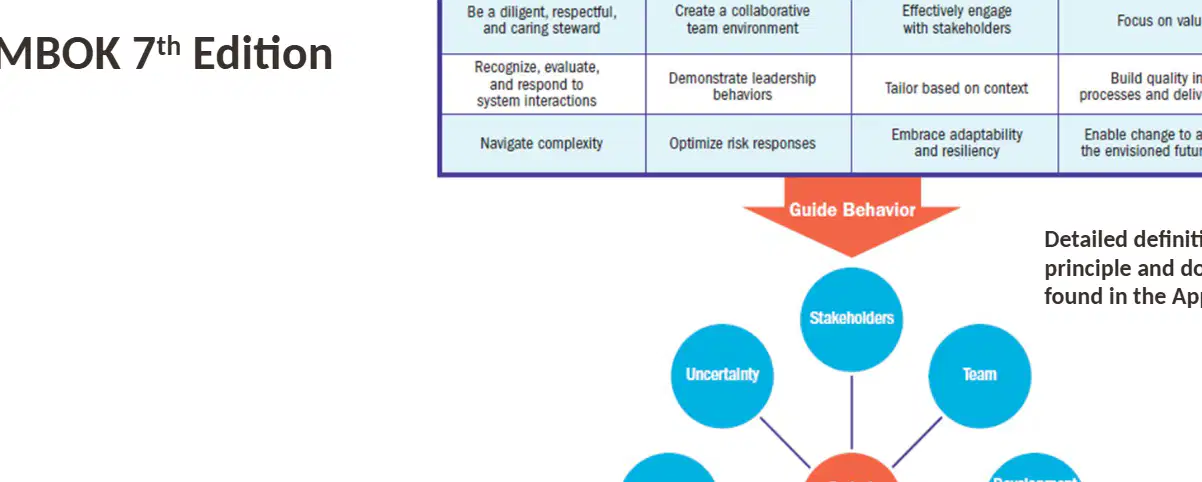
Which of the following best describes the relationship between project management principles and project performance domains?
Project management principles guide the behavior within each project performance domain.
Project performance domains determine the principles to be followed.
Principles and domains are unrelated.
Domains are only relevant for small projects.
Which principle encourages project managers to "embrace adaptability and resiliency"?
Principles of Project Management in PMBOK 7th Edition
Project Performance Domains
Appendix Definitions
Seneca Guidelines
If a project manager is tailoring their approach based on the context of the project, which principle are they applying?
Tailor based on context
Focus on value
Optimize risk responses
Build quality into processes and deliverables
Which project performance domain would most likely address the process of tracking and evaluating project progress?
Measurement
Team
Uncertainty
Development Approach and Life Cycle
Which of the following is NOT a type of project lifecycle mentioned in the image?
Predictive (Waterfall)
Adaptive (Agile & Lean)
Hybrid
Sequential (Linear)
At what point in the project lifecycle does the journey typically begin, according to the image?
Objectives
Start
Planning
Execution
Which project lifecycle approach is best suited for projects with a high degree of change and uncertainty?
Predictive (Waterfall)
Adaptive (Agile & Lean)
Hybrid
Linear
Explain how the unique project context might influence the choice of project lifecycle. Use reasoning to support your answer.
The unique project context determines which lifecycle is most appropriate by considering factors such as project complexity, uncertainty, and stakeholder needs.
The unique project context has no impact on the choice of lifecycle.
The unique project context only affects the project budget.
The unique project context is only relevant for hybrid projects.
Which statement best reflects the current approach to tools and techniques in project management?
There is no one way of doing things anymore.
There is only one best practice for every situation.
Context is not important in project management.
All projects must follow the same procedure.
What is the main reason for the shift from a single "best practice" to multiple "good practices" in project management?
The need for more paperwork
The importance of context in each situation
The requirement to use only digital tools
The reduction of project budgets
What is PMI’s Standards+?
A digital companion to the PMBOK 7th edition that helps project management professionals stay current
A printed version of the PMBOK 7th edition
A software for scheduling tasks
A certification exam for project managers
How does PMI’s Standards+ help project management professionals?
By sharing original case studies, articles, videos, and downloadable templates
By providing only theoretical knowledge
By offering only in-person workshops
By focusing solely on financial management
A project manager is facing a unique situation that does not fit traditional "best practices." Based on the current trends in project management, what should the manager do?
Look for context-appropriate "good practices" instead of relying on a single "best practice"
Ignore the context and follow the standard procedure
Wait for new best practices to be published
Consult only the PMBOK 6th edition

