
 Worksheets
NASM Chapter 5 Lab Activity
Total questions: 8
Worksheet time: 26mins
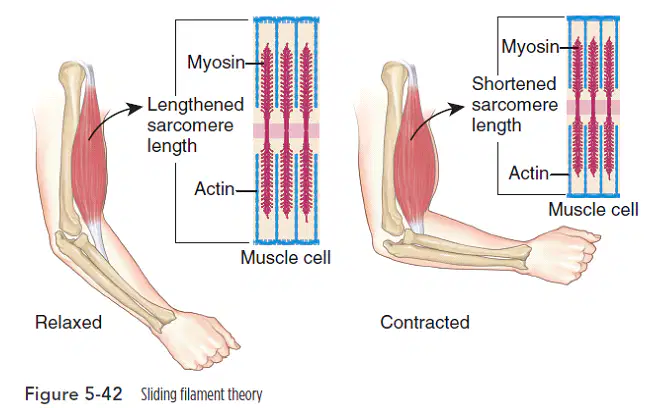
Number the following events in the order (1 through 5) in which they occur during the sliding filament theory:
The nerve impulse begins in the CNS and travels down the motor neuron, which is facilitated by sodium and potassium electrolytes, to the neuromuscular junction.
Acetylcholine is released into the neuromuscular junction, which then helps the nerve impulse cross the synapse into the muscle.
The nerve impulse travels into the muscle infrastructure, stimulating a small organ called the sarcoplasmic reticulum to release the electrolyte calcium
Calcium is then released into the muscle, stimulating a chain of events that results in the myosin heads binding to actin.
The myosin heads then pull the actin toward the sarcomere center, which slides the overlapping filaments past each other, shortening the entire muscle.
List out the characteristics of each type of bone and provide one to two examples of each.

Long

Short

Flat

Irregular

Sesamoid
Match the number of bones in the different sections of the vertebral column.
Cervical
7
Thoracic
12
Lumbar
5
Sacrum/Coccyx
3-5 fused
(a) is the description of bone movement (e.g., flexion and extension), while (b) is the description of joint movement (i.e., the interaction between two bone surfaces)
⦁ Discuss the difference between a synovial and non-synovial joint. Provide an example for each.

Suture
most common joints
no joint capsule, fibrous connective tissue, or cartilage
exhibit little to no movement

Gliding

Hinge

Condyloid

Saddle

Pivot

Ball and Socket
As a certified personal trainer, you just began training a husband and wife on alternate days of the week. The husband is a former collegiate football player who has a primary goal of regaining his muscle strength and size. The wife is a recreational runner who has a primary goal of building overall endurance.
Write out one to two SMART goals for each client’s primary fitness goal.
What types of muscle fibers will you focus on during their training? Provide a detailed description and rationale for each client.
What types of exercise will you choose that are related to each client’s goal and targeted muscle fiber type?
If you show them new exercises, what stages of motor skill development will they go through to learn the new skill?
Describe the components of the nervous system in the following flowchart. Provide specific details and examples of each box
Muscles spindles are sensory receptors within (a) that run parallel to the muscle fibers and are sensitive to change in (b)
Golgi tendon organs are specialized sensory receptors located at the point where skeletal muscle fibers insert into the (c) of skeletal muscle. They are sensitive to changes in (d)

