
 Worksheets
Chapter 1 Elements , Compounds and Solutions Review
Total questions: 20
Worksheet time: 10mins
Which pair of elements is matched with the correct chemical symbols?
Fluorine, F, and argon, Ag
Fluorine, F, and iodine, I
Sulfur, Su, and bromine, Br
Nitrogen, Ni, and argon, Ar
Which of the set of actions is more likely to increase the rate of dissolution of a pill in water?
hot water, crush pill, stir constantly
hot water, crush pill, stir occasionally
hot water, cut pill in half, stir constantly
warm water, crush pill, stir at the beginning
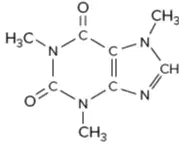
The diagram shows one molecule of caffeine. A caffeine molecule has 8 atoms of ________________, 10 atoms of ________________, 4 atoms of ________________, and ________________ atoms of ________________.
8 atoms of carbon, 10 atoms of hydrogen, 4 atoms of nitrogen, and 2 atoms of oxygen.
6 atoms of carbon, 12 atoms of hydrogen, 4 atoms of nitrogen, and 2 atoms of oxygen.
8 atoms of carbon, 8 atoms of hydrogen, 4 atoms of nitrogen, and 4 atoms of oxygen.
7 atoms of carbon, 10 atoms of hydrogen, 5 atoms of nitrogen, and 2 atoms of oxygen.
Scientists commonly work with corrosive acids in the laboratory, being careful to wear gloves and safety goggles or respirators to protect their skin and airways. Other acids are much weaker and are even found in common foods and drinks. The following table lists the names, chemical formulas, and common uses for four different acids. Acid Name | Chemical Formula | Common Uses Perchloric acid | HClO4 | Fireworks, vehicle airbag initiators Acetic acid | HC2H3O2 | Main vinegar ingredient Sulfuric acid | H2SO4 | Fertilizers Carbonic acid | H2CO3 | Carbonated drink ingredient.
Perchloric acid contains sulfur atoms.
Acetic acid contains the most atoms.
A molecule of sulfuric acid contains one hydrogen atom.
Carbonic acid is the main ingredient in vinegar.
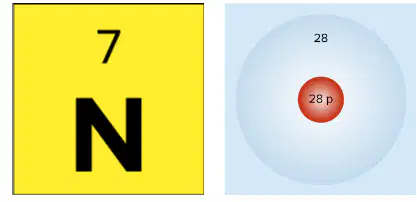
Reference the following two drawings. Which of the following statements is true?
The element square from the periodic table with atomic number 7 is nitrogen.
Both the element square and the atom drawing represent the same element.
The atom drawing shown is nitrogen.
None of these statements is true.
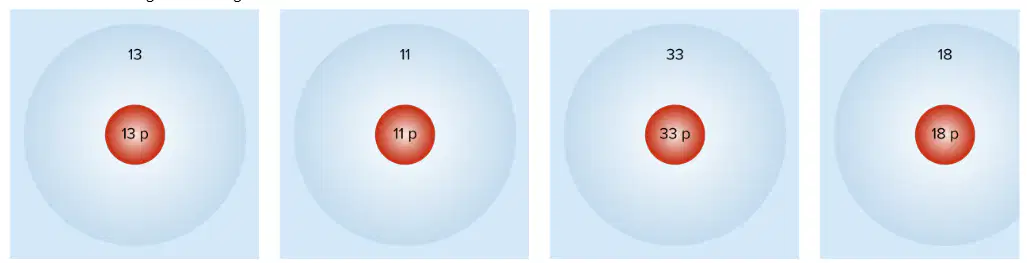
Reference the following four drawings of different atoms. Arrange the atoms in the drawings from lowest atomic number to highest atomic number.
Al, Ar, As, Na
Ar, As, Na, Al
Na, Al, Ar, As
Na, Al, As, Ar
The chemical formula for chocolate is C7H8N4O2. Use a periodic table to identify the types and number of each atom that makes up C7H8N4O2.
7 carbon atoms, 8 hydrogen atoms, 4 nitrogen atoms, and 2 oxygen atoms
7 cobalt atoms, 8 hydrogen atoms, 4 nitrogen atoms, and 2 oxygen atoms
7 carbon atoms, 8 helium atoms, 4 nitrogen atoms, and 2 oxygen atoms
7 cobalt atoms, 8 helium atoms, 4 neon atoms, and 2 oxygen atoms
Which of the following is an example of a chemical change?
blending milk and a banana to make a smoothie
breaking a rock
rotting banana
hammering metal into a sheet
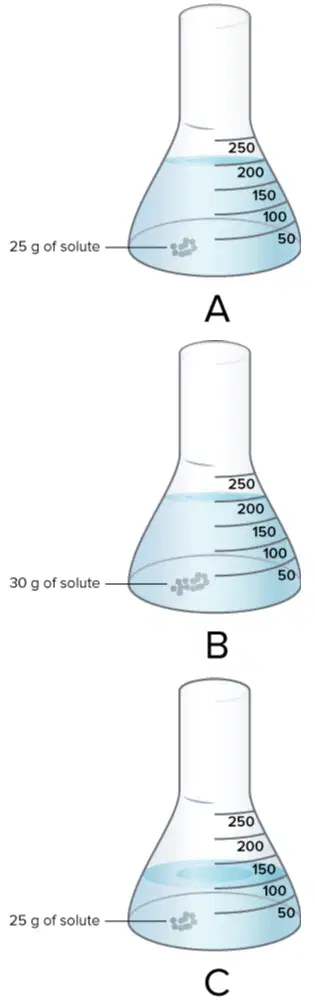
Examine the following four figures showing solutions containing different amounts of a solute dissolved in different amounts of water. Based on the diagrams labeled A, B, and C, which solution is the most concentrated?
25 g of solute in 200 mL water
30 g of solute in 200 mL water
25 g of solute in 100 mL water
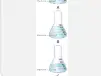
Which of the following statements is true?
Solution A is more concentrated than Solution B.
Solution B is more concentrated than Solution D.
Solution D is the most concentrated of the four solutions.
Solutions A and C have equal concentrations.
A chemist is investigating the effect of temperature and stirring on the rate of dissolution of a solid. She places 10 g of the solid in each test tube and places the test tubes in the conditions summarized in the following table. She then records how long it takes for the solid to dissolve. Treatment | Temperature (°C) | Stirring | Time to dissolve (Seconds) 1 | 15 | none | 150 2 | 15 | continual | 120 3 | 25 | none | 30 4 | 25 | continual | 20 What can you conclude from these results?
Higher temperature and stirring both effect the rate of dissolution, but temperature has a stronger effect.
Higher temperature and stirring both effect the rate of dissolution, but stirring has a stronger effect.
Higher temperature and stirring both effect the rate of dissolution about the same amount.
Higher temperatures increase the rate of dissolution and stirring has no effect.
A student carried out four experiments combining two liquids. The table summarizes the liquids and solids that were combined and the student’s observations. Which experiment is most likely caused by a chemical change?
Experiment 1
Experiment 2
Experiment 3
Experiment 4
There are many steps to making an omelette. Which of the following steps are chemical changes in matter? Select all answers that apply.
Cook eggs.
Warm up eggs after they are taken out of the fridge.
Beat the eggs with a fork.
Crack the eggs into a bowl.
Melt butter in a pan.

Nitrate, NO₃⁻, is an important component of many fertilizers. Use the periodic table to identify the types of atoms that make up NO₃⁻.
Nickel and oganesson
Nickel and oxygen
Nitrogen and oganesson
Nitrogen and oxygen
Classify each of the following as a chemical change or a physical change.
Chemical change: rusting nail, burning fuel in a car, digesting a chocolate bar; Physical change: air drying clothes, boiling water, breaking apart a chocolate bar, melting butter.
Chemical change: boiling water, melting butter, breaking apart a chocolate bar; Physical change: rusting nail, burning fuel in a car, digesting a chocolate bar.
Chemical change: air drying clothes, boiling water, melting butter; Physical change: rusting nail, burning fuel in a car, digesting a chocolate bar.
Chemical change: breaking apart a chocolate bar, air drying clothes, boiling water; Physical change: rusting nail, burning fuel in a car, melting butter.
Examine the following two figures. Each solution consists of 50 g of NaNO3 dissolved in water. Which of the following statements is true?
Solution A is more concentrated than Solution B.
Solution B is more concentrated than Solution A.
Both solutions have equal concentrations.
None of the statements are true.
Which of the following is NOT a true statement regarding solutions?
A solution is a mixture.
In a solution, a solute dissolves in a solvent.
In a solution, the solute and solvent are chemically combined.
Solutions may have color or be colorless.

People who are lactose intolerant can take a lactase pill before having milk or milk products. Lactase is an enzyme that breaks down lactose, the sugar in milk. Your friend wonders if it is better to take Brand X lactase, which recommends taking one large pill, or Brand Y lactase, which recommends taking two smaller pills. The pills are identical, except for their size. Therefore, the amount of lactase is the same for 1 pill of Brand X and 2 pills of Brand Y. What do you suggest to your friend if he wants the pills to dissolve quickly so they act faster?
Take Brand X, because the larger pill has a greater surface area than the two smaller pills from Brand Y, so they will dissolve faster.
Take Brand X, because the larger pill has a smaller surface area than the two smaller pills from Brand Y, so they will dissolve faster.
Take Brand Y, because two smaller pills have a greater surface area than the single pill from Brand X so they will dissolve faster.
Take Brand Y, because two smaller pills have a smaller surface area than the single pill from Brand X so they will dissolve faster.
Refer to the drawing of a burning candle. What types of changes to matter are occurring?
physical change
chemical change
both a physical and a chemical change
neither a physical nor chemical change
Use a periodic table to identify the number of each atom that make up washing soda, Na2CO3.
1 sodium atom, 2 carbon atoms, and 3 oxygen atoms
2 nitrogen atoms, 1 calcium atom, and 3 oxygen atoms
2 sodium atoms, 1 carbon atom, and 3 oxygen atoms
2 sodium atoms, 3 carbon atoms, and 3 oxygen atoms
2 sodium atoms, 2 carbon atoms, and 3 oxygen atoms

