
 Worksheets
Knowledge Check #3/4
Total questions: 28
Worksheet time: 26mins
Consider the following quotation: "It is agreed on all sides, that the powers properly belonging to one of the departments, ought not to be directly and completely administered by either of the other departments." James Madison, Federalist #48, 1788 Which of the following constitutional principles is James Madison defending in the quote?
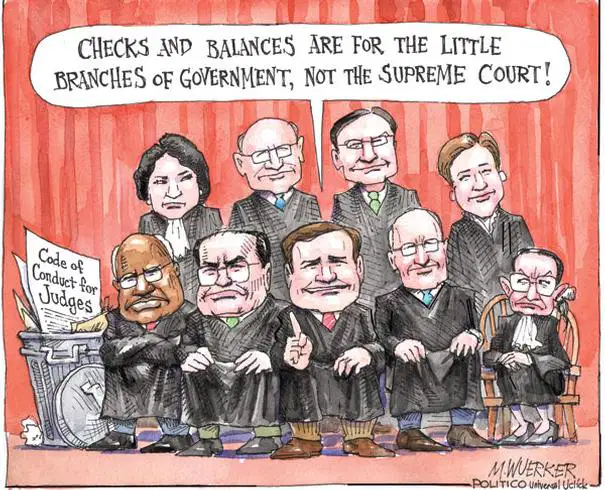
From the image consider: Which of the following checks on the judicial branch is the author most likely commenting on?
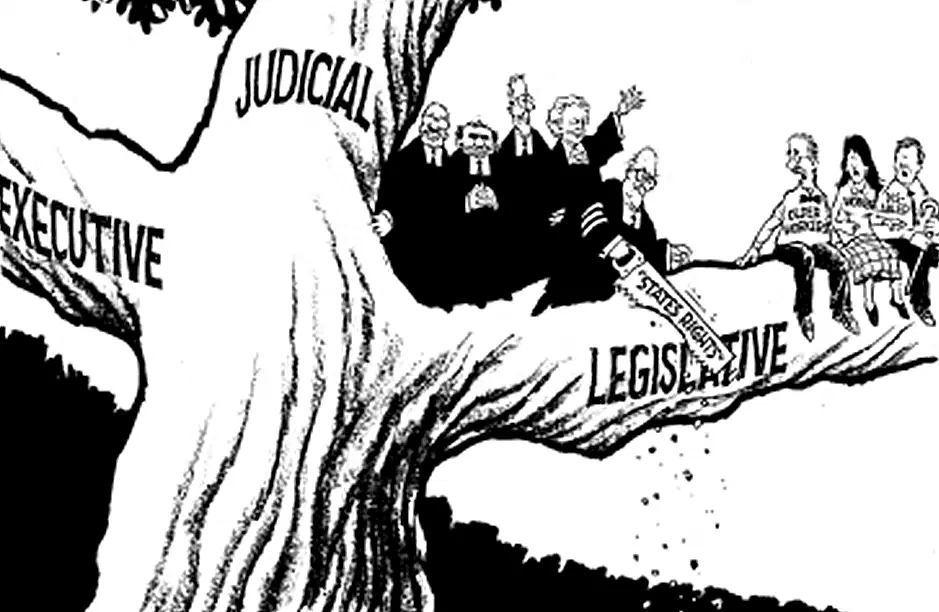
Which of the following checks could the judicial branch be using on the legislative branch as shown in the image ?
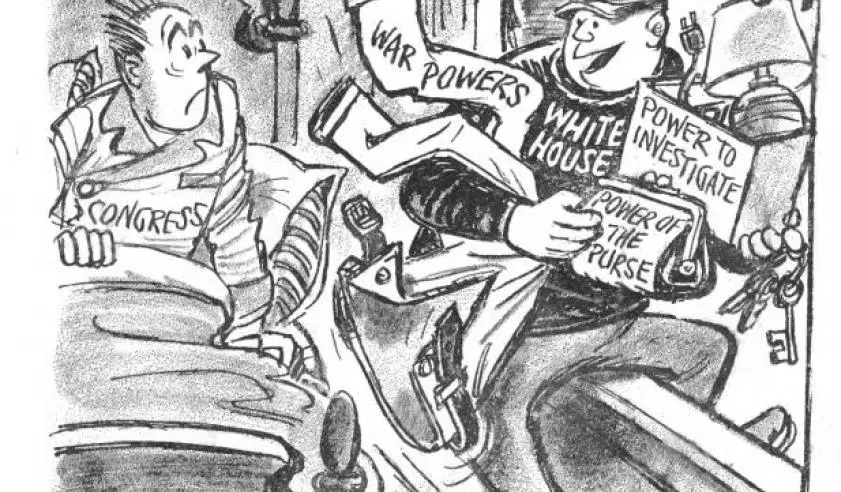
Which of the following statements best explains the author's message in the image?
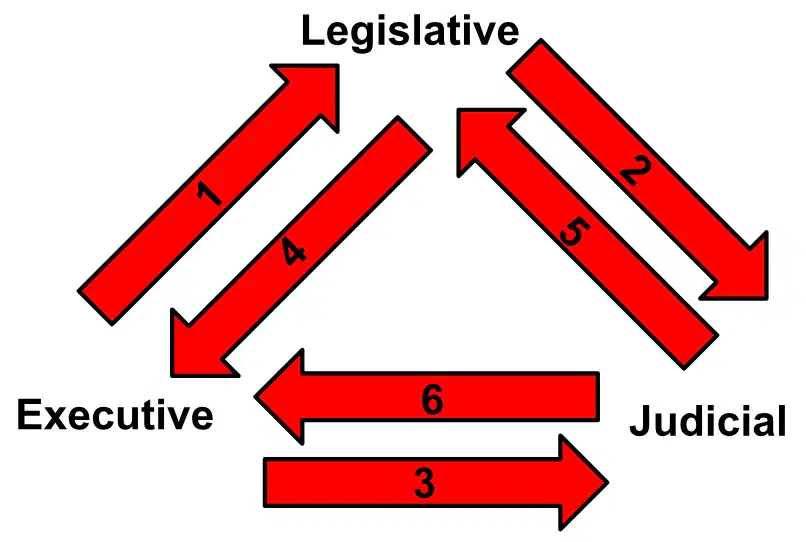
Which of the following checks belongs on arrow #4? The Legislative Branch Checking the Executice
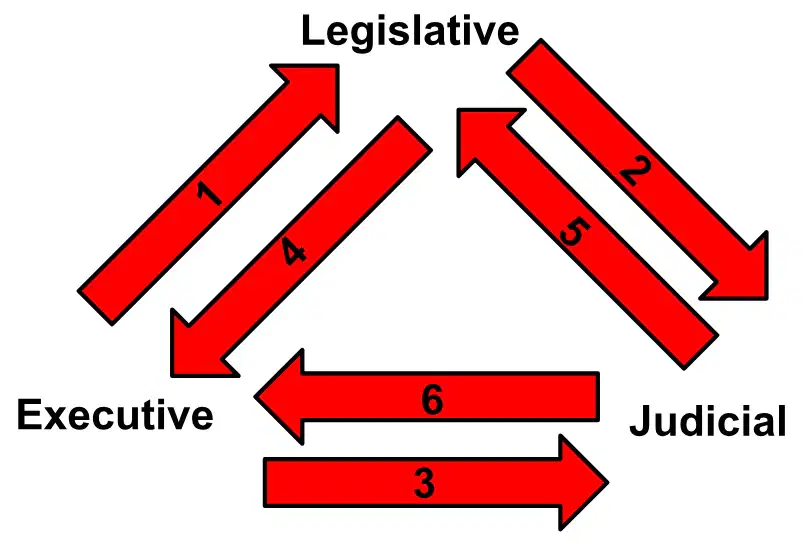
Which of the following checks belongs on arrow #1? The Executive branch checking the Legislative.
The U.S. Supreme Court has ruled that the separation of powers is integral to the Constitution not to preserve the prerogatives of each branch of government but to divide governmental powers among the branches so as to keep power diffused—and thereby limited and protective of personal freedom. . . .
Thus, even if one branch of government consented to ceding an essential power to another branch, such a giveaway would be unconstitutional. . . .
Can the president legally use military force to attack a foreign land without a serious threat or legal obligation or a declaration of war from Congress? In a word: No. Here is the back story. . . .
. . . [A] bipartisan group of senators offered legislation supported by the president that . . . would permit a president to strike whomever and wherever he pleases. The president would be restrained only by a vote of Congress—after hostilities have commenced.
Such a statute would give the president far more powers than he has now, would directly violate Congress’ war-making powers by ceding them away to the president, would defy the Supreme Court on the unconstitutionality of giving away core governmental functions, would commit the U.S. to foreign wars without congressional and thus popular support, and would invite dangerous mischief by any president wanting to attack any enemy—real or imagined, old or new—for foreign or domestic political purposes, whether American interests are at stake or not.
Andrew Napolitano, “At War with the Separation of Powers,” The Washington Times, 2018
Which of the following principles of government is most related to the author’s argument in the passage?
Separation of powers is necessary to our constitutional system to limit the power of the three branches and guarantee limited government.
The president’s power is constitutionally permitted to expand during times of crisis, which can lead to the use of force without permission from Congress.
As the legislative branch, Congress is authorized to change the constitutional balance of power whenever it deems necessary.
Separation of powers guarantees that each branch can focus on what it does best, but in some cases one branch may voluntarily cede power to another branch.
Which of the following describes a possible method that can check the power of the president who willingly violates the constitutional balance of power as described in the passage?
Congress can pass a law that removes the president from office.
The Supreme Court can rule that the presidential election results are null and void based on the actions of the president.
States can recall the president through a special election process.
Congress can impeach and remove a president who is unable or unwilling to perform his or her official functions.
Which of the following political processes would best solve the problem regarding the system of checks and balances, as articulated by the author in the passage?
The president agrees to lift sanctions and signs a peace treaty with another country without waiting for the approval from Congress.
Congress cuts the budget from the Armed Forces without getting presidential approval to prevent the president from sending troops abroad.
The Supreme Court rules on a suit brought by an interest group that legislation permitting the president to launch military strikes without congressional approval is unconstitutional.
The Supreme Court refuses to take a case on legislation that permits the president to launch military strikes without congressional approval.
What mechanism did the Founders embed in the Constitution so they have a final resolution in cases where state and national government disagree on policy?
Necessary and Proper Clause
Privileges and Immunities Clause
Supremacy Clause
Full Faith and Credit Clause
Which of the following explanations best explains the difference between enumerated and implied powers in the Constitution?
Implied powers are specifically listed in the Constitution, while enumerated powers may go beyond the list as needed but in line with the Constitution
Enumerated powers are specifically listed in the Constitution, while implied powers may go beyond the specific list as needed
Enumerated powers are only for state governments while implied powers are for only the national government
Implied powers give state governments flexibility while enumerated powers keep national government in its proper place with limited room for expansion
How is the 10th amendment different from the Enumerated powers in the Constitution?
The 10th amendment's list of powers is more restrictive
The enumerated powers are vaguely worded
The enumerated powers cannot be challenged in court while 10th amendment powers can be
The 10th amendment reserves future unknown powers for states
One of the major issues debated at the Constitutional Convention in Philadelphia was -
proposing a new strategy to proceed with the abolition of slavery
creating a plan for representation of both large and small states
whether or not to remain neutral in the French Revolution
if Missouri should be allowed to join the country as a free state
Northern and Southern delegates vehemently argued on how slaves should be counted as population for representation purposes, the result of this debate was the -
Three-fifths compromise
Great Compromise
Virginia and Kentucky Resolutions
Missouri Compromise
To James Madison, the size of the American nation should be
small, to allow lots of individual attention.
medium, because he believed in Aristotle’s “moderation in all things.”
large, so that many diverse groups could exist.
spherical, in order for the president to be in the center.
Madison thought that extensive republics were likely to produce good representatives because it would be difficult for unworthy candidates to win by unfair campaigning.
True
False
Which of the following best represents the ideas described in Brutus 1?
Separation of powers and checks and balances will prevent tyranny of the government and render a Bill of Rights unnecessary
The Constitution gives too much power to the federal government which will take away the powers of the states and fail to protect personal liberties
Powers delegated to the Constitution are very few and defined and as a result do not threaten the powers of the states that are many and indefinite
Factions can threaten a government, but a large republic would allow many different views to be heard and would not threaten the rights of the minority
Explain the following statement in the context of Madison's argument: "If men were angels, no government would be necessary......"
Government is not the end to the means but rather the means to the end
A direct democracy is the most efficient way to govern
The nation would function more efficiently if religion played a big part in its governing
Men abuse power and therefore need to be kept in check
According to analysis of Federalist 10, how is the Constitution designed to prevent injustice and instability from factions based on opinions and passions?
It teaches people to respect one another's opinions and to resist violence.
It shapes the circumstances of civil society so opinions and passions will be less important to people than economic interests.
It creates a circumstance with many different factions, based on opinion and passion, none of which is large enough to be a majority.
It works to make people understand that violence removes any chance for stable satisfaction of basic needs.
The principle that states federal and state governments must share powers
Checks & Balances
Republicanism
Federalism
Popular Sovereignty
A government in which the people rule, the authority of the government comes from the people
Checks & Balances
Popular Sovereignty
Federalism
Separation of Powers
This idea calls for the people to exercise or delegate their power by electing or voting for their political representation
Limited Government
Separation of Powers
Republicanism
Federalism
This is the idea that everyone, citizens and powerful leaders alike, must obey the law
Federalism
Republicanism
Limited Government
Popular Sovereignty
the power of federal courts to declare laws and actions of local, state, or national governments invalid if they violate the Constitution
popular sovereignty
limited government
separation of powers
checks and balances
judicial review
A two-thirds vote in each House of Congress is needed to override a president's veto.
popular sovereignty
federalism
separation of powers
checks and balances
limited government
What is the 5th Amendment?
Individuals cannot sue a state in federal court
Rights of the accused, (no double jeopardy, witness against yourself), can be found in which Amendment?
Women's Suffrage
No cruel or unusual punishment
What is the 9th Amendment?
Rights reserved to the States
Abolished Slavery
Defines Citizenship
Citizens still have rights not listed in the Constitution

