
 Worksheets
Y10 AUT1 Assessment
Total questions: 121
Worksheet time: 2hrs 35mins
Match the key theoretical frameworks
How media communicates a message to audience(s).
Media Language
How media constructs identities of groups of people.
Media Representation
The organisation the produce, distribute an regulate media
Media Industry
How people are categorised and influenced by media
Media Audience
How media is impacted by the environment in which it is produced and/or consumed.
Media Context
A term describing a media text or sign that has multiple possible meanings or interpretations.
(a)
A form of mass communication created for the consumption by a large audience. Consumption is the means by which an audience take in a media's message.
(a)
The process of taking in media. This will differ based on the type of media.
(a)
The critical analysis of media products.
(a)
Match the key theoretical frameworks
How media communicates a message to audience(s).
Media Language
How media constructs identities of groups of people.
Media Representation
The organisation the produce, distribute an regulate media
Media Industry
How people are categorised and influenced by media
Media Audience
How media is impacted by the environment in which it is produced and/or consumed.
Media Context
A term describing a media text or sign that has multiple possible meanings or interpretations.
(a)
Refers to the literal, surface-level meaning of a media text, image, or word—what is explicitly shown or said, without any hidden meaning or interpretation.
(a)
Refers to the deeper, implied or symbolic meaning behind what is shown or said in a media text—how audiences interpret the media based on cultural, emotional, or social context.
(a)
A term describing a media text or sign that has multiple possible meanings or interpretations.
Connotation
Denotation
Polysemic
Refers to the literal, surface-level meaning of a media text, image, or word—what is explicitly shown or said, without any hidden meaning or interpretation.
Connotation
Denotation
Polysemic
Refers to the deeper, implied or symbolic meaning behind what is shown or said in a media text—how audiences interpret the media based on cultural, emotional, or social context.
Connotation
Denotation
Polysemic
Match the terms
Refers to the deeper, implied or symbolic meaning behind what is shown or said in a media text—how audiences interpret the media based on cultural, emotional, or social context.
Connotation
Refers to the literal, surface-level meaning of a media text, image, or word—what is explicitly shown or said, without any hidden meaning or interpretation.
Denotation
A term describing a media text or sign that has multiple possible meanings or interpretations.
Polysemic
A film poster shows an image of a single red balloon floating in the air.
denotation
connotation
The red balloon in the poster makes audiences think of childhood innocence and hidden danger.
denotation
connotation
An advert features a model standing in front of a giant clock.
denotation
connotation
The clock in the advert suggests ideas of urgency, running out of time, or timeless beauty.
denotation
connotation
A charity campaign shows cracked, dry earth on a poster.
denotation
connotation
Denotation refers to the literal, surface-level meaning of an image or word.
True
False
The signifier is the physical form (word, sound, or image), while the signified is the concept or meaning behind it.
True
False
Connotation is always the same for everyone and never changes across cultures.
True
False
Denotation is connected to the signified because it refers to the literal meaning of a sign.
True
False
Connotation has nothing to do with the signifier and only relates to denotation.
True
False
In a film poster, the denotation of a gun is simply “a weapon,” while its connotation might suggest violence or danger.
True
False
A picture of a crown has the denotation of a piece of headwear, but the connotation of power or royalty.
True
False
A film poster shows a dark stormy sky. This literally means the weather is stormy.
Denotation
Connotation
An advert features a sports car, which suggests wealth, luxury, and high social status.
Denotation
Connotation
A magazine cover has a model in a white dress
Denotation
Connotation
A logo with a red cross makes audiences think of healthcare, first aid, and emergency help.
Denotation
Connotation
A political cartoon shows a lion wearing a crown. Which of the following is the denotation?
The lion symbolises Britain’s monarchy and power.
The image is of a lion with a crown on its head.
It suggests leadership, courage, and national identity.
It represents royal authority and tradition.
A crown appears on a magazine cover. What is the connotation of the crown?
It’s made of gold
It’s a hat
It represents royalty, power, or leadership
It has sharp edges
What is the denotation of a rose shown in a romantic film?
Love
Romance
A red flower with petals
A symbol of passion
A storm appears in the background of a horror film scene. What might the storm connote?
Weather
The setting is outside
Tension, danger, or emotional chaos
Night-time
What is the denotation of a police siren in a TV crime drama?
Fear and panic
A loud sound from a police car
A warning to criminals
A symbol of justice
In an advert, a person is shown wearing all white clothes. What could the colour white connote?
Fabric or cotton
Peace, innocence, or purity
Expensive clothing
They are cold
Key Term: A term describing a media text or sign that has multiple possible meanings or interpretations.
Connotation
Denotation
Polysemic
Key Term: Refers to the literal, surface-level meaning of a media text, image, or word—what is explicitly shown or said, without any hidden meaning or interpretation.
(a)
Refers to the deeper, implied or symbolic meaning behind what is shown or said in a media text—how audiences interpret the media based on cultural, emotional, or social context.
Connotation
Denotation
Polysemic
Key Term: Refers to the deeper, implied or symbolic meaning behind what is shown or said in a media text—how audiences interpret the media based on cultural, emotional, or social context.
(a)
Refers to the literal, surface-level meaning of a media text, image, or word—what is explicitly shown or said, without any hidden meaning or interpretation.
Connotation
Denotation
Polysemic
A term describing a media text or sign that has multiple possible meanings or interpretations.
(a)
Match the terms
Refers to the deeper, implied or symbolic meaning behind what is shown or said in a media text—how audiences interpret the media based on cultural, emotional, or social context.
Connotation
Refers to the literal, surface-level meaning of a media text, image, or word—what is explicitly shown or said, without any hidden meaning or interpretation.
Denotation
A term describing a media text or sign that has multiple possible meanings or interpretations.
Polysemic
A crown appears on a magazine cover. What is the connotation of the crown?
It’s made of gold
It’s a hat
It represents royalty, power, or leadership
It has sharp edges
What is the denotation of a rose shown in a romantic film?
Love
Romance
A red flower with petals
A symbol of passion
A storm appears in the background of a horror film scene. What might the storm connote?
Weather
The setting is outside
Tension, danger, or emotional chaos
Night-time
What is the denotation of a police siren in a TV crime drama?
Fear and panic
A loud sound from a police car
A warning to criminals
A symbol of justice
In an advert, a person is shown wearing all white clothes. What could the colour white connote?
Fabric or cotton
Peace, innocence, or purity
Expensive clothing
They are cold
In Media Studies, (a) refers to the literal meaning of a sign — what we can (b) , such as the colour red on a poster. (c) , however, is the deeper or associated meaning that audiences might interpret, such as red connoting danger, love, or passion. Media texts are often (d) , which means they can be interpreted in multiple ways depending on the audience’s (e) . For example, a luxury car advert may denote an expensive vehicle, but it may connote wealth, success, or even arrogance, depending on who is viewing it.
Hero: Traditionally, the hero is the one who goes on a quest, faces obstacles, and achieves a goal
Thanos
Avengers
The Infinity Stones
Gamora and The Collector
Star Lord
Villain: Those who try to stop the hero
Thanos
Avengers
The Infinity Stones
Gamora and The Collector
Star Lord
Donor: Provides something useful to the hero
Thanos
Avengers
The Infinity Stones
Gamora and The Collector
Star Lord
Princess/Prize: The goal of the quest
Thanos
Avengers
The Infinity Stones
Gamora and The Collector
Star Lord
False Hero: Appears to be good but may mislead.
Thanos
Avengers
The Infinity Stones
Gamora and The Collector
Star Lord
A typical character, symbol, or storyline that is universally recognised and repeated across different media and cultures.
(a)
Vladimir (a) argued that most (b) follow a structure of (c) , each playing a role in (d) . This theory helps us understand how a character's narrative function shape the plot, rather than just focusing on (e) .
Propp Character Archetype: The character who actively tries to prevent the hero from completing their quest or journey
(a)
Propp Character Archetype: The character who gives the hero items to help on the quest
(a)
Propp Character Archetype: The character who wants to steal the prize from the hero
(a)
Propp Character Archetype: The character who sends a hero on their quest
(a)
Propp Character Archetype: The character who supports the hero on their quest
(a)
Propp Character Archetype: The main character who is on a quest or journey
(a)
Match the terms
The one who goes on a quest, faces obstacles, and achieves a goal
Hero
Those who try to stop the hero
Villain
The goal of the quest.
Prize
Provides something useful to the hero
Donor
Attempts to steal the hero's prize
False Hero
A typical character, symbol, or storyline that is universally recognised and repeated across different media and cultures.
(a)
Vladimir (a) argued that most (b) follow a structure of (c) , each playing a role in (d) . This theory helps us understand how character function shape the plot, rather than just focusing on (e) .
Aids the hero in achieving their goal.
Helper
Dispatcher
Match the terms
The one who goes on a quest, faces obstacles, and achieves a goal
Hero
Those who try to stop the hero
Villain
The goal of the quest.
Prize
Provides something useful to the hero
Donor
Appears to be good but may mislead.
False Hero
Sends the hero on their quest.
Helper
Dispatcher
Which of the following BEST describes the difference between Propp’s Dispatcher and Donor?
The Dispatcher is always the villain, while the Donor is always the hero.
The Dispatcher sends the hero on the quest, while the Donor provides a magical item or guidance to help.
The Dispatcher gives the hero a reward after the quest, while the Donor betrays the hero.
The Dispatcher and Donor are the same archetype under different names.
Which example BEST illustrates a False Hero in Propp’s framework?
A character who pretends to help or claim credit for the hero’s actions but is later revealed as deceitful.
A hero who fails at the quest but redeems themselves.
A villain who is secretly working for the hero.
A donor who withholds their gift.
How can Propp’s archetypes enhance media analysis of modern films or TV dramas?
They dictate the only correct way to write a narrative.
They are outdated and irrelevant for contemporary stories.
They apply only to fantasy and fairy tale genres.
They reveal underlying narrative structures and character functions, even when roles are combined or subverted.
Match the terms
Refers to the deeper, implied or symbolic meaning behind what is shown or said in a media text—how audiences interpret the media based on cultural, emotional, or social context.
Connotation
Refers to the literal, surface-level meaning of a media text, image, or word—what is explicitly shown or said, without any hidden meaning or interpretation.
Denotation
A term describing a media text or sign that has multiple possible meanings or interpretations.
Polysemic
Which statement BEST explains the difference between denotation and connotation?
Denotation is the emotional response to a sign, while connotation is its literal meaning.
Denotation and connotation mean exactly the same thing.
Denotation is the literal description of a sign, while connotation is the cultural or emotional meaning attached to it.
Connotation only applies to written texts, not visual media.
A film poster shows a lone figure walking down a dark alley at night. Which connotation is MOST appropriate?
Danger, isolation, or suspense.
It is literally a person walking down an alley.
The person is definitely a villain.
The film is a comedy.
Why is understanding connotation important in media analysis?
It prevents any disagreement among audience members.
It reveals the underlying values, ideologies, or emotions that producers encode into media texts.
It eliminates the need to study denotation.
It ensures all audiences will interpret a text in the same way.
Why is polysemy important when analysing audience responses to a film poster?
It shows that posters are often misprinted or poorly designed.
It highlights that audiences bring their own experiences and values, creating different interpretations of the same signs.
It proves that posters are meaningless without prior knowledge of the film
It suggests that producers have no control over audience interpretation.
Which of these scenarios BEST demonstrates polysemic interpretation?
Every viewer laughs at the same joke in a sitcom for the same reason.
One group views a music video as empowering, while another sees it as objectifying.
A teacher explaining a media theory in a lecture.
A director correcting an actor’s line delivery during filming.
the pairing of two contrasting ideas—like good versus evil or rich versus poor—whose tension helps structure meaning in a media text.
(a)
Media often use clear (a) —like life vs death or good vs evil—to help us understand (b) . Spotting these opposites shows us the (c) of the media and helps us see the (d) the product wants us to (e) .
What does “binary opposition” mean in media studies?
Pairing two similar ideas
Pairing two contrasting ideas that create meaning
Repeating one idea for emphasis
Mixing three unrelated themes
Which pair is the best example of a binary opposition?
Cat / Kitten
Hero / Villain
Book / Story
Music / Sound
According to binary opposition theory, why are opposites important?
They make plots shorter
They help audiences understand themes
They remove tension from the story
They replace dialogue with visuals
If a narrative shows “freedom” versus “control,” what is this an example of?
A flashback
Character development
A subplot
Binary opposition
Which of the following is NOT a binary opposition?
Day / Night
Rich / Poor
Calm / Peaceful
Chaos / Order
When analysing a media text, identifying binary oppositions can help you:
Spot grammatical errors
Understand underlying messages
Count the number of scenes
Memorise character names
In many stories, the resolution happens when:
The binary oppositions are balanced or resolved
New characters are introduced
The soundtrack becomes louder
The setting changes suddenly
Which question best applies Lévi-Strauss’s theory during analysis?
“Who produced this text?”
“What opposites create tension here?”
“What camera angle is used?”
How long is the scene?”
Binary oppositions can appear in visuals, dialogue, and:
The page numbers
Background music
The credits list
Scene transitions only
A text that deliberately blurs or mixes its opposites is likely trying to:
Confuse the audience for no reason
Question simple “either/or” meanings
Shorten the running time
Avoid having a theme
the pairing of two contrasting ideas—like good versus evil or rich versus poor—whose tension helps structure meaning in a media text.
(a)
Media often use clear (a) —like life vs death or good vs evil—to help us understand (b) . Spotting these opposites shows us the (c) of the media and helps us see the (d) the product wants us to (e) .
According to binary opposition theory, why are opposites important?
They make plots shorter
They help audiences understand themes
They remove tension from the story
They replace dialogue with visuals
Match the key terms
Refers to the deeper, implied or symbolic meaning behind what is shown or said in a media text—how audiences interpret the media based on cultural, emotional, or social context.
Connotation
Refers to the literal, surface-level meaning of a media text, image, or word—what is explicitly shown or said, without any hidden meaning or interpretation.
Denotation
A term describing a media text or sign that has multiple possible meanings or interpretations.
Polysemic
a typical, universal pattern, role, or character type that appears repeatedly across stories, myths, films, and other forms of media.
Archetype
a pair of contrasting ideas, values, or concepts (such as good vs evil, hero vs villain, male vs female) that are used in media texts to create meaning and drive narratives.
Binary Opposition
Match the Propp archetypes
The one who goes on a quest, faces obstacles, and achieves a goal
Hero
Those who try to stop the hero
Villain
The goal of the quest.
Prize
Provides something useful to the hero
Donor
Undermines the hero by being either selfish or deceptive
False Hero
A deliberate mystery or unanswered question within a media text that keeps the audience guessing and encourages them to continue watching or reading.
(a)
Roland Barthes said that many texts use (a) to (b) the audience and (c) .
Media analysts look for these questions because they reveal how a product (d) and guides (e) .
Which of these is the BEST example of an enigma code?
A scene showing a calendar with today’s date circled
A character staring at an unopened letter without revealing its contents
A long panoramic shot of a city skyline
A close-up of someone eating lunch
Why do creators use enigma codes in media texts?
To shorten the running time
To keep production costs low
To build suspense and encourage the audience to keep watching
To make dialogue easier for actors
A film trailer ends with a voice saying, “You’re next.” What question does this enigma code raise?
What is the soundtrack called?
Who is “you” and what is going to happen next?
Which camera angle was used?
How much did the film cost?
Which of these is NOT an enigma code?
A locked safe shown in the first scene
A sudden unexplained flashback
A character reading out the full plot to the audience
A shadowy figure watching from a distance
Which of the following describe an enigma code?
A mystery or puzzle that makes the audience ask questions
A way to create suspense by hiding information
A costume colour that symbolises good or evil
A character’s unanswered backstory
Which examples are enigma codes?
A character receives a letter, but we don’t see what it says
A hidden figure watches from the shadows
A dramatic fight where the winner is shown clearly
A door is locked and we don’t know what’s behind it
How do enigma codes keep audiences engaged?
By creating unanswered questions
By forcing the audience to think ahead and guess outcomes
By showing obvious answers immediately
By building tension through mystery
Enigma codes are used to create (a) and keep the audience (b) . For example, a poster might show a character holding a secret object or looking into the distance without explanation. This makes the audience ask questions like “ (c) ” or “Why is that important?” These unanswered questions encourage them to (d) further with the product to (e) .
A deliberate mystery or unanswered question within a media text that keeps the audience guessing and encourages them to continue watching or reading.
(a)
Roland (a) said that many texts plant (b) — unanswered questions called (c) —to hook the audience and keep them (d) . Media analysts look for these questions because they (e) and guides viewers towards later revelations.
What is an enigma code?
A repeated catchphrase in a comedy show
A mystery or unanswered question that hooks the audience
A technical term for background music
A filming mistake left in by accident
Which of these is the BEST example of an enigma code?
A scene showing a calendar with today’s date circled
A character staring at an unopened letter without revealing its contents
A long panoramic shot of a city skyline
A close-up of someone eating lunch
Why do creators use enigma codes in media texts?
To shorten the running time
To keep production costs low
To build suspense and encourage the audience to keep watching
To make dialogue easier for actors
A film trailer ends with a voice saying, “You’re next.” What question does this enigma code raise?
What is the soundtrack called?
Who is “you” and what is going to happen next?
Which camera angle was used?
How much did the film cost?
Which of these is NOT an enigma code?
A locked safe shown in the first scene
A sudden unexplained flashback
A character reading out the full plot to the audience
A shadowy figure watching from a distance
What effect do multiple layered enigma codes usually have on a TV series?
They make each episode self-contained
They encourage binge-watching to find the answers
They remove any sense of mystery
They lower viewer engagement over time
Which production technique can help create an enigma code?
Showing a prop in extreme close-up without explanation
Listing every plot point in the opening credits
Using only bright, cheerful music
Adding laugh tracks after every line
In a mystery podcast, the host plays a distorted voicemail and says, “We still don’t know who sent this.” This voicemail functions as:
A narrative resolution
Comic relief
An enigma code
Product placement
When is an enigma code typically resolved?
Immediately after it is introduced
At the end or key turning point, giving the audience a payoff
Before the opening titles
Only in the marketing materials
Which question would a media analyst ask to spot an enigma code?
“How many scenes are in this episode?”
“What unanswered question keeps the audience curious?”
“Which camera brand was used?”
“How long is the closing credits sequence?”
Match the terms
Refers to the deeper, implied or symbolic meaning behind what is shown or said in a media text—how audiences interpret the media based on cultural, emotional, or social context.
Connotation
Refers to the literal, surface-level meaning of a media text, image, or word—what is explicitly shown or said, without any hidden meaning or interpretation.
Denotation
A term describing a media text or sign that has multiple possible meanings or interpretations.
Polysemic
Match the theory with the definition
Stories use recurring character roles (like hero, villain, helper) that drive the narrative forward.
Character Archetype
Media texts create mystery by posing questions or withholding information to keep the audience engaged.
Enigma Codes
Meaning is constructed through pairs of opposing ideas (good vs evil, male vs female, life vs death), which helps audiences understand conflict and themes more clearly.
Binary Opposition
Match the theory with the theorists
Character Archetypes
Propp
Enigma Codes
Barthes
Binary Opposition
Levi-Strauss

The Guardians of the Galaxy poster reflects Propp’s character archetypes through its use of visual codes. Star-Lord (Chris Pratt) is positioned at the centre, holding his weapon forward, clearly constructed as the (a) who will lead the narrative. Surrounding him are Rocket and Groot, whose proximity and action-ready poses mark them as helpers, supporting the hero on his journey. Gamora (Zoe Saldana) stands in the foreground with weapons drawn, suggesting she is both an active fighter and potentially framed within Propp’s (b) role, although updated for a modern audience to show independence and strength. Drax (Dave Bautista) is shown aggressively holding blades, which could be read as a (c) figure if judged solely on visual codes, though the ensemble format makes roles less rigid. The tagline “All heroes start somewhere” functions as a (d) , suggesting a mission or journey that propels the characters into action. Overall, the poster uses Propp’s framework but adapts it for a modern superhero team narrative, where multiple characters share heroic and helper roles rather than a (e) .

The Diet Coke advertisement constructs meaning through several binary oppositions. Firstly, there is a clear opposition between (a) : the tagline “Stay Extraordinary” suggests that drinking Diet Coke can elevate an everyday act into something glamorous and aspirational, with Taylor Swift embodying the extraordinary lifestyle. There is also an opposition between (b) , where Swift represents an idealised celebrity figure while the competition (“win a $2,500 gift card and prizes”) offers the consumer a way to bridge the gap and step into her glamorous world. Additionally, the visual codes emphasise (c) product: although Diet Coke is a mass-market drink, the use of champagne flutes, a stylish red dress, and a sophisticated mise-en-scène presents it as luxurious and fashionable. Finally, the colour scheme reinforces (d) , symbolising passion, glamour, and celebration contrasted with purity, simplicity, and style. These oppositions work together to position Diet Coke as not just a soft drink but a lifestyle choice linked to success, elegance, and (e) .
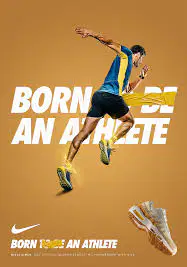
The Nike poster uses Barthes’ Enigma Codes to create (a) audience engagement. The bold slogan “Born an Athlete” immediately raises (b) : what does it mean to be “born” an athlete, and how does Nike help to unlock that natural potential? The runner is shown mid-jump, his body energised and glowing with dynamic yellow light trails, which creates further enigma — how has Nike’s product given him this power, speed, or energy? The placement of the shoe at the bottom of the poster acts as another enigma: the audience is (c) how this specific trainer connects to the athlete’s extraordinary performance. Even the background, stripped of detail, emphasises (d) , pushing the focus onto the action and slogan. These unanswered questions encourage the viewer to seek resolution by associating Nike with athletic identity, (e) .

