
 Worksheets
Chapter 1 Study Guide
Total questions: 36
Worksheet time: 18mins
Name
Class
Date
1.
Choose the correct definition of persecute.
a)
to treat an individual or group cruelly, especially because of race or political or religious beliefs.
b)
to stop someone from proceeding
c)
to not allow someone or something to enter a place or take part in an activity
d)
to unfairly judge a person or people due to race, sex, religion, nationality, or other characteristics.
2.
Choose the correct definition of colonize.
a)
to claim land for a nation by drawing a map.
b)
to claim land for a nation by making a new culture.
c)
to claim land for a nation by establishing a settlement.
d)
to claim land for a nation by exploring it.
3.
Read the definition below. Then choose the vocabulary term defined.
A northern ocean trade route around North America connecting the Atlantic and Pacific Oceans.
a)
Northwest Passage
b)
New World Passage
c)
Mayflower Passage
d)
Fur Trade Passage
4.
Choose the correct word to complete the definition below.
common good - the interests or well-being of _____________ in the whole community.
a)
a single person
b)
everyone
c)
all good citizens
d)
all fair people
5.
Read the definition below. Then choose the vocabulary term defined.
a naturally-made item, such as a tree, mineral, or fresh water, that people can use to help meet a need or want.
a)
industry
b)
chemical
c)
human modification
d)
natural resource
6.
Choose the correct definition of consequence.
a)
something that is a new idea or process.
b)
something that is against the law
c)
something that happens as a result of an action, event, or circumstance.
d)
something that happens before an action, event or circumstance.
7.
Choose the correct word or phrase to complete the definition below.
missionary - a person who works to spread their _____________, often in a foreign country.
a)
religious beliefs
b)
wealth
c)
langauge
d)
government
8.
Read the definition. Then choose the vocabulary term defined.
to change to something new or different.
a)
revert
b)
support
c)
convert
d)
manufacture
9.
Choose the correct definition of mercantilism.
a)
a political policy to fund explorations for future profit.
b)
an economic policy to refuse to trade with other countries or colonies.
c)
an economic policy in which the goal is to gain wealth by exporting more goods than are imported.
d)
a political policy to take over more territory and build settlements.
10.
Read the definition. Then choose the vocabulary term defined.
of or relating to the production, distribution, and consumption of goods and services.
a)
economic
b)
interdependence
c)
scarcity
d)
trade
11.
Choose the correct definition of indigenous.
a)
originating from or first to live in a particular region or environment.
b)
traveling to or visiting a particular region or environment.
c)
exploring or settling in a particular region or environment.
d)
fighting for or in a particular region or environment.
12.
Read the definition. Then choose the vocabulary term defined.
an original record of a past event, usually created by someone who actually saw or participated in the event.
a)
secondary source
b)
encyclopedia
c)
primary source
d)
story
13.
Choose the correct definition of unify.
a)
to rule or govern
b)
to allow or encourage
c)
to join together
d)
to separate
14.
Choose the correct definition of sanctuary.
a)
a place of commerce, especially a trading post.
b)
a place of territorial expansion, especially a colony.
c)
a place of persecution, especially against certain religious groups
d)
a place of safety, especially for religious worship
15.
Choose the correct definition of trade route.
a)
a path used to transport goods between two places.
b)
a location used to exchange goods from other places
c)
a location used to discuss trade relations
d)
a path used to block trade between two places.
16.

Which vocabulary term best describes the image?
a)
secondary source
b)
primary source
c)
chronological order
d)
artifact
17.
Read the definition. then choose the vocabulary term defined.
loyalty to one's own region or localized interests, instead of to the country as a whole.
a)
antebellum
b)
social class
c)
distinction
d)
sectionalism
18.
When the Europeans first arrived in North America it was ____________________.
a)
unihabited
b)
inhabited by American Indians
c)
settled by Asian colonists seeking trade routes to Europe
19.
What is one of the primary economic reasons for European exploration of the Americas?
a)
the search for resources
b)
the desire to trade with American Indians
c)
Pilgrims and Puritans were persecuted in Europe
d)
the belief that American Indians were more civilized
20.
What is one of the primary religious reasons for European colonization of the Americas?
a)
the lure of mercanitlism
b)
the quest for new opportunites
c)
Catholics were persecuted in Europe
d)
Pilgrims and Puritans wanted to create sanctuaries in the Americas
21.
Determine whether the reason for European exploration below was a result of religious or economic motivation.
Escaping persecution
a)
Economic motivation
b)
Religious motivation
22.
Determine whether the reason for European exploration below was a result of religious or economic motivation.
Converting American Indians
a)
Economic motivation
b)
Religious motivation
23.
Determine whether the reason for European exploration below was a result of religious or economic motivation.
Pursuing trade routes to Asia
a)
Economic motivation
b)
Religious motivation
24.
Determine whether the reason for European exploration below was a result of religious or economic motivation.
Creating religious sanctuaries
a)
Economic motivation
b)
Religious motivation
25.
Determine whether the reason for European exploration below was a result of religious or economic motivation.
Questing for new opportunities
a)
Economic motivation
b)
Religious motivation
26.
Determine whether the reason for European exploration below was a result of religious or economic motivation.
Searching for natural resources
a)
Economic motivation
b)
Religious motivation
27.
Choose the correct word or phrase to complete the sentence.
Economic choices are made in part because wants are ____________.
a)
scarce
b)
unlimited
28.
Choose the correct word or phrase to complete the sentence.
Economic choices are made in part because resources are __________________.
a)
scarce
b)
unlimited
29.
Choose the correct word or phrase to complete the sentence.
In any economic decision, choices are made by individuals, businesses, and governments have ______________ consequences.
a)
no
b)
present
c)
future
d)
present and future
30.
How did England use the policy of mercantilism in its colonies?
a)
to establish the fur trase
b)
to convert American Indians
c)
to benefit from a trade route to Asia
d)
to gain raw materials and sell goods
31.
Which statements best describe England, France, and Spain in the 1500 and 1600s? (Choose 2)
a)
They were weak
b)
They were rivals
c)
They were partners
d)
They were powerful
32.
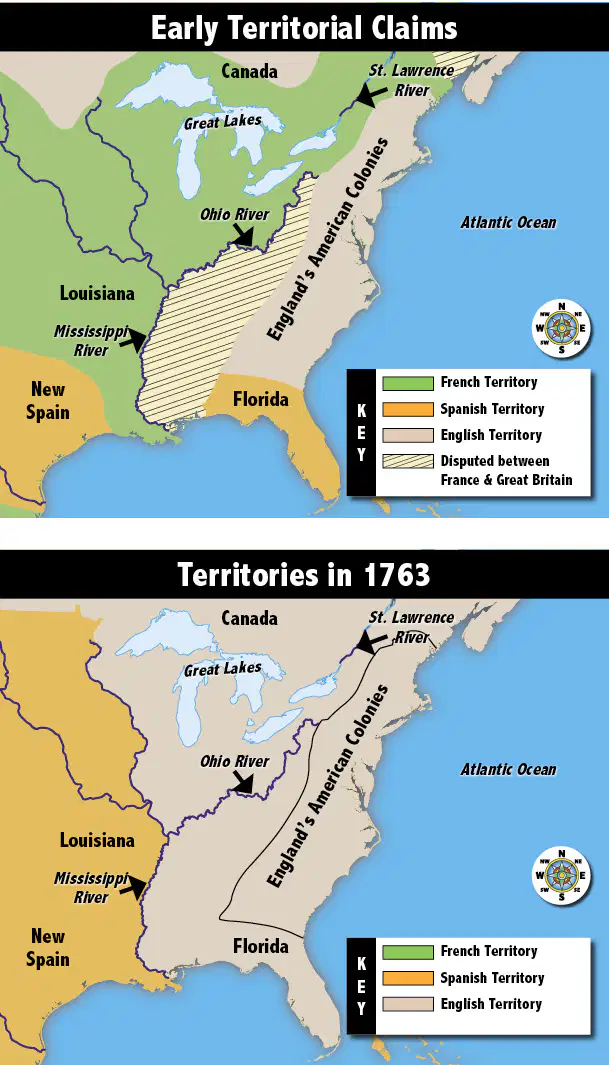
Use the maps to help answer the question.
Which two nations' early claims stayed closer to the coast?
a)
England and France
b)
England and Spain
c)
France and Spain
33.
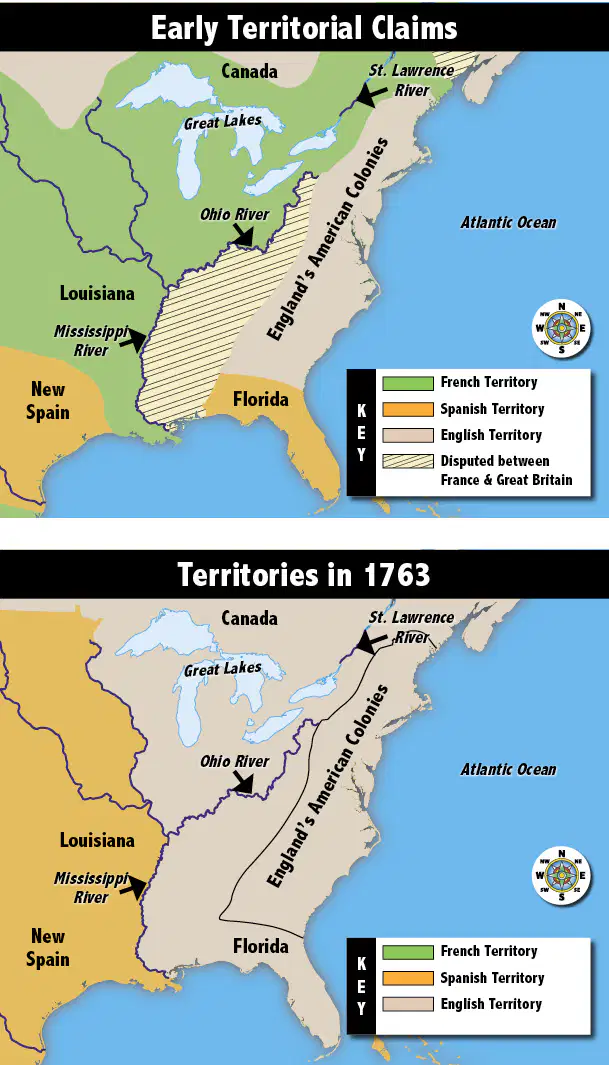
Use the maps to help answer the question.
Which nation lost the most territory by 1763?
a)
England
b)
France
c)
Spain
34.
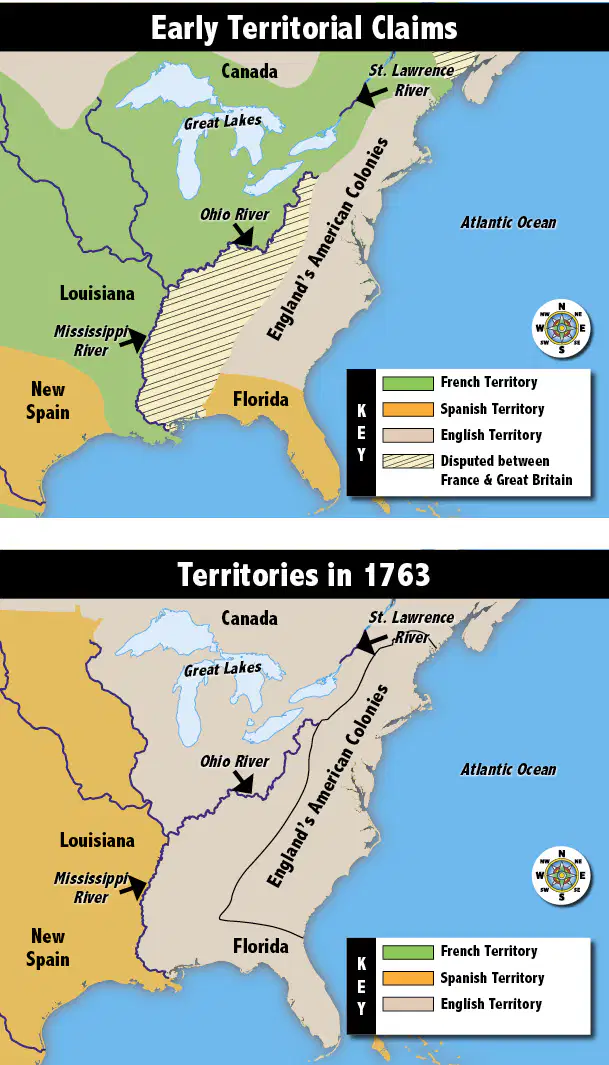
Use the maps to help answer the question.
Which nation's territory expanded and moved farther north after its early claims?
a)
England
b)
France
c)
Spain
35.
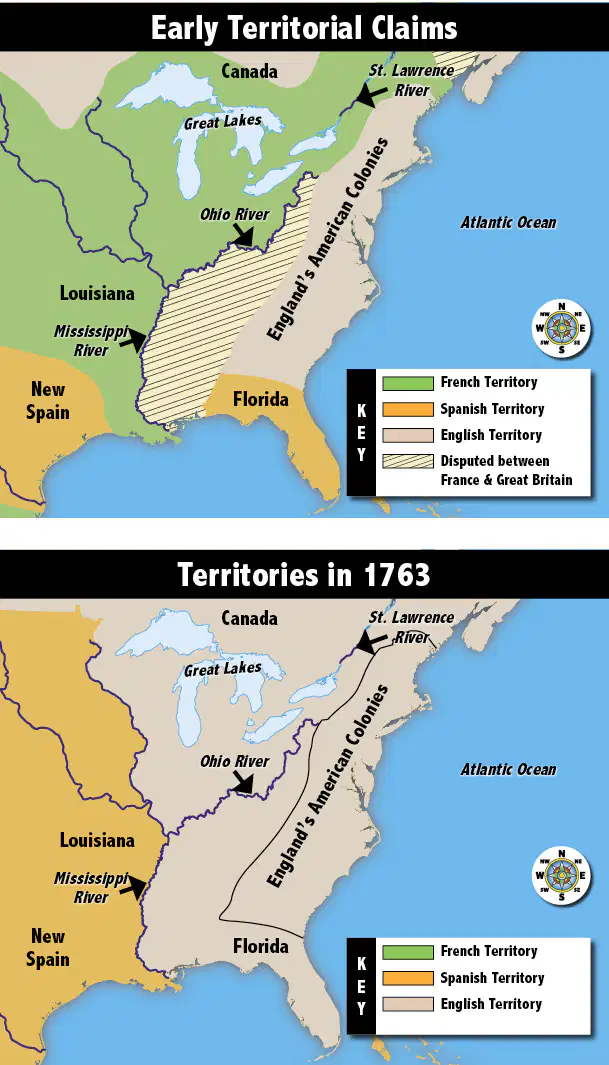
Use the maps to help answer the question.
Which nation's territory expanded and moved farther west after its early claims?
a)
England
b)
France
c)
Spain
36.
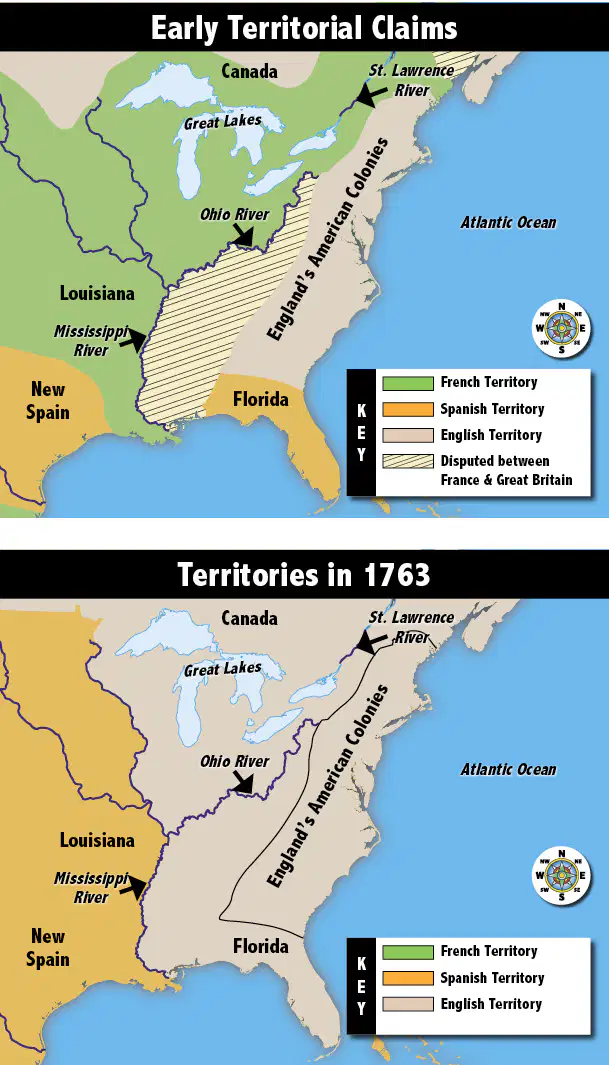
Use the maps to help answer the question.
Which nation maintained all its early territory and unified the area around it?
a)
England
b)
France
c)
Spain
100 %
![[2024] Layers Quest [A]](https://cf.quizizz.com/image/image-loader.svg)
