
 Worksheets
2.2 Mesopotamia Notes Part 1
Total questions: 38
Worksheet time: 19mins
What is an empire?
A city-state with a single ruler
A state containing several countries or territories
A small village with no government
A group of independent farmers
Why did the city-states of Sumer often come into conflict?
They wanted to share resources equally
They were all ruled by the same leader
They each wanted to gain control over more resources
They were located far apart from each other
What was the result of strong rulers conquering the whole region of Sumer?
The creation of the world’s first empires
The destruction of all city-states
The end of all conflicts
The rise of democracy
Based on the passage, what can you infer about the relationship between power and conflict among the Sumerian city-states?
More power led to less conflict
Increased power and wealth led to more rivalry and conflict
Power had no effect on conflict
Wealth made the city-states peaceful
What does the image most likely represent in the context of the passage?
A modern city
An ancient Sumerian city or empire
A small village
A natural landscape
What was a common result of the frequent fighting between Sumerian city-states?
The city-states became stronger and more united.
Sumerian city-states grew weaker.
The city-states formed a single large kingdom immediately.
There was no effect on the city-states.
Which two city-states are mentioned as examples of conflict in Sumer?
Ur and Babylon
Umma and Lagash
Akkad and Nineveh
Kish and Eridu
What is an ally according to the passage?
A city-state that is always at war with others
An independent state that works with other states to achieve a shared military or political goal
A ruler of Sumer
A region of fertile land
Explain how the frequent conflicts among Sumerian city-states contributed to the conquest of Sumer. (DoK Level 3: Strategic Thinking)
The conflicts made the city-states stronger and able to resist conquest.
The conflicts weakened the city-states, making them easier to conquer.
The conflicts led to the creation of new city-states.
The conflicts had no impact on the conquest of Sumer.
Around what year did armies from Umma and Lagash meet in a major battle?
2450 BCE
2375 BCE
2000 BCE
3000 BCE
What weapons did soldiers use in the battle between Umma and Lagash?
Bronze axes and long spears with sharp metal points
Wooden clubs and slingshots
Iron swords and shields
Bows and arrows
What did Lagash soldiers do to celebrate their victory over Umma?
Looted and burned Umma, and captured prisoners to be sold as slaves
Built a monument in Umma
Signed a peace treaty with Umma
Returned home without any celebration
How long did it take for Umma to recover from its defeat by Lagash?
Years
Days
Months
Decades
In 2375 BCE, what significant event happened involving Umma and Lagash?
A powerful king of Umma defeated Lagash and other Sumerian city-states
Lagash built a new city
Umma and Lagash formed an alliance
The Sumerians discovered bronze
Why did the rule of the powerful king of Umma come to an end soon after his victory?
The text does not specify the reason
He was assassinated
He moved to another city
He became a peaceful ruler
Which people lived to the northwest of Sumer and spoke a different language from the Sumerians?
Akkadians
Babylonians
Egyptians
Persians
What major change did Sargon make after becoming king of Kish?
He changed the government language to Akkadian.
He built a new capital city.
He banned all religious practices.
He destroyed the city of Ur.
How did Sargon help solidify his power in Mesopotamia?
By placing loyal Akkadians in important government and religious positions
By building large monuments
By making peace with all neighboring states
By abolishing taxes
Why was Sargon’s empire considered the world’s first empire?
It united much of Mesopotamia under one rule.
It was the first to use written laws.
It was the largest in the world.
It lasted the longest.
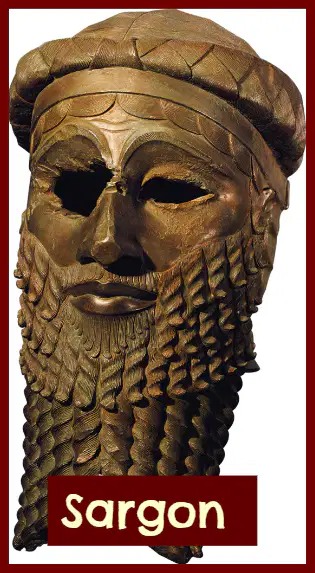
What does the image most likely represent?
A bronze head believed to be Sargon of Akkad
A statue of a Sumerian god
A mask used in religious ceremonies
A modern sculpture of a king
What is a cultural trait?
An idea or way of doing things that is common in a certain culture.
A type of food eaten by a group of people.
A law created by a government.
A type of clothing worn by ancient people.
Which writing system did both the Akkadians and Sumerians use?
Hieroglyphics
Cuneiform
Latin alphabet
Greek script
As Sargon’s troops moved throughout the Fertile Crescent, what did they bring with them?
New crops
Their cultural traits
Wild animals
Weapons from the Indus Valley
Why did the Akkadians trade with people as far away as the Indus Valley?
To spread their religion
Because the Fertile Crescent lacked trees and minerals
To conquer new lands
To find new writing systems
Which of the following was NOT obtained by the Akkadians through trade?
Wood
Copper
Wheat
Lapis lazuli
Explain how trade contributed to the spread of Akkadian and Sumerian culture to other regions.
Trade allowed Akkadian and Sumerian culture to be adopted by other peoples.
Trade made the Akkadians and Sumerians wealthy, so they could build more cities.
Trade caused wars between the Akkadians and Sumerians.
Trade led to the discovery of new crops in the Fertile Crescent.
How did Sargon manage to control the large Akkadian Empire during his rule?
He appointed local rulers to govern different regions.
He ruled every region himself.
He divided the empire into independent countries.
He allowed the people to govern themselves.
What happened to the Akkadian Empire after Sargon’s death in 2279 BCE?
It faced rebellions and invasions and eventually collapsed.
It became stronger and expanded further.
It was immediately taken over by the Egyptians.
It remained peaceful and united for centuries.
Who eventually took control of the region after the fall of the Akkadian Empire?
Warriors from the Zagros Mountains, east of the Tigris River
Merchants from the Indus Valley
Farmers from the Nile River
Sailors from the Mediterranean Sea
Based on the information, what can you infer was a major challenge for large empires like Akkad after the death of a strong leader?
Maintaining control and preventing rebellions and invasions
Finding enough food for the population
Building new cities quickly
Trading with distant lands
Who united Sumer around 2100 BCE and issued the world’s first known law code?
Hammurabi
Sargon
Ur-Nammu
Gilgamesh
How long did Ur prosper under Ur-Nammu and later rulers before being destroyed by rebels?
About 50 years
About 100 years
About 200 years
About 20 years
What event led to the end of Ur’s rule over Sumer?
A drought
An uprising of rebels from the east
A peaceful agreement
A volcanic eruption
What happened after the fall of Ur’s rule over Sumer?
The Akkadian Empire was restored
The Sumerian city-states fought over power
Sumer became a democracy
The Persians took control
What does the carving shown in the image honor?
The building of Ur
The defeat of Sumer
Naram-Sin’s victory over enemies
The creation of the law code
Based on the information provided, why might the world’s first known law code have been important for Ur’s prosperity?
It helped Ur win battles.
It provided a system of rules and order.
It made Ur famous for its art.
It allowed Ur to conquer new lands.
Which group took control of several Sumerian cities, including Babylon, after the destruction of Ur?
The Amorites
The Egyptians
The Persians
The Greeks
What was Babylon like before it became the center of a new Mesopotamian empire?
A small, unimportant city on the Euphrates River
The largest city in Mesopotamia
A powerful military capital
A famous trading port on the Mediterranean Sea

