
 Worksheets
Cell Practice
Total questions: 20
Worksheet time: 10mins
Which statement correctly describes how nutrients move across a cell membrane?
Passive transport moves nutrients from low to high concentration without energy.
Active transport uses energy to move nutrients from low to high concentration.
what happens to a normal cell in a hypertonic solution?
shrinks
swells
Why do a basketball player's leg muscles feel sore after a workout?
More glucose is produced in muscle cells during aerobic respiration.
More lactic acid is produced in muscle cells during anaerobic respiration.
Which statement correctly matches a plant structure with its function?
A plant’s leaves absorb water from the environment that can be used during the process of anaerobic respiration
A plant’s stomata are responsible for allowing gases to exchange between the leaf and the environment during the process of photosynthesis.
How does ATP provide energy to cells?
Bonds are formed by adding adenosine groups, releasing energy.
The bonds between phosphate groups break and release energy.
Which best describes photosynthesis?
Light energy is turned into chemical energy and oxygen is released.
Chemical energy is turned into light energy and carbon dioxide is released.
If the vacuole in a plant cell is damaged, what would most likely happen?
The plant would wilt due to loss of water within the cells.
The plant would be unable to produce proteins.
Which chemical reaction shows aerobic cellular respiration?
oxygen + glucose → water + carbon dioxide + energy
glucose + lactose → oxygen + water
How was the cell theory developed?
Mutations cause changes in cells, so scientists could not create a law for all cells.
The cell theory is a well-tested explanation based on the work of many scientists.
What 3 organelles are unique to a plant cell
cell wall
chloroplast
large central vacuole
nucleus
What do eukaryotic cells have that prokaryotic cells do not?
nucleus with DNA
cell wall
What microscopes contains multiple objective lenses, creates a 2-dimensional image of the specimen being viewed, has a light source located below?
compound light
transmission electron
How are the processes of photosynthesis and cellular respiration related
Photosynthesis removes carbon dioxide from the atmosphere and cellular respiration releases carbon dioxide into the atmosphere.
The products of photosynthesis are carbon dioxide and water; cellular respiration produces oxygen and sugars
What diagram correctly shows photosynthesis?
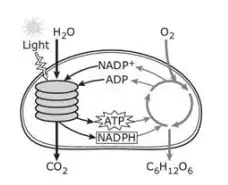
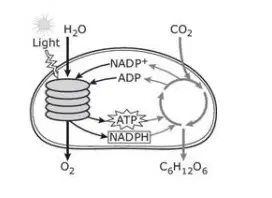
True/False: Cells are the basic building blocks of all living organisms.
t
f
What process uses the products in this reaction (C6H12O6 + 6O2→ 6CO2 + 6H2O) as the reactants?
CR
PS
True False: lysosome – break down waste materials
t
f
What organelle stores genetic info responsible for producing proteins?
nucleus
ER
What would happen to a cell that did not have golgi bodies?
Organelles would not receive the products they need to function and materials that were made within the cell would not be able to leave the cell for use
Proteins would not be able to be made because the ribosomes would not have the instructions they need to produce them.
What is the equation for aerobic cellular respiration
oxygen + glucose → water + carbon dioxide + energy
glucose + lactose → oxygen + water

