
 Worksheets
Causes of the Civil War Quiz
Total questions: 95
Worksheet time: 48mins
What was the primary purpose of establishing the Jamestown Settlement?
To create a religious haven
To establish a military base
To generate wealth for investors
To explore new territories
Who brought a new variety of tobacco to Jamestown in 1617?
John Smith
John Rolfe
James I
William Penn
What significant event occurred in August 1619 at Point Comfort on the James River?
The founding of Jamestown
The first documented arrival of Africans in the colony
The signing of a peace treaty with Native Americans
The discovery of gold
By the end of the 17th century, what was the status of black people in the colony?
Free citizens
Temporary workers
Lifelong, hereditary slaves
Military personnel
In 1662, what law did Virginia adopt regarding slavery?
Slavery was abolished.
Slavery was made hereditary through the father.
Slavery was made hereditary through the mother.
Slavery was only allowed for a limited term.
What was the reasoning behind the 1669 Virginia law regarding the murder of a slave?
Slaves were considered equal to their owners.
Slaves were not considered property.
Owners could not have the intent to sustain a murder charge.
Slaves were given the right to defend themselves.
What roles did enslaved women typically perform in the North?
Farming and mining
Cooking, cleaning, and nursing children
Teaching and writing
Military service
Why did white workers in the North feel threatened by enslaved people?
They feared losing their jobs to unpaid labor.
They believed enslaved people were more skilled.
They wanted to abolish slavery.
They were concerned about safety.
Who was Phillis Wheatley?
A prominent abolitionist
A wealthy merchant
An enslaved poet who wrote in English and Latin
A plantation owner
What was the primary role of enslaved people in the North and South from the 1600s to 1865?
Industrial labor
Cash crop agriculture
Domestic service
Mining
Which crop was the first staple cash crop in the colonies?
Rice
Sugarcane
Tobacco
Cotton
What was the nickname given to rice due to its economic importance in South Carolina and Georgia?
Southern Gold
Carolina Gold
Plantation Gold
Colonial Gold
What method did white planters use to manage water in rice fields?
Drip irrigation
Sprinkler systems
Sophisticated irrigation systems with gates
Manual watering
In which region did women constitute a majority of the labor force in rice cultivation?
Northern colonies
Low Country of South Carolina and Georgia
Western territories
New England
What crop outpaced all other crops by the 1790s in America?
Tobacco
Indigo
Cotton
Wheat
Who invented the improved cotton gin in 1793?
Thomas Jefferson
Eli Whitney
Andrew Jackson
George Washington
What was one of the main reasons for westward expansion in the early 1800s?
The Gold Rush
The Louisiana Purchase
The Industrial Revolution
The Trail of Tears
By 1840, what percentage of the world's cotton was grown in the South?
30%
50%
60%
70%
What role did slavery play in the economic development of the pre-Civil War United States?
It was insignificant
It provided over half of all US export earnings
It was only important in the North
It was limited to small farms
Why did many African Americans place a high value on literacy during the time of slavery?
To write letters to their families
To read the Bible and access its lessons
To learn new languages
To become teachers
What was one method enslaved people used to learn to read?
Attending public schools
Using Noah Webster’s Blue Back Speller
Watching educational programs
Listening to radio broadcasts
How did some slave owners interpret the Bible to justify slavery?
By claiming it supported equality
By stating it condemned slavery
By arguing it supported the enslavement of Africans
By suggesting it promoted freedom for all
What fear did some slave owners have regarding enslaved people's literacy?
It would lead to economic prosperity
It would undermine their authority
It would cause health issues
It would increase agricultural productivity
How did some enslaved African Americans interpret the story of Moses in the Bible?
As a call to remain obedient
As a prophecy of their liberation
As a lesson in patience
As a warning against rebellion
Who was the first African American to sit on the Supreme Court and commented on the Constitution being "defective from the start"?
Thurgood Marshall
Martin Luther King Jr.
Frederick Douglass
Malcolm X
What was the purpose of the three-fifths clause in the Constitution?
To grant full voting rights to slaves
To count three-fifths of the slave population for representation
To abolish slavery
To provide education for slaves
Which states were mentioned as potentially refusing to join the Union if the Constitution restricted the slave trade?
Virginia and Maryland
South Carolina and Georgia
New York and Pennsylvania
Texas and Florida
What was the stance of Luther Martin regarding the slave trade?
He supported the continuation of the slave trade
He believed it should be subject to federal regulation
He wanted to abolish the slave trade immediately
He had no opinion on the matter
What was John Rutledge's stance on the regulation of the slave trade?
He believed it should be regulated by the federal government.
He insisted it should be left to the states.
He thought it should be abolished immediately.
He wanted it to be regulated by international law.
What did George Mason believe about the impact of slavery on society?
It encouraged arts and manufactures.
It brought prosperity to the nation.
It discouraged arts and manufactures and corrupted slaveholders.
It was beneficial for economic growth.
How did Oliver Ellsworth view the economic impact of ending the slave trade?
It would decrease the price of slaves.
It would benefit slaveholders in the Chesapeake region.
It would have no impact on the economy.
It would lead to economic collapse.
What was the outcome of the controversy over the Atlantic slave trade?
It was resolved by abolishing the slave trade.
It was settled by compromise with a 20-year ban on restrictions.
It led to a civil war.
It resulted in the immediate end of slavery.
What type of resistance did slaves often engage in according to historians?
Violent uprisings and revolts.
Day-to-day resistance involving 'crimes' against property.
Peaceful protests and negotiations.
Legal battles in court.
What was the main goal of the abolitionist movement in the United States?
To promote industrialization
To end the practice of slavery
To expand territorial boundaries
To establish a new political party
Which religious movement inspired abolitionists to rise up against slavery?
The First Great Awakening
The Protestant Reformation
The Second Great Awakening
The Enlightenment
Who was William Lloyd Garrison?
A famous Civil War general
A leader of the women's suffrage movement
An influential early abolitionist
A prominent industrialist
What publication did William Lloyd Garrison start to support the abolitionist movement?
The Emancipator
The Liberator
The Freedom Journal
The North Star
In which states did abolitionism start before spreading to other Northern states?
Virginia and Maryland
New York and Massachusetts
Georgia and Alabama
Ohio and Pennsylvania
Who was Frederick Douglass and what was he known for?
An author of Uncle Tom's Cabin
A radical abolitionist who organized raids
An escaped slave who published a memoir
A women's rights advocate
What was Harriet Beecher Stowe best known for?
Organizing the Underground Railroad
Writing Uncle Tom's Cabin
Leading slave revolts
Giving the speech "Ain't I a Woman?"
What significant event did John Brown organize?
The Stono Rebellion
The Underground Railroad
A raid on Harpers Ferry
The publication of a memoir
What was Harriet Tubman known for?
Writing a famous novel
Leading the Stono Rebellion
Helping enslaved people escape
Organizing women's suffrage
What was Sojourner Truth best known for?
Writing a memoir
Her speech "Ain't I a Woman?"
Organizing slave revolts
Leading the Underground Railroad
What was the Stono Rebellion?
A famous speech by Sojourner Truth
The largest slave revolt in the 13 colonies
A novel written by Harriet Beecher Stowe
A raid organized by John Brown
What was the native Kikongo word used by slaves to express "Liberty" during their uprising against the English?
Lukango
Umoja
Uhuru
Amani
In what year did Nat Turner's Rebellion take place?
1831
1820
1800
1850
How many states were in the Union at the time of the Missouri Compromise?
22
23
11
50
What was the outcome for Nat Turner after he was captured?
He was sentenced to hang.
He was pardoned.
He escaped to Canada.
He was imprisoned for life.
What was the population of Missouri at the time of its request to be admitted as a new slave state?
56,000 free men and women and 10,000 slaves
100,000 free men and women and 5,000 slaves
30,000 free men and women and 20,000 slaves
70,000 free men and women and 15,000 slaves
What was identified as the root cause of the dispute over tariffs according to Calhoun?
Economic policies
The institution of slavery
Political power struggles
Trade imbalances
What action did South Carolina take in response to the federal tariffs?
Accepted the tariffs
Ignored the tariffs
Repealed its nullification ordinance
Increased tariffs
How did President Andrew Jackson respond to South Carolina's challenge regarding the tariffs?
He ignored the challenge
He reinforced the federal fort in Charleston harbor
He reduced the tariffs immediately
He supported South Carolina's stance
What was one of the consequences of the collapse of nullification?
Decrease in southern population
Increase in new slave states
Immediate abolition of slavery
Economic prosperity in the North
How did the North and South differ in their relationship with slavery according to Ira Berlin?
Both were equally dependent on slavery
The North was a society with slaves, the South was a slave society
The South had no slaves, the North had many
Both regions had abolished slavery
What was the main reason Southerners attributed to the backwardness of their region compared to the North?
The lack of industrialization
The large profits amassed by Northern businessmen
The peculiar institution of slavery
The absence of educational institutions
Which U.S. President oversaw the greatest territorial expansion of the United States to date?
Thomas Jefferson
James K. Polk
Andrew Jackson
Abraham Lincoln
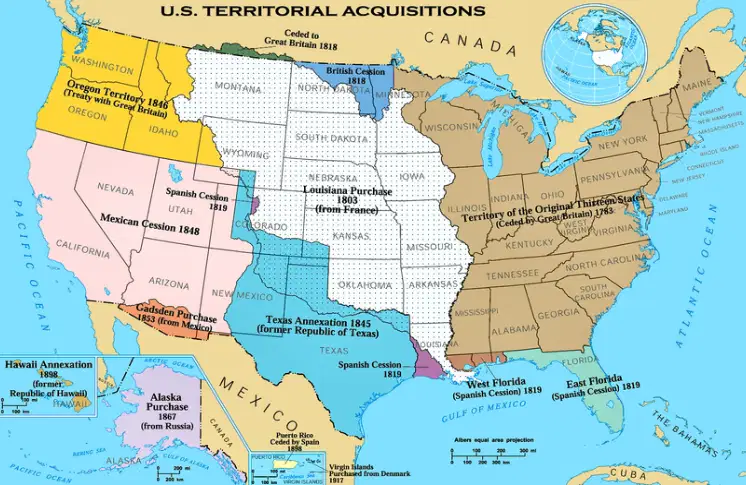
What significant event ended with the signing and ratification of the Treaty of Guadalupe-Hidalgo in 1848?
The American Civil War
The Mexican-American War
The War of 1812
The Spanish-American War
Which states were brought under the control of the United States following the events described in the text?
Texas, California, Nevada, New Mexico, Arizona, Utah, Washington, Oregon
Florida, Georgia, Alabama, Mississippi, Louisiana
New York, New Jersey, Pennsylvania, Delaware
Illinois, Indiana, Ohio, Michigan
Who was the U.S. President that managed to get Texas admitted into the United States?
Martin van Buren
John Tyler
James K. Polk
Zachary Taylor
What was the main reason for tension between the United States and Mexico after Texas' independence?
Disputed border with Texas
Trade disagreements
Cultural differences
Language barriers
What was the outcome of the Treaty of Guadalupe-Hidalgo?
Mexico retained all its territories
The United States ceded land to Mexico
Mexico ceded approximately 525,000 square miles to the United States
The United States paid $30 million to Mexico
What was the role of Nicholas Trist in the negotiations with Mexico?
Military commander
Chief clerk of the Department of State and peace emissary
President of the United States
Mexican ambassador
What was the outcome of the treaty submitted to the Senate on March 10, 1848?
It was rejected by a large margin.
It passed by a margin of 38 to 14.
It was passed unanimously.
It was postponed indefinitely.
What did the Wilmot Proviso stipulate regarding territories acquired from Mexico?
Slavery would be allowed in all new territories.
Neither slavery nor involuntary servitude shall ever exist in any territory acquired.
Only involuntary servitude would be allowed.
Slavery would be decided by popular vote in each territory.
By 1840, which states allowed blacks to vote on an equal basis with whites?
New York, Pennsylvania, Ohio
Maine, New Hampshire, Vermont, Massachusetts, Rhode Island
Virginia, North Carolina, South Carolina
California, Texas, Florida
What was a major concern for Northerners regarding the expansion of slavery?
It would lead to economic prosperity for all.
It would increase proslavery votes in Congress and the national government.
It would decrease the value of their land.
It would lead to a decrease in agricultural production.
Who was the Whig Party nominee in the presidential election of 1848?
Lewis Cass
Martin Van Buren
Zachary Taylor
Millard Fillmore
Which party did Martin Van Buren represent in the 1848 election?
Whig
Democratic
Free Soil
Republican
What was the main issue addressed by the Free Soil Party in the 1848 election?
Taxation
Slavery
Immigration
Trade
Which state was Zachary Taylor's home state during the 1848 election?
Michigan
New York
Louisiana
Virginia
Who became president after Taylor died in July of 1850?
Henry Clay
Millard Fillmore
Stephen A. Douglas
James Buchanan
What was the main purpose of the Compromise of 1850?
To expand the United States' territory
To resolve the issue of slavery and avoid civil war
To establish new trade agreements with Mexico
To create a new constitution for the United States
Which state was added to the Union as a "free state" under the Compromise of 1850?
Texas
Utah
California
New Mexico
What did the Fugitive Slave Act of 1850 require citizens to do?
Assist in the capture of runaway slaves
Provide slaves with a jury trial
Abolish slavery in all states
Support the antislavery movement
Who was known as "The Great Compromiser" for his work on the Missouri Compromise?
Millard Fillmore
Stephen A. Douglas
Henry Clay
John C. Calhoun
What was the main purpose of the Kansas-Nebraska Act introduced by Senator Stephen Douglas in 1854?
To abolish slavery in all territories
To divide the land into two territories, Kansas and Nebraska
To enforce the Missouri Compromise
To establish a national railroad system
Why were anti-slavery supporters outraged by the Kansas-Nebraska Act?
It allowed slavery in all states
It repealed the Missouri Compromise
It banned slavery in the South
It enforced the Fugitive Slave Act
What nickname was given to the conflict in Kansas following the Kansas-Nebraska Act?
The Kansas Conflict
Bleeding Kansas
The Kansas War
The Kansas Crisis
What was the result of the popular sovereignty provision of the Kansas-Nebraska Act by early 1855?
Peaceful elections in Kansas
Armed Missourians fraudulently carried elections
Immediate abolition of slavery
Establishment of a new national government
What event in Washington magnified the national impact of the Kansas-Nebraska Act in 1856?
The signing of the Missouri Compromise
The election of a new president
The assault on Senator Charles Sumner
The start of the Civil War
What was the main consequence of the Kansas-Nebraska Act according to the text?
It led to the immediate abolition of slavery.
It caused the United States to move closer to civil war.
It resulted in the peaceful resolution of sectional conflicts.
It strengthened the Missouri Compromise.
Which political party was formed in opposition to the spread of slavery into the territories as a result of the Kansas-Nebraska Act?
The Democratic Party
The Whig Party
The Republican Party
The Free-Soil Party
What was the significance of the Dred Scott Court Decision in 1857?
It upheld the Missouri Compromise.
It declared that slaves were not citizens and had no legal rights.
It granted freedom to all slaves in the Northern states.
It supported the abolitionist movement.
Who was the Chief Justice during the Dred Scott Court Decision?
John Marshall
Roger Taney
Earl Warren
William Rehnquist
What was the main conclusion of the Supreme Court's decision read by Taney on March 6, 1857?
Blacks were considered citizens under the Constitution.
The Missouri Compromise was constitutional.
Blacks had no rights which the white man was bound to respect.
The Declaration of Independence applied to all races.
What was Justice Benjamin Curtis's main argument in his dissent against Taney's decision?
He believed Taney's decision was in line with the Constitution.
He argued that the Constitution was made exclusively for the white race.
He believed that Taney used the Court to advance a political agenda.
He supported the Fugitive Slave Act on constitutional grounds.
How did Curtis view the Constitution in terms of black citizenship?
He believed it provided full political equality for blacks.
He saw it as providing for the possibility of black citizenship.
He thought it excluded blacks entirely from citizenship.
He believed it was made exclusively for the white race.
What was the impact of the Court's decision in Scott v. Sandford on the political climate in the United States?
It resolved tensions between the North and South.
It contributed to the run-up to the Civil War.
It strengthened the Missouri Compromise.
It was widely accepted without dissent.
What was the main issue highlighted in the Lincoln-Douglas Debates of 1858?
Economic policies
Slavery versus free labor
Foreign relations
Women's suffrage
Who was the front runner for the Democratic presidential nomination in 1860?
Abraham Lincoln
Frederick Douglass
Stephen A. Douglas
John C. Calhoun
What did Lincoln predict about the Union in his famous speech?
It would become a monarchy
It would remain united
It would cease to be divided
It would become a dictatorship
What was Justice McLean's stance on slavery in the Dred Scott case?
He supported it as a state institution
He opposed it
He was neutral
He supported it as a federal institution
What was the main focus of the debates between Lincoln and Douglas?
Economic policies
Slavery and its influence on American politics
Foreign relations
Technological advancements
How did Lincoln view the fundamental rights of slaves?
Right to vote
Right to own property
Right to life, liberty, and the pursuit of happiness
Right to education
What was Douglas's belief regarding the status of African Americans?
They should be equal citizens
They were inferior and should not be citizens
They should have voting rights
They should be educated

