
 Worksheets
Test on Solar System
Total questions: 25
Worksheet time: 13mins
Name
Class
Date
1.

Which statement is NOT part of Kepler's Laws on Planetary Motion?
a)
Planets move through orbits faster in some places than in others.
b)
Planets that are far from the sun take longer to orbit the sun.
c)
Orbits are counter-clockwise and elliptical.
d)
The motion of a planet around the sun is the result of gravity and inertia.
2.

What are Jovian planets formed far from the sun?
a)
Less affected by the sun, gases stayed and planets grew large
b)
Became so hot from sun that gases mostly boiled away, leaving rock
c)
Inner planets were formed by the collision of hydrogen nuclei to form helium
d)
Outer planets were formed by the collision of metals and other debris
3.
A lunar eclipse occurs when the Earth passes between the Moon and the Sun, however a solar eclipse occurs when —
a)
the Moon passes between the Earth and the Sun
b)
the Sun passes between the Earth and the Moon
c)
the Earth passes between the Moon and the stars
d)
the Moon passes between the stars and the Earth
4.
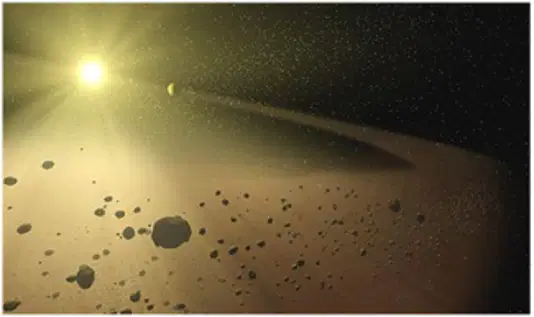
Which of the following CORRECTLY describes the Solar Nebular Theory?
a)
The solar system was formed from a disk of dust and gas orbiting a newly formed star.
b)
The solar system is made of planets that move through orbits faster in some places than in others
c)
The solar system was formed from the gases released by a dying star.
d)
The solar system was formed by the collision of metals and other dense materials in space.
5.
Which of the following caused gases and debris to condense?
a)
gravity
b)
orbit
c)
nuclear fusion
d)
inertia
6.
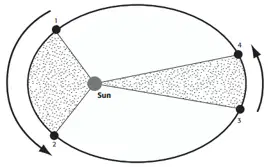
Which TWO factors resulted to the formation of planetary orbits?
a)
gravity and inertia
b)
nuclear fusion and fission
c)
revolution and rotation
d)
eccentricity and elliptical
7.
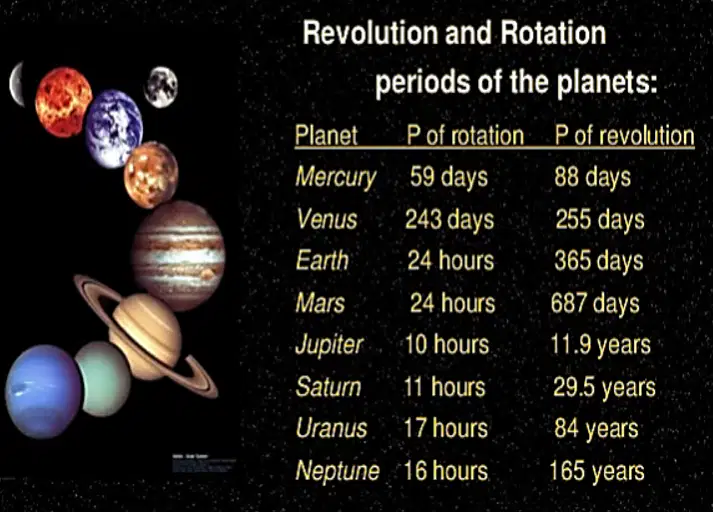
Which statement correctly describes revolution?
a)
the length of time it takes for a planet to complete its orbit
b)
the length of time it takes for a planet to complete a turn on its axis
c)
the length of time it takes for light from the sun to reach the earth
d)
the length of time it takes for the sun to continually undergo nuclear fusion
8.
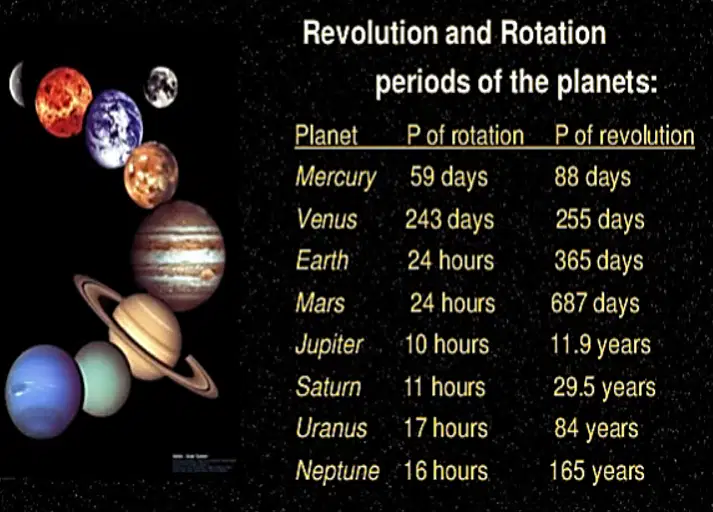
Which statement is TRUE about the data table provided below?
a)
Planets move through orbits faster in some places than in others.
b)
Planets that are far from the sun take longer to orbit the sun.
c)
Orbits are counter-clockwise and elliptical.
d)
The motion of a planet around the sun is the result of gravity and inertia.
9.
What causes this cycle of the Earth's changing seasons?
a)
Earth's tilt as it revolves around the Sun
b)
Moon revolving around the Earth
c)
Earth spinning on its axis every 24 hours
d)
Planets revolving around the Sun
10.
A lunar eclipse occurs when the Earth passes between the Moon and the Sun, however a solar eclipse occurs when —
a)
the Moon passes between the Earth and the Sun
b)
the Sun passes between the Earth and the Moon
c)
the Earth passes between the Moon and the stars
d)
the Moon passes between the stars and the Earth
11.
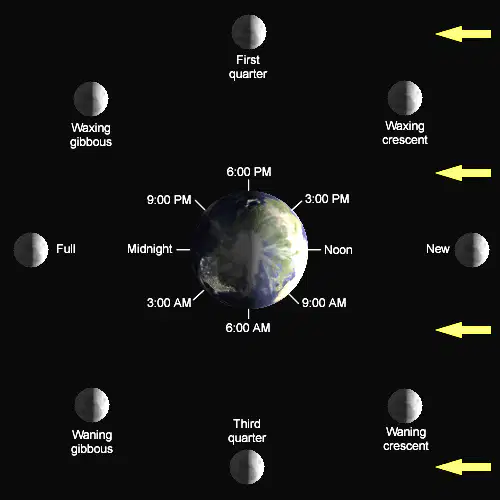
Study the images of the phases of the moon. Which of the following statements explains the pattern seen in the phases of the moon?
a)
The visible part of the moon that is seen each night grows larger when it is waning.
b)
The visible part of the moon that is seen each night grows smaller after the new moon and larger after the full moon.
c)
The visible part of the moon that is seen each night grows smaller when it is waxing.
d)
The visible part of the moon that is seen each night grows larger after the new moon and smaller after the full moon.
12.
Which statements explain why planets closer to the Sun are terrestrial rather than gaseous in nature?
a)
Frequent collisions prevented the planets from growing large.
b)
Nebular gasses could not accumulate and condense in the close proximity of the Sun due to its low temperature.
c)
There was insufficient gravity around the inner planets to capture gases such as hydrogen and helium.
d)
Only heavy elements with high densities and melting points could condense under gravity to form terrestrial planets.
13.
The gravity of Earth is six times greater than that of the Moon. Based on the difference in gravity, which statement is true about the mass and weight of an object?
a)
The mass and weight of an object will be the same on the Moon.
b)
The mass of an object will be the same on Earth and on the Moon.
c)
The weight of an object will be less on Earth than on the Moon.
d)
The weight of an object will be the same on the Moon than on Earth.
14.
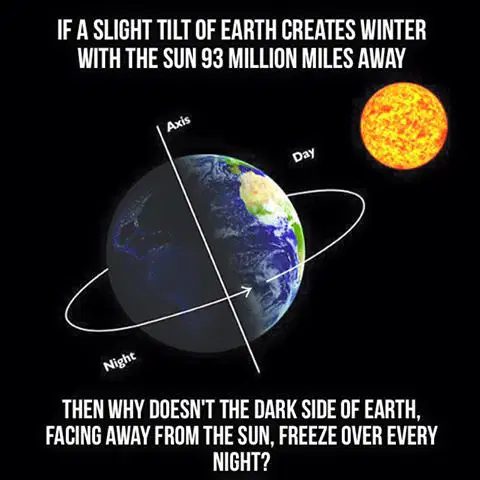
What is caused primarily by the tilt of the Earth’s axis?
a)
Magnetic poles
b)
Tides
c)
Seasons
d)
Oceanic currents
15.
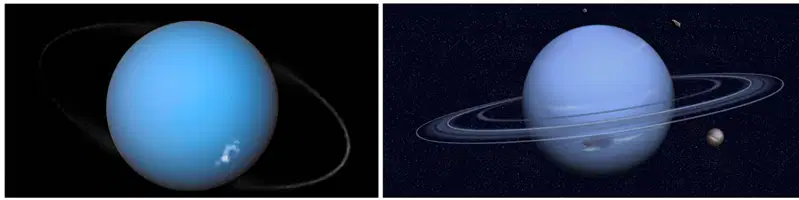
Which statement is TRUE about the rings of Uranus and Neptune?
a)
Rings mainly made of dust
b)
Rings are made up of icy particles
c)
Rings contain carbon-containing compounds
d)
Rings are made of thick clouds with water and ice
16.

The image shows the position of the Sun, the Moon, and the Earth during new moon and full moon phases.
Which statements about the relative positions of the Sun, the Moon, and the Earth during these phases are correct?
a)
During a full moon, Earth is between the Moon and the Sun.
b)
During a full moon and a new moon, Earth, the Moon, and the Sun don’t lie on the same line.
c)
During a new moon, Earth is at a lower position than the Moon and the Sun.
d)
During a new moon, the Moon is at a higher position than Earth and the Sun.
17.
The gravity of Earth is six times greater than that of the Moon. Based on the difference in gravity, which statement is true about the mass and weight of an object?
a)
The mass and weight of an object will be the same on the Moon.
b)
The mass of an object will be the same on Earth and on the Moon.
c)
The weight of an object will be less on Earth than on the Moon.
d)
The weight of an object will be the same on the Moon than on Earth.
18.
A friend sees a “half moon” in the sky and says it must be halfway through the moon’s cycle. Which explanation best describes why scientists actually call it a quarter moon?
a)
Because the moon looks only one-quarter as bright as the full moon
b)
Because the moon has completed one-quarter of its orbit around Earth
c)
Because one-quarter of the moon’s surface is visible from Earth
d)
Because it takes a quarter of the night for the moon to rise
19.
Why do people see the moon in different shapes throughout the month?
a)
the Moon changes its shape
b)
the Moon is a flat surface
c)
the Moon revolves around the Earth
d)
the Moon is sometimes behind clouds
20.
What causes day and night on Earth?
a)
the revolution of the Earth around the Sun
b)
the tilt of the Earth’s axis
c)
the rotation of the Earth on its axis
d)
the tides
21.
Which statement is true about the planets?
a)
The four outer gas planets are larger in size compared to the four inner terrestrial planets.
b)
All of the planets revolve around the sun at the same speed.
c)
Each planet is an equal distance from one another.
d)
Starting with planet number nine, each planet decreases in size going towards the sun.
22.
Terrestrial planets are Earth-like planets. They have a solid surface and a core made of rocks and metals. Which statement is true for the terrestrial planets?
a)
They revolve around the Sun.
b)
They are farther to the Sun than the gas planets.
c)
There are three terrestrial planets.
d)
They are believed to have formed from the solar nebula.
23.
What is the correct order of the planets starting with the planet closest to the sun?
a)
Mars, Uranus, Earth, Neptune, Saturn, Jupiter, Mercury, Venus
b)
Neptune, Uranus, Saturn, Jupiter, Mars, Earth, Venus, Mercury
c)
Mercury, Venus, Earth, Mars, Jupiter, Saturn, Uranus, Neptune
d)
Mercury, Saturn, Earth, Jupiter, Venus, Neptune, Mars, Uranus
24.
What are the two factors that Sir Isaac Newton identified as influencing a planet’s motion around the Sun?
a)
Inertia and velocity
b)
Gravity and speed
c)
Inertia and gravity
d)
Mass and distance
25.
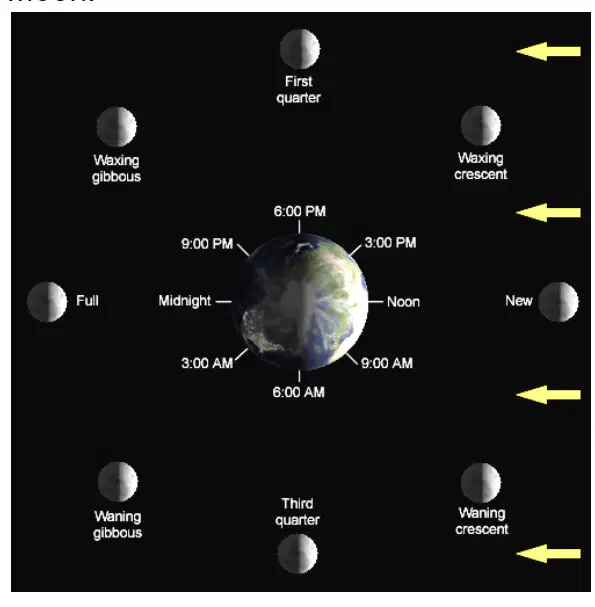
A teacher shows her students a picture of the different phases of the Moon.
How does this information help the students better understand the phenomenon of moon phases?
a)
Demonstrates revolution of the Moon around the Sun
b)
Different portions of the Moon are seen in each phase
c)
Shows surface composition of the Moon
d)
The amount of light reflected by the Moon does not change
100 %

