
NEW
Font size
 Worksheets
Law of Conservation of Mass
Total questions: 52
Worksheet time: 26mins
What does the Law of Conservation of Mass state?
Matter can be created but not destroyed.
Matter cannot be created or destroyed.
Matter can be destroyed but not created.
Matter can be created and destroyed.
Which of the following is an example that demonstrates the Law of Conservation of Mass?
Water boiling and turning into steam, but the total mass remains the same.
Burning paper and the mass disappears completely.
Melting ice and the mass increases.
Freezing water and the mass decreases.
Why is the Law of Conservation of Mass important in science?
It explains why energy is always lost.
It helps scientists understand that matter is always conserved in physical and chemical changes.
It shows that matter can disappear.
It proves that mass can be created from nothing.
Which of the following statements best describes the law of conservation of mass?
Mass is always lost during chemical changes.
Mass is always gained during physical changes.
Mass is always conserved in physical and chemical changes.
Mass can be created during chemical reactions.
Why does the total mass of substances remain the same before and after a physical or chemical change?
Because matter can be created or destroyed.
Because matter only gets rearranged or reshaped.
Because mass disappears during changes.
Because new matter is formed.
A student burns a piece of wood in a closed container. According to the law of conservation of mass, what should happen to the total mass inside the container after the wood is burned?
The total mass will increase.
The total mass will decrease.
The total mass will remain the same.
The total mass will double.

What does the balance scale in the image represent in the context of physical and chemical changes?
The creation of new mass.
The destruction of mass.
The conservation of mass.
The measurement of temperature.

What happens during the process of melting?
A liquid turns into a solid by removing heat.
A solid turns into a liquid by adding heat.
A gas turns into a liquid by adding heat.
A liquid turns into a gas by removing heat.

If you have 10 grams of ice and it melts completely, how much water will you have?
5 grams
8 grams
10 grams
12 grams

Which statement best describes the process of freezing?
Adding heat to turn a solid into a liquid.
Removing heat to turn a liquid into a solid.
Adding heat to turn a liquid into a gas.
Removing heat to turn a gas into a liquid.
Why does the mass of ice remain the same as the mass of water after melting?
Because melting creates new matter.
Because the process of melting does not change the amount of matter.
Because water is lighter than ice.
Because some mass is lost as heat.

What is evaporation?
When heat turns liquid water into steam gas or water vapour.
When steam cools and changes back into liquid water.
When water freezes into ice.
When water is filtered to remove impurities.
What is condensation?
When heat turns liquid water into steam gas or water vapour.
When steam cools and changes back into liquid water.
When water is mixed with another liquid.
When water is absorbed by a sponge.
If you start with 10 grams of water and it all evaporates, how much steam will you have?
5 grams
20 grams
10 grams
0 grams
Why is the mass of water the same as the mass of steam after boiling?
Because water disappears during boiling.
Because mass is lost as heat.
Because the process only changes the state, not the amount of matter.
Because steam is heavier than water.
Explain how condensation is the reverse of evaporation.
Condensation turns water into steam, while evaporation turns steam into water.
Condensation and evaporation are the same process.
Condensation turns steam back into liquid water, while evaporation turns liquid water into steam.
Condensation freezes water, while evaporation melts ice.
A kettle boils 15 grams of water into steam. After cooling, how much liquid water would you expect to collect from the steam?
10 grams
20 grams
15 grams
5 grams

What is dissolving?
When a solid mixes with a liquid to form a solution.
When a liquid turns into a gas.
When a solid turns into a gas.
When a liquid freezes into a solid.

Which of the following is an example of dissolving?
Salt added to water to form a saltwater solution.
Ice melting into water.
Water boiling into steam.
Oil floating on water.
How can the process of dissolving be reversed?
By evaporating the liquid, leaving the solid behind.
By freezing the solution.
By shaking the solution.
By adding more liquid.
If you mix 10 grams of salt with 90 grams of water, what will be the mass of the saltwater solution produced?
100 grams
90 grams
10 grams
80 grams
Why does the combined mass of salt and water equal the mass of the saltwater solution produced?
Because mass is conserved during dissolving.
Because the salt disappears completely.
Because water evaporates.
Because the salt turns into a gas.
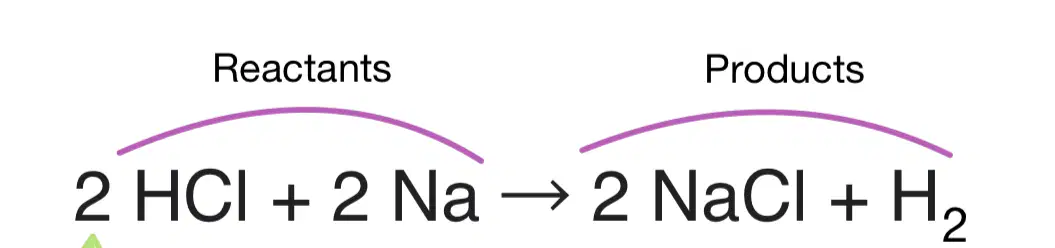
What is the term for a statement that combines chemical formulas to show which substances react and which substances are formed in a chemical reaction?
Chemical equation
Physical change
Atomic number
Solution
In a chemical reaction, what do we call the substances that exist before the reaction begins?
Products
Reactants
Catalysts
Solvents
Which of the following best describes "products" in a chemical reaction?
Substances that exist before the reaction begins
Substances that form as a result of the reaction
Substances that speed up the reaction
Substances that dissolve in water
If you are given a chemical equation, how can you identify the reactants and products?
Reactants are always on the right side of the arrow, products on the left
Reactants are always listed after the word "yield"
Reactants are on the left side of the arrow, products are on the right side
Reactants and products are always mixed together
What symbol is used to separate more than one reactant or product in a chemical equation?
Minus sign (-)
Multiplication sign (×)
Plus sign (+)
Division sign (÷)
In the chemical equation 2H₂ + O₂ → 2H₂O, what does the plus sign (+) indicate?
The substances are being subtracted
The substances are being multiplied
There is more than one reactant
The reaction is reversible
Why is a plus sign used in a chemical equation?
To show the direction of the reaction
To separate different reactants or products
To indicate the reaction is complete
To balance the equation
What are reactants in a chemical equation?
The starting materials on the left side of the equation
The new substances formed on the right side of the equation
The arrow that shows the direction of change
The products of the reaction
What does the yield sign (arrow) in a chemical equation represent?
The end of the reaction
The direction of the change, meaning "yields" or "produces"
The starting materials
The balance of the equation
What are products in a chemical reaction?
The substances you start with
The substances formed as a result of the reaction
The symbols used in the equation
The reactants on the left side
Why must a chemical equation be balanced?
To make the equation look neat
To meet the law of conservation of mass
To show the direction of the reaction
To identify the reactants
Given the equation NaOH + HCl → NaCl + H₂O, which of the following are the products?
NaOH and HCl
NaCl and H₂O
Na and Cl
H₂ and O₂
According to the Law of Conservation of Mass, what happens to matter during a chemical reaction?
Matter cannot be created or destroyed.
Matter can be created but not destroyed.
Matter can be destroyed but not created.
Matter always disappears.
What must be true about the number of atoms of each element before and after a chemical reaction?
The number must stay the same.
The number must double.
The number must decrease.
The number must be random.
When combining hydrogen and oxygen to make water, what must be true about the number of hydrogen and oxygen atoms before and after the reaction?
The number of H's and O's must be the same before and after.
The number of H's must increase and O's must decrease.
The number of H's and O's must be different before and after.
The number of H's must decrease and O's must increase.
Why is it important to start and end a chemical reaction with the same elements?
To follow the Law of Conservation of Mass.
To create new elements.
To destroy old elements.
To change the mass of the system.

What is wrong with the chemical equation as it is written: H₂ + O₂ → H₂O?
The equation is not balanced.
The equation uses the wrong chemical symbols.
The equation is missing a product.
The equation is written backwards.
Why is it important to balance chemical equations like H₂ + O₂ → H₂O?
To make sure the number of atoms of each element is the same on both sides.
To make the equation look more complicated.
To change the substances involved in the reaction.
To increase the number of products formed.
What does the law of conservation of mass state when applied to chemical equations?
Mass is created during a chemical reaction.
Mass is destroyed during a chemical reaction.
Mass is neither created nor destroyed in a chemical reaction.
Mass doubles during a chemical reaction.
Which of the following best describes a balanced chemical equation?
The number of atoms of each element is the same on both sides of the equation.
The number of molecules is always equal on both sides.
The equation contains only one reactant and one product.
The equation has more products than reactants.
What is the balanced chemical equation shown in the image?
N₂ + 3F₂ → 2NF₃
N₂ + F₂ → 2NF₃
2N₂ + 3F₂ → 2NF₃
N₂ + 2F₂ → 2NF₃
Which of the following is a product in the chemical reaction: MgF₂ + Li₂CO₃ → MgCO₃ + 2LiF?
MgF₂
Li₂CO₃
MgCO₃
F₂
How many molecules of LiF are produced in the reaction: MgF₂ + Li₂CO₃ → MgCO₃ + 2LiF?
1
2
3
4
Which of the following is a product in the reaction: RbNO₃ + BeF₂ → Be(NO₃)₂ + 2RbF?
RbNO₃
BeF₂
Be(NO₃)₂
O₂
How many rubidium fluoride (RbF) molecules are produced in the reaction: RbNO₃ + BeF₂ → Be(NO₃)₂ + 2RbF?
1
2
3
4
Which of the following is a product in the chemical reaction: 2HCN + CuSO₄ → H₂SO₄ + Cu(CN)₂?
HCN
CuSO₄
H₂SO₄
H₂O
How many molecules of HCN are required to react with one molecule of CuSO₄ according to the equation: 2HCN + CuSO₄ → H₂SO₄ + Cu(CN)₂?
1
2
3
4
Which compound contains copper in the products of the reaction: 2HCN + CuSO₄ → H₂SO₄ + Cu(CN)₂?
H₂SO₄
CuSO₄
Cu(CN)₂
HCN

Which of the following is a product in the chemical reaction shown in the image?
Na₃PO₄
CaCl₂
NaCl
PO₄

How many molecules of CaCl₂ are required to react with 2 molecules of Na₃PO₄ according to the equation?
2
4
6
3

