
 Worksheets
Y8- Topic 3& 4 EOY practice
Total questions: 70
Worksheet time: 46mins
What is urbanisation?
The movement of people from urban to rural areas
The growth and expansion of urban areas and the increase in the proportion of people living in urban areas
The decline of urban areas and the increase in rural populations
The development of agricultural land in rural areas
Which of the following is a push factor for migration from rural to urban areas?
Job opportunities
Better housing
Lack of medical services
Improved education
Which of the following is a pull factor for migration to urban areas?
War
Famine
Job opportunities
Natural disasters
Which city is mentioned as being reliant on foreign workers?
London
New York
Dubai
Sydney
Which of the following is a disadvantage of urbanisation?
Increased job opportunities
Improved healthcare
Higher cost of living
Better education facilities
Internal migration is defined as:
The movement of people from one region in Australia to another
How people commute to work each day
The buying and selling of houses within Australia
An 'urban area' refers to:

The graphs shows the top 10 megacities, which cities have population below 25 000?
Cairo, Beijing, Karachi, Mexico city
Cairo, Karachi, Mexico city, Lagos
Manila, Beijing, Mexico city
Delhi, Beijing, Karachi, Cairo

Which statement is NOT TRUE about the diagram?
The fastest growing city is in Tanzania.
London has the highest urban population.
There are more cities in Asia.
The city that has the highest population is Hyderabad.

Name a country that has the highest amount of deaths due to air pollution.
Madagascar
Turkey
Indonesia
China
What is Erosion?
Movement of rocks from one place to another
The dropping off of rocks
The wearing away of rocks
The picking up of rocks
What is Transportation?
Movement of rocks from one place to another
The dropping off of rocks
The wearing away of rocks
The picking up of rocks
What is Deposition?
Movement of rocks from one place to another
The dropping off of rocks
The wearing away of rocks
The picking up of rocks
What causes Erosion?
Sea
Ice
Rivers
Humans
Sun
How does the Sea cause Erosion?
Wears away valleys at the bottom and the sides of it
Coastlines are under constant attack by waves
Wears away bits of rock from its bed and the bank on either side of the channel
Bulldozers or Lorries move large amounts of soil or loose rock, remove trees and vegetation which allows water, wind and ice to erode the land more easily
Picks up tiny particles of sand and blast them against anything
How do Humans cause Erosion?
Wears away valleys at the bottom and the sides of it
Coastlines are under constant attack by waves
Wears away bits of rock from its bed and the bank on either side of the channel
Bulldozers or Lorries move large amounts of soil or loose rock, remove trees and vegetation which allows water, wind and ice to erode the land more easily
Picks up tiny particles of sand and blast them against anything
How does the Ice cause Erosion?
Wears away valleys at the bottom and the sides of it
Coastlines are under constant attack by waves
Wears away bits of rock from its bed and the bank on either side of the channel
Bulldozers or Lorries move large amounts of soil or loose rock, remove trees and vegetation which allows water, wind and ice to erode the land more easily
Picks up tiny particles of sand and blast them against anything
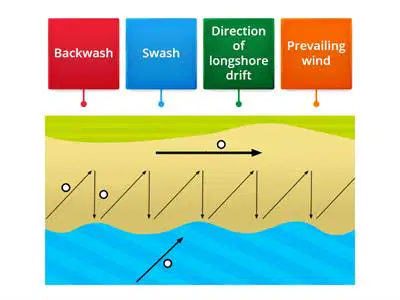
What does the Top, Boldest Arrow mean?
Direction of Longshore Drift
Prevailing Wind
Swash
Backwash
What does the Bottom, 2nd Boldest Arrow mean?
Direction of Longshore Drift
Prevailing Wind
Swash
Backwash
What does the Middle, facing Downwards Arrow mean?
Direction of Longshore Drift
Prevailing Wind
Swash
Backwash
What does the Middle, facing the Top Right Corner Arrow mean?
Direction of Longshore Drift
Prevailing Wind
Swash
Backwash
How are Erosion Landforms formed?
They are made because of Tornadoes
They are made because of Volcanoes
They are made because of the Wearing away of the Coast
They are made because of the Movement of Plates
Population density is defined as...
The amount of people living in a geographical location
The spatial distribution of people
The number of people living within one square kilometre of land
Amount of brain cells in an ant
Population distribution is defined as...
Cost of living in an urban area
The pattern of where people live
A high density region of a city
A social factor in a rural area
Define a megacity...
A city with a population over 10 million
Has a cultural significance
Is a capital city
Located in Asia
A push factor is defined as...
Something that attracts people to an area
A type of dance move
Something that drives people out of an area
Someone that pushes people away
A negative environmental impact of a big city is...
Funding for environmental projects
Energy efficiency
Landscaping
Pollution

This graph shows...
Urbanisation decreasing
A straight and dotted line intersecting
People living in urban areas increasing
People in rural areas increasing

A social impact if the trend continues...
More people living in urban areas
Greater urban density
Less people living in rural areas
All of the above

A negative environmental impact if the trend continues...
Greater environmental destruction
Increase of pollution in urban areas
Negative impact on food production
All of the above
Internal migration is defined as...
Only happens in China
People leaving a country
People moving within a country
Socially driven
A Less Economically Developed Country (LEDC) is located in...
Latin America
Africa
Asia
All of the above
What does coastline mean?
Where the land meets the sea
Where the land meets the sea, it is a forever changing line
Where there is a beach
Where the sea is
Headlands and bays are created because of...
layers of different rock types
it's always been like that
tides
destructive waves
'The wearing away of the landscape ' is the definition for...
Weathering
Erosion
Attrition
Abrasion
Which of these is the definition for hydraulic action?
Bits of rock and sand grind down the coast line like sandpaper
The waves smash rocks and pebbles into the shore, and each other, they break and become smoother
Acids contained in the water will dissolve some types of rock
Air may become trapped in cracks in the coast. The trapped air is compressed which weakens the rocks
What is meant by transportation?
The wearing away of the landscape
When eroded rock is moved to another place by the sea
When transported material is dropped by the sea
The breaking down of rock
What are headlands usually made from?
Soft rock
Hard rock
Rock candy
Rock metal
What does backwash mean (in geography terms of course)?
The water that moves up the beach at an angle
The water that flows straight back down the beach
When someone has some of your drink but the water from their mouth ends up back in the bottle
The wearing away of rock
Which process is 'the dropping of material by the sea'?
Erosion
Transportation
Weathering
Deposition

What process causes a scene like this?
Weathering
Longshore drift
Solution
Suspension

What coastal protection strategy is shown in the image?
Groynes
Sea Wall
Revetments
Beach Nourishment


24.Which of the following is an ENVIRONMENTAL disadvantage of fracking?
Habitats being destroyed
Stops the government from investing in renewables
Workers from outside areas flood small towns
Heavy trucks crowd roads - increased traffic
On a choropleth map, the lightest colour usually represents...
The smallest number in the data set
The greatest number in the data set
The prettiest colour in the rainbow
The ocean

On the image, in what positions of the moon would Earth experience a SPRING tide?
A
B
C
D

Which of the waves in the image have the longest wavelength?
Red (A)
Orange (B)
Yellow (C)
Green (D)
Blue (E)
During a neap tide there is ________ difference between high and low tide.
the largest
the smallest
no noticeable

What causes surface waves?
underwater volcanoes
earthquakes
wind
landslides
Which of the following can cause tsunamis?
earthquake
landslide
meteorite/asteroid
underwater volcano
Which of the following can cause tsunamis?
earthquake
landslide
meteorite/asteroid
underwater volcano
Which of the following affects surface currents?
Coriolis Effect
Continental Deflection
Global Winds
All of the above
Which factor is MOST responsible for the ocean tides?
the wind
earthquakes
the moon's gravity
density differences in water

