
 Worksheets
6th Grade PMA 1 Review
Total questions: 64
Worksheet time: 46mins
Which of the following is caused by a non-contact force?
A magnet attracting a paperclip
A person lifting a box
Rubbing hands together to produce heat
A car stopping due to brakes
A soccer ball is kicked across a field and eventually stops. Which force is mainly responsible for slowing the ball down?
Gravity
Friction
Normal force
Magnetic force
A ball is rolling on the ground and gradually slows down until it stops. Which two forces are primarily responsible for this change in motion?
Friction and gravity
Magnetism and gravity
Air resistance and tension
Normal force and buoyancy
Which of the following best describes normal force?
A. A pulling force that acts through ropes or strings
B. A pushing force that acts upward on objects resting on surfaces
C. A resistive force that slows motion between surfaces
D. A pulling force between two objects due to mass
If the distance between Earth and the Moon increased, what would happen to the gravitational force between them?
It would increase.
It would decrease.
It would stay the same.
It would disappear completely.
A book is resting on a desk. Which force is acting upward on the book, preventing it from falling through the desk?
Gravity
Normal force
Friction
If two people move farther apart from each other, what happens to the gravitational force between them?
The force decreases
The force increases
The force stays the same
The force becomes zero
Which of the following actions involves a contact force?
A. The wind blowing leaves off a tree
B. The Sun keeping planets in orbit
C. A person kicking a soccer ball
D. A balloon repelling another balloon
After rubbing a balloon on their hair, a student notices that the balloon can stick to a wall for a short time. Which force is responsible for this effect?
Normal force
Electrical force
Friction
Magnetic force
Suppose there are two objects: Object M = 5 kg, Object N = 10 kg, positioned close together. What will happen to the gravitational force between them if the mass of M is tripled to 15 kg?
The gravitational force will increase.
The gravitational force will decrease.
The gravitational force will stay the same.
The gravitational force will disappear.
Two objects are placed farther apart. What happens to the gravitational force between them?
A. It increases.
B. It decreases.
C. It stays the same.
D. It reverses direction.
Which force acts to stop a rolling soccer ball on a grassy field?
A. Gravity
B. Friction
C. Magnetism
D. Electrical force
A ball is dropped from the top of a slide. Which statement best describes the energy transformation as it moves down?
The ball’s kinetic energy increases as its potential energy decreases.
The ball’s potential energy increases as it moves down.
The ball’s kinetic energy transforms into potential energy.
The ball loses both kinetic and potential energy.
A book is pushed off a shelf and begins to fall. Which statement best explains the changes in the book’s energy during its fall?
The book’s potential energy is converted into kinetic energy.
The book’s kinetic energy is converted into potential energy.
The book loses all of its energy as it falls.
The book gains energy from the air as it falls.
At which point does a roller coaster have the greatest potential energy?
At the very top of the highest hill
At the bottom of the first drop
Halfway up the second hill
While moving across a flat track
A basketball is thrown straight upward. At the highest point, the ball has—
Maximum potential energy and minimum kinetic energy
Maximum kinetic energy and minimum potential energy
Equal potential and kinetic energy
No energy at all
A ball is placed at the top of a ramp and allowed to roll down. What happens to its energy as it moves down the ramp?
A. Its potential energy increases and kinetic energy decreases.
B. Its potential energy decreases and kinetic energy increases.
C. Both potential and kinetic energy decrease.
D. Both potential and kinetic energy increase.
A child pushes a swing, and it moves back and forth. At the lowest point, the swing has—
The most potential energy
The most kinetic energy
No energy
Researchers used to think that wetlands were not good habitats for animals because the soil lacked nutrients. However, recent research has revealed that wetlands have special processes for recycling nutrients, supporting a wide variety of life. What should scientists do in response to these new findings?
A. Scientists should revise their understanding to reflect the new research.
B. Scientists should dismiss the new research because it challenges previous ideas.
C. Scientists should stick to their original beliefs without considering new data.
D. Scientists should disregard the new research since it is only one example.
John reads a report about how light intensity affects the rate of photosynthesis in plants. He thinks the experiment might have some errors. What should John do to best verify the findings?
A. He can repeat the experiment to check if he gets similar results.
B. He can use a different measurement tool to get new results.
C. He can test the effect of water instead of light intensity.
D. He can assume the results are correct without further testing.
A team of biologists describes every step of their experiment on how fertilizer impacts algae in a lake. Why do they provide such detailed instructions in their published report?
So other scientists can replicate the experiment and verify the results.
So they can keep their findings secret from others.
So they can avoid using any equipment.
So they can test a different hypothesis.
Years ago, many believed that sickness was caused by things like bad weather or foul odors. Later, scientists discovered through experiments that microorganisms such as bacteria and viruses are responsible for spreading diseases. What is the best way for scientists to react to this new understanding?
A. Scientists should revise their theories to fit the new scientific findings.
B. Scientists should stick to their old beliefs despite the new discoveries.
C. Scientists should ignore the new evidence and continue with past explanations.
D. Scientists should dismiss the new findings because they challenge traditional ideas.
A researcher watches squirrels in a park and notes how often they gather food at different times of the day. She does not interact with the squirrels or change their surroundings. What type of scientific investigation is this?
Experimental investigation because she provides different types of food.
Observational investigation because she observes without disturbing the squirrels.
Comparative investigation because she studies different parks.
Descriptive investigation because she only writes descriptions.
What is the effect of friction on the motion of objects?
It speeds them up
It slows them down
It changes their direction
It has no effect
Kinetic energy is the energy of:
Position
Motion
Rest
Height
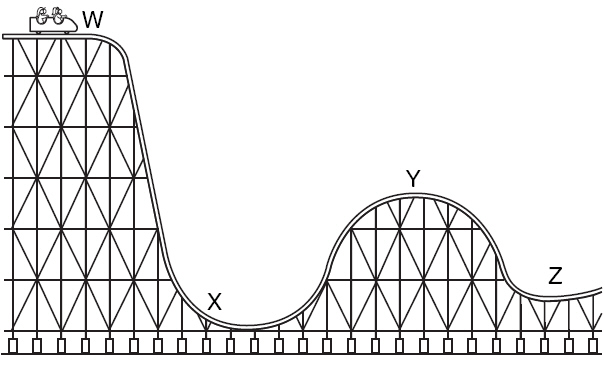
At which point is potential energy greatest?
W
X
Y
Z

Explain what happens to the potential energy of a rock as it falls off the side of a cliff.
The kinetic energy decreases as the potential energy increases.
The kinetic energy decreases as the potential energy decreases.
The potential energy decreases as the kinetic energy increases.
The potential energy decreases as the kinetic energy decreases.
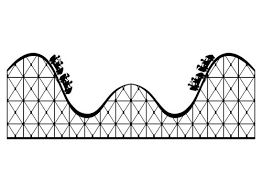
When a roller coaster is at the bottom of a hill it has
high potential energy
high kinetic energy
low kinetic energy
equal amounts of kinetic and potential energy

As a pendulum swings from its highest to lowest position, what happens to its kinetic and potential energy?
The PE and KE increase and decrease together
The PE decreases while the KE increases
Impossible to know without knowing the mass

Which 2 letters have the most kinetic energy
W & Y
X & Z

At what position would a cyclist have the most kinetic energy?
A
B
D
F

You drop a 5 kg ball from a height of 2 m. Just before it reaches the ground, what type of energy does it have?
Potential Energy
Kinetic Energy
Nuclear Energy
Chemical Energy

What is the term for energy an object has due to its position?
Thermal Energy
Kinetic Energy
Potential Energy
Nuclear Energy
Which of the following is an example of a non-contact force?
Friction
Tension
Gravitational force
Normal force
Gravitational Force
Contact
Noncontact
Normal Force
Non Contact
Contact
Friction Force
Contact
Non Contact
Magnetic Force
Contact
Non Contact
Electric Force
Contact
Non Contact
Air Resistance
Non Contact
Contact
Applied Force
Non Contact
Contact

The line graph shows five years of data about a dog. What information does the graph show? (Click the graph to see it larger.)
How the mass of the dog changed.
How much food the dog consumed.
What kinds of food the dog consumed.
When the dog was measured each month.
A student measured the power of a motor operating at different temperatures. The student recorded a total of 11 measurements, one at each 2 degree interval between 10°C and 30°C. Which change in the procedure would most improve the validity of conclusions based on this investigation?
Increasing the number of variables.
Decreasing the range of the independent variable.
Repeating the experiment several times.
Producing a graph of numerical observations.

On a small island, scientists observed and graphed changes in wolf and moose populations. From 1965 to 1970, which data pattern did scientists observe?
A drop in wolf population and a drop in moose population.
An increase in wolf population and a drop in moose population.
A drop in wolf population and in increase in moose population.
An increase in wolf population and an increase in moose population.
What should you do after you make a conclusion?
analyze your data
conduct an experiment
share your results
make a hypothesis
Scientists should always have the same hypothesis.
True
False
The more trials you do of an experiment, the more reliable the results will be.
True
False
A law describes what happens while a theory explains why it happens.
True
False
An explanation (why/how) based on repeated experimentation and observation.
law
theory
hypothesis
experiment
A statement that can be tested through experiments and observations
Law
Theory
Hypothesis
Explanation
The one variable you change is called the
Control
Dependent (outcome) Variable
Independent (test) Variable
Experiment

At which position on the half-pipe ramp will the skateboarder have the greatest amount of kinetic energy?
Position A
Position B
Position C
Position D

Student’s in Ms. Giannone's science class each exercised different amounts. After, they measured their resting heart rate. The data is below.
What conclusion can be made?
Exercising fewer hours a week will decrease the students' heart rate.
Heart rate remains unchanged regardless of how many hours of exercise.
Students who exercise more hours a week have a higher resting heart rate.
Increasing the amount of hours exercised will lower the students' heart rate.
What is the difference between a scientific theory and a scientific law?
A theory is a well-tested range of representations and a law is a concrete physical representation.
A theory is a well-tested range of observations of why something works and a law is a well-tested concrete explanation how things work
A theory is a well-tested range of observations of how something works and a law is a well-tested concrete explanation of why things work
A theory is a hypothesis that is yet to be proven false and a law is a hypothesis that will always be true.
Is it important to revise scientific theories as new discoveries are made?
True
False
Replication is when one scientist
copies another scientist's experiment.
laughs at another scientist's experiment.
repeats their own experiment several times.
clones another scientist.
Repetition is when one scientist
copies another scientist's experiment.
bumps into another scientists.
repeats their own experiment several times.
clones a T. rex.
Why must scientific investigations be replicable?
To prove its validity within the scientific community
To prove the reliability of the results
To confirm ideas and theories
To improve the investigation each time
Shawn conducted an experiment and did not get the results he was expecting. What should he do first?
Shawn should write conclusions
Shawn should share his results.
Shawn should check his experiment for errors and try again
Shawn should explain what he thought should have happened.
An experimental investigation...
is controlled with variables
is really boring
compares two or more things
is just observing without interfering
An observational investigation...
is just observing without interfering
is comparing two or more things
Is controlled with variables
is super fun with a friend
A comparative investigation...
compares two or more things
is just an observation
is a controlled experiment with variables
makes you a detective
The independent variable is the ONE thing you __?__.
change
control
measure
hug
The variable that you measure is the __?__.
Dependent
Independent
Control
Investigation

