
 Worksheets
IGCSE chemistry
Total questions: 64
Worksheet time: 1hrs 12mins
Sublimation is a process at which
a solid turns into a liquid
a solid turns into a gas
a liquid turns into a solid
a gas turns into a liquid
what causes brownian motion?
diffusion of smoke particles in the air
molecules in the air hitting the smoke particles
sublimation of smoke particles
smoke particles hitting the walls of the containers
Which statements describe the arrangement of particles in solids?
particles are moving in all directions
Particles are arranged in an orderly manner
particles can slide over one another.
particles vibrate about their positions
Which statement about liquids is correct?
They have a fixed shape and a fixed volume.
They have a fixed shape but not a fixed volume.
They have no fixed shape but they do have a fixed volume.
They have no fixed shape and no fixed volume.
Why does solid has a fixed shape?
The particles are held by very strong forces of attraction. They can only vibrate about their fixed position. Hence, they have an orderly arrangement.
The particles are held by weak forces of attraction. They can move rapidly in all directions. Hence, they have an disorderly arrangement.
The particles are held by strong forces of attraction. They can slide over one another. Hence, they have an disorderly arrangement.
What is expansion?
An object increases in volume without a change in mass
An object decreases in volume without a change in mass
Which statement best describes the fact that gases can be compressed?
The particles in a gas do not have a fixed volume.
The particles in a gas are very far apart.
The particles in a gas have no force of attraction (bonds) between them.
The particles in a gas are constantly moving very rapidly.

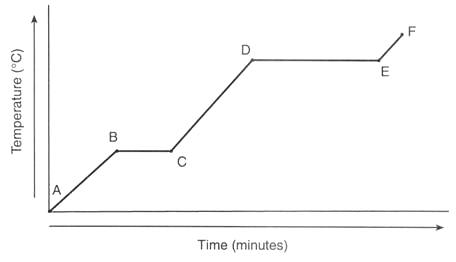


Which statement(s) best describes the fact that a liquid flows?
The particles in a liquid have weak bonds between them.
The particles in a liquid have no fixed position.
The particles in a liquid are close and touching.
The particles in a liquid are moving slowly over each other.
When a liquid evaporates the temperature of the liquid decreases. Which statement(s) best describes why this happens?
Some closely packed particles at the surface of the liquid break the bonds which are keeping them close to neighbouring particles.
Breaking bonds is an endothermic process (requires energy).
When particles enter the gaseous state they take their (kinetic) energy with them.
Particles at the surface of the liquid make bonds with gaseous particles above the surface of the liquid.
Making bonds is an exothermic process (releases energy).

The three states of matter are represented by diagrams X, Y and Z. Which change occurs during condensation?
X to Y
X to Z
Y to X
Z to X

The diagram shows the electron arrangement in atoms of four elements. Which one does not form covalent bonds?
A
B
C
D
Which compound matches this description?
"Electrons from each element are shared by both of the elements in a compound."
Lead bromide
Sodium Chloride
Water
Zinc Oxide

Which diagram does not show the outer shell electrons in the molecule correctly?
A
B
C
D

Why do ionic compounds conduct electricity when molten or in solution?
The electrons are free to move
The ions are free to move
The ions are in fixed positions
Ionic compounds have delocalised electrons

Identify the following compound as ionic or covalent: CO
ionic
covalent
Identify the following compound as ionic or covalent: CF4
ionic
covalent
What is the name of the following compound: Na2SO4
Sodium sulfide
Sodium sulfate
Sulphur sulfide
Sulfur sulfate
Select the best explanation for how the atoms in molecules are held together
They share a pair or pairs of electrons
There is an electrostatic attraction between the atoms in the molecule
There is an electrostatic attraction between the shared pair of electrons and the nuclei of both atoms
There is an electrostatic attraction between the oppositely charged ions
Atoms involved in a covalent bond are not charged, while atoms involved in an ionic bond are charged (negative or positive)
true
false
Is the formula S4N4 an ionic or covalent compound?
ionic
covalent

A
B
C
D

A
B
C
D

A
B
C
D

A
B
C
D

A
B
C
D

A
B
C
D

A
B
C
D

A
B
C
D

A
B
C
D

A
B
C
D

A
B
C
D

A
B
C
D

A
B
C
D

A
B
C
D

A
B
C
D

A
B
C
D
A
B
C
D

A
B
C
D

A
B
C
D

A
B
C
D

A
B
C
D

A
B
C
D

A
B
C
D

A
B
C
D

A
B
C
D

A
B
C
D

A
B
C
D
A
B
C
D

A
B
C
D

A
B
C
D

A
B
C
D
An element is in Group VI of the Periodic Table. What information does this give about the element?
the number of protons in the nucleus
the number of outer electrons
the reactivity of the element
the relative atomic mass of the element

Which diagrams show a giant molecular structure?
1 only
2 only
3 only
1, 2 and 3

A solid has a giant structure. It does not conduct electricity but does so when it is dissolved in water. What could the solid be?
A
B
C
D

Which diagram represents an alloy?
A
B
C
D

