wayground logo

Free Printable Worksheets

Font size

S
M
L
XL
Worksheets

Lesson 1 Position and Motion

Total questions: 44

Worksheet time: 26mins

Name
Class
Date
1.
Speed and direction are included in which of the follow?
a)
speed
b)
reference point
c)
velocity
d)
acceleration
2.
The starting point you choose to describe the location, or position, of an object is a __________.
a)
reference direction
b)
position
c)
reference point
d)
distance
3.
An object’s distance in a certain direction from a reference point is its ____________.
a)
motion
b)
position
c)
reference point
d)
reference distance
4.
What is the process of changing position called?
a)
velocity
b)
motion
c)
speed
d)
displacement
5.
The measure of the distance an object travels per unit of time is the _________ of the object.
a)
velocity
b)
speed
c)
distance
d)
displacement
6.
What is needed to determine the position of an object?
a)
direction
b)
time
c)
distance
d)
speed
e)
velocity
7.
A storm moving southeast at 35 mph is an example of?
a)
acceleration
b)
speed
c)
force
d)
velocity
8.
Which is the best description for a balanced force?
a)
When an object moves because of another force.
b)
When a force has the same mass as another force.
c)
When one force acting on he object is greater than the other.
d)
When an object does not move or moves at a constant speed.
9.

Friction always acts in a direction (a)   to the direction of motion.
10.
Which is the best description for a unbalanced force?
a)
An object at rest.
b)
When a force has the same mass as another force.
c)
When one force acting on the object is greater than the other.
d)
When an object does not move or moves at a constant speed.
11.

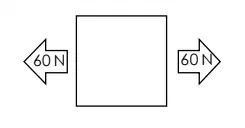
What is the net force?

(a)  

12.

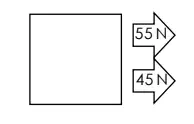
What is the net force?

(a)  

13.

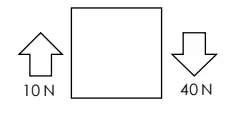
What is the net force?

(a)  

14.

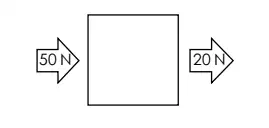
What is the net force?

(a)  

15.

What is the force needed to move a .42 kg football at a rate of 40 m/s? F= m x a

(a)  

16.

A pitcher hurls a baseball 30 m/s with a force of 15 N, what is the mass? F= m x a

(a)  

17.

Acceleration has a standard unit of:

(a)  

18.
When colliding objects bounce off each other it is called:
a)
normal force
b)
force pairs
c)
elastic collision
d)
inelastic collision
19.
When colliding objects stick to each other it is called:
a)
normal force
b)
force pairs
c)
elastic collision
d)
inelastic collision
20.
If you throw a ball into the air, Earth exerts a force on the ball. The ball in the air exerts no force on Earth.
a)
true
b)
false
21.
Kelly sits on a rock in a field. Which of the following correctly name force pairs?
a)
Kelly pushes on the rock, and the rock pushes on Earth.
b)
Earth pulls on Kelly, and Kelly pulls on Earth.
c)
Kelly pushes on the rock, and the rock pushes on Kelly.
d)
The rock pushes on Earth, and Earth pulls on the rock.
22.
When a bug hits a windshield of a car, the force of the car on the bug equals the force of the bug on the car.
a)
true
b)
false
23.
A planet is discovered that has twice the mass of Earth but the same gravitational acceleration. If you weigh 700 N on Earth, on the new planet you would weigh ___________.
a)
350 N
b)
700 N
c)
1,400 N
d)
2,800 N
24.
Mass varies depending on where the object is located.
a)
True
b)
False
25.
An attractive force that exists between all objects with mass.
a)
friction
b)
gravity
c)
field
26.
The region of space that has a force at every point around something with mass.
a)
field
b)
force
c)
friction
27.
The law that describes the motion of an object when an unbalanced object acts upon it.
a)
1st
b)
2nd
c)
3rd
d)
4th
28.
An object in motion stays in motion, and an object at stays at rest unless acted on by unbalanced for.
a)
1st
b)
2nd
c)
3rd
d)
4th
29.
A rocket ship taking off is an example of:
a)
1st
b)
2nd
c)
3rd
d)
4th
30.
A comet travelling at a constant speed through space is an example of:
a)
1st
b)
2nd
c)
3rd
d)
4th
31.
A shopping cart full of food accelerates slower than an empty shopping cart when equal forces are applied.
a)
1st
b)
2nd
c)
3rd
d)
4th
32.
A person who falls forward as the subway comes to a stop is an example of:
a)
1st
b)
2nd
c)
3rd
d)
4th
33.
A student sitting in a rolling chair pushes against the wall and moves in the opposite direction.
a)
1st
b)
2nd
c)
3rd
d)
4th
34.

Which of the following best describes inertia?

a)

The tendency of an object to resist a change in motion

b)

The force that pulls objects toward Earth

c)

The amount of space an object occupies

d)

The rate at which velocity changes

35.

A soccer ball remains at rest on the field until it is kicked. This is an example of which law?

a)

1st

b)

2nd

c)

4th

d)

3rd

36.

What is a reference point?

a)

A place or object that is staying still, that is used to determine if something else is moving.

b)

A place or spot where something is located

c)

The action of moving or being moved

d)

Shortest distance between starting position and ending position

37.

What is the term for the total path length traveled by an object?

a)

Velocity

b)

Distance

c)

Speed

d)

Displacement

38.

If a car travels 60 km in 2 hours, what is its average speed?

a)

30 km/hr

b)

60 km/hr

c)

120 km/hr

d)

15 km/hr

39.

In order to determine an object’s location, you need a _____.

a)

time

b)

displacement

c)

speed

d)

reference point

40.

20 km/hr is an example of

a)

direction

b)

velocity

c)

speed

d)

distance

41.

What is the definition of MASS?

a)

Anything that has mass and takes up space.

b)

The measure of the gravitational pull on an object.

c)

That amount of matter in an object.

42.

The measure of the gravitational pull on an object is called:

a)

weight

b)

mass

c)

matter

43.
What is the net force?
a)
1.3 N left
b)
1.3 N right
c)
3.7 N left
d)
3.7 N right
44.
A cyclist traveling at 25 km/hr turns sharply to the left while continuing to move 25 km/hr. This means the forces involved are_____________________.
a)
Balanced, because the cyclist's speed did not change.
b)
Balanced, because he was still moving forward.
c)
Unbalanced, because it's the same bicycle.
d)
Unbalanced, because his direction changed.