
 Worksheets
DFT-PSD D6-27/09/2025
Total questions: 10
Worksheet time: 10mins
A 52-year-old male with a history of type 2 diabetes mellitus presents with a productive cough, evening pyrexia, and significant weight loss over three months. His sputum CBNAAT report indicates "MTB DETECTED, Rifampicin Resistance: DETECTED". He has no prior history of tuberculosis treatment. According to the latest programmatic guidelines for multidrug-resistant tuberculosis, which all-oral therapeutic regimen is the most appropriate to initiate?
Bedaquiline, Pretomanid, Linezolid, Moxifloxacin
Bedaquiline, Linezolid, Clofazimine, Cycloserine
Isoniazid (high-dose), Levofloxacin, Ethionamide, Pyrazinamide, Cycloserine
Rifampicin, Isoniazid, Pyrazinamide, Ethambutol
A 34-year-old male, a seasonal migrant laborer with a history of travel to Bihar, presents with a 3-month history of intermittent high-grade fever, progressive fatigue, and significant unintentional weight loss. Physical examination reveals marked pallor and massive, non-tender splenomegaly extending 8 cm below the left costal margin. Laboratory investigations reveal pancytopenia. According to the National Vector Borne Disease Control Programme (NVBDCP) guidelines, which rapid diagnostic test is most appropriate to pursue first?
Recombinant K39 (rK39) antigen-based immunochromatographic test
Histidine-rich protein 2 (HRP-2) antigen detection assay
Nonstructural protein 1 (NS-1) antigen ELISA
Aldehyde test of Napier
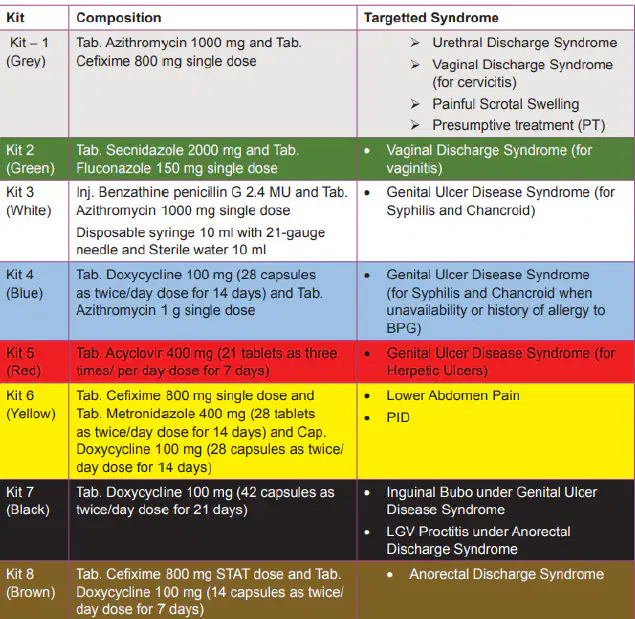
A 35-year-old male presents to a primary health center with a single, painless, indurated ulcer on the glans penis that he noticed 10 days ago. Examination reveals non-tender, rubbery inguinal lymphadenopathy. The patient's medical records clearly document a past episode of a severe anaphylactic reaction to penicillin. According to the provided syndromic management guidelines, which color-coded kit should be administered?
Kit 4 (Blue)
Kit 3 (White)
Kit 7 (Black)
Kit 1 (Grey)
The National Leprosy Eradication Programme (NLEP) manager is reviewing the case file of a 35-year-old male who recently completed a 12-month course of standard multidrug therapy (MDT) for multibacillary (MB) leprosy. The patient had a high bacteriological index (BI) of 4+ at diagnosis but is now clinically stable with no new skin lesions or nerve function impairment. According to current WHO guidelines, what is the most critical component of his long-term post-treatment management?
Annual clinical follow-up for five years to monitor for relapse and reactions.
A repeat 6-month course of MDT after a one-year treatment-free interval.
Lifelong administration of monthly rifampicin as secondary prophylaxis.
Immediate referral for reconstructive surgery to prevent potential deformities.
The district health administration of a non-metropolitan city with a population of 800,000 is planning to establish a new Urban Community Health Centre (U-CHC) to comply with IPHS 2022 norms. The planning committee is debating the required number of specialist medical officers for this new facility. As per the guidelines, what is the minimum number of MD/MS specialist officers mandated for this single U-CHC?
9
5
4
14
A district with a mid-year population of 250,000 reports 5,500 live births and 2,000 deaths in a given year. Concurrently, demographic surveillance records a net in-migration of 250 individuals. What is the district's annual population growth rate?
1.5%
1.4%
0.15%
2.3%
The dermatomal vesicular eruption depicted in the 68-year-old male is a consequence of viral reactivation. Within which specific anatomical structure does the etiologic agent typically establish lifelong latency following the primary infection?
Dorsal root ganglia
Trigeminal ganglion
Anterior horn cells
Epidermal Langerhans cells
A public health officer is reviewing the operational efficiency and impact of a regional malaria control program implemented over the past fiscal year. The program focused on insecticide-treated net distribution and case management. Which of the following indicators provides the most direct measure of the program's operational efficiency in case detection?
Annual Blood Examination Rate (ABER)
Infant Parasite Rate (IPR)
Annual Parasite Incidence (API)
Spleen Rate in children aged 2-9 years
A 24-year-old nulligravid woman, planning to conceive in the next year, is found to be non-immune to rubella on routine prenatal screening serology. She has no contraindications to vaccination. What is the most critical counseling point to provide this patient upon administration of the appropriate vaccine?
Strict adherence to effective contraception is required for 28 days post-vaccination.
She should defer any attempts at conception for a minimum of six months.
Mild arthralgia and a transient rash are common sequelae in adult females.
The vaccine can be safely administered if she becomes pregnant in the interim.
A 34-year-old epidemiologist presents to the emergency department with a 2-day history of abrupt-onset fever (39.5°C), severe retro-orbital headache, myalgia, and a single episode of non-bilious vomiting. He returned 12 days ago from a rural province in Uganda where he was investigating an outbreak of a febrile illness. On examination, he is lethargic, has conjunctival injection, and a faint, non-pruritic maculopapular rash is noted on his trunk. His blood pressure is 100/60 mmHg and his heart rate is 110/min. What is the most critical initial step in this patient's management?
Isolate the patient using appropriate personal protective equipment (PPE) and immediately notify infection control and public health departments.
Administer a 2-liter bolus of 0.9% normal saline and obtain a rapid diagnostic test for malaria.
Initiate empiric broad-spectrum antibiotics, such as ceftriaxone and doxycycline, after drawing blood cultures.
Perform a lumbar puncture to rule out meningitis given the severe headache and lethargy.

