Worksheets
UA Review
Total questions: 54
Worksheet time: 48mins
A student pours oil into a density column along with water and corn syrup. The oil floats on top of the water and does not mix. What does this observation best show?
The oil changed into a new substance
The oil maintained its physical properties
The oil became more dense than water
The oil chemically reacted with the syrup
Using the Periodic Table of elements determine whether the element is a Metal, Nonmetal, or Metalloid.
a. Si Metalloid, b. Au Metal, c. H Nonmetal, d. As Metalloid, e. Ne Nonmetal, f. Mg Metal, g. Al Metal, h. He Nonmetal
a. Si Metal, b. Au Metalloid, c. H Metal, d. As Nonmetal, e. Ne Metalloid, f. Mg Nonmetal, g. Al Metalloid, h. He Metal
a. Si Nonmetal, b. Au Nonmetal, c. H Metalloid, d. As Metal, e. Ne Metal, f. Mg Metalloid, g. Al Nonmetal, h. He Metalloid
a. Si Metalloid, b. Au Metalloid, c. H Metalloid, d. As Metalloid, e. Ne Metalloid, f. Mg Metalloid, g. Al Metalloid, h. He Metalloid
Name the characteristics of: Metals: Nonmetals: Metalloids:
Metals: Conduct electricity, have luster, malleable, ductile Nonmetals: Dull, brittle, do not conduct electricity (insulators) Metalloids: Conduct some electricity, dull
Metals: Dull, brittle, do not conduct electricity Nonmetals: Conduct electricity, have luster, malleable, ductile Metalloids: Conduct all electricity, shiny
Metals: Conduct some electricity, dull Nonmetals: Conduct all electricity, shiny Metalloids: Dull, brittle, do not conduct electricity
Metals: Dull, brittle, conduct some electricity Nonmetals: Have luster, malleable, ductile Metalloids: Conduct electricity, have luster, malleable, ductile
Homogenous is defined as:
A substance or mixture that is uniform in composition throughout.
A mixture where the components are easily distinguished.
A material made up of different phases.
A substance that changes composition frequently.
Students are given two beakers, one contains small rocks and water, the other is sugar and water. Which beaker contains a solution?
The beaker with sugar and water contains a solution.
The beaker with small rocks and water contains a solution.
Both beakers contain a solution.
Neither beaker contains a solution.
Fill in the blanks: a. Has no definite shape but has a definite volume ____________________________
Liquid
Solid
Gas
Plasma
Fill in the blanks: b. Has a definite shape and a definite volume ____________________________
Solid
Liquid
Gas
Plasma


Which box shows an element?
A
B
C
D


pure element
heterogeneous mixture
homogeneous mixture
pure compound

Is Helium a metal, nonmetal or a metalliod?
Nonmetal
Metal
Metalliod

Which atomic arrangement(s) represent an element?
P only
R only
P and Q
R and S


The lightest shaded area on the periodic table is known as-
Metals
Nonmetals
Metalloids
Rare Earth Metals


What are the blue elements in the periodic table?
(select all that apply)
alkali metals
transition metals
alkaline earth metals
halogens


In what order do we find these on the Periodic Table?
metals, nonmetals, metalloids
metalloids, metals, nonmetals
nonmetals, metalloids, metals
metals, metalloids, nonmetals

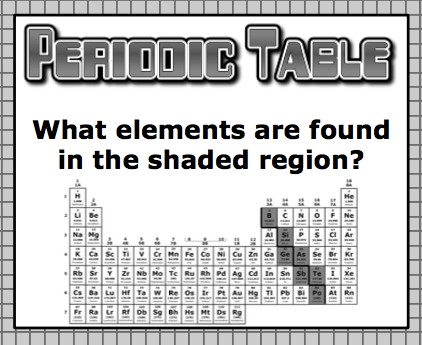
These shaded elements are
metals
nonmetals
metalloids

What classification of element is Silicon?
Metal
Nonmetal
Metalloid

Gold, silver, zinc, and copper are
elements
mixtures
solutions
compounds

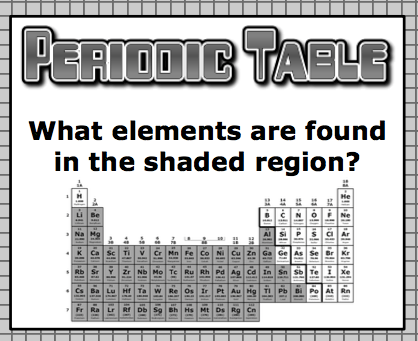
These shaded elements are
metals
nonmetals
metalloids

How would you classify a solid Aluminum (Al) pop tabs?
Element
Compound
Homogeneous Mixture
Heterogeneous Mixture

The colored part of the periodic table is called:
Metals
Nonmetals
Transition metals
Metalloids


The ______ are located on the left side of the zig-zag 'staircase' on the Periodic Table. (except for Hydrogen)
metals
non-metals
metalloids


How would you classify helium (He)
Element
Compound
Homogeneous Mixture
Heterogeneous Mixture


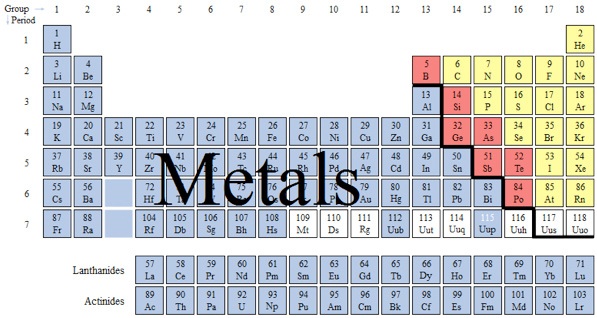
Which color identifies as the group non-metals?
neither color
blue
red
yellow


What would He (Helium) be categorized as on the periodic table?
Nonmetal
Metal
Noble gas
Transitional metal

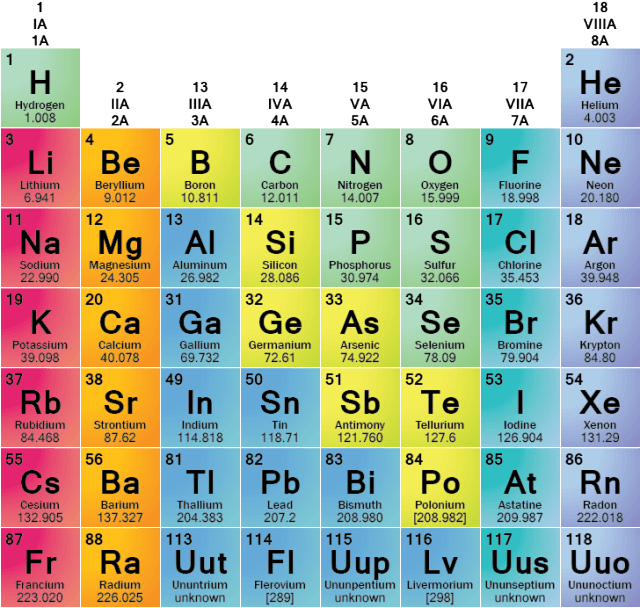

What is this?
A mixture
A compound
An element
A Solution


What is the best classification for this substance?
An element
A compound
A mixture