
 Worksheets
DFT-PATHOLOGY-29/09L2025
Total questions: 10
Worksheet time: 8mins
Which of the following processes is fundamentally characterized by the enzymatic digestion of cellular components, leading to a viscous liquid mass, and is predominantly mediated by hydrolytic enzymes released from neutrophils?
Liquefactive necrosis
Fat necrosis
Fibrinoid necrosis
Apoptosis
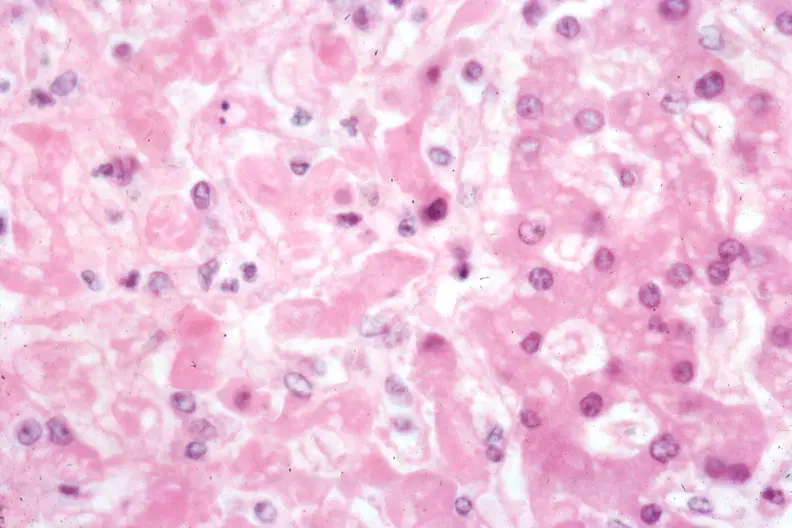
A 45-year-old male who underwent allogeneic hematopoietic stem cell transplant 6 weeks ago for acute myeloid leukemia presents with painful skin rash and jaundice. Liver biopsy is performed. The high-power H&E stained section of the liver biopsy is shown below:
Councilman bodies
Mallory-Denk bodies
Liquefactive necrosis
Caseous necrosis
A 62-year-old male with a long-standing history of chronic hepatitis C infection undergoes a liver biopsy for prognostic evaluation. The pathologist reports 'bridging fibrosis with architectural distortion.' To visually highlight and quantify the extent of collagen deposition for staging the cirrhosis, which of the following special stains would be most appropriate?
Masson Trichrome
Sweet's reticulin stain
Periodic acid-Schiff (PAS)
Toluidine Blue
In a flow cytometry analysis separating hematopoietic cell populations, the parameter directly proportional to a cell's internal complexity and granularity, such as distinguishing a granulocyte from a lymphocyte, is measured by which of the following?
Side Scatter
Forward Scatter
Fluorescence Emission
Hydrodynamic Focusing
A 38-year-old male is evaluated for premature aging. He developed bilateral cataracts at age 30, has type 2 diabetes mellitus, non-healing shin ulcers, diffuse alopecia, a high-pitched voice, and taut, atrophic skin. Karyotyping reveals multiple chromosomal breaks and translocations indicating genomic instability. Which enzyme deficiency is the most likely cause of this condition?
DNA helicase
Telomerase
Sirtuin-1
Reverse transcriptase
55-year-old male with a history of poorly controlled hypertension presents with symptoms consistent with a vasculitis syndrome. Histopathological examination of affected blood vessels shows deposition of immune complexes and fibrin within the vessel walls, creating a bright eosinophilic amorphous pattern. Which necrosis subtype best corresponds to these histological findings?
Fibrinoid necrosis
Fat necrosis
Liquefactive necrosis
Coagulative necrosis
A 60-year-old woman undergoes splenectomy following trauma. Pathology reveals pale, wedge-shaped areas in her spleen with preserved tissue architecture and abrupt margins. What is the likely underlying pathophysiology and necrosis pattern in this lesion?
Arterial occlusion leading to white infarct with coagulative necrosis
Venous occlusion leading to red infarct with liquefactive necrosis
Arterial occlusion leading to red infarct with caseous necrosis
Venous occlusion leading to white infarct with fat necrosis
A 36-year-old male suffers a severe burn injury. Over the next several days, he develops widespread edema due to persistent leakage of plasma proteins from the microvasculature. Which mechanism of vascular leakage most accurately explains this finding?
Direct endothelial cell injury with delayed, prolonged leakage
Endothelial cell contraction with immediate transient response
Endothelial cell retraction with delayed transient response
Endothelial cell damage due to thorn prick injury with immediate transient response
A biopsy specimen from a patient with suspected liver fibrosis is stained with Masson Trichrome. Collagen appears blue, muscle fibers red, and nuclei black on microscopy. What does this staining method specifically help demonstrate?
Fibrous tissue deposition in liver
Melanin pigment in melanoma cells
Nucleic acid detection in tumor cells
Reticulin fiber network in portal tracts
A 30-year-old woman sustains a clean surgical wound. On day 4, the wound is covered with granulation tissue and new capillaries, as shown in the histology image. Which of the following cell types is primarily responsible for wound contraction at this stage?
Myofibroblasts
Neutrophils
Langerhans cells
Multinucleated giant cells

