
 Worksheets
MOTION IN ONE DIRECTION REVIEW
Total questions: 12
Worksheet time: 8mins
You cover 10 meters in 1 second. Is your speed the same if you cover 20 meters in 2 seconds?
Yes, the speed is the same.
No, the speed is doubled.
No, the speed is halved.
No, the speed is different.
The speedometer of a car reads which of the following?
Instantaneous speed
Average speed
Maximum speed
Constant speed
Velocity has both magnitude and direction, while speed has a magnitude. Which of the following is a vector?
Speed
Velocity
Both speed and velocity
Neither speed nor velocity
The two controls on a car that cause a change in speed are:
The accelerator and the brake
The steering wheel and the horn
The clutch and the gear lever
The windshield wipers and the headlights
The control that causes only a change in velocity is:
Accelerator
Clutch
Horn
Headlight switch
What is the acceleration of a car moving along a straight-line path that increases its speed from zero to 100 km/h in 10 seconds?
2.78 m/s²
10 m/s²
0.28 m/s²
1.67 m/s²
By how much does the speed of a vehicle moving in a straight line change each second when it is accelerating at 2 km/h/s?
2 km/h
4 km/h
1 km/h
0.5 km/h
The velocity of a freely falling object dropped from rest at the end of the 3rd second is:
9.8 m/s
19.6 m/s
29.4 m/s
39.2 m/s
For a freely falling object dropped from rest, the acceleration at the end of the 3rd second is:
9.8 m/s²
0 m/s²
3.3 m/s²
19.6 m/s²
The slope of the curve on a distance vs. time graph represents:
the speed of the object
the distance traveled by the object
the time taken by the object
the acceleration of the object
The slope of the curve on a velocity vs. time graph represents:
acceleration
velocity
distance
force
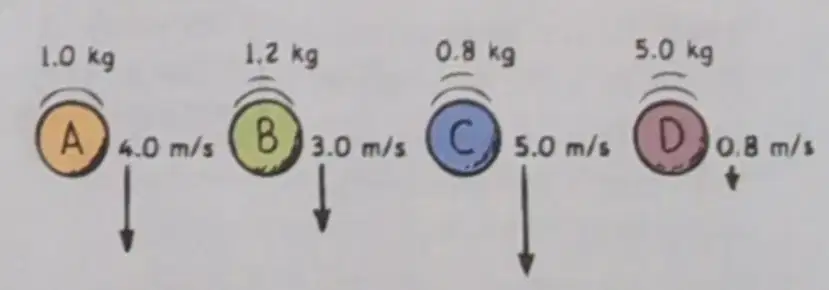
Rank their accelerations from greatest to least or explain why the accelerations are the same for each.
The accelerations are the same for each.
The first object has the greatest acceleration, followed by the second, then the third.
The third object has the greatest acceleration, followed by the first, then the second.
The second object has the greatest acceleration, followed by the third, then the first.

